

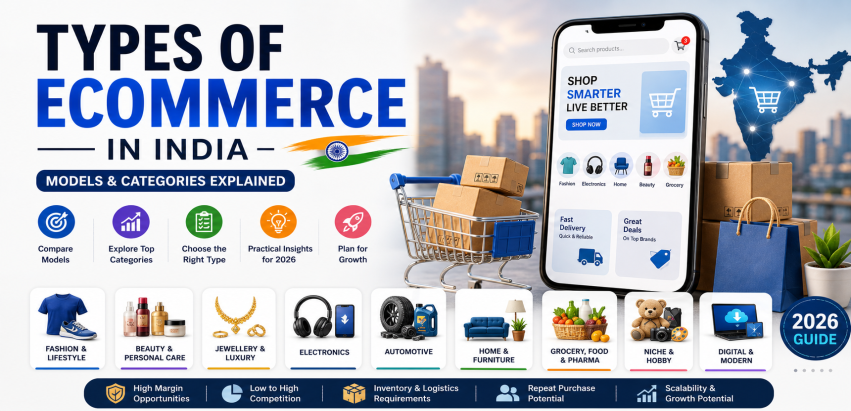
Ecommerce in India has grown from simple online selling to a complete business ecosystem. Today, businesses can reach customers across cities, states, and even international markets without relying only on physical stores.
At its core, ecommerce refers to buying and selling products or services through digital platforms. This includes websites, mobile apps, marketplaces, and social commerce channels. With increasing internet access and digital payments, more businesses are moving online every year.
However, not all ecommerce businesses work in the same way. The structure you choose affects how you sell, how you manage operations, and how you grow over time.
For example, some businesses sell directly to customers, while others depend on marketplaces. Some focus on high-volume sales, while others target niche audiences with higher margins. Each approach comes with different costs, challenges, and growth paths.
This is why understanding different types of ecommerce is important. It helps you make better decisions about your business model, marketing strategy, and long-term scalability.
Instead of looking at ecommerce as a single concept, it is more useful to break it into categories that define how businesses operate and generate revenue.
To begin with, it helps to understand the core business models that form the foundation of ecommerce in India.
Ecommerce Business Models in India
After understanding why ecommerce types matter, the next step is to look at how online businesses are structured. Many people confuse product categories with business models, but both are different. A business model defines how you sell, how revenue is generated, and how you interact with customers.
Choosing the right model is important because it affects your margins, operations, and marketing approach. Two businesses selling the same product can perform very differently depending on the model they follow.
The following are the main ecommerce business models used in India.
B2C (Business to Consumer)
In this model, businesses sell directly to end customers. This is one of the most common forms of ecommerce, where products are listed on a website or app and customers place orders directly.
Examples include online clothing stores, electronics retailers, and branded product websites. This model works well when you have control over pricing, branding, and customer experience.
However, it also requires strong marketing and customer acquisition strategies to drive consistent sales.
B2B (Business to Business)
In B2B ecommerce, businesses sell products or services to other businesses instead of individual customers. This includes wholesale platforms, bulk suppliers, and service providers.
Transactions are usually higher in value but lower in volume compared to B2C. The buying process is more structured, and relationships play a key role in long-term growth.
This model works well for manufacturers, distributors, and companies dealing with bulk orders.
D2C (Direct to Consumer)
D2C is a growing model in India where brands sell directly to customers without relying on intermediaries. This gives businesses full control over branding, pricing, and customer data.
It is commonly used in industries like fashion, beauty, and lifestyle products. The success of this model depends heavily on brand positioning and digital marketing.
For example, many businesses use paid campaigns and content strategies to build visibility and drive sales, which is often supported by structured ecommerce SEO services to improve long-term organic growth.
C2C (Consumer to Consumer)
This model allows individuals to sell products directly to other individuals through platforms. It is commonly seen in resale marketplaces, second-hand product platforms, and community-based selling.
The platform acts as a facilitator, while transactions happen between users. Trust and platform credibility play a major role in this model.
Marketplace Model
In this model, businesses sell through large platforms that connect multiple sellers with buyers. The marketplace handles traffic, while sellers focus on product listing, pricing, and fulfillment.
This model is useful for businesses that want quick access to a large audience without building their own platform. However, it comes with higher competition and dependency on platform policies.
Quick Commerce
Quick commerce focuses on fast delivery, often within a few hours. It is commonly used for groceries, essentials, and daily-use products.
This model depends on strong logistics, local inventory management, and high order frequency. While demand is high, margins are usually lower and operations are more complex.
Each of these models defines how a business operates and grows. The right choice depends on your product, target audience, and available resources.
Once the business model is clear, the next step is to understand how different product categories behave in ecommerce, starting with one of the most competitive segments in India.
Fashion & Lifestyle Ecommerce in India – High Demand, High Competition
Fashion and lifestyle products continue to lead ecommerce growth in India. Categories like clothing, footwear, and accessories attract a large share of online buyers due to frequent demand and changing trends.
However, this growth also makes the category one of the most competitive. New brands enter the market regularly, and existing players invest heavily in marketing and customer experience to maintain visibility.
Before entering this space, it is important to understand both the opportunity and the operational challenges involved.
Strong Demand Driven by Trends and Social Influence
Fashion is influenced by trends, seasons, and social platforms. Customers often discover products through short-form content, influencers, and ads. This creates consistent demand but also short product life cycles.
Brands need to update collections regularly and respond quickly to market changes to stay relevant.
High Return Rates and Size-Related Issues
One of the biggest challenges in fashion ecommerce is product returns. Issues related to sizing, fit, and expectations often lead to higher return rates compared to other categories.
This directly impacts logistics cost and overall profitability. Businesses need clear sizing guides, better product images, and accurate descriptions to reduce return rates.
Rising Customer Acquisition Costs
With more brands competing for the same audience, the cost of acquiring customers has increased. Paid advertising, especially on social platforms, plays a major role in driving traffic.
At the same time, relying only on ads can increase long-term costs. Many brands invest in content and organic strategies such as SEO for ecommerce brands to reduce dependency on paid channels over time.
Compliance and Platform Dependency in 2026
In recent years, ecommerce platforms and regulations in India have introduced stricter guidelines around product listings, pricing transparency, and return policies. Businesses selling through marketplaces must follow these rules carefully to avoid penalties or listing restrictions.
Dependence on large marketplaces also limits control over branding and customer relationships. This is why many fashion brands are building their own D2C presence alongside marketplace sales.
Need for Strong Visual Presentation and User Experience
Fashion products rely heavily on visual appeal. High-quality images, videos, and detailed product pages play a major role in conversion.
Without a strong user experience, even well-marketed products may struggle to convert traffic into sales.
Fashion ecommerce offers large-scale opportunity, but it requires continuous marketing, strong operations, and clear positioning to stay competitive.
To understand how ecommerce works in another high-growth segment, it helps to look at categories where branding and trust play an even bigger role in purchasing decisions.
Beauty & Personal Care Ecommerce in India – Brand Trust Drives Growth
Beauty and personal care products are among the fastest-growing ecommerce categories in India. This includes skincare, cosmetics, hair care, wellness products, and supplements.
Unlike fashion, where trends change quickly, this category is driven more by trust, consistency, and repeat usage. Customers are careful about what they apply or consume, which makes decision-making more sensitive.
This creates strong growth potential, but also increases the importance of branding and credibility.
High Repeat Purchase and Customer Lifetime Value
Many products in this category are used regularly, which leads to repeat purchases. Once a customer trusts a brand, they are more likely to continue buying from it.
This improves long-term revenue, but only if the product experience matches expectations.
Brand Positioning and Perception Matter More Than Price
Customers often compare ingredients, reviews, and brand messaging before making a purchase. A well-positioned brand can compete even at a higher price point if it builds credibility.
This is why branding, storytelling, and clear communication play a major role in conversions.
Influencer and Content-Driven Discovery
Social platforms play a strong role in product discovery. Customers rely on reviews, tutorials, and influencer recommendations before trying new products.
As a result, content marketing and paid campaigns work together to drive awareness and trust. Many brands combine this with structured strategies like Meta Ads campaigns to reach targeted audiences effectively.
Regulatory and Compliance Requirements in 2026
In India, beauty and wellness products are subject to regulations related to labeling, ingredients, and claims. Misleading information or lack of compliance can lead to product removal or legal issues.
This makes it important for businesses to maintain transparency in product descriptions and certifications.
Importance of Reviews and Social Proof
Customer reviews play a major role in purchase decisions. New brands often struggle in the beginning because trust takes time to build.
Consistent positive feedback, clear product information, and visible results help improve conversion rates over time.
Beauty ecommerce offers strong margins and repeat business, but success depends heavily on trust, branding, and customer experience.
To explore a category where trust and value are even more critical due to higher pricing, it helps to look at jewellery and luxury ecommerce next.
Jewellery & Luxury Ecommerce in India – High Value, Trust-Driven Buying
Jewellery and luxury products represent one of the most complex ecommerce categories in India. While the average order value is higher compared to other segments, the buying decision takes more time and involves greater trust.
Customers do not make quick purchases in this category. They evaluate product quality, authenticity, pricing, and brand credibility before making a decision.
This creates both an opportunity for higher margins and a challenge in converting traffic into sales.
High Average Order Value with Lower Conversion Rates
Luxury products such as gold-plated jewellery, bridal sets, and premium accessories often have higher ticket sizes. While this increases potential revenue per order, it also reduces conversion rates because customers take longer to decide.
This means businesses need stronger product presentation and trust signals to improve conversion.
Trust as the Primary Buying Factor
Customers want assurance about product authenticity, material quality, and durability. Without clear trust indicators such as certifications, reviews, and transparent policies, hesitation increases.
New brands often struggle in this phase because building trust takes time and consistent communication.
Visual Experience and Product Presentation
High-quality images, videos, and close-up views play a major role in decision-making. Since customers cannot physically inspect the product, the online experience must compensate for that gap.
Detailed descriptions, styling suggestions, and real-use visuals help improve confidence.
Dependence on Brand Positioning and Marketing
Luxury ecommerce relies heavily on perception. Branding, storytelling, and positioning influence how customers value the product.
Targeted campaigns, especially through platforms that support visual discovery, are often combined with strategies such as Instagram marketing for jewellery brands to build awareness and engagement.
Logistics and Return Sensitivity
Returns in this category are sensitive due to product value and condition requirements. Clear policies and secure packaging are essential to maintain customer confidence and reduce losses.
Jewellery ecommerce offers strong revenue potential, but it requires a clear focus on trust, presentation, and customer experience to succeed.
To understand a category where competition is driven more by pricing and volume, it helps to look at electronics and automotive ecommerce next.
Electronics & Automotive Ecommerce in India – Scale, Competition, and Pricing Pressure
Electronics and automotive products are among the most searched categories in Indian ecommerce. Both segments attract high demand, but they operate differently in terms of pricing, margins, and customer expectations.
While electronics is driven by fast-moving consumer demand, automotive products often depend on specific needs such as replacement, upgrades, or accessories.
Understanding these differences is important before entering either category.
Electronics Ecommerce – High Demand with Low Margin Pressure
Electronics products such as mobile phones, laptops, and accessories generate large volumes of online traffic. Customers actively compare prices across multiple platforms before making a purchase.
This creates strong demand but also intense price competition. Margins are usually lower, and businesses need to focus on volume to generate profit.
Another challenge is marketplace dominance. Large platforms control a major share of electronics sales, making it difficult for independent stores to compete without strong differentiation.
In this category, paid advertising plays a key role in visibility. Many sellers rely on targeted campaigns such as Google Ads for ecommerce to appear in search results where buying intent is high.
Automotive Ecommerce – Demand Driven by Need and Compatibility
Automotive ecommerce includes car accessories, spare parts, and performance upgrades. Unlike electronics, demand is often need-based rather than trend-driven.
Customers search for specific products based on vehicle type, model, or usage. This makes product accuracy and compatibility very important.
One of the main challenges in this category is ensuring correct product fit. Returns and dissatisfaction can increase if product details are not clear.
At the same time, competition is relatively more fragmented compared to electronics, which creates opportunities for niche positioning and specialization.
Inventory and Supply Chain Challenges
Both categories require careful inventory management. Electronics products can become outdated quickly due to new launches, while automotive products need proper categorization based on specifications.
Managing stock, pricing updates, and supplier relationships becomes critical to maintain competitiveness.
Customer Expectations and Decision Behavior
In electronics, customers focus on price, features, and brand reputation. In automotive, the focus shifts to compatibility, durability, and performance.
Understanding these differences helps in building better product pages and marketing strategies.
Electronics and automotive ecommerce offer large-scale opportunities, but they require strong pricing strategy, accurate product data, and consistent marketing to compete effectively.
To explore a category where visual appeal and lifestyle positioning play a bigger role than price competition, it helps to look at home and furniture ecommerce next.
Home, Furniture & Living Ecommerce in India – High Value with Operational Complexity
Home, furniture, and living products have seen steady growth in ecommerce as more customers prefer to explore options online before making a purchase. Categories such as furniture, home decor, kitchen items, and lifestyle products attract buyers who are looking for both utility and aesthetics.
Compared to other ecommerce segments, this category operates differently. Products are often higher in value, larger in size, and require more consideration before purchase.
This creates opportunities for higher order value, but also introduces operational and conversion challenges.
Higher Average Order Value with Longer Decision Time
Furniture and home products usually involve higher spending per order. Customers compare multiple options, check dimensions, and evaluate how the product fits their space before making a decision.
This results in longer buying cycles compared to categories like fashion or beauty. Businesses need to provide enough information to support this decision process.
Logistics and Delivery Complexity
Bulky and fragile items increase shipping costs and delivery challenges. Handling, packaging, and transportation require more planning compared to smaller products.
Returns in this category are also more expensive, which makes it important to reduce errors in product selection and expectations.
Importance of Visual Presentation
Customers rely heavily on visuals when buying home and furniture products online. Images, videos, and layout examples help them understand how the product will look in real settings.
Without clear visuals, conversion rates may remain low even if traffic is high.
User Experience and Conversion Optimization
Product pages need to provide complete information such as size, material, usage, and care instructions. A well-structured page reduces confusion and improves conversion.
Many businesses focus on improving user experience through better layouts, faster loading pages, and clearer product details, often supported by strategies such as conversion rate optimization services to increase performance without increasing traffic.
Inventory Planning and Supplier Coordination
Managing inventory is more complex due to product size and variety. Stock planning, supplier coordination, and delivery timelines need to be aligned to avoid delays and cancellations.
This becomes more important as businesses scale and handle larger product catalogs.
Home and furniture ecommerce offers strong revenue potential, but success depends on managing logistics, improving user experience, and providing detailed product information.
To understand a category where demand is driven by daily consumption and fast delivery, it helps to look at grocery, food, and pharma ecommerce next.
Grocery, Food & Pharma Ecommerce in India – High Volume with Low Margin Pressure
Grocery, food, and pharmaceutical ecommerce have grown rapidly in India, driven by convenience and frequent purchase behavior. Customers rely on online platforms for daily essentials, quick meals, and basic healthcare products.
Unlike other categories, this segment is not driven by high margins but by repeat orders and volume. Businesses need to focus on consistency, delivery speed, and operational efficiency to succeed.
This makes the category highly scalable but also operationally demanding.
Repeat Orders and High Purchase Frequency
Customers in this category buy regularly, which creates predictable demand. This helps in building recurring revenue, but only if the service remains reliable.
Consistency in product availability and delivery experience plays a key role in retaining customers.
Quick Commerce and Delivery Expectations in 2026
Fast delivery has become a standard expectation, especially in urban areas. Many businesses operate on quick commerce models where orders are delivered within hours.
This requires local inventory, strong logistics networks, and real-time order management systems.
Low Margins and Pricing Sensitivity
Profit margins in grocery and food ecommerce are generally lower compared to other categories. Customers are price-sensitive and often compare across platforms before ordering.
To remain competitive, businesses need efficient operations and optimized pricing strategies.
Regulatory and Compliance Requirements
Food and pharmaceutical products are subject to strict regulations in India. Businesses must follow guidelines related to safety, labeling, and storage conditions.
Non-compliance can lead to product removal or legal complications, making it important to maintain proper standards.
Technology and App-Based Ecosystem
This category relies heavily on mobile apps and automated systems for order management, delivery tracking, and customer experience.
Businesses often invest in technology infrastructure or platforms supported by ecommerce website and app development to manage operations efficiently.
Grocery, food, and pharma ecommerce can scale quickly due to repeat demand, but success depends on logistics efficiency, technology, and compliance.
To explore opportunities where smaller audiences can generate strong returns, it helps to look at niche and hobby-based ecommerce next.
Niche & Hobby Ecommerce in India – Smaller Audience, Higher Intent
Not all ecommerce businesses need to target large markets. In many cases, focusing on a specific niche can lead to better results than competing in broad categories.
Niche and hobby-based ecommerce includes products such as toys, pet supplies, art materials, stationery, collectibles, and specialized lifestyle products. These categories may have a smaller audience, but the buying intent is often stronger.
This creates an opportunity for focused growth with less direct competition.
Lower Competition with Clear Positioning
Niche markets usually have fewer competitors compared to mainstream categories. This allows businesses to build a clear identity and stand out more easily.
Instead of competing on price alone, brands can focus on product quality, specialization, and customer experience.
Community-Driven Demand
Many niche categories are supported by communities. Customers often share interests, preferences, and recommendations within these groups.
This makes word-of-mouth and organic discovery more effective compared to broader markets.
Higher Margins with Targeted Audience
Customers in niche markets are often willing to pay more for products that match their specific needs or interests. This can result in better margins compared to highly competitive categories.
However, reaching the right audience requires focused targeting rather than broad campaigns.
Dependence on SEO and Content Strategy
Since search volume may be lower, visibility depends on targeting specific queries and content topics. Businesses often rely on strategies such as SEO for niche ecommerce to attract relevant traffic over time.
Content plays a key role in building authority and connecting with the right audience.
Limited Scalability Without Expansion
While niche businesses can grow steadily, scaling beyond a certain point may require expanding into related categories or increasing product range.
This requires careful planning to maintain focus while exploring growth opportunities.
Niche ecommerce offers a balanced approach with lower competition and higher intent, but success depends on positioning, targeting, and consistent content strategy.
To understand a model where scalability is not limited by physical products, it helps to look at digital and modern ecommerce types next.
Digital & Modern Ecommerce in India – Scalable Without Inventory
Digital and modern ecommerce models are growing rapidly as businesses look for ways to sell without managing physical inventory. These models include digital products, print-on-demand, subscription services, and other automated selling systems.
Unlike traditional ecommerce, the focus here is not on logistics or storage, but on content, distribution, and customer acquisition. This makes it easier to start but requires a different approach to growth.
Understanding how these models work helps in evaluating their potential and limitations.
Digital Products and Services
Digital products include courses, templates, software, and downloadable content. Once created, these products can be sold multiple times without additional production cost.
This creates high-margin opportunities, but success depends on demand, quality, and visibility.
Print-on-Demand (POD) and Custom Products
Print-on-demand allows businesses to sell customized products without holding inventory. Items are produced only after an order is placed.
This reduces risk but also requires strong design and marketing to stand out in a competitive space.
Subscription-Based Ecommerce
Subscription models focus on recurring revenue. Customers pay regularly for access to products or services, such as curated boxes, memberships, or digital platforms.
This model works well when there is consistent value delivered over time.
Global Reach and Scalability
Digital ecommerce is not limited by geography. Products can be sold across different regions without shipping constraints.
However, reaching a wider audience requires structured marketing strategies, often supported by digital marketing for ecommerce businesses to build visibility and attract targeted traffic.
Dependence on Content and Distribution
Since there is no physical product experience, content becomes the main driver of trust and conversion. This includes product descriptions, videos, reviews, and educational material.
Without consistent content and promotion, even high-quality products may struggle to generate sales.
Digital and modern ecommerce models offer strong scalability and flexibility, but they rely heavily on marketing, positioning, and audience targeting.
With all major ecommerce types covered, the next step is to compare these categories and understand which one fits your business goals best.
Which Ecommerce Type is Best for Your Business
After exploring different ecommerce categories, the next step is to compare them based on practical factors. There is no single best option for every business. The right choice depends on your budget, product type, and ability to manage operations.
Instead of focusing on trends, it is more useful to evaluate categories based on margin, competition, logistics, and scalability.
The comparison below helps in understanding how these categories differ.
Comparison of Ecommerce Categories
| Category | Margin Potential | Competition Level | Operational Complexity | Scalability |
|---|---|---|---|---|
| Fashion & Lifestyle | Medium | High | High (returns, sizing) | High |
| Beauty & Personal Care | High | Medium | Medium | High (repeat orders) |
| Jewellery & Luxury | High | Medium | Medium | Medium |
| Electronics | Low | Very High | Medium | High |
| Automotive | Medium | Medium | High (compatibility) | Medium |
| Home & Furniture | High | Medium | High (logistics) | Medium |
| Grocery & Pharma | Low | High | Very High (delivery) | Very High |
| Niche & Hobby | Medium to High | Low | Low to Medium | Medium |
| Digital & Modern | Very High | Medium | Low | Very High |
Each category comes with trade-offs. High-margin categories often require stronger branding and trust, while high-volume categories depend on efficiency and scale.
For example, fashion and electronics may offer large demand but require continuous marketing investment. On the other hand, niche and digital products may have lower competition but require focused targeting and content strategies.
The goal is not to find the easiest category, but to choose one that matches your resources and long-term plan.
Many businesses also combine multiple approaches, such as starting with a niche product and expanding into related categories over time. This approach works well when supported by structured strategies like ecommerce marketing and growth planning to scale gradually.
With this comparison in mind, the next step is to look at how to choose the right ecommerce type based on your specific situation.
How to Choose the Right Ecommerce Type for Your Business
After comparing different ecommerce categories, the next step is to decide which one fits your business. This decision should not be based only on trends or market size.
A better approach is to align your choice with your resources, product type, and ability to manage operations over time.
The following steps can help you make a more practical decision.
Step 1: Define Your Budget and Investment Capacity
Start by identifying how much you can invest. Some categories require higher upfront cost for inventory, logistics, or marketing, while others can be started with lower investment.
For example, digital and niche products may need less capital compared to electronics or furniture businesses.
Step 2: Evaluate Product Fit and Demand
Choose a product category where demand exists but competition is manageable. Broad categories may offer large demand but also require stronger marketing efforts.
On the other hand, niche products may have smaller demand but allow better positioning and easier differentiation.
Step 3: Understand Operational Requirements
Each ecommerce type comes with different operational needs. Categories like grocery and furniture require strong logistics, while digital products focus more on content and distribution.
Understanding these requirements helps in avoiding challenges later.
Step 4: Assess Your Marketing Capability
Marketing plays a major role in ecommerce success. Some categories depend heavily on paid ads, while others rely on organic growth and content strategies.
Businesses often combine both approaches with support from services like ecommerce SEO and marketing strategies to build consistent traffic and sales.
Step 5: Plan for Long-Term Growth
Think beyond the initial setup. Choose a category that allows you to expand over time, either by adding new products or entering related segments.
This helps in building a sustainable business instead of relying on short-term trends.
A common mistake is selecting a category based only on popularity. A better decision comes from matching your business strengths with the requirements of the category.
When these factors are considered together, it becomes easier to choose an ecommerce type that fits your goals and resources.
If you are planning to start or scale your ecommerce business, having a clear strategy and execution plan becomes the next important step.
Still Not Sure Which Ecommerce Type Is Right for You
Choosing the right ecommerce model is not only about selecting a category. It involves understanding your budget, product potential, competition, and how you plan to grow.
Many businesses start without this clarity and face challenges later in marketing, operations, or scaling. A small mistake at the beginning can increase cost and slow down growth.
If you are planning to start or improve your ecommerce business, it helps to evaluate your current situation before making a decision.
What You Can Do Next
You can review your business idea, product category, and marketing approach with a structured plan. This helps in identifying gaps and choosing the right direction early.
If you already have an ecommerce store, analyzing performance data can show where improvements are needed, whether in traffic, conversion, or customer acquisition.
Get a Practical Ecommerce Strategy
A clear strategy can help you avoid common mistakes and focus on what actually works for your business. This includes selecting the right ecommerce type, planning marketing channels, and improving overall performance.
If you want a structured approach, you can explore ecommerce growth and SEO services to understand how to build and scale your online business effectively.
The goal is not just to start ecommerce, but to build a system that can grow consistently.