

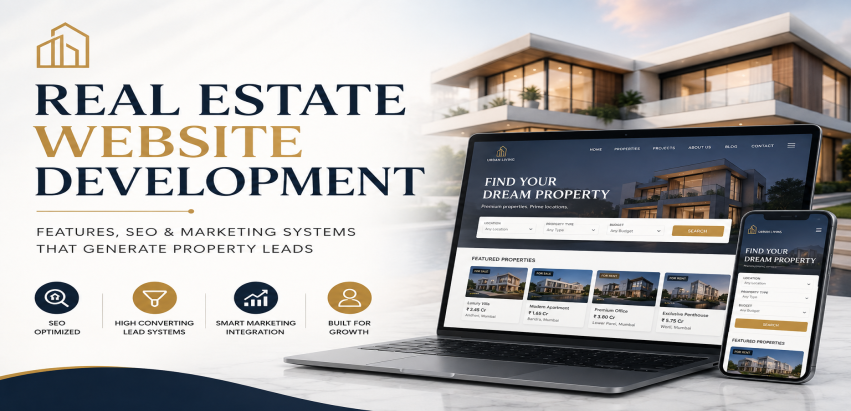
Most property businesses that invest in a website expect enquiries. Most are disappointed. Not because the website looks bad, but because it was built as a digital portfolio rather than a lead acquisition system. The design impresses visitors. The architecture produces nothing.
A builder with 5,000 monthly website visitors generating 3 enquiries is not experiencing a traffic problem. A competitor with 1,200 visitors generating 40 enquiries is not getting lucky. The difference is conversion architecture: how the website is structured to capture buyer intent, route it into a CRM, and trigger follow-up before the buyer contacts someone else.
Real Estate Website Development: Why Modern Property Websites Are Built for Lead Generation
Real estate website development is the process of building a property business's online infrastructure to generate, capture, and convert buyer enquiries through SEO visibility, paid advertising landing pages, CRM integration, and automated follow-up systems. Unlike a brochure website built to establish presence, a lead generation website is designed from day one to produce owned enquiries that do not depend on portals or pay-per-lead platforms.
The hidden intent behind every search for real estate website development is the same: more property enquiries at a lower cost than portals charge. This guide covers everything that sits between that goal and the website currently underdelivering it. Features that drive enquiries. Pages that capture different buyer intents. How website architecture determines your SEO ceiling. How landing page quality directly affects your cost per paid lead. And the CRM and automation layer that determines whether captured leads convert or disappear into an inbox.
Why Many Real Estate Websites Fail to Generate Property Leads
When we audit property websites, the same six architectural problems appear regardless of how recently the site was built or how much was spent on design. These are not aesthetic failures. They are structural ones. A website can look completely professional and still be architecturally unfit for lead generation.
No SEO Structure Built Into the Architecture
Pages with no keyword mapping, no internal linking hierarchy, and no location-specific content cannot rank for the searches that generate property enquiries. A homepage that talks about the company rather than the specific configurations it sells in specific areas is invisible to the buyer searching "apartments in [area]." SEO is not something added to a website after it is built. The architecture determines what SEO can achieve, and most property websites are built with no SEO infrastructure at all.
Weak or Misplaced Lead Forms
A contact form buried on a contact page is not a lead capture system. It is an afterthought. High-converting property websites place lead capture mechanisms above the fold on every page where a buyer with purchase intent might land. Removing unnecessary form fields reduces abandonment. Every additional field a buyer must complete before making contact reduces the probability they complete it at all.
No CRM Connected
A website that captures leads into an email inbox has no lead management system. Leads arrive, agents respond when they remember, follow-up is inconsistent, and the conversion rate from first enquiry to site visit reflects it. Without a CRM receiving every lead from every channel automatically, the follow-up process is as reliable as whoever checks email first. That is not a system. It is a gamble on attention.
Poor Mobile UX and Slow Page Speed
The majority of property searches happen on mobile. A website that takes 6 seconds to load on mobile loses the buyer before the page renders. A contact form that requires pinching and zooming to complete loses the buyer at the moment of highest intent. Page speed is not a technical nicety. For a property website receiving mobile traffic, it is a direct conversion variable with measurable revenue impact.
No Landing Pages for Paid Traffic
A brokerage spending significant budget monthly on Google Ads sending all traffic to the homepage is paying for visitors to arrive at a page with multiple navigation options, multiple messages, and no single conversion focus. A dedicated landing page for each campaign converts paid traffic at three to five times the rate of a homepage for the same spend. The ad cost is identical. The lead volume is not.
No Trust Signals That Justify Enquiry
A buyer considering a significant property transaction does not contact a business they know nothing about. They check reviews, look at project photos, verify credentials, and assess whether the developer or agent appears credible. A website with no testimonials, no project gallery, no professional credentials, and no team information gives the buyer no reason to choose this business over the next result. Trust signals are not decoration. They are the conversion mechanism that moves a visitor from interested to enquiring.
| Factor | Brochure Website | Lead Generation Website |
|---|---|---|
| Primary goal | Look professional online | Generate property enquiries |
| SEO structure | Often absent or bolted on after build | Built into the architecture from day one |
| Lead capture | Generic contact form on contact page | Smart forms, messaging channels, booking on every relevant page |
| CRM connection | Not connected | Fully integrated, every lead routed automatically |
| Landing pages | None | Built for every campaign and project launch |
| Page speed | Often slow, especially on mobile | Engineered for Core Web Vitals compliance |
| Mobile experience | Responsive only, not conversion-optimised | Mobile-first with frictionless lead capture |
| Follow-up | Manual email, inconsistent | Automated messaging and email sequences |
| Cost per lead trend | High, permanently portal-dependent | Reduces over time as owned channels compound |
If your current website has three or more of these structural gaps, it is costing you enquiries every week regardless of how much traffic it receives.
Website Traffic vs Website Conversions: Why More Visitors Do Not Always Mean More Enquiries
A brokerage owner spending significant monthly budget on Google Ads with a 0.5 percent website conversion rate has a conversion problem, not a traffic problem. Every dollar or pound spent driving additional traffic to a website that converts poorly multiplies the waste rather than the results. Before scaling acquisition, the conversion architecture must be fixed.
The Conversion Rate Reality for Property Websites
Conversion rate is the percentage of website visitors who take a defined lead action: submitting a form, initiating a message, calling the number, or booking an appointment. Most property websites convert at under 0.5 percent. A well-structured lead generation website for the same audience converts at 2 to 4 percent. The difference is not more traffic. It is architecture.
The numbers make the case clearly. Website A receives 10,000 visitors per month at a 0.5 percent conversion rate and produces 50 leads. Website B receives the same 10,000 visitors at a 2 percent conversion rate and produces 200 leads. Same traffic. Same ad spend. Four times the enquiry volume. The difference is conversion architecture, not budget.
How Buyer Intent Determines Conversion Probability
Buyer intent describes how close a visitor is to making a property decision when they arrive on the website. A buyer who searched "2-bedroom apartments for sale in [area]" has declared specific intent. If the page they land on directly addresses that intent with relevant listings, clear pricing, and an obvious next step, conversion is highly probable. If they land on a homepage that requires navigation to find what they searched for, they leave. Intent without a matched experience converts poorly regardless of how much was spent generating the click.
Fix Conversion Before Scaling Traffic
The correct sequencing for a property business with low enquiries is to audit and fix conversion architecture first, then scale traffic. Improving conversion from 0.3 to 2 percent on existing traffic produces a 6x increase in enquiries without touching the ad budget. The return on a conversion architecture improvement almost always exceeds the return on equivalent traffic acquisition spend. The features and pages that fix conversion architecture are covered in the sections that follow.
Features Every Real Estate Website Needs to Support Growth
A real estate website designed for lead generation needs seven core features, each connected to a specific business outcome. A feature without an enquiry outcome is overhead. The question for each feature is not "does my website have this" but "is this generating enquiries for my business?"
Property Listings Search
IDX (Internet Data Exchange) and MLS (Multiple Listing Service) integration allows property websites to display live, searchable listings from a shared database, giving buyers the ability to search, filter, and browse available inventory directly on the website rather than leaving for a property portal. In markets where a centralised MLS is not available, the equivalent architecture is a developer-owned property database or CRM-connected inventory system that delivers the same buyer experience. Websites with searchable property inventory generate significantly longer session durations, higher return visit rates, and stronger organic SEO performance because individual listing pages become indexable assets. This connects directly to your real estate SEO strategy: property pages with individual URLs, location-specific metadata, and schema markup produce long-tail organic traffic that a portal-dependent website entirely misses.
Saved Searches and Alerts
Saved searches allow buyers to set their criteria and receive automated alerts when new matching inventory appears. This feature converts passive browsers into identified leads without requiring them to complete an enquiry form. A buyer who saves a search for specific property criteria has declared intent and provided contact information. They are in the lead pipeline. When a matching property is added, the automated alert brings them back to the website at peak intent. Without this feature, a buyer who does not find what they want today leaves and does not return.
Lead Forms
Lead forms placed above the fold on property pages, project pages, and landing pages with minimal required fields produce dramatically higher completion rates than forms buried on contact pages with ten required fields. The principle is friction reduction. A buyer with high intent who encounters a short form above the fold completes it. The same buyer who must navigate to a contact page and complete a lengthy form does not. Form placement, field count, and mobile optimisation each affect completion rate independently and cumulatively.
Messaging Channel Integration
Integrating the preferred messaging channel for your target market reduces enquiry friction significantly. In many markets, buyers prefer initiating contact through a messaging app rather than completing a form, particularly for high-value property decisions where they want a more immediate and personal first interaction. Identifying which messaging channel your buyers prefer, whether SMS, live chat, or a messaging platform, and making it prominently available on all key pages removes a barrier that costs enquiries on websites that offer only traditional contact forms.
Appointment Booking
Appointment booking removes the friction between an interested visitor and a confirmed site visit. A buyer who wants to visit a property but must call during business hours, wait for a callback, and negotiate a time loses momentum at every step. An online booking system showing available site visit slots converts that same buyer in the same session as their decision, before the motivation to act fades. Businesses that offer online booking consistently report lower cancellation rates and higher show rates because the buyer completed a commitment rather than leaving it to a future callback.
Property Comparison Tools
Property comparison tools let buyers select multiple listings or projects and view them side by side across configuration, price, location, amenities, and availability. A buyer actively comparing properties on the website is providing a high-intent signal while spending extended time on the platform. Critically, the buyer who would otherwise leave to compare on a portal stays in the ecosystem, and the lead capture mechanisms on the website remain available throughout their comparison process.
AI Chat Support
AI chat solves the after-hours enquiry problem that every property business faces. A buyer who visits at 10pm and finds only a contact form that promises a response within one business day has no reason to stay. An AI chat that responds within seconds, collects the buyer's requirements, shares the relevant project information, and confirms that a team member will follow up creates a documented, CRM-captured lead from an enquiry that would otherwise be lost entirely.
| Feature | What It Does | Business Outcome | Without It |
|---|---|---|---|
| IDX and Property Search | Syncs live inventory with searchable filters | Longer sessions, higher engagement, organic SEO value | Buyers leave to portal sites to search inventory |
| Saved Searches | Lets buyers save criteria and receive match alerts | Passive lead capture, high-intent return visits | Buyers who do not find a match today are permanently lost |
| Lead Forms | Captures buyer intent directly | Direct enquiries routed to CRM | Buyers have no conversion mechanism available |
| Messaging Integration | Instant preferred contact channel | Higher enquiry completion rate | Buyers abandon rather than complete a form |
| Appointment Booking | Removes friction from first conversation | More property visit bookings, higher show rate | Motivated buyers lose momentum before confirming |
| Property Comparison | Lets buyers shortlist and compare listings | Higher intent signal, longer session, lower portal exit rate | Buyers leave to compare on competitor or portal sites |
| AI Chat | 24/7 lead qualification and requirement capture | After-hours leads captured, speed-to-lead maintained | After-hours enquiries lost entirely |
Pages High-Converting Real Estate Websites Include
High-converting real estate websites are not single-page portfolios with a listings section. They are structured systems of interconnected page types, each designed to capture a specific buyer intent and drive a specific conversion action. A developer with multiple projects in different areas who has only a homepage, a listings page, and a contact page is missing every page type that generates the search traffic and buyer trust that produce organic enquiries.
Property Pages
Property pages are individual pages for each unit or listing in the inventory. Beyond displaying property details, a well-structured property page carries RealEstateListing schema markup that enables rich results in search, a specific URL optimised for configuration and location keywords, and conversion elements including a primary contact button, enquiry form, and floor plan download above the fold. Without individual property pages with proper schema, the website cannot rank for the long-tail search queries that represent a buyer at the late stage of their decision process.
Location Pages
Location pages target buyers searching by area or city before they have committed to a specific property. A page optimised for "apartments in [area name]" with relevant inventory, area information, and conversion elements captures buyers who are still deciding where to buy, before any project preference has formed. Without location pages, the website is invisible to every buyer who begins their search at the area level rather than the listing level, which represents the majority of property buyers. For a complete strategy on how location pages support organic rankings, see our guide to real estate SEO.
Neighborhood Pages
Neighborhood pages go below the city and area level to the micro-locality level where buyers research lifestyle factors before evaluating specific properties. A buyer searching for school catchment areas, transport links, or local amenities in a specific neighborhood is in the research phase, not the purchase phase. A neighborhood page that covers these questions positions the developer or agent as the authoritative local resource before the buyer has formed any property preference, earning brand familiarity that converts into enquiries when the buyer reaches the decision stage.
Project Pages
Project pages serve developers and builders selling multiple units within a single development. A project page covers the full development: site plan, unit configurations available, completion timeline, amenities, compliance registration numbers, price range, and location advantages. It is the primary conversion page for a buyer who has decided to evaluate this specific development before booking a viewing.
Agent Pages
Agent pages serve a dual function. The visible function is trust: a buyer considering a significant transaction wants to know who they are dealing with and their professional credentials. The less visible function is local SEO. An agent page optimised for a specific area can rank independently for neighbourhood-specific searches, driving direct enquiries to that agent without requiring the buyer to navigate the broader website.
Landing Pages
Landing pages are purpose-built pages for specific paid campaigns with no navigation menu, a single focused message, and one conversion action. Every Google Ads or social media campaign that sends traffic to a homepage rather than a dedicated landing page is accepting a fraction of its potential lead volume at full budget cost. A developer launching a new project phase needs a landing page for that specific launch covering the key highlights, pricing indication, professional credentials, and a prominent primary CTA.
| Page Type | Buyer Intent Captured | SEO Target | Primary Conversion |
|---|---|---|---|
| Property Page | Researching a specific unit or configuration | Property-specific keywords plus schema markup | Enquiry form or messaging button |
| Location Page | Searching for properties by area or city | "Apartments in [location]" and related queries | Listings browse plus lead form |
| Neighborhood Page | Researching lifestyle and infrastructure before deciding where to buy | Hyperlocal and lifestyle queries | Return visit and saved search capture |
| Project Page | Evaluating a specific development in detail | Project name plus location keywords | Viewing or site visit booking |
| Agent Page | Looking for an agent specialising in a specific area | "Property agent [area]" queries | Direct contact or appointment booking |
| Landing Page | Responding to a specific paid ad | Campaign-specific, not organic | Single CTA conversion |
Neighborhood Pages and Organic Traffic: The Most Underrated SEO Asset for Property Websites
Most property buyers begin their search at the neighborhood level, not the project level. Before evaluating which developer or agent to work with, they decide where they want to live. They search for schools, transport links, price trends, upcoming infrastructure, and lifestyle information about specific micro-areas. These searches happen at high volume, at lower competition compared to project-level keywords, and represent buyers at the very beginning of their journey before any brand or project preference has formed.
A developer whose neighborhood pages appear when a buyer researches a specific local area earns brand recognition before any competitor has had the opportunity to make an impression. That familiarity compounds across weeks of research and directly influences the enquiry decision when the buyer is finally ready to make contact.
What a Neighborhood Page Contains
Neighborhood pages aggregate the information property buyers search for when researching where to live. A neighborhood page for a specific area might cover: nearby schools and their catchment boundaries, transport links and commute times to major employment centres, average price per square foot trends, upcoming infrastructure or development projects in the area, lifestyle amenities including retail, healthcare, and recreation, and the types of residential properties available across different price ranges. This aggregates information the buyer is already searching for across multiple sources into one authoritative local resource on the developer's or agent's own website.
How Neighborhood Pages Generate Organic Traffic at Lower Competition
A developer competing for "apartments [city]" is competing against every major property portal, every national developer with a presence in that city, and every local competitor with an established SEO history. A developer competing for "schools near [neighborhood]" or "apartments with transport links [specific area]" is competing against a much smaller field of websites that have created neighborhood-specific content. These lower-competition queries collectively generate substantial monthly search volume from buyers in the research phase that precedes every property purchase decision.
The Compounding Traffic Effect of a Neighborhood Page Network
A developer with projects across multiple areas who creates a neighborhood page for each area is simultaneously building separate organic traffic entry points targeting different local buyer intent clusters. As each page accumulates organic authority, the topical authority of the entire website increases, improving the ranking probability of every connected page including project pages, location pages, and the homepage. Neighborhood pages do not just generate direct traffic. They build the domain-level authority that makes every other page on the website easier to rank.
For the complete organic acquisition strategy that connects neighborhood pages to rankings and long-term traffic growth, see our full guide to real estate SEO.
How Real Estate Websites Support SEO and Organic Visibility
SEO activities including content creation, link building, and Google Business Profile management operate on top of a foundation that the website provides. The ceiling of what SEO can achieve is determined entirely by how the website was built. A property business that has invested significantly in SEO services for 18 months and seen limited ranking improvement is almost always experiencing a website architecture problem rather than an SEO execution problem. The technical foundation is capping the returns on the SEO investment above it.
Internal Linking Architecture as Topical Authority Signal
Internal linking communicates to Google which pages are most important on a website and what the topical relationships between pages are. The strategic internal linking structure for a property website runs like this: every piece of content about an area links to the location page for that area, which links to the project pages for properties in that area, which link to the enquiry form. Authority flows from content to location to project to conversion. A developer whose content is interlinked this way concentrates authority on the commercial pages that generate enquiries rather than distributing it randomly across the site.
Schema Markup for Real Estate
Schema markup implemented in JSON-LD format communicates structured data to Google that enables rich results, knowledge graph recognition, and enhanced search appearances that plain HTML cannot achieve. Four schema types deliver the highest value for real estate websites. RealEstateListing schema on property pages enables price, bedroom count, and location to appear directly in search results. LocalBusiness schema on location and neighborhood pages connects the business to specific geographic entities in Google's knowledge graph. FAQPage schema on project and neighborhood pages enables question-and-answer pairs to appear in featured snippets. BreadcrumbList schema on all pages creates navigational path display in search results that increases click-through rate.
Indexation Logic for Large Property Inventories
A property website with large inventory available in multiple configurations can theoretically generate thousands of URL variants through filtered navigation. If Google's crawl budget is consumed indexing filtered variants rather than the primary category and project pages that generate revenue, the commercial pages are indexed less frequently and rank less reliably. Proper indexation logic using canonical tags, robots.txt configuration, and noindex directives on thin filter variants protects crawl budget for the pages that matter.
Location Page Hierarchy as a Ranking System
A location page hierarchy structured as city to area to neighborhood to project creates a URL and internal link architecture that directly supports local search rankings at every geographic level. Each page in this hierarchy is indexable, keyword-specific, and linked to the pages above and below it, creating the structured topical coverage that earns rankings for geo-targeted searches that competitors with flat site structures cannot capture.
| Website Element | SEO Benefit | Business Impact |
|---|---|---|
| Internal linking architecture | Communicates topical relevance and concentrates page authority | Location and project pages rank faster for commercial queries |
| Schema markup in JSON-LD | Enables rich results and knowledge graph entity recognition | Higher click-through rate from search results |
| Core Web Vitals compliance | Positive page experience signal in ranking algorithm | Ranking advantage over competitors with slow mobile sites |
| Location page hierarchy | Enables ranking for area-specific and neighborhood searches | Captures buyers researching locations before property evaluation |
| Clean URL structure | Crawlable, keyword-relevant URL signals | Location keywords in URL support geographic ranking signals |
| Indexation control | Protects crawl budget, prevents thin content dilution | Core commercial pages crawled and re-indexed more frequently |
| Content heading hierarchy | Semantic structure signals topical relevance | Featured snippet and AI Overview eligibility for key buyer questions |
For a complete real estate SEO execution system covering keyword strategy, content creation, link building, and Google Business Profile management, our real estate SEO guide covers the full organic acquisition framework beyond website architecture.
How Real Estate Websites Improve Paid Ad Performance
Real estate businesses often have their website built by one vendor and their Google Ads managed by another. This creates a structural problem that neither vendor is positioned to solve: the ads team cannot fix the landing pages, and the website team does not measure cost per lead. The result is a paid advertising campaign that underperforms not because the ads are poorly structured but because the website is architecturally unfit for conversion.
Quality Score and Landing Page Experience
Google Ads Quality Score is determined by three factors: expected click-through rate, ad relevance, and landing page experience. Landing page experience is directly affected by the website. A landing page that loads slowly on mobile, contains no content relevant to the search query that triggered the ad, or has no clear conversion mechanism receives a low landing page experience score. A low Quality Score means paying more per click for the same position than a competitor with a higher Quality Score. That is a website quality problem showing up as an advertising cost problem.
Landing Page Conversion Rate and Cost Per Lead
The relationship between landing page conversion rate and cost per lead is direct and calculable. At 1 percent conversion from a homepage destination, a given ad budget produces a fraction of the leads that the same budget produces when directed to a dedicated project landing page converting at 4 percent. Same budget. Same clicks. Cost per lead drops by up to 75 percent. The ad system did not change. The website changed.
Retargeting Website Visitors
Retargeting uses the data collected by tracking pixels installed on the website to show ads specifically to people who have already visited. A buyer who spent several minutes on a project page, viewed the floor plan section, but did not enquire is a higher-intent audience than a cold prospect who has never encountered the brand. Retargeting this buyer costs a fraction of prospecting campaigns because the audience is pre-qualified by their own browsing behaviour. Without retargeting pixels installed on the website, this audience cannot be built and every visitor who leaves without enquiring is permanently lost to the paid advertising system.
Conversion Tracking and Campaign Optimisation
A Google Ads campaign that does not track which keywords and ads produce actual lead conversions is optimising toward proxy metrics. Smart Bidding algorithms require real conversion data to optimise toward the right searches and audiences. Without conversion tracking configured to capture form submissions, messaging clicks, phone calls, and appointment bookings as distinct events, the campaign's bidding system is allocating budget based on incomplete information, producing higher cost per enquiry than campaigns with complete conversion data.
For the complete paid advertising strategy covering campaign structure, keyword targeting, audience segmentation, and bid optimisation for property businesses, see our guide to real estate paid ads.
Property Landing Pages: Why PPC Campaigns Fail Without Them
A landing page is a single-purpose page built for one campaign objective: no navigation, no distractions, one message, one CTA. Every additional navigation link on a landing page reduces conversion rate. Most real estate Google Ads campaigns send traffic to a homepage or listings page, pages designed for exploration rather than conversion. This is the number one reason real estate PPC campaigns underperform relative to their budget.
Why Your Homepage Cannot Function as a Landing Page
Your homepage serves multiple purposes simultaneously: brand introduction, navigation hub, SEO asset for broad queries, and general information resource. These functions make it an excellent homepage and a poor landing page. A buyer who clicks a specific ad for a property development and arrives at a homepage displaying a full service range, multiple navigation menus, and no clear next step related to the ad they just clicked has been given mixed signals. Most resolve that confusion by pressing the back button. The competitor whose landing page directly continues the ad's conversation does not lose those buyers.
The Anatomy of a High-Converting Property Landing Page
A property landing page built for a specific project launch should contain these elements in order:
Hero section: Project photography or render, project name and location, a single headline that continues the ad's message, and a primary contact button visible without scrolling.
Key highlights: Unit configurations available, price range, completion or possession date, and the strongest USPs of the project in scannable format.
Floor plan or brochure section: Downloadable plans for each configuration, which serve as a lead capture trigger when gated behind a name and contact number form.
Testimonials and social proof: Buyer testimonials specific to this project or developer, not generic company reviews.
Regulatory credentials: Relevant compliance registration numbers or professional certifications displayed prominently as a trust signal that reduces hesitation before enquiring.
Primary CTA: A primary contact button and a short enquiry form in the same visible area. Offering multiple contact options serves different buyer preferences and maximises completion rate.
Sticky CTA bar: A persistent call to action that follows the buyer as they scroll, ensuring the enquiry mechanism is always visible regardless of scroll depth.
Mobile-First Landing Page Design
The majority of property ad traffic arrives on mobile devices. A landing page designed for desktop that is then made responsive for mobile is not a mobile-first landing page. A genuinely mobile-first landing page has the primary contact button above the fold, a form that requires minimal typing, project images that load quickly on a mobile connection, and a sticky CTA bar that does not obstruct content. The difference in conversion rate between a responsive desktop design and a genuinely mobile-first design is material for high-traffic property campaigns.
For full guidance on landing page testing, campaign integration, and paid acquisition strategy for property businesses, see our real estate paid ads guide.
Lead Capture Systems for Property Businesses
A lead form is not a lead capture system. A lead capture system is a coordinated set of channels that catches buyers at different stages of intent: saved searches for early researchers, forms and messaging for ready enquirers, email automation for long-consideration buyers, call tracking for decision-stage callers. Missing any of these channels means losing the buyers that channel would have captured, permanently and invisibly.
Messaging Automation
Automated messaging sends a templated first response within seconds of a buyer initiating contact through the website's preferred messaging channel. The automated first message acknowledges the enquiry, shares the project brochure or relevant information, and sets a callback expectation. By the time a team member is available to follow up personally, the buyer has already received a substantive first response rather than silence. Messaging automation does not replace the human sales conversation. It ensures that conversation begins immediately rather than hours later when the buyer may have already spoken to a competitor.
Email Automation
Email automation serves buyers in the consideration stage who are not yet ready to speak with a sales team but are building their shortlist over days or weeks. A buyer who downloaded a floor plan and provided an email address but did not submit an enquiry form enters an automated email sequence: a project overview email on day one, a neighborhood guide on day three, a testimonial from a satisfied buyer on day seven, and a consultation invitation on day fourteen. Each email provides value without pressure and keeps the developer's project present during the buyer's extended research period.
Call Tracking
Call tracking assigns unique phone numbers to different marketing channels, allowing a property business to identify exactly which source generated each inbound call. Without call tracking, a business knows how many calls it received but cannot attribute them to Google Ads, organic search, a specific campaign, or a specific landing page. Call tracking data reveals which channels drive actual phone conversions, which is particularly important for property businesses where a significant percentage of leads choose to call rather than submit a form for high-value transactions.
Saved Searches
Saved searches as a lead capture mechanism work differently from active enquiry channels. Rather than capturing a buyer at the moment of peak intent, saved searches capture buyers who are still in the research phase by giving them a reason to provide contact information before they are ready to enquire. The buyer saves their criteria, receives an alert when new matching inventory is added, and returns to the website at a future moment of renewed interest. This converts a buyer who would otherwise leave and never return into an identified lead in the pipeline.
Lead Scoring
Lead scoring assigns intent weight to buyer actions on the website so that sales teams can prioritise follow-up toward buyers most likely to convert. A buyer who viewed a project page three times, downloaded a floor plan, and clicked a contact button has demonstrated stronger intent than a buyer who submitted a general enquiry form after a single page visit. A simple lead scoring model assigns points by action and routes high-scoring leads to immediate priority follow-up while lower-scoring leads enter automated nurture sequences.
| Method | Buyer Stage Captured | Response Speed | Lead Quality Signal | Automation Possible |
|---|---|---|---|---|
| Lead form | Ready to enquire | Instant with automation | High | Yes, CRM auto-assign |
| Messaging button | Ready to talk now | Instant | Very high | Yes, templated first response |
| Saved search | Early research stage | Alert on new match | Medium, early intent | Yes, automated match alert |
| Call tracking | Decision stage | Immediate | High | Yes, CRM log and recording |
| Email capture | Content consumer | Drip sequence start | Low to medium initially | Yes, full drip automation |
| Lead scoring | All stages combined | Ongoing | Prioritises highest intent | Yes, CRM rule-based |
CRM and Automation Systems for Real Estate Businesses
A website that captures leads but has no connected CRM is a leaky bucket. Leads arrive via form, messaging, call tracking, and saved search alerts and then fall into an email inbox where they age and die. CRM is the system that receives every lead, routes it to the right person, and triggers the follow-up sequences that convert initial interest into a viewing and eventually a sale. CRM is not a sales team tool bolted on after the website is live. It is a website dependency. The website is not complete without it.
Lead Routing and Assignment
Lead routing automatically assigns incoming leads to specific agents based on predefined rules: geographic area, property type, budget range, or source channel. Without routing rules, leads land in a shared inbox where the first person who sees the notification responds and everyone else assumes someone else handled it. Routing eliminates that ambiguity and ensures every lead has a named owner within seconds of arriving.
Sales Pipeline Management
A sales pipeline defines the stages a lead passes through from first contact to eventual sale: New Lead, Contacted, Information Shared, Viewing Scheduled, Viewing Complete, Proposal, Negotiation, Closed. Each stage has associated tasks, automated reminders, and defined time limits before an escalation trigger fires. Pipeline visibility gives management an immediate view of where leads are stalling and makes conversion problems identifiable and addressable rather than invisible until they appear in revenue figures.
Automated Follow-Up Sequences
Automated follow-up ensures every lead receives a consistent series of contacts regardless of how busy the sales team is. A new lead triggers an immediate message, a follow-up call reminder to the assigned agent after 2 hours, an email with the project information after 4 hours if no response is recorded, and a second call reminder the following morning. These sequences ensure human judgment is applied at the right moments rather than only when someone remembers to follow up.
| CRM | Best For | Integration Capability | Automation Level | Pricing |
|---|---|---|---|---|
| HubSpot | Brokerages with combined marketing and sales teams | Strong, wide integration library | High | Freemium to paid tiers |
| Zoho CRM | Mid-size property businesses | Strong, good messaging integrations | High | Low cost, strong value |
| LeadSquared | Large brokerages with high lead volume | Strong, native messaging support | Very high | Mid-range |
| Salesforce | Enterprise real estate groups | Comprehensive | Very high | High |
| Freshsales | Small teams needing easy onboarding | Good via integrations | Medium | Low cost |
Speed-to-Lead: Why Fast Follow-Up Increases Property Enquiry Conversions
A lead that is not contacted within 5 minutes of enquiring is significantly more likely to have already contacted a competitor. In property, buyers are typically researching multiple options simultaneously. The first agent to respond starts a conversation with a warm prospect. Agents who follow up hours later find a buyer who has already scheduled a viewing elsewhere, not because they were less interested, but because they heard from someone else first.
Speed-to-lead is the time between a buyer submitting an enquiry and receiving a first meaningful response. Research consistently shows that leads contacted within the first minute of enquiring qualify at dramatically higher rates than leads contacted after 30 minutes. In a competitive property market, this timing difference is not marginal. It determines whether the conversation happens at all.
The solution is automation at the first response stage. An automated message sent within 30 seconds of form submission acknowledges the buyer, shares the relevant project information, and sets a response expectation. The buyer feels heard immediately. The human follow-up call that arrives shortly after connects to a buyer who is still engaged rather than one who has moved on.
Consider this timeline: a buyer submits an enquiry form late on a Friday evening. Without automation, the agent responds the following morning. By then, the buyer has already scheduled a viewing with a competitor. With automation, a message goes out within seconds with the brochure and a response expectation. The buyer stays in the pipeline. The human follow-up the next morning arrives to a warm lead rather than a cold one.
IDX and MLS Integration: What Property Businesses Need to Know
IDX, which stands for Internet Data Exchange, is a standardised protocol that allows property websites to display live listings from a shared MLS (Multiple Listing Service) database. An MLS is a centralised database where agents and brokers submit all available property listings, making them searchable across all participating websites through IDX integration. Buyers visiting any participating website can search the complete inventory available in that market, not just the listings from one agency.
In markets where a centralised MLS does not exist, the equivalent architecture is a developer-owned property database or CRM-connected inventory system that provides buyers with the same searchable, filterable property experience on the website itself. The technical approach differs by market, but the buyer experience objective is identical: search, filter, save, and enquire without leaving the website.
How Listing Architecture Affects SEO and Engagement
Whether a website uses IDX or a custom property database, the listing architecture determines two critical outcomes. First, individual property pages with unique URLs generate indexable SEO assets. Each listing page can rank for long-tail property searches that aggregate into significant organic traffic volume across a large inventory. Second, keeping buyers on the website to browse inventory rather than sending them to portals increases session duration, return visit rate, and the number of opportunities for lead capture mechanisms to activate.
The question when specifying property search functionality is not simply which technology to use but how buyers will search and filter the specific inventory, and how individual listing pages will be structured to support organic rankings alongside the direct buyer experience.
Real Estate Website Cost: What Influences the Investment
Real estate website cost is not a fixed number. It is determined by the scope of the system being built. A brochure website and a lead generation website with property inventory search, CRM integration, neighborhood pages, and landing page infrastructure are entirely different projects. The right question is not "how much does a real estate website cost?" but "what does my business need, and what does that system cost compared to what it returns?"
What Drives Development Cost
The variables that determine cost are: the number of page types required and how many pages of each type need to be created at launch, the features and integrations specified including property search, CRM connection, messaging automation, booking systems, and AI chat, the design complexity and whether a custom design or an adapted framework is appropriate, the content creation required including property page copy, neighborhood page writing, and landing page development, and the ongoing maintenance and hosting infrastructure required to support the expected traffic volume.
| Website Type | Typical Scope | Investment Level | Expected Business Outcome |
|---|---|---|---|
| Basic brochure website | Homepage, about, listings, contact page | Entry level | Brand presence, minimal reliable lead generation |
| Enhanced template with lead capture | Plus messaging integration, forms, basic SEO, CRM connection | Mid range | Moderate enquiry volume from existing traffic |
| Custom lead generation system | Plus property database, neighborhood pages, landing pages, full CRM | Growth investment | Owned organic and paid lead pipeline |
| Enterprise system | Custom plus programmatic SEO, multi-agent, advanced automation | Enterprise investment | Full integrated acquisition system at scale |
Evaluating Website Investment Against Property Lead Value
The ROI calculation for a property website is more straightforward than most marketing investments because the revenue per converted lead is high and quantifiable. If a custom website generates owned enquiries per month, and the business converts a predictable percentage into viewings and a further percentage into sales, the annual commission value of those owned leads can be compared directly against the website investment. Evaluated this way, the question of whether a properly built lead generation website is justified answers itself for most property businesses operating in any market. For a detailed analysis of real estate lead acquisition economics, see our guide to real estate lead generation cost.
Template vs Custom Real Estate Website: Which Is Better for Business Growth
Template websites serve businesses that need an online presence while testing their market. They become a constraint the moment the business needs SEO architecture, custom CRM integration, landing pages, neighborhood pages, or conversion-optimised flows. The question is not template versus custom as a budget question. It is how quickly will a template become a ceiling for growth ambitions.
| Factor | Template Website | Custom Website |
|---|---|---|
| Initial cost | Lower | Higher |
| Setup time | Days to weeks | Weeks to months |
| SEO architecture control | Limited by theme structure | Built to specification |
| CRM integration | Complex or plugin-dependent | Built to specification |
| Property inventory system | Plugin-dependent, limited customisation | Custom-built for inventory requirements |
| Landing page creation speed | Manual, constrained by theme | Template-driven via CMS |
| Page speed under load | Often compromised by plugin stack | Engineered for performance requirements |
| Scalability | Constrained by theme and plugins | Unlimited within specification |
| Migration risk if upgraded later | High, full rebuild required | Incremental improvements possible |
| Best for | New business testing market, low volume expectations | Growth-focused businesses with defined lead generation goals |
A brokerage on a template website investing in SEO for several months with minimal ranking improvement often discovers the template generates duplicate meta titles across listing pages, loads slowly on mobile due to plugin weight, and cannot support neighborhood page architecture without a full rebuild. Starting custom is almost always cheaper than migrating to custom later, as the rebuild carries URL migration requirements and ranking risk that a correctly built initial website avoids entirely.
When Real Estate Businesses Need Website Redevelopment
Website redevelopment is not failure. It is a strategic reset. Most real estate websites that underperform were built to the standards of their time with the goals of their earlier stage. As the business grew, the website did not. The signals that indicate a need for redevelopment are specific and measurable.
Your website fails Core Web Vitals on mobile. Pages are loading too slowly and failing LCP and CLS thresholds. SEO content investment will not overcome a technical foundation that Google's ranking algorithm penalises as a poor page experience.
Your CRM vendor cannot integrate with the website. The development team quotes a cost that approaches the cost of a rebuild. A website that cannot connect to your sales system is a lead generation tool that does not complete the sales journey.
Your SEO agency has been working on the site for 12 to 18 months with limited ranking improvement. A technical audit reveals duplicate meta titles, thin content on filter variant URLs consuming crawl budget, and no schema markup. These are foundational architectural problems that more content and links will not overcome.
Your mobile conversion rate is below 1 percent despite meaningful mobile traffic. Your conversion architecture is wrong for the device generating the majority of your property search traffic.
You cannot create landing pages quickly for new campaigns without full developer involvement. Your neighborhood or location page architecture is not supported by the current platform. These pages are required for the organic traffic strategy your business needs to reduce portal dependency.
If three or more of these signals apply to your current website, redevelopment is likely the more cost-effective path than continued optimisation of a constrained foundation. A properly executed URL migration with 301 redirects preserves existing SEO equity while removing the architectural constraints preventing further ranking growth.
Common Real Estate Website Mistakes That Reduce Lead Volume
Beyond the architectural failures covered earlier, these are the specific operational mistakes that appear in the majority of real estate website audits and directly reduce enquiry volume.
Sending all paid ad traffic to the homepage. Every campaign that sends traffic to a page with multiple navigation paths and no single conversion focus is accepting a fraction of its potential lead volume at full cost.
No schema markup on property or neighborhood pages. Pages without structured data cannot compete for the rich results, featured snippets, and enhanced search appearances that schema-marked-up competitor pages earn.
Mobile page speed failing Core Web Vitals. A website that loads too slowly on mobile loses a measurable percentage of visitors before the page renders. Those exits are competitor visits happening invisibly.
No CRM connected to the website. Leads arriving in a shared email inbox are systematically lost to slow response times, forgotten follow-ups, and the absence of any pipeline visibility.
Duplicate meta titles across listing pages. A property website using the same meta title template across all listings is generating duplicate content signals that suppress rankings for all of those pages simultaneously.
Too many form fields reducing form completion rate. A form requesting multiple detailed fields is a survey, not an enquiry form. Reducing required fields consistently increases form completion rate.
No trust signals on project or property pages. No reviews, no project photography, no team credentials, no professional registration numbers. A buyer considering a significant transaction needs evidence of credibility before sharing contact details.
No neighborhood or location pages. A website without location and neighborhood content is invisible to buyers at the research stage, which represents the largest and lowest-competition search category available to property businesses.
No retargeting pixels installed. Every visitor who leaves without enquiring is permanently lost from the paid advertising system. A retargeting pixel installed from day one builds a continuously growing audience of pre-qualified buyers.
Landing page missing primary conversion elements. A landing page without a visible contact mechanism above the fold, regulatory credentials as trust signals, or a social proof section is structurally incomplete and will underperform against properly built competitor pages.
Real Estate Website Development Checklist for Property Businesses
A real estate website development brief should begin with business objectives and work backwards to the technical requirements, page architecture, feature set, integration requirements, and content needs that will deliver those objectives. Use this checklist as a development brief to ensure no critical business requirement is missed.
| Category | Requirement | Business Purpose |
|---|---|---|
| Technical Foundation | SSL certificate, mobile-first responsive design, page load under 3 seconds | Google ranking signal, user trust, mobile conversion rate |
| Technical Foundation | Hosting plan scaled for traffic spikes, CMS appropriate for team capability | Uptime reliability, ongoing manageability without developer dependency |
| Page Architecture | Homepage, property pages, location pages, neighborhood pages | Buyer journey coverage across all search intent stages |
| Page Architecture | Project pages, agent pages, dedicated landing pages per campaign | Conversion paths for each buyer type and acquisition channel |
| Features | Property inventory search with filters by configuration, area, price, availability | Buyer engagement, return visits, reduced portal exit rate |
| Features | Saved searches with alert emails, preferred messaging channel, appointment booking, AI chat | Lead capture at every buyer intent level |
| SEO Infrastructure | Schema markup: RealEstateListing, LocalBusiness, FAQ, BreadcrumbList | Rich results eligibility, knowledge graph recognition |
| SEO Infrastructure | Internal linking map, clean URL structure, canonical tags, XML sitemap, robots.txt | Crawl and indexation control, topical authority distribution |
| Lead Capture | Lead forms above fold on key pages, Google Ads conversion pixel, Meta pixel | Measurable lead attribution by source and campaign |
| Lead Capture | Call tracking number, messaging click tracking, retargeting audience setup | Full-funnel measurement and re-engagement capability |
| CRM and Automation | CRM connected to all lead sources, lead routing rules, automated first response | Speed-to-lead compliance, no lead lost to slow response |
| CRM and Automation | Pipeline stages configured, email drip sequences, agent task reminders | Systematic lead nurturing from first contact to viewing |
| Content | Property page template, neighborhood page content model, landing page template | SEO coverage and buyer information at every decision stage |
| Content | Agent bio pages, professional credentials displayed, project photography and floor plans | Trust signals that reduce hesitation before enquiring |
| Performance Standards | Core Web Vitals passing, mobile Lighthouse score 80 or above, 404 handling configured | Technical SEO foundation, ranking eligibility, user experience standards |
When Real Estate Businesses Need Professional SEO or Paid Advertising Support
A well-built website creates the infrastructure for organic and paid lead generation. But infrastructure alone does not generate traffic. SEO and paid advertising require ongoing execution: keyword strategy, content creation, campaign management, and continuous optimisation. The businesses that get the strongest return from their website investment pair it with ongoing acquisition systems.
SEO support is worth the investment when your website is built but not ranking for any terms beyond your brand name after 6 months; when your organic enquiry volume is not growing month on month despite having the right page architecture; or when competitors are appearing in featured snippets and local search results for queries your business should own. Our SEO services are built for property businesses operating in competitive local markets, covering the full execution system from keyword strategy through to ranking and enquiry attribution.
Paid advertising support is worth the investment when your campaigns are running but cost per lead is above what the market should produce, when your landing pages are not converting at the rates this guide describes as achievable, or when you are scaling ad spend without the conversion tracking data needed to optimise Smart Bidding toward actual enquiry events. Our PPC management services cover Google Ads and Meta Ads for property businesses, integrating campaign management with the landing page and conversion tracking requirements that determine whether paid advertising produces a return.
If you want to understand exactly where your current website is losing enquiries and what the highest-priority changes would produce, a website audit is the starting point. It identifies structural gaps, conversion architecture failures, and acquisition channel misalignment before any further investment is made in traffic that the current system cannot convert.
Frequently Asked Questions
Why do real estate agents need websites?
Real estate agents need websites to generate owned property enquiries that do not depend on paying per lead to property portals. A well-built agent website captures buyers who search for agents or properties in a specific area, builds trust through portfolio and reviews, and produces enquiries at zero per-lead cost once the organic and conversion infrastructure is established.
How do real estate websites generate leads?
Real estate websites generate leads through organic search visibility from location and neighborhood pages, paid ad landing pages that convert traffic into enquiries, saved search mechanisms that capture early-stage buyers, and AI chat that converts after-hours visitors. The website generates leads when it is built as an integrated acquisition system rather than a digital brochure.
What is IDX and does my real estate website need it?
IDX (Internet Data Exchange) is a protocol that allows real estate websites to display live listings from a shared MLS database. In markets where a centralised MLS exists, IDX integration is standard practice for competitive property websites. In markets without a centralised MLS, a custom property database or CRM-connected inventory system delivers the same buyer experience. The underlying need, searchable live inventory on the website itself, is universal.
How much does real estate website development cost?
Real estate website development cost varies by scope. A basic brochure website represents an entry-level investment. A comprehensive custom lead generation system with CRM integration, property database, neighborhood pages, and landing page infrastructure represents a growth investment. The correct evaluation framework is not the absolute cost but the return: how many owned leads will the website generate, and what is the revenue value of those leads over 12 months?
Can a website improve SEO for real estate businesses?
Yes. The website's architecture directly determines what SEO can achieve. Internal linking, schema markup, location page hierarchy, clean URL structure, and Core Web Vitals compliance all affect how well SEO investment translates into rankings. A poorly architected website caps SEO performance regardless of how much content and link building is invested above it.
Does website quality affect Google Ads performance?
Yes, directly. Google Ads Quality Score is partly determined by landing page experience, which is a function of website quality. A poor landing page experience reduces Quality Score and increases cost per click for the same ad position. A dedicated landing page converting at 4 percent instead of a homepage converting at 1 percent reduces cost per lead by up to 75 percent from the same ad spend.
What CRM should property businesses use?
HubSpot suits brokerages with combined marketing and sales teams. Zoho CRM and Freshsales suit smaller and mid-size property businesses needing cost-effective automation. LeadSquared and Salesforce suit larger brokerages with high lead volume and enterprise-level automation requirements. The CRM selection should be made before website development begins so the integration architecture is built into the website rather than retrofitted after launch.
How long does real estate website development take?
A basic template-based website typically takes 2 to 4 weeks from brief to launch. A custom lead generation website with CRM integration, property database, multiple page types, and full conversion tracking typically takes 8 to 16 weeks depending on scope and content requirements.
What pages should a real estate website include?
A complete real estate website should include property pages for individual listings, location pages for each area served, neighborhood pages for micro-localities, project pages for each development, agent pages for each team member, and dedicated landing pages for each paid campaign. Missing any of these page types creates gaps where specific buyer intents go unserved.
Template or custom website for a property business?
Template websites are appropriate for new businesses testing their market with low lead volume expectations. Custom websites are appropriate for businesses with defined lead generation goals, SEO ambitions, CRM integration requirements, and plans to run paid advertising campaigns. The threshold is typically when neighborhood pages, a property inventory system, and CRM integration are all needed simultaneously, at which point template limitations make the custom build more cost-effective than retrofitting those capabilities.