

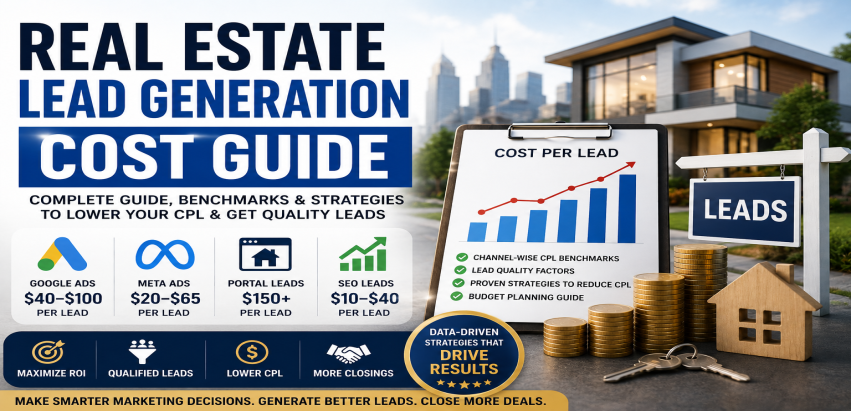
Real estate has one of the highest lead acquisition costs of any industry. That is not a flaw in your campaigns. It is a function of deal size, sales cycle length, and the competitive pressure that follows high-commission transactions everywhere they go.
The challenge is not just paying for leads. It is understanding what you are actually paying for. A $12 cost per lead from a Facebook instant form and a $180 cost per lead from a high-intent Google search campaign are not comparable figures. One is a name and a phone number. The other is a buyer actively searching for a property right now.
This guide breaks down real estate lead generation cost across every major channel, property type, and market, so you can plan budgets around ROI rather than surface-level CPL numbers that mean very different things depending on where they came from.
What Is Real Estate Lead Generation Cost?
Real estate lead generation cost, also called cost per lead or CPL, is the total marketing spend divided by the number of leads generated within a given period. It sounds simple. The complexity comes from what a lead actually represents in real estate versus other industries.
What Counts as a Real Estate Lead?
In most industries, a lead is anyone who submits contact information with some level of interest. In real estate, that definition creates serious problems because the gap between a casual inquiry and a qualified lead ready to transact can be months of follow-up, multiple site visits, and significant qualification work by the sales team.
A real estate lead can mean any of the following:
- A name and phone number from a Facebook instant form with minimal intent verification
- A search-driven enquiry from someone actively comparing properties in a specific location
- A portal registration from a user browsing listings passively
- A direct website enquiry with a specified budget, timeline, and property requirement
- A booked site visit from a pre-qualified buyer
The cost per lead looks very different depending on which of these you are generating. Most businesses measure CPL without separating lead types, which makes benchmarking misleading.
Why Real Estate Leads Cost More Than Other Industries
Three structural factors push real estate CPL higher than most categories.
First, transaction value. When a single closed deal generates tens of thousands in commission, competitors are willing to spend aggressively to win high-intent buyers. That competition raises auction prices for every advertiser in the market.
Second, sales cycle length. A lead that takes four to six months to convert costs more to acquire because the funnel must remain active, nurtured, and qualified over a long period. Short-cycle products can afford cheap, high-volume leads. Real estate cannot.
Third, geographic competition. Markets with limited inventory and high demand, whether in major metros or luxury coastal segments, see CPC and CPL figures that bear no resemblance to secondary markets. The same campaign structure can cost three times as much in a competitive city as it does in a lower-competition region.
Average Real Estate Lead Generation Cost in 2026
Across channels, real estate CPL benchmarks in 2026 range from under $20 for low-intent social leads to over $300 for high-intent search-driven enquiries in competitive markets. The range is that wide because the product is not the same at either end of it.
Average Cost Per Lead by Channel
Each acquisition channel produces leads at a different cost and a different quality level. The cheapest CPL channel is rarely the most profitable one when you trace revenue back through the funnel.
| Channel | Average CPL | Lead Quality | Conversion Potential |
|---|---|---|---|
| Google Search Ads | $80 to $250+ | High | Strong, active purchase intent |
| Meta / Facebook Ads | $15 to $60 | Low to Medium | Requires strong qualification process |
| YouTube Ads | $30 to $90 | Medium | Good for awareness, weaker for immediate conversion |
| SEO / Organic | $10 to $40 effective CPL | High | Strong, intent-driven, compounding over time |
| Property Portals | $20 to $80 | Medium | Shared leads, lower exclusivity |
| Email / Referral | Near zero to $15 | Very High | Highest conversion rates across all channels |
Buyer Leads vs Seller Leads
Seller leads consistently cost more than buyer leads in most markets. Homeowners considering listing have been researched by agencies for decades, they receive competing offers, and they make higher-stakes decisions. Generating a qualified seller lead through paid search typically costs 30 to 60 percent more than a comparable buyer lead in the same market.
Buyer leads are higher volume and lower cost, but their conversion path is longer and depends heavily on how quickly and effectively the sales team qualifies and nurtures them after the initial enquiry.
Luxury vs Affordable Housing CPL
Luxury property lead generation costs substantially more, but the economics justify it. A single luxury transaction may produce 10 to 20 times the commission of an affordable housing sale, which means CPL can be proportionally higher and still deliver strong ROI.
Affordable housing and first-home buyer segments produce higher lead volumes at lower CPL, but also face higher competition from aggregators, portals, and government-backed programmes that create buyer confusion and reduce lead exclusivity.
Why CPL Benchmarks Vary So Much
Lead quality matters more than cheap CPL. A developer paying $180 per lead from Google Search and converting 8 percent of those leads into site visits will outperform a developer paying $22 per lead from Facebook with a 1 percent site visit rate on almost every meaningful metric, including cost per site visit, cost per deal, and total revenue per marketing dollar.
CPL benchmarks vary because market competition, property type, ad creative quality, landing page conversion rate, and qualification speed all affect the final number independently. A figure quoted without these variables attached to it is context-free.
Google Ads Real Estate Lead Generation Cost
Google Ads generates leads from people actively searching for property. That search intent is what separates it from every other paid channel. The person clicking a Google search ad for "3BHK apartments for sale in Dubai" or "homes for sale in Austin Texas" has already decided to look. The ad intercepts that decision at its most active moment.
Average Google Ads CPL for Real Estate
Real estate Google Ads campaigns typically produce CPL figures between $80 and $300 in competitive English-speaking markets. In emerging markets across Southeast Asia, the Middle East, and South Asia, CPL can be significantly lower while maintaining comparable intent quality.
The higher cost reflects the competitive auction environment. Real estate is consistently among the most expensive verticals in Google Ads globally, with average CPC figures ranging from $2 to $15 in standard markets and climbing well above that in premium segments like New York, London, Dubai, and Sydney.
Search Ads vs Performance Max
Standard search campaigns give advertisers direct control over keyword targeting, match types, and negative keyword management. Performance Max uses machine learning to distribute spend across search, display, YouTube, Gmail, and Maps simultaneously.
For real estate, search campaigns typically produce higher lead quality because the targeting is demand-driven rather than audience-driven. Performance Max can deliver volume, but it requires careful asset group structure and clear conversion signal quality to avoid spending budget on low-intent audience placements masquerading as search traffic.
| Campaign Type | Average CPC | Average CPL | Intent Level |
|---|---|---|---|
| Branded Search | $0.50 to $3 | $20 to $60 | Very High |
| Non-Brand Search | $3 to $12 | $80 to $200 | High |
| Performance Max | $1 to $8 | $40 to $150 | Medium to High |
| Display Remarketing | $0.30 to $1.50 | $30 to $90 | Medium |
Luxury Property Google Ads Cost
Luxury real estate Google Ads campaigns carry substantially higher CPC because competition is concentrated among a small number of high-budget advertisers targeting a narrow audience. Keywords like "luxury waterfront homes" or "ultra-premium villas" in major markets can cost $15 to $40 per click.
The CPL for luxury property often reaches $200 to $500 or more, but when a single transaction yields $50,000 to $500,000 in commission, that acquisition cost remains commercially justified at a fraction of the revenue potential.
What Affects Real Estate CPC?
Several account and market factors move CPC up or down independent of your bid settings:
- Geographic competition: Metros with high inventory and high advertiser density push auction prices up
- Quality Score: Ad relevance, expected CTR, and landing page experience together determine how much you pay per click relative to competitors
- Keyword match types: Broad match with weak negative keyword coverage bleeds spend into irrelevant search queries
- Seasonality: Property search volumes shift significantly with interest rate announcements, school year cycles, and local market conditions
- Ad scheduling: Peak search hours are more expensive. Off-peak scheduling can reduce CPC without proportionally reducing conversion quality
How to Reduce Google Ads CPL
The most reliable ways to lower CPL without sacrificing lead quality work on the conversion side rather than the bidding side. A landing page that converts at 6 percent produces leads at half the cost of a landing page that converts at 3 percent from the same traffic.
Negative keyword management, geographic bid adjustments, and audience exclusions reduce wasted spend. Conversion tracking accuracy, particularly ensuring GA4 is recording the correct events and Google Tag Manager is firing without duplication, ensures bid strategies optimize toward real leads rather than proxy conversions. Businesses looking to run high-intent real estate PPC campaign management with proper tracking and bid strategy structure will see meaningfully lower CPL over time compared to campaigns built without that infrastructure. Aarmus Marketing structures real estate search campaigns around conversion tracking validation first, ensuring bid strategies optimize toward genuine enquiries rather than platform proxies.
Facebook and Meta Ads Real Estate Lead Cost
Meta Ads reach real estate audiences at lower CPL than Google Search. The tradeoff is intent. Facebook users are not searching for property when your ad appears. They are browsing content, responding to social signals, and making decisions about their attention rather than their next property transaction.
That does not make Meta Ads ineffective. It makes them a different tool, requiring a different qualification system to extract commercial value from the volume they generate.
Average Facebook CPL for Real Estate
Facebook real estate campaigns typically generate leads between $15 and $60 in most markets. In highly competitive segments or with weak creative, CPL can rise into the $80 to $120 range without producing proportional lead quality improvement.
The lower CPL reflects the passive nature of the audience. Facebook allows advertisers to reach large volumes of demographically matched users at low cost. Whether those users are ready to act is a separate question that only the qualification process can answer.
Instant Forms vs Landing Pages
Meta's instant lead forms pre-populate contact details from the user's profile, reducing friction and increasing submission volume. They also reduce quality because the low friction that increases form completions removes the commitment signal that separates genuinely interested buyers from casual browsers.
Landing page campaigns require the user to leave Facebook, load an external page, and actively complete a form. That extra friction filters out passive responders. CPL from landing page campaigns is typically 40 to 80 percent higher than instant form CPL. Lead-to-site-visit conversion rates from landing pages are typically two to four times higher.
| Campaign Type | Average CPL | Lead Volume | Lead Quality |
|---|---|---|---|
| Instant Lead Form | $12 to $35 | High | Low to Medium |
| Landing Page Campaign | $35 to $80 | Medium | Medium to High |
| WhatsApp Click-to-Chat | $10 to $40 | High | Variable, qualification-dependent |
| Video View Retargeting | $20 to $55 | Medium | Medium, intent warmed by prior exposure |
Why Cheap Meta Leads Often Fail
Cheap leads do not always convert. A real estate developer paying $18 per lead from a Facebook instant form campaign targeting a broad audience may receive 200 leads per month. If the sales team qualifies 8 percent of those leads into genuine site visit opportunities, that is 16 site visits at an effective cost of $225 per visit, before accounting for the time cost of working through 184 unqualified enquiries.
The headline CPL looks efficient. The actual cost per qualified conversation is not. This is why measuring CPL without measuring cost per site visit, cost per qualified lead, and cost per closed deal produces misleading budget decisions.
WhatsApp Funnel Impact on CPL
WhatsApp-integrated real estate funnels have become a primary qualification layer in markets where WhatsApp penetration is high, including India, the UAE, Southeast Asia, and parts of Latin America. A click-to-WhatsApp campaign sends the lead directly into a conversation rather than a static form submission.
WhatsApp qualification produces higher engagement rates than form-based follow-up because the channel is native to how the audience already communicates. Leads that respond to WhatsApp outreach within the first 30 minutes of enquiry convert at substantially higher rates than leads that receive a phone call 24 hours after submitting a form.
Understanding the full scope of real estate PPC strategies that incorporate WhatsApp, retargeting, and multi-stage qualification is increasingly important for developers and agencies trying to get commercial value from paid social volume.
Retargeting and Lead Quality
Retargeting campaigns on Meta target users who have already visited the property website, watched a video, or engaged with a previous ad. These audiences demonstrate prior interest, which moves them closer to the high-intent end of the spectrum without requiring Google Search's CPC premium.
Retargeting CPL typically falls between $20 and $55 and produces meaningfully better conversion rates than cold audience campaigns. For property developers with significant monthly traffic, retargeting is often the highest-ROI Meta campaign type available.
SEO vs Paid Ads Real Estate Lead Cost
The SEO versus paid ads comparison in real estate is not really a question of which channel is better. It is a question of time horizon, risk tolerance, and how quickly a business needs leads to flow through the pipeline.
Short-Term vs Long-Term Lead Cost
Paid advertising generates leads immediately. Turn the campaign on and leads arrive within hours. Turn it off and leads stop. The cost per lead is direct and measurable at any given moment, but it resets every month and scales linearly with spend.
SEO builds an organic asset over six to eighteen months that then generates leads at a declining effective CPL for years. The early investment is high relative to output. The mature investment produces leads at a fraction of the paid cost from the same search queries.
SEO Lead Quality vs Paid Ads
Organic search leads and Google Search ad leads share the same quality characteristic: both come from people actively searching. The difference is trust positioning. A business that ranks organically for "luxury apartments in Dubai Marina" is perceived as a category authority by the searcher in a way that a paid ad above it is not.
That perceived authority translates into slightly higher conversion rates for organic leads versus paid leads from comparable searches, even when the intent level is similar.
Why Organic Leads Usually Convert Better
Organic leads tend to convert at higher rates for three reasons. First, the searcher has seen the brand appear in trusted editorial results rather than paid placements, which reduces the initial skepticism that real estate buyers carry toward advertising. Second, organic landing pages that rank well have typically been content-optimized in ways that also improve conversion rate. Third, the user journey for organic visits often involves more pre-visit research, which means the buyer is further along in their decision process by the time they submit an enquiry.
When PPC Makes More Sense
Paid ads are the right choice when a business needs leads now, when a new project launches without the organic authority to rank competitively, or when targeting very specific high-intent search queries that generate low monthly volume but strong conversion economics. PPC also gives businesses real-time control over budget, targeting, and message that SEO cannot match on any short-term timescale.
SEO ROI in Real Estate
The effective CPL from SEO, calculated by dividing total SEO investment by organic leads generated, typically reaches its lowest point 18 to 24 months after a serious content and authority-building programme begins. At that point, a real estate business generating 80 to 120 organic leads per month from a total SEO spend of $3,000 to $5,000 monthly is producing leads at an effective CPL of $25 to $60, competitive with or lower than most paid channels, with no cost-per-click exposure.
For businesses committed to long-term organic lead generation in the property sector, the compounding nature of SEO authority means that dollar invested in month one continues producing leads in month 24 without additional spend. No paid channel offers that economics.
Combining SEO and PPC
The most efficient real estate marketing programmes run SEO and PPC together, not as alternatives. Paid ads cover immediate lead requirements and new project launches. SEO builds the organic infrastructure that reduces paid dependence over time. Together, they produce lower blended CPL than either channel alone.
Businesses ready to build that combined strategy through scalable SEO growth strategies alongside paid programmes typically see blended CPL decline 30 to 50 percent over a 12-month period compared to paid-only programmes.
| Factor | SEO | Paid Ads |
|---|---|---|
| Time to first lead | 3 to 6 months minimum | Hours to days |
| Effective CPL at maturity | Low, declining over time | Fixed, scales with spend |
| Lead quality | High, intent-driven | High (Search), Variable (Social) |
| Budget risk | Low once established | High, stops when budget stops |
| Scalability | Slow but compounding | Fast but linear with spend |
| Brand trust signal | Strong editorial positioning | Perceived as advertising |
| Best for | Long-term market presence | Launch campaigns, fast pipeline |
Factors That Affect Real Estate Lead Generation Cost
Two real estate businesses can run structurally identical campaigns in the same city and produce CPL figures that differ by 200 percent. The difference is almost never the platform. It is the variables that sit around the campaign.
Location and City Competition
Markets with high advertiser density and limited inventory drive auction prices up across every paid channel. A real estate developer advertising in central London, Manhattan, or central Singapore operates in a fundamentally different cost environment than a developer in a secondary market with lower competition. City-level CPL differences of three to five times between competitive and low-competition markets are common.
Luxury vs Affordable Properties
Luxury property advertising targets a narrow, high-value audience. Reaching that audience repeatedly with appropriate creative across search and social costs more per impression and more per click than affordable housing campaigns targeting broader demographics. The narrower the audience, the higher the frequency cost required to generate enquiry volume.
Landing Page Quality
Landing page conversion rate is one of the most significant levers available to reduce CPL without touching the ad platform at all. A landing page converting at 4 percent produces leads at half the cost of a landing page converting at 2 percent from the same traffic source. Page load speed, mobile optimization, offer clarity, and form friction all directly affect that conversion rate.
Real estate landing pages that include specific project details, floor plans, location maps, and clear pricing information consistently outperform generic enquiry pages that request contact information without giving the visitor enough to make a commitment decision.
CRM and Follow-Up Speed
Speed-to-lead is one of the most documented drivers of lead conversion in real estate. Studies across markets consistently show that responding to an enquiry within five minutes produces dramatically higher contact and qualification rates than responding within an hour, and an hour produces better results than 24 hours.
A campaign generating 100 leads per month at $60 CPL, where the sales team responds within 5 minutes, will typically outperform a campaign generating 200 leads at $30 CPL where response time averages four to six hours, even though the second campaign appears to deliver twice the volume at half the cost.
Creative Quality
Ad creative quality affects both CTR and audience qualification. Generic creative with stock photography and generic headlines attracts a general audience. Project-specific creative showing actual renders, completed units, or location context attracts audiences with genuine interest in that specific product. Higher creative relevance produces lower CPL and higher lead quality simultaneously.
Audience Targeting
Targeting quality determines how much of the ad budget reaches people with genuine purchase intent. Broad targeting reduces CPL on paper by reaching more people at lower cost per impression, but it inflates absolute costs by generating enquiries from audiences with no realistic prospect of transacting. Interest layering, lookalike audiences based on past buyers, and geographic precision targeting consistently produce better CPL economics than broad reach campaigns.
Lead Qualification Process
A structured lead qualification process, whether handled by a dedicated pre-sales team, an automated WhatsApp flow, or a combined CRM and human follow-up system, dramatically affects the true cost of a conversion. Businesses that qualify leads within hours rather than days reduce the volume of leads that go cold before the first conversation, effectively improving the ROI of every lead generated without reducing CPL.
Market Demand Cycles
Real estate demand is cyclical and responds to interest rate movements, economic conditions, seasonal patterns, and project launch timelines. Running campaigns during peak demand periods increases competition and raises CPL. Maintaining consistent campaign activity during slower periods can produce lower CPL with comparable or better lead quality, as the pool of active buyers is smaller but more serious.
Real Estate Lead Cost by Property Type
CPL does not behave the same across property segments. A lead for a studio apartment priced at $150,000 and a lead for a beachfront villa priced at $4 million are both called leads, but the acquisition economics, qualification requirements, and ROI calculations are entirely different.
Luxury Real Estate Lead Cost
Luxury leads justify higher CPL because the commission value on a single transaction can be 50 to 200 times the value of an affordable housing commission. Luxury property campaigns targeting buyers for properties above $1 million typically produce CPL between $150 and $500 on Google Search and $50 to $180 on Meta, with significant variation based on market and specificity of targeting.
The qualification bar for luxury leads is also higher. The real cost metric that matters is cost per qualified site visit, not cost per enquiry. Commission value impacts ROI far more than CPL at the luxury end of the market.
Affordable Housing CPL
Affordable housing and first-home buyer campaigns generate high volumes at lower CPL, typically $20 to $80 on Google and $10 to $40 on Meta. The challenge is lead exclusivity. Government buyer assistance programs, comparison portals, and high advertiser density in this segment mean leads are often shared across multiple agencies and developers simultaneously, reducing the probability of conversion for any individual advertiser.
Commercial Property Lead Cost
Commercial property leads, covering office space, retail, industrial, and investment property, are low in volume and high in value. These transactions take longer, involve more stakeholders, and require different qualification criteria. CPL for commercial property enquiries typically ranges from $100 to $400 on search channels, with small volumes making optimization difficult in early campaign stages.
Rental Property Lead Generation Cost
Rental property leads are the most commoditized segment. Portals dominate rental search, and the revenue per transaction is far lower than sales. CPL for rental enquiries is typically low, between $8 and $35, but the volume of unqualified applications makes cost per placed tenant a more meaningful metric than cost per lead.
New Launch Projects
New project launches require a different lead generation approach because organic search authority does not yet exist for the project name, and paid campaigns must build awareness and intent simultaneously. Early-stage launch CPL is typically 30 to 60 percent higher than steady-state campaign CPL because the audience is being educated rather than intercepted at an active search point.
Resale Property Leads
Resale property leads compete directly with portal listings and organic search results from established property aggregators. CPL for resale buyer leads from paid search is competitive with new launch costs, while seller leads for resale properties, where the agent needs to win the listing mandate, are substantially more expensive to generate and require a different nurture approach entirely.
| Property Type | Average CPL | Competition Level | Conversion Difficulty |
|---|---|---|---|
| Luxury Residential | $150 to $500+ | Medium (narrow audience) | High, long qualification cycle |
| Affordable / Mid-Market | $20 to $80 | Very High | Medium, portal competition reduces exclusivity |
| Commercial Property | $100 to $400 | Medium | High, multi-stakeholder decision |
| Rental Property | $8 to $35 | High | Low per lead, high unqualified volume |
| New Launch Projects | $50 to $180 | High initially | Medium, pre-launch awareness required |
| Resale Listings | $30 to $120 | High | Medium, portal competition is significant |
Why Cheap Real Estate Leads Often Fail
The appeal of a $15 lead is obvious. The problem becomes visible when you trace what happens after the lead arrives.
Low Intent vs High Intent Leads
Low-intent leads are generated from people who responded to creative, not from people who were searching for a property. They may match a demographic profile that suggests they could be buyers. They have not demonstrated any active search behaviour that confirms they are. The gap between these two states is where cheap leads fail.
A person who clicked on a Facebook ad because the render looked attractive and they submitted their details on impulse is in a fundamentally different purchase state than a person who typed "2-bedroom apartment near downtown Austin for sale" into Google and clicked through to a dedicated project page. Both are "leads" in the spreadsheet. One is several weeks or months away from being ready to transact.
Portal Leads vs Exclusive Leads
Property portal leads are distributed across multiple agents and developers simultaneously. The same buyer enquiry goes to three, five, or ten businesses at once. Cheap leads are not always profitable when they are shared, because conversion probability drops with every additional respondent the buyer hears from. Exclusive leads, generated through your own campaigns and captured on your own landing pages, cost more per lead and convert at substantially higher rates.
The Problem With Broad Targeting
Broad audience targeting produces high-volume, low-cost lead campaigns that look impressive in dashboards and perform poorly in sales meetings. A campaign targeting all homeowners in a city aged 30 to 55 with household income above a threshold will generate enquiries. Most of those enquiries will come from people who are not genuinely in market for the property type being advertised, regardless of how accurate the demographic filter appears to be.
Conversion quality matters. Narrower audiences with higher creative relevance and specific property messaging generate fewer leads at higher CPL and convert at rates that make the economics significantly better when traced through to closed deals.
Why Speed-to-Lead Matters
Real estate buyers considering a purchase are typically evaluating multiple properties simultaneously. A lead who submits an enquiry at 2pm on a Tuesday and receives a response at 10am on Wednesday has almost certainly spoken with two or three other agents or developers in that window. The first business to make quality contact sets the standard against which all subsequent contact is measured.
Speed-to-lead is not a nice-to-have operational detail. It is a core conversion driver. The difference between a five-minute response and a four-hour response is not a 10 percent improvement in contact rate. In most markets, it is a 40 to 60 percent difference in the probability of converting that lead into a qualified conversation.
Lead Quality vs CPL
The right metric for evaluating lead generation performance in real estate is not cost per lead. It is cost per qualified lead, cost per site visit, cost per deal, and revenue per marketing dollar. A business optimizing toward CPL alone will consistently choose channels and strategies that look efficient in isolation and underperform commercially because the downstream conversion funnel never closes at the rates that cheap CPL implies.
How to Reduce Real Estate Lead Generation Cost
Reducing CPL without reducing lead quality requires working on the entire funnel, not just the bidding settings inside an ad platform. The biggest CPL reduction levers in real estate sit outside the ad account.
Improve Landing Page Conversion Rate
Every percentage point of improvement in landing page conversion rate reduces CPL by the same proportion. Moving from 2 percent to 4 percent conversion rate halves CPL from the same traffic. Specific actions that move conversion rate in real estate landing pages include: showing actual project renders rather than generic property imagery, placing the enquiry form above the fold, reducing form fields to name, phone, and one qualifying question, adding social proof in the form of sold units or testimonials near the form, and ensuring mobile page load time is under three seconds.
Use WhatsApp Automation
Automated WhatsApp follow-up sequences triggered within seconds of lead submission address the speed-to-lead problem without requiring a sales team member to be available at the moment of enquiry. An initial WhatsApp message acknowledging the enquiry, sharing a project brochure, and asking one qualifying question keeps the lead engaged while the sales team prepares for the conversation. Businesses using automated WhatsApp follow-up see 30 to 50 percent improvement in lead-to-conversation rates compared to phone-only follow-up strategies.
Retarget Website Visitors
Retargeting campaigns reach audiences who have already demonstrated interest by visiting the website or project page. These audiences cost less to reach than cold audiences and convert at higher rates because they have prior brand exposure. Real estate businesses with 2,000 or more monthly website visitors have an existing retargeting asset that most underutilize. Retargeting campaigns with project-specific creative to prior visitors typically produce CPL 40 to 60 percent lower than cold audience campaigns targeting the same geographic market.
Optimize Creative Quality
Creative that shows the actual property, specific features, and genuine value proposition attracts a more qualified audience than generic creative. An ad showing a specific floor plan, a real price point, and a location benefit will generate fewer clicks from unqualified audiences and more clicks from people with genuine interest, which improves both CPL and lead quality simultaneously.
Use CRM Automation
CRM automation ensures no lead goes uncontacted, no follow-up is forgotten, and no qualified prospect slips out of the pipeline because of a manual process failure. Integrating the ad platform lead capture with a CRM that triggers automated follow-up sequences, assigns leads to sales agents, and tracks pipeline stage reduces the effective cost of every lead generated by increasing the percentage that convert into qualified conversations and eventually transactions.
For a full analysis of how ad management efficiency and optimization connects to overall acquisition economics, including CRM integration and bid strategy alignment, the infrastructure decisions made at the campaign level directly affect how much of the lead generation spend produces commercial outcomes.
Focus on Qualified Leads
Restructuring campaigns to generate fewer, more qualified leads rather than maximum volume often reduces total marketing spend while increasing closed deal rate. This means tightening audience targeting, using landing pages with higher friction that filter casual enquirers, and qualifying leads through a structured first conversation before passing them to the full sales process. Retargeting warm audiences rather than cold-reaching broad demographics is the most direct way to implement this shift.
Improve Follow-Up Speed
If the sales team is responding to leads four to eight hours after enquiry, fixing that operational gap will produce a larger CPL reduction than any campaign optimisation available at the platform level. The same leads, contacted in five minutes rather than four hours, will convert into qualified conversations at rates that effectively halve the cost per qualified lead without spending a dollar less on media. For businesses tracking long-term long-term organic acquisition economics, the same principle applies: organic leads also convert better when they receive fast, personalised responses rather than being held in a queue alongside paid leads.
Real Estate Lead Generation Cost by Country
Lead generation costs for real estate vary significantly across countries because market competition, platform usage patterns, property price levels, and buyer behaviour all differ. A CPL benchmark from the United States does not translate to India, and a UAE benchmark does not apply to the United Kingdom without market-specific context.
Real Estate CPL in India
India is one of the most volume-driven real estate markets digitally. Facebook and Meta Ads dominate lead generation for developers across Mumbai, Delhi NCR, Bengaluru, Hyderabad, Pune, and Chennai, with CPL typically ranging from INR 200 to INR 800 (approximately $2.50 to $10) for volume campaigns and INR 1,000 to INR 4,000 ($12 to $50) for higher-intent search-driven campaigns.
The low CPL figures are often misleading. A developer receiving 500 leads per month at INR 300 CPL and converting 2 percent into site visits is generating 10 site visits at an effective cost of INR 15,000 per visit. A developer running tighter search campaigns at INR 2,500 CPL with 15 percent site visit conversion may achieve the same 10 site visits at INR 16,700, with dramatically lower sales team effort and higher buyer seriousness at the visit stage. Local buyer behavior in India also makes WhatsApp qualification essential rather than optional.
Real Estate CPL in USA
The United States has the most mature and competitive real estate digital advertising market globally. Google Ads CPL for residential real estate ranges from $80 to $300 in standard markets and significantly higher in premium coastal markets like New York, San Francisco, Los Angeles, Miami, and Boston. Meta Ads CPL for real estate in the USA typically ranges from $25 to $80, with significant variation by state and market density.
US real estate advertisers also contend with portal competition from Zillow, Realtor.com, and Redfin, which capture significant organic search volume and run their own paid campaigns in the same auctions. Market competition impacts CPL in the USA more directly than almost any other factor.
Real Estate CPL in UAE
Dubai and Abu Dhabi represent some of the most competitive real estate advertising markets in the world relative to market size. International buyers, high-value transactions, and dozens of active developers competing for search visibility push Google Ads CPL for premium property searches to AED 500 to AED 2,000 ($135 to $545) in competitive segments.
The UAE real estate market is also heavily influenced by referral networks, agent ecosystems, and off-plan launch events, which means digital lead generation operates alongside significant offline acquisition infrastructure. WhatsApp is the dominant communication channel for buyer follow-up across the UAE market.
Real Estate CPL in UK
UK real estate digital lead generation is concentrated in London and the South East, with significantly lower CPL in regional markets. London property Google Ads CPL ranges from GBP 60 to GBP 200 ($75 to $250) depending on property type and targeting precision. Regional UK markets produce CPL between GBP 25 and GBP 80 for comparable campaign structures.
The UK market has high Rightmove and Zoopla portal dependency, which creates both organic traffic competition and a buyer expectation that listings are available on those platforms. Developer-direct lead generation runs alongside rather than replacing portal presence in most UK campaigns.
Why Global CPL Benchmarks Differ
Platform pricing varies by country based on advertiser demand, which is directly tied to transaction values, commission economics, and digital marketing adoption rates in the real estate sector. A market where individual deals generate $500,000 in value will attract higher advertiser competition and therefore higher CPC and CPL than a market where deals generate $50,000. Currency differences are part of the comparison, but purchasing power parity and transaction economics explain the CPL gap far more than currency exchange alone.
| Country | Google Ads CPL | Meta Ads CPL | SEO Effective CPL |
|---|---|---|---|
| India | $12 to $50 | $2.50 to $12 | $3 to $15 |
| USA | $80 to $300+ | $25 to $80 | $20 to $60 |
| UAE | $135 to $545 | $30 to $100 | $25 to $80 |
| UK | $75 to $250 | $20 to $65 | $15 to $50 |
| Australia | $60 to $220 | $20 to $60 | $15 to $45 |
How Much Should Realtors Spend on Lead Generation?
The right real estate marketing budget is not a fixed dollar figure. It is a function of the number of closed deals the business needs, the average deal value, the expected conversion rate from lead to close, and the CPL achievable in the target market.
Monthly Budget Recommendations
A useful starting framework: if a real estate agent or developer needs 5 closed deals per month, with an average lead-to-close conversion rate of 3 percent across all channels, they need approximately 167 leads per month. At a blended CPL of $80, that is a $13,360 monthly lead generation budget. At a $150 blended CPL in a more competitive market, it becomes $25,050.
The implication is that reducing lead-to-close conversion rate from 3 percent to 5 percent through better qualification, faster follow-up, and stronger sales process reduces the required lead volume to 100 per month, and the budget requirement drops to $8,000 to $15,000 at the same CPL levels. Sales process improvement and budget reduction are directly connected.
Budget by Property Segment
Luxury property businesses need smaller lead volumes at higher CPL. An agent or developer needing 3 luxury deals per month with a 5 percent lead-to-close rate needs 60 qualified leads at $300 CPL, a $18,000 monthly budget. The commission on 3 luxury transactions typically justifies that spend within a single deal.
Mid-market developers needing 20 closings per month with a 4 percent conversion rate need 500 leads. At a $50 blended CPL across search and social channels, that requires a $25,000 monthly budget. Scale requirements determine whether that budget is spent on search volume, social volume, or a combination driven by market dynamics.
Lead Volume vs Conversion Quality
The consistent finding across real estate markets is that businesses chasing maximum lead volume at minimum CPL consistently underperform businesses that generate moderate volumes of higher-quality leads with strong qualification systems. ROI matters more than lead count. A business generating 100 leads per month and converting 8 percent into closed deals generates 8 closings. A business generating 400 leads at 2 percent generates 8 closings at four times the lead generation cost and with significantly more sales team effort wasted on unqualified follow-up.
How to Measure ROI
Real estate lead generation ROI is measured in revenue per marketing dollar, not leads per dollar. The calculation requires tracking lead source through to closed deal, which demands CRM discipline and consistent attribution practices. The formula: total commission revenue attributable to a channel divided by total marketing spend on that channel over the same period. Businesses with this data can make rational budget allocation decisions. Businesses without it are guessing.
| Business Type | Monthly Budget | Expected Leads | Best Channels |
|---|---|---|---|
| Individual Realtor | $500 to $2,000 | 10 to 40 | Meta Ads, local SEO |
| Small Agency (5 to 15 agents) | $2,000 to $8,000 | 40 to 150 | Google Search, Meta, SEO |
| Mid-Size Developer | $8,000 to $30,000 | 100 to 500 | Google, Meta, YouTube, SEO |
| Luxury Property Specialist | $5,000 to $25,000 | 20 to 80 | Google Search, programmatic, SEO |
| Large Developer / National Brand | $30,000 to $150,000+ | 500 to 3,000+ | Full channel mix, OOH, programmatic |
Frequently Asked Questions About Real Estate Lead Generation Cost
What is a good CPL for real estate?
A good CPL for real estate depends entirely on deal value and conversion rate. For affordable residential property, $30 to $80 from paid search is reasonable. For luxury property, $200 to $500 can still be profitable if commission per deal is high. The better question is: what is your cost per closed deal, and does it justify the spend relative to commission earned?
Why are real estate leads expensive?
Real estate leads are expensive because deal values are high, commissions are large, and competitive advertisers are willing to pay premium prices to win those transactions. High-value markets attract heavy advertiser competition, which drives up CPC and CPL across all paid channels. The cost of the lead is proportional to the revenue opportunity it represents.
Which platform gives the cheapest real estate leads?
Facebook and Meta Ads consistently produce the lowest CPL for real estate, typically $15 to $60. However, cheapest CPL does not mean best value. Meta leads require more qualification effort and convert at lower rates than search-driven leads. Google Search Ads cost more per lead but produce higher-quality enquiries from active buyers. The cheapest lead source is rarely the most profitable one.
How much should realtors spend on marketing?
Individual realtors typically need $500 to $2,000 per month to generate a consistent lead pipeline through digital channels. Small agencies need $2,000 to $8,000. Developers and large agencies running full-funnel campaigns across search and social need $10,000 to $50,000 or more depending on lead volume targets and market competition. Budget should be set based on how many closed deals the business needs per month, not on what competitors appear to be spending.
Are Facebook real estate leads worth it?
Facebook real estate leads are worth it when the business has a strong qualification system, fast follow-up, and the patience to nurture leads through a longer consideration cycle. They are not worth it when the sales team is overwhelmed, follow-up is slow, and there is no filtering mechanism between form submission and sales conversation. Lead quality is a function of what you do with the lead as much as where it came from.
Do SEO leads convert better than PPC leads?
SEO leads from organic search typically convert slightly better than PPC leads from comparable search intent because organic rankings carry implicit trust signals that paid placements do not. Both are significantly better than social media leads in terms of purchase intent. The difference between SEO and PPC lead quality is smaller than the difference between search intent leads and social media leads regardless of platform.
How can I lower my real estate CPL?
The highest-impact CPL reduction levers are: improving landing page conversion rate, tightening audience targeting to reduce unqualified traffic, improving speed-to-lead response, adding WhatsApp automation for immediate follow-up, retargeting prior website visitors rather than constantly prospecting cold audiences, and improving ad creative relevance to filter for genuine purchase intent before the click happens.
What is the best channel for luxury real estate leads?
Google Search Ads targeting high-intent keywords specific to the property type and location produce the highest-quality luxury real estate leads. For brand awareness and audience warming among high-net-worth individuals, YouTube, programmatic display on premium publishers, and organic SEO for location and project-specific keywords complement the search strategy. Meta Ads work for luxury retargeting and WhatsApp-based follow-up but rarely produce primary luxury buyer leads at scale.
Why do cheap leads fail to convert?
Cheap leads fail to convert because they come from audiences who did not actively search for the property and may have submitted details on impulse rather than with genuine purchase intent. Portal shared leads fail because the buyer speaks with multiple agents simultaneously, reducing exclusivity. Broad audience social leads fail because demographic targeting does not equal purchase readiness. Low CPL and low conversion rate are usually symptoms of the same underlying cause: reaching the wrong audience at the wrong moment.
How long does SEO take for real estate?
Real estate SEO typically takes six to twelve months to produce significant organic lead volume for competitive keywords. New domains and new projects with no existing content authority take longer. Markets with established portal dominance, like the USA or UK, take longer to break into organically than markets where developer-direct websites can compete more readily. The payoff after that investment period is compounding: organic leads continue to arrive without incremental spend per lead.
Final Thoughts on Real Estate Lead Generation Cost
Every real estate business wants lower CPL. The businesses that actually achieve sustainable, profitable lead acquisition are the ones that stop optimizing for cheaper leads and start optimizing for better economics across the full funnel.
Focus on Qualified Leads, Not Cheap CPL
Qualified leads are the only leads that produce revenue. A campaign delivering 300 leads per month at $20 CPL with a 1.5 percent site visit conversion produces 4.5 site visits. A campaign delivering 80 leads per month at $70 CPL with a 12 percent site visit conversion produces 9.6 site visits at a lower cost per site visit, from one-third the lead volume, with dramatically less sales team time wasted on unqualified enquiries.
The metrics that matter are:
- Cost per qualified lead
- Cost per site visit
- Cost per closed deal
- Revenue per marketing dollar by channel
Businesses that track these figures across channels make consistently better budget allocation decisions than businesses tracking CPL alone.
Why Long-Term Lead Generation Wins
Paid advertising will always be a necessary part of real estate lead generation. But businesses that build organic search authority alongside their paid programmes create a compounding asset that gradually reduces their dependence on paid CPL economics over time.
The developers, agencies, and brokers who consistently outperform their markets on cost-per-deal metrics are typically running both: search campaigns that intercept active buyers today, and SEO programmes that build the authority to capture those buyers organically tomorrow. That combination, executed with the right qualification infrastructure and follow-up speed, is where long-term marketing ROI actually lives in real estate.
If you are ready to build that kind of lead generation programme for your real estate business, Aarmus Marketing offers real estate marketing consultation that covers channel mix, CPL benchmarking, and funnel architecture to help you reach your sales targets without overpaying for leads that do not convert.