

Most businesses approach SEO pricing the wrong way. They search for a number, compare packages, and pick what seems affordable. Then six months later, they wonder why nothing moved.
SEO pricing is not a fixed tariff. It reflects the amount of real work your website, market, and competition actually require. This guide covers what SEO costs in India and globally, what drives that cost, and how to evaluate whether a quote you receive is realistic or a red flag.
How Much Do SEO Services Cost in 2026?
SEO pricing sits across a wide range, and that range is intentional, not arbitrary. A local bakery in Surat competing for "best bakery in Surat" has a fundamentally different SEO workload than a national ecommerce brand competing for "buy gold jewellery online." Treating these as similar projects leads to either underinvestment or overpricing.
SEO Pricing in India
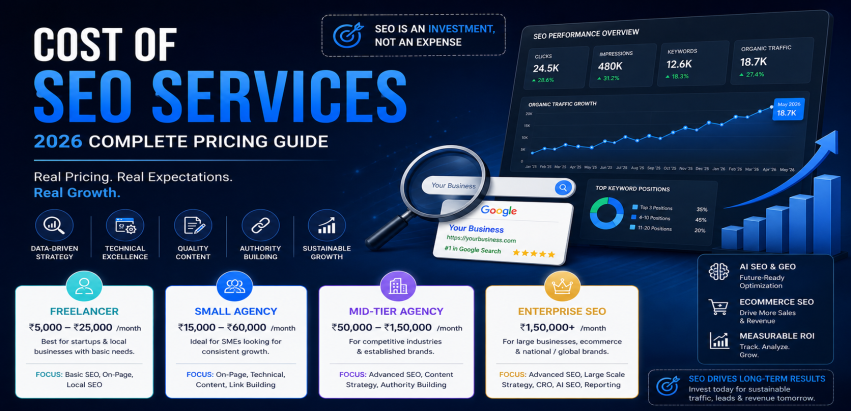
In India, monthly SEO retainers commonly range from ₹15,000 for small local businesses to ₹2,00,000+ for enterprise or highly competitive ecommerce accounts. Freelancer pricing runs lower, typically ₹10,000–₹60,000/month depending on scope. Mid-market agencies handling multi-channel SEO programs sit in the ₹40,000–₹1,50,000/month range.
Global SEO Pricing Context
Globally, small businesses pay $500–$2,000/month for SEO services. Competitive verticals like legal, finance, SaaS, and healthcare regularly see retainers between $3,000–$15,000/month. Enterprise SEO programs at scale can exceed $30,000/month when content production, technical sprints, and international targeting are factored in.
These numbers are not arbitrary. They reflect hours of professional time, tool subscriptions, content production costs, and the depth of technical work involved.
| Business Type | Typical Monthly SEO Cost (India) | SEO Scope | Suitable For |
|---|---|---|---|
| Local business (single city) | ₹15,000 – ₹35,000 | Local citations, GMB, on-page basics | Restaurants, salons, clinics, retailers |
| Small service business | ₹25,000 – ₹60,000 | Keyword targeting, content, technical fixes | Lawyers, consultants, agencies, B2B services |
| SME / regional brand | ₹50,000 – ₹1,20,000 | Full-service SEO with content production | Growing brands, multi-location businesses |
| Ecommerce website | ₹60,000 – ₹2,50,000+ | Category SEO, schema, catalog management | Shopify, WooCommerce, custom ecommerce stores |
| Enterprise / national brand | ₹1,50,000 – ₹5,00,000+ | Technical SEO at scale, authority building | Large brands, high-competition verticals |
Why SEO Pricing Varies So Much Between Businesses
The single biggest reason SEO quotes differ, even for similar-looking businesses, is operational complexity. An SEO provider is not pricing based on how much money you have. They are pricing based on how much actual work your situation requires to produce results.
Competition Level
If you are entering a market where the top three results are occupied by established domains with thousands of backlinks and years of consistent content output, you need more investment to compete. A competitor analysis is not optional. It directly determines your minimum viable SEO budget.
Website Size and Technical Condition
A 10-page service website and a 10,000-product ecommerce store are completely different technical SEO projects. Areas like crawl architecture, duplicate content, page speed, structured data, and Core Web Vitals all require more time to audit and fix on larger websites. The initial technical remediation work often takes months before growth-focused SEO can even begin.
Content Production Requirements
Some businesses have strong existing content that just needs optimization. Others are starting from zero in categories where content depth is a ranking prerequisite. Content production, meaning researched, semantically structured, topically relevant writing, is one of the most time-intensive parts of any SEO program.
Backlink Acquisition
In competitive verticals, link acquisition is not optional. It requires outreach, relationship building, and sometimes content creation specifically designed to earn editorial links. This work does not scale cheaply.
Local vs National vs Global SEO
Local SEO for a single city is simpler in scope. National SEO requires competing across broader keyword sets, larger audiences, and more authoritative competitors. International SEO adds hreflang, multi-region architecture, and market-specific content, with each layer increasing the overall workload.
Ecommerce Complexity
Ecommerce SEO involves category-level strategy, faceted navigation handling, product schema, feed management, and often coordination with paid shopping campaigns. The SEO workload is ongoing because the catalog changes, products go out of stock, and category pages need continuous improvement.
What Is Usually Included in SEO Services?
One of the most common frustrations businesses have with SEO is the gap between what they thought they were buying and what was actually delivered. Clarifying deliverables before signing is the single best way to avoid that outcome.
A well-structured SEO services engagement typically covers the following areas, with the depth of each determined by your retainer level.
Technical SEO
This is the foundation. A technical SEO audit identifies crawl issues, duplicate content, broken links, page speed problems, Core Web Vitals failures, structured data errors, and indexation problems. Without fixing these, every other SEO effort is partially wasted. Technical SEO is not a one-time task. It requires ongoing monitoring as your website grows and changes.
Keyword Research and Content Strategy
Effective keyword research maps your audience's actual search behaviour to the pages you should create or optimize. This includes identifying primary keywords, related semantic terms, question-based queries, and commercial-investigation intent keywords. The output is a content roadmap, not a keyword spreadsheet.
On-Page Optimization
Each page needs a clear hierarchy: an H1 targeting primary search intent, a meta title and description designed to earn clicks, and body content that covers the topic with enough depth and semantic relevance to outrank what currently ranks. This involves structured rewriting, not just keyword insertion.
GA4 and Reporting
GA4 setup, goal tracking, and monthly reporting should be standard in any retainer. A good SEO report does not just show traffic numbers. It connects SEO activity to business outcomes: organic leads, conversion rates from organic traffic, keyword position changes, and technical health scores.
| SEO Activity | Purpose | Frequency | Complexity Level |
|---|---|---|---|
| Technical SEO audit | Identify and fix crawlability issues | Monthly (ongoing monitoring) | High |
| Keyword research | Map search demand to content opportunities | Quarterly refresh | Medium-High |
| On-page optimization | Align page content with search intent | Ongoing per content calendar | Medium |
| Content production | Build topical authority and capture informational queries | Weekly or bi-weekly | High |
| Internal linking | Distribute authority and guide crawlers | Ongoing | Medium |
| Backlink acquisition | Build domain authority and competitive ranking signals | Monthly outreach | High |
| GA4 tracking and reporting | Measure SEO impact on business outcomes | Monthly | Medium |
| Core Web Vitals monitoring | Maintain page experience signals | Monthly | Medium |
Monthly SEO Retainers vs One-Time SEO Projects
SEO is not one project with a finish line. It is ongoing work in a competitive environment that keeps moving whether you are active or not. That said, there are legitimate use cases for project-based and one-time SEO engagements.
Monthly Retainers
A retainer is the standard model for businesses that want sustained organic growth. You pay a fixed monthly fee for an agreed scope of work: audits, content, links, reporting. Each month's work builds on the last, which is how compounding progress becomes possible.
One-Time SEO Audits
A technical SEO audit is a project-based deliverable that many businesses buy before committing to a retainer. This gives you a clear picture of what needs to be fixed and why. Audits typically cost ₹15,000–₹80,000 depending on website size.
Performance-Based SEO
Performance-based models, where you pay only for ranking improvements, sound attractive but carry structural risks. Providers focused on fast ranking gains are more likely to use methods that work short-term but create penalties long-term. Very few credible agencies use pure performance pricing.
| Pricing Model | Best For | Advantages | Limitations |
|---|---|---|---|
| Monthly retainer | Businesses wanting sustained growth | Compounding results, consistent execution | Requires longer commitment to see ROI |
| One-time audit | Websites with undiagnosed technical issues | Clear action list, no long commitment | No execution included; you implement yourself |
| Hourly consulting | Businesses with in-house teams needing guidance | Flexible, pay only for what you use | Difficult to maintain strategic momentum |
| Project-based SEO | Specific campaigns, new website launches | Defined scope and budget | No ongoing optimization after project ends |
| Performance-based | Very limited situations | Lower upfront risk | Incentivises shortcuts; rarely sustainable |
Freelancer vs SEO Agency Pricing: What Changes?
The freelancer-versus-agency question is not about quality. There are excellent freelancers and mediocre agencies. The real difference is execution capacity: what can actually be delivered within a given timeframe, and who does the work?
How Freelancers Operate
A skilled SEO freelancer works alone or with occasional contractors. Their pricing is lower because their overhead is lower and their team is smaller. They work well for focused scopes such as a technical audit, a keyword strategy, or content optimization for a specific set of pages. Where freelancers struggle is simultaneous execution across multiple SEO workstreams at speed.
How Agencies Operate
An SEO agency brings a team: an account strategist, a technical SEO specialist, a content team, a link-building outreach function, and a reporting analyst. This structure allows parallel execution where technical fixes happen while content is being produced and links are being earned. The higher cost reflects that operational infrastructure.
| Factor | Freelancer | SEO Agency |
|---|---|---|
| Team structure | Solo or small team | Specialists across SEO functions |
| Execution speed | Sequential across tasks | Parallel across workstreams |
| SEO tool access | May use 1-2 tools | Full tool stack (Ahrefs, Semrush, etc.) |
| Reporting depth | Variable, freelancer dependent | Structured reporting with dashboards |
| Strategy depth | Strong for specific focus areas | Cross-channel, data-integrated strategy |
| Monthly cost (India) | ₹10,000 – ₹60,000 | ₹40,000 – ₹2,50,000+ |
| Best suited for | Focused projects, limited budgets | Growth-stage and scaling businesses |
Why Cheap SEO Services Often Create Long-Term Problems
The appeal of low-cost SEO is understandable. The premise is simple: pay less, get the same result. The reality is different, and the consequences tend to surface well after the initial investment is spent.
Spam Backlinks and Manual Penalties
Low-cost link building almost always relies on private blog networks, link farms, or purchased links from irrelevant directories. Google's spam detection has become considerably more sophisticated. Websites that accumulate these links risk manual actions, and recovering from a penalty can take six to twelve months of disavow and reconsideration work.
Thin AI-Generated Content
Bulk AI content without human editing, fact-checking, and topical structure is increasingly identifiable by search algorithms. Content that lacks genuine depth, original perspective, or semantic coherence does not rank sustainably. It often triggers quality signals that suppress the entire website's rankings, not just individual pages.
No Reporting, No Strategy
Many cheap SEO packages consist of a list of tasks performed without any connection to business goals. There is no content strategy, no keyword roadmap, and no GA4 tracking to measure what is actually working. Without a strategic framework, SEO activity becomes random effort that rarely compounds into meaningful visibility.
Ranking Guarantees as a Warning Sign
Any provider guaranteeing specific keyword rankings is either misleading you or planning to use methods that work short-term and cause damage long-term. No ethical SEO professional, whether freelancer or agency, can guarantee specific positions in a search algorithm they do not control.
The real cost of cheap SEO is not just the money spent. It is the time lost, the rankings suppressed, and the remediation work required before legitimate SEO can even begin.
SEO Pricing for Ecommerce Websites
Ecommerce SEO is a distinct discipline, not a more expensive version of standard SEO, but a fundamentally different type of work. The complexity comes from the scale of the website, the dynamic nature of product catalogs, and the technical patterns that ecommerce platforms create by default.
Category Page Strategy
For most ecommerce sites, category pages drive the highest commercial search volume, not product pages. Optimizing these pages requires clear information architecture, keyword-targeted H1s and meta tags, curated product ordering, and bottom-section content that adds topical depth. Getting this wrong means competing for nothing at scale.
Faceted Navigation and Duplicate Content
Faceted navigation (size filters, colour filters, price sorting) generates thousands of URLs automatically. Without careful canonical tagging, noindex rules, and crawl budget management, these URLs cannibalize your core category rankings and dilute Google's crawl across non-indexable pages. Fixing this requires both technical SEO expertise and development collaboration.
Product Schema and Merchant Center
Product schema covering price, availability, reviews, and identifiers is essential for rich results in Google Shopping and organic search. Keeping this accurate across large, frequently changing catalogs is ongoing technical work. Google Merchant Center integration compounds this further, requiring feed health monitoring alongside organic SEO.
For full ecommerce organic growth, our ecommerce SEO services and Shopify SEO services cover this end-to-end.
| Website Size | SEO Complexity | Typical SEO Focus | Estimated SEO Investment (India/month) |
|---|---|---|---|
| Under 500 products | Moderate | Category SEO, on-page, basic schema | ₹40,000 – ₹80,000 |
| 500 – 5,000 products | High | Faceted navigation, content, link building | ₹80,000 – ₹1,50,000 |
| 5,000 – 50,000 products | Very High | Crawl budget, technical architecture, feeds | ₹1,50,000 – ₹3,00,000 |
| 50,000+ products | Enterprise | Programmatic SEO, international, CMS SEO | ₹3,00,000+ |
How SEO Tool Costs Affect SEO Pricing
One thing many businesses do not account for when evaluating SEO quotes is that a portion of every retainer covers tool subscriptions. Professional SEO requires access to data platforms that are not cheap, and that cost is factored into agency pricing.
Why This Matters
When a freelancer or agency uses Ahrefs, Semrush, Screaming Frog, and a reporting platform simultaneously, the monthly subscription total before any human time is spent ranges from $500 to $1,500. This is not padding. These tools are operationally necessary for competitive research, technical audits, keyword tracking, and backlink analysis.
Tools do not create rankings on their own. They make the people doing SEO faster, more accurate, and better informed. The value of the investment lies in how the data is interpreted and acted upon, not in the subscriptions themselves.
| SEO Tool | Primary Purpose | Starting Price (USD/month) | Used For |
|---|---|---|---|
| Ahrefs | Backlink research, keyword tracking | $129 | Competitor analysis, link audits, content gap |
| Semrush | Full-suite SEO platform | $140 | Keyword research, site audits, rank tracking |
| Screaming Frog | Technical SEO crawler | £249/year | Site crawl, redirect audits, technical issues |
| Google Search Console | Organic performance data | Free | Index coverage, query data, Core Web Vitals |
| GA4 (Google Analytics) | Traffic and conversion tracking | Free | SEO traffic attribution, goal measurement |
| Surfer SEO / Clearscope | Content optimization | $89 – $170 | On-page semantic scoring, NLP optimization |
| Looker Studio | Reporting dashboards | Free | Client reporting, data visualization |
SEO Pricing by Business Stage
The right SEO budget is not just about your industry. It is about where your business is in its growth journey. A startup with no organic presence has different priorities than an established SME trying to defend existing rankings while expanding into new markets.
Startups and New Websites
For new websites, the SEO foundation matters most: technical setup, a content architecture that builds topical authority from the start, and a realistic expectation that results compound over 6–12 months. Spending heavily before the foundation is solid rarely accelerates results.
Local Businesses
Local SEO focuses on Google Business Profile optimisation, local citations, map pack rankings, and review generation. The competitive bar is lower than national SEO but consistency matters. Businesses that stop local SEO often see rankings drop within 3–6 months. Our dental SEO guide is one example of how local SEO strategy varies by vertical.
SMEs Scaling Regionally or Nationally
SMEs at growth stage need full-service SEO: content production, link acquisition, technical excellence, and ongoing competitive monitoring. This is where the investment-to-return ratio is often most favourable, because the website already has some authority and the incremental gains from consistent SEO are compounding.
Enterprise and Large Ecommerce
At enterprise scale, SEO becomes a systems problem. Hundreds of pages, multiple product categories, international markets, and complex CMS dependencies. For WordPress-based brands, structured WordPress SEO services address these layers specifically.
| Business Stage | SEO Priority | Recommended SEO Budget (India/month) | Primary Focus |
|---|---|---|---|
| Startup / new website | Foundation and topical authority | ₹20,000 – ₹50,000 | Technical setup, content architecture |
| Local business | Map pack and local visibility | ₹15,000 – ₹40,000 | GMB, citations, local content |
| SME (regional growth) | Competitive ranking and lead generation | ₹50,000 – ₹1,20,000 | Content, links, technical SEO |
| Ecommerce (growing) | Category domination and product visibility | ₹80,000 – ₹2,50,000 | Category SEO, schema, feed management |
| Enterprise / national brand | Market leadership and defensibility | ₹2,00,000 – ₹5,00,000+ | Programmatic SEO, international, authority |
What Businesses Should Expect From Monthly SEO Services
Clear expectations are the foundation of a good SEO relationship. When a business understands what actually happens month by month and how long organic growth typically takes, they make better decisions about their investment and their provider.
SEO Timelines: What to Expect and When
Months 1–2 are predominantly foundational: technical audits, keyword research, content planning, tracking setup. Businesses should not expect significant traffic movement in this phase. Months 3–5 begin to show early signals, where some pages start to rank for lower-competition queries, crawl issues get resolved, and content production builds momentum. Months 6–12 is where compounding becomes visible for most websites.
New websites, websites with technical debt, and businesses in highly competitive markets will see these timelines extended. This is not a failure of SEO. It is the nature of organic visibility in a competitive environment.
Traffic Quality Over Traffic Volume
Monthly SEO reporting should not focus exclusively on traffic growth. The relevant metrics are organic traffic from commercial-intent queries, conversion rates from organic visitors, keyword position changes for your priority terms, and the quality of organic leads. A website that ranks for ten highly relevant queries and converts well is far more valuable than one that attracts broad traffic that does not convert.
What Good SEO Reporting Looks Like
A meaningful monthly report connects SEO activity to business outcomes. It shows which pages improved, which technical issues were resolved, which content was published, and critically, how organic traffic is converting. If your monthly SEO report is just a keyword position table, you are not getting the transparency you are paying for.
How AI SEO and GEO Are Changing SEO Pricing in 2026
The search landscape has shifted structurally in the past 18 months. AI Overviews in Google, conversational AI platforms, and generative answer engines are changing how search results are consumed, and consequently what SEO programs need to account for.
AI Overviews and Organic Click Patterns
Google's AI Overviews now appear at the top of results for a significant proportion of informational queries. These summaries pull from websites that Google considers authoritative and well-structured. Being cited in AI Overviews requires content that is semantically precise, factually clear, and structured so that AI systems can extract direct answers. This is not just good SEO. It requires deliberate optimization.
GEO: Generative Engine Optimization
Generative Engine Optimization (GEO) refers to optimizing content for visibility in AI-driven answer systems such as ChatGPT, Perplexity, Google AI Overviews, and emerging AI search interfaces. GEO requires entity-level optimization: ensuring your brand, services, and expertise are clearly defined and consistently cited across authoritative sources. This is adjacent to traditional SEO but requires a different layer of content architecture.
AEO: Answer Engine Optimization
Answer Engine Optimization (AEO) focuses on capturing direct-answer placements in both traditional search and AI systems. FAQ schema, structured Q&A content, and clearly defined factual statements are the building blocks of AEO. Businesses that invest in AEO are building AI visibility alongside traditional organic visibility.
Impact on SEO Pricing
GEO and AEO are not replacing traditional SEO. They are adding to its scope. Agencies and consultants that account for AI visibility in their programs charge more because they are doing more. For businesses in competitive markets, ignoring AI search optimization in 2026 is increasingly a competitive disadvantage.
For sector-specific applications of AI SEO, see our guides on real estate SEO and SEO for jewelers as examples of how entity optimization applies across different business types.
How to Evaluate SEO Pricing Properly Before Hiring an Agency
The difference between a well-priced SEO engagement and an expensive disappointment is almost never visible in the price itself. It shows up in how the provider talks about their work before you sign.
Ask for Deliverables, Not Promises
A legitimate SEO provider will tell you specifically what they will do each month: how many pieces of content, what technical tasks, what the link-building approach is. If a proposal is heavy on outcome language ("rank on page one", "dominate your market") and light on operational specifics, that is a gap worth clarifying before committing.
Understand the Reporting Structure
Ask to see a sample report. Good SEO reporting is connected to business data: GA4 traffic, conversion events, keyword position trends, and an explanation of what happened and why. If the reporting is a bulk keyword ranking spreadsheet with no analysis, the strategic depth of the engagement is probably shallow.
Initial SEO Audit as a Trust Signal
A provider that starts with a thorough SEO audit before recommending a budget is demonstrating strategic integrity. They are basing their recommendation on what your website actually needs, not on what fits their package pricing. This is a meaningful signal that the engagement is likely to be managed responsibly.
Business Alignment and Communication
The best SEO relationships work because the agency understands your business model, your revenue drivers, and your competitive position. An agency that asks good questions about your customers, your margins, and your growth goals before proposing a plan is one that treats SEO as business infrastructure rather than a service delivered mechanically.
An SEO roadmap, meaning a forward-looking plan showing what will be done in months 1, 3, 6, and 12, is another marker of a provider serious about long-term outcomes rather than short-term activity metrics.
FAQs About SEO Pricing
How much should SEO cost per month?
In India, monthly SEO retainers typically range from ₹15,000 to ₹2,00,000+ depending on competition, website size, and business goals. Globally, small businesses pay $500–$2,000/month. The right budget depends on what you are competing for, not what you are comfortable spending.
Why is SEO expensive?
SEO involves skilled professionals doing continuous work: technical audits, content production, link acquisition, reporting, and strategy updates. Agency tool subscriptions alone add $500–$1,500/month. The investment reflects real operational output, not a premium for the word "SEO."
How long does SEO take?
Most websites see measurable organic traffic improvement between 3 and 6 months. Competitive niches may take 9–12 months before significant ranking gains appear. Timelines depend on competition level, content velocity, and your domain's existing authority.
Is cheap SEO worth it?
Rarely. Low-cost SEO often uses spammy link-building, thin AI-generated content, and template reports disconnected from real performance. The risk is not just wasted money. Earning a manual penalty sets your website back months of recovery work before legitimate SEO can begin.
How much does ecommerce SEO cost?
Ecommerce SEO retainers in India commonly range from ₹40,000 to ₹2,50,000+ per month. The higher cost reflects category page strategy, faceted navigation handling, product schema, and continuous catalog management. It is not just about ranking individual product pages.
Should I hire a freelancer or agency?
Freelancers work well for focused scopes such as a technical audit, a content strategy, or a specific optimization task. Agencies suit businesses that need consistent execution across technical SEO, content, and link building simultaneously. Your choice should reflect the scope of work needed.
What is included in SEO services?
A complete SEO engagement typically covers keyword research, technical SEO audits and fixes, on-page optimization, content production, internal linking, backlink acquisition, GA4 tracking setup, Core Web Vitals monitoring, and monthly reporting. Exact scope depends on your retainer level.
Can SEO guarantee rankings?
No. Any provider guaranteeing specific positions is making a claim Google itself cannot validate. Ethical SEO guarantees the quality of work done: content published, technical issues resolved, links earned. Ranking outcomes depend on those efforts alongside algorithm changes and competitor behaviour.
For businesses in the food and hospitality sector, we have a detailed guide on SEO for restaurants that covers local SEO and Google Business Profile optimisation specifically.
SEO Investment vs SEO Spend: How to Think About the Cost
The businesses that get the most from SEO are those that treat it as infrastructure rather than a marketing expense to be minimized. A paid ad stops delivering traffic the moment you stop paying. A well-built organic presence continues generating qualified visitors, leads, and brand visibility months and years after the content is published and the technical foundation is set.
That does not make any price the right price. It means the right price is one that reflects the actual work required for your specific market, website condition, and growth objectives, where that work is executed transparently, measured accurately, and connected clearly to business outcomes.
Before shopping for SEO packages, it is worth having one conversation about your actual goals. Where do you want to be in 12 months? What search queries should your customers be finding you for? What does a qualified organic lead mean to your business? The answers to those questions determine the right SEO investment more reliably than any pricing table can.
If you want to explore what a realistic SEO program looks like for your website and your market, we are happy to start with an honest assessment rather than a proposal. Reach out to the Aarmus Marketing team to begin that conversation.