

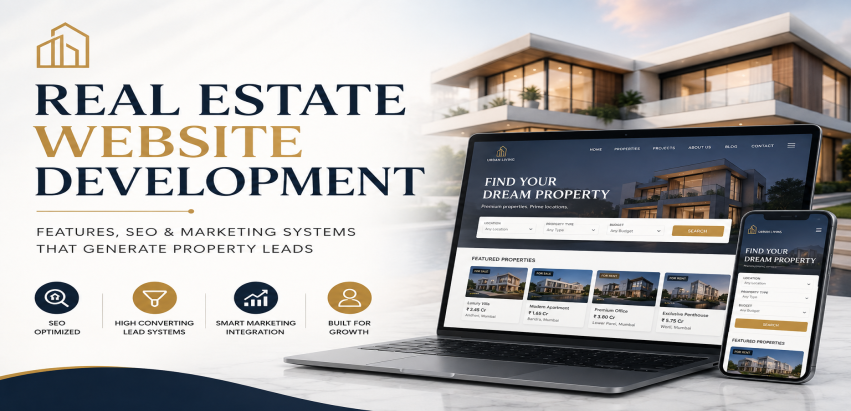
Most real estate businesses in the US that invest in a website expect enquiries. Most are disappointed. Not because the website looks bad, but because it was built as a digital portfolio rather than a lead acquisition system. The design looks professional. The architecture produces nothing.
A brokerage with 5,000 monthly website visitors generating 3 leads is not experiencing a traffic problem. A competitor with 1,200 visitors generating 40 leads is not getting lucky. The difference is conversion architecture: how the website is structured to capture buyer intent, route it into a CRM, and trigger follow-up before the buyer calls Zillow, Realtor.com, or a competing agent.
Real Estate Website Development: Why US Property Websites Are Built for Lead Generation, Not Just Listings
Real estate website development is the process of building a property business's online infrastructure to generate, capture, and convert buyer enquiries through IDX and MLS integration, SEO visibility, paid advertising landing pages, CRM connection, and automated follow-up systems. Unlike a brochure website built to establish presence, a lead generation website is designed from day one to produce owned leads that do not depend on paying Zillow, Realtor.com, or Redfin per lead at escalating costs.
The hidden intent behind every search for real estate website development is the same: more owned property leads at a lower cost than the portals charge. This guide covers everything that sits between that goal and the website currently underdelivering it. IDX integration done correctly. Pages that capture every buyer intent stage. How website architecture determines your SEO ceiling. How landing page quality directly affects your Google Ads cost per lead. And the CRM and automation layer that determines whether captured leads convert or die in a shared inbox.
Why Many US Real Estate Websites Fail to Generate Property Leads
When we audit real estate websites in the US market, the same six architectural problems appear regardless of how recently the site was built or how much was spent on design. These are not aesthetic failures. They are structural ones. A website can look completely professional and still be architecturally unfit for lead generation.
IDX Integration That Does Not Support SEO
Many US real estate websites have IDX integration but have configured it in a way that actively harms their SEO. When IDX listings are delivered in iframes or as dynamically loaded content that search engines cannot crawl, the individual property pages that should be generating long-tail organic traffic become invisible to Google. A correctly implemented IDX integration creates indexable individual property pages with unique URLs, proper schema markup, and location-specific metadata that support organic rankings. Incorrectly implemented IDX means paying for portal traffic to find properties that should be discoverable directly through the website.
No SEO Architecture Beyond the IDX Feed
IDX provides the listings. It does not provide the SEO architecture. Location pages for specific cities, neighborhoods, and zip codes, agent pages, and content pages for buyer intent searches require a deliberate SEO strategy built into the website structure. Most US real estate websites have IDX and a homepage and rely entirely on paid portals for visibility beyond their brand name. Without location page architecture and neighborhood content, the website is invisible to buyers at the research stage of the property journey.
Weak Lead Capture on IDX Pages
IDX pages that display listings without embedded lead capture mechanisms are displaying inventory for buyers without capturing any intent signal. A buyer who browses 15 listings on the website and leaves generates zero leads for the agent despite demonstrating clear purchase intent. IDX pages need lead capture integrated at the listing level: saved search registration, call-to-action forms above the fold, SMS or click-to-call buttons on mobile, and appointment booking directly from the listing page.
No CRM Connected
A website that captures leads into an email inbox has no lead management system. Leads arrive, agents respond when they remember, follow-up is inconsistent, and the lead-to-appointment conversion rate reflects it. Without a CRM receiving every lead from every channel automatically, the follow-up process is as reliable as whoever checks email first. At any lead volume above 20 per month, this produces systematic lead loss that is invisible in reporting but highly visible in closed transaction counts.
No Dedicated Landing Pages for Paid Traffic
A brokerage spending significant monthly budget on Google Ads sending all traffic to the homepage or a generic listings page is paying for visitors to arrive at a page designed for exploration rather than conversion. A dedicated landing page for each campaign converts paid traffic at three to five times the rate of a homepage for the same spend. The ad cost is identical. The lead volume is not.
Missing Trust Signals That US Buyers Expect
A buyer considering a $500,000 or $1,000,000 property transaction does not contact an agent they cannot verify. US buyers check Google reviews, verify NAR membership, look for state license numbers, check Zillow Premier Agent or Realtor.com profiles, and assess the professionalism of the agent's online presence. A website with no professional credentials, no client testimonials, no transaction history displayed, and no verifiable license information gives the buyer no reason to choose this agent over the next result.
| Factor | Brochure Website | Lead Generation Website |
|---|---|---|
| Primary goal | Look professional online | Generate owned property leads |
| IDX integration | Present but not SEO-optimised | Indexable listing pages with schema and lead capture |
| SEO structure | Often absent beyond IDX feed | Location pages, neighborhood pages, agent pages built in |
| Lead capture | Generic contact form on contact page | Forms, SMS CTA, saved search, booking on every listing page |
| CRM connection | Not connected, leads go to email | Fully integrated, every lead routed automatically |
| Landing pages | None, ads go to homepage | Built for every campaign and listing type |
| Page speed | Often slow due to IDX plugin weight | Engineered for Core Web Vitals compliance |
| Trust signals | Generic bio, no credentials displayed | NAR membership, state license, reviews, transaction history |
| Cost per lead trend | High, Zillow and portal-dependent | Reduces over time as owned organic channels compound |
If your current website has three or more of these structural gaps, it is costing you leads every week regardless of how much traffic it receives.
Website Traffic vs Website Conversions: Why More Visitors Do Not Always Mean More Leads
An agent spending significant monthly budget on Google Ads with a 0.5 percent website conversion rate has a conversion problem, not a traffic problem. Every dollar spent driving additional traffic to a website that converts poorly multiplies the waste rather than the results. Before scaling acquisition spend, the conversion architecture must be fixed.
The Conversion Rate Reality for US Real Estate Websites
Conversion rate is the percentage of website visitors who take a defined lead action: submitting a form, sending an SMS, calling the number, registering for saved search, or booking a showing appointment. Most real estate websites in the US convert at under 0.5 percent. A well-structured lead generation website for the same audience and traffic source converts at 2 to 4 percent. The difference is not more traffic. It is architecture.
The numbers make the case directly. Website A receives 10,000 visitors per month at 0.5 percent conversion and produces 50 leads. Website B receives the same 10,000 visitors at 2 percent conversion and produces 200 leads. Same traffic. Same ad spend. Four times the lead volume. That difference is conversion architecture, not budget.
How Buyer Intent Determines Conversion Probability
Buyer intent describes how close a visitor is to making a property decision when they arrive on the website. A buyer who searched "3 bedroom homes for sale in [neighborhood] under 500k" has declared specific intent: location, configuration, and budget. If the page they land on directly addresses that intent with relevant listings, clear agent contact information, and an obvious next step, conversion is highly probable. If they land on a homepage requiring navigation, they leave. Intent without a matched experience converts poorly regardless of how much was spent generating the click.
Fix Conversion Before Scaling Traffic
The correct sequencing for a real estate business with low leads is to audit and fix conversion architecture first, then scale traffic. Improving conversion from 0.3 to 2 percent on existing traffic produces a 6x increase in leads without touching the ad budget. The return on conversion architecture improvement almost always exceeds the return on equivalent paid traffic acquisition spend. The IDX setup, features, and pages that fix conversion architecture are covered in the sections that follow.
Features Every US Real Estate Website Needs to Support Growth
A US real estate website designed for lead generation needs seven core features, each connected to a specific business outcome. The question for each feature is not "does my website have this" but "is this generating leads for my business?"
IDX and MLS Integration Done Correctly
IDX (Internet Data Exchange) integration pulls live MLS listings directly onto the website, allowing buyers to search the complete inventory of available properties in the market without leaving for Zillow or Realtor.com. Correctly implemented IDX creates individual indexable listing pages with unique URLs, proper RealEstateListing schema markup, location-specific metadata, and embedded lead capture on each listing. This means each MLS listing becomes an organic SEO asset as well as a buyer destination, generating long-tail search traffic from buyers searching specific address, neighborhood, or configuration queries. The connection between IDX architecture and organic search performance is the reason IDX setup is covered in depth in our guide to real estate SEO.
The critical mistake many US real estate websites make is implementing IDX via an iframe or a fully JavaScript-rendered feed that search engines cannot index. This gives buyers the search experience without giving the website any of the SEO benefit. Properly implemented IDX with server-side rendering or pre-rendered listing pages is the standard that competitive real estate websites in the US should be meeting.
Saved Searches and Listing Alerts
Saved searches allow buyers to register their criteria and receive automated email or SMS alerts when new matching listings hit the MLS. This feature converts passive browsers into identified leads without requiring them to submit a contact form. A buyer who registers for saved search alerts for 3-bedroom homes in a specific zip code under a specific price has declared intent and provided contact information. They are in the lead pipeline. When a new listing matches, the automated alert brings them back to the website at peak intent. Without this feature, a buyer who does not find what they want today leaves permanently.
Lead Capture Forms and SMS CTAs
Lead capture forms placed above the fold on listing pages, neighborhood pages, and landing pages with minimal required fields produce dramatically higher completion rates than generic contact forms. For US real estate, SMS is the preferred first-contact method for a significant portion of buyers, particularly for showing requests and quick questions. A prominent "Text Us" button on listing pages alongside a short form serves different buyer preferences and captures leads that the form alone would miss. Field count matters: name, email, and phone is the maximum for first-contact forms. Asking for timeline and budget at the enquiry stage reduces completion rate measurably.
SMS and Live Chat Integration
SMS is the dominant response channel for US real estate leads. Buyers who receive a text response within minutes of submitting a showing request are significantly more likely to book than those who wait for an email callback. Integrating SMS response capability directly into the website's lead capture system, so that form submissions trigger an immediate automated SMS acknowledgment while the agent prepares to respond personally, addresses the speed-to-lead requirement that determines whether a lead converts into a showing appointment.
Showing and Appointment Booking
Online showing requests and appointment booking remove the friction between an interested buyer and a confirmed showing time. A buyer who wants to view a property but must call during business hours, leave a voicemail, and wait for a callback loses momentum at every step. An online showing request system that allows buyers to select their preferred time directly from the listing page converts that buyer in the same session as their decision. Agents who offer showing requests directly from listings consistently report higher show rates because the buyer completed a commitment rather than leaving it to a callback.
Property Comparison Tools
Property comparison tools let buyers select multiple MLS listings and view them side by side across price, square footage, bedroom count, year built, days on market, and school district. A buyer actively comparing properties on the website is demonstrating high purchase intent while remaining in the agent's ecosystem rather than leaving to compare on Zillow or Realtor.com. The lead capture mechanisms available on the website remain accessible throughout the comparison process.
AI Chat and Lead Qualification
AI chat solves the after-hours lead response problem that every US real estate agent faces. A buyer who visits the website at 9pm on a Sunday and finds only a contact form is a buyer who will submit the same search to Zillow and speak with whoever calls back first. An AI chat that responds within seconds, qualifies the buyer's needs, identifies relevant listings, and books a showing request or callback appointment creates a documented, CRM-captured lead from an interaction that would otherwise be lost to a portal competitor.
| Feature | What It Does | Business Outcome | Without It |
|---|---|---|---|
| IDX Integration (SEO-optimised) | Syncs live MLS listings as indexable pages with lead capture | Organic ranking for listing queries, portal-independent leads | Buyers leave to Zillow or Realtor.com to search |
| Saved Searches and MLS Alerts | Lets buyers save criteria and receive match alerts | Passive lead capture, high-intent return visits | Buyers who do not find a match today are permanently lost |
| Lead Forms with SMS Option | Captures buyer intent via preferred channel | Higher lead completion rate across buyer preferences | Buyers who prefer SMS over forms go unanswered |
| SMS and Live Chat | Instant preferred response channel for US buyers | Higher lead-to-showing conversion rate | Leads wait hours for email response and contact a competitor |
| Showing Request Booking | Removes friction from first property visit | More showing bookings, higher show rate | Motivated buyers lose momentum before confirming |
| Property Comparison | Lets buyers shortlist and compare MLS listings | Higher intent signal, longer session, lower Zillow exit rate | Buyers leave to compare on Zillow or Realtor.com |
| AI Chat | 24/7 lead qualification and showing request capture | After-hours leads captured before portals respond | After-hours leads go to Zillow Premier Agents |
Pages High-Converting US Real Estate Websites Include
High-converting US real estate websites are not IDX search pages with agent contact information. They are structured systems of interconnected page types, each designed to capture a specific buyer intent at a specific stage of the purchase journey. An agent or brokerage whose website has only an IDX search page, a homepage, and a contact form is missing every page type that generates organic search traffic and converts buyers earlier in their decision process.
Property Pages
Property pages are individual pages for each MLS listing, delivered by IDX but optimised as standalone organic SEO assets. Each listing page requires a unique URL incorporating the property address or MLS number, RealEstateListing schema markup encoding price, bedrooms, bathrooms, square footage, and listing status, and embedded lead capture including a showing request form, SMS button, and saved search registration. Without individually optimised listing pages, the IDX feed exists only for buyers already on the website rather than generating new organic traffic from address-specific searches.
Location Pages
Location pages target buyers searching by city, zip code, or neighborhood before committing to a specific property. A page optimised for "homes for sale in [city name]" or "condos in [zip code]" with featured IDX listings, local market statistics, and agent contact information captures buyers who are still selecting their search area rather than evaluating specific properties. Without location pages, the website is invisible to buyers at this stage of their search, which represents a significant portion of total buyer traffic. Location pages are a core component of the organic strategy covered in our real estate SEO guide.
Neighborhood Pages
Neighborhood pages target buyers who are researching the lifestyle and community factors that determine where they want to live before evaluating specific listings. A buyer searching for "best school districts in [city]," "walkable neighborhoods in [city]," or "median home prices [neighborhood]" is at the beginning of a purchase journey that will eventually produce a transaction. A neighborhood page that addresses these questions positions the agent as the local authority for that area before any buyer preference for a specific property or agent has formed.
Agent Pages
Agent pages serve a critical trust and local SEO function in the US market. US buyers routinely search agent names before making contact, verify license numbers through state licensing boards, check Google reviews, and compare agents across Zillow and Realtor.com profiles before deciding who to work with. An agent page should display NAR membership, state license number and verification link, years of experience, specialisation areas, recent transactions in the local market, and Google review aggregation. Agent pages optimised for specific neighborhoods or property types can also rank independently for local agent searches.
Landing Pages
Landing pages are purpose-built pages for specific paid campaigns with no navigation menu, a single focused message, and one conversion action. Every Google Ads or social media campaign that sends traffic to a homepage or IDX search page rather than a dedicated landing page is accepting a fraction of its potential lead volume at full budget cost. A buyer campaign targeting "first-time homebuyers in [city]" needs a landing page addressing first-time buyer concerns: down payment programs, buyer agent services, local market education, and a showing request or consultation booking form.
| Page Type | Buyer Intent Captured | SEO Target | Primary Conversion |
|---|---|---|---|
| Property Page (IDX) | Researching a specific MLS listing | Address-specific and MLS number searches | Showing request or SMS button |
| Location Page | Searching for homes by city or zip code | "Homes for sale in [location]" queries | IDX search plus lead registration |
| Neighborhood Page | Researching community, schools, lifestyle before choosing area | Hyperlocal and lifestyle queries | Saved search registration and agent contact |
| Agent Page | Verifying agent credentials and local expertise | "Real estate agent [neighborhood]" queries | Direct contact or consultation booking |
| Landing Page | Responding to a specific paid ad | Campaign-specific, not organic | Single CTA conversion |
Neighborhood Pages and Organic Traffic: The Most Underrated SEO Asset for US Real Estate Websites
US property buyers begin their search at the neighborhood level before the listing level. Before evaluating which agent to work with or which specific home to view, they decide which areas meet their needs: school district quality, commute time to work, walkability, price range, and community character. These searches happen at high volume, at lower competition than listing-level keywords, and represent buyers at the very beginning of a purchase journey that typically takes 8 to 12 weeks to complete.
An agent whose neighborhood pages appear when a buyer researches specific local areas earns brand recognition and trust before any competing agent has had the opportunity to make contact. That familiarity is a significant advantage when the buyer is ready to select an agent weeks later.
What a US Real Estate Neighborhood Page Contains
A neighborhood page for a specific area covers the information US buyers search for during their location research phase: school district ratings and specific school names with GreatSchools scores, median home prices and price trend data for that neighborhood, walkability and transit scores, commute times to major employment centres, HOA information where applicable, lifestyle amenities including parks, restaurants, and retail, and recent transaction data showing typical days on market and sale-to-list price ratios. Much of this data is publicly available from MLS statistics, GreatSchools, Walk Score, and local government sources. The value is aggregating it into one authoritative local resource on the agent's website.
Why Neighborhood Pages Rank at Lower Competition Than Listing Pages
An agent competing for "homes for sale in [major city]" is competing against Zillow, Realtor.com, Redfin, and every large regional brokerage with years of domain authority. An agent competing for "best school districts in [specific suburb]" or "walkable neighborhoods in [city] under 400k" is competing against a much smaller field. These neighborhood research queries collectively represent a substantial share of the total organic traffic available to real estate websites and convert into leads at strong rates because buyers at this research stage are planning a transaction, not browsing casually.
For the complete organic acquisition strategy including IDX SEO, location page architecture, and neighborhood content, see our full guide to real estate SEO.
How Real Estate Websites Support SEO and Organic Visibility
SEO activities including IDX optimisation, content creation, link building, and Google Business Profile management operate on top of a foundation that the website provides. The ceiling of what SEO can achieve is determined entirely by how the website was built. A brokerage that has been investing in SEO for 18 months and seeing limited ranking improvement is almost always experiencing a website architecture problem rather than an SEO execution problem.
IDX Implementation and Organic Search Performance
The single most impactful technical SEO decision for a US real estate website is how IDX is implemented. An IDX feed delivered through server-side rendering or pre-rendered pages creates thousands of individually indexable listing pages that can rank for address-specific and configuration-specific searches. An IDX feed delivered through client-side JavaScript or iframes creates the same buyer experience with zero organic SEO benefit. The difference between these two implementations is the difference between a website that generates organic listing traffic and one that depends entirely on paid portals for every lead.
Internal Linking Architecture as Topical Authority Signal
Internal linking communicates to Google which pages are most important and what the topical relationships between pages are. The strategic internal linking structure for a US real estate website runs as follows: neighborhood pages link to location pages for that city, which link to IDX search results for that area filtered by relevant criteria, which link to individual listing pages, which link to the showing request form and agent contact. Authority flows from research content to location to listings to conversion, concentrating ranking power on the commercial pages that generate leads.
Schema Markup for US Real Estate
Schema markup implemented in JSON-LD format communicates structured data to Google that enables rich results and enhanced search appearances. Four schema types deliver the highest value. RealEstateListing schema on IDX listing pages enables price, bedroom count, bathroom count, square footage, and listing status to appear in search results. LocalBusiness schema on location and neighborhood pages connects the brokerage to specific geographic entities in Google's knowledge graph. Person schema on agent pages links the agent's identity to their professional credentials and service areas. FAQPage schema on neighborhood and buyer guide pages enables featured snippet appearances for common buyer questions.
Location Page Hierarchy for US Market Search Patterns
US property buyers search by state, metro area, city, zip code, and neighborhood in patterns that the website's page hierarchy should mirror. A location page hierarchy structured as metro area to city to zip code to neighborhood creates the URL and internal link architecture that supports rankings at every geographic level. This structure enables the website to rank for "homes for sale in [state]" at the top level, "homes for sale in [city]" at the city level, and "homes for sale in [neighborhood]" at the micro level, capturing buyer traffic across the full geographic specificity range that US property searches span.
| Website Element | SEO Benefit | Business Impact |
|---|---|---|
| Server-side rendered IDX | Individual listing pages indexable by Google | Organic traffic from address and listing-specific searches |
| RealEstateListing schema | Rich results showing price, beds, baths in search | Higher click-through rate from listing search results |
| Internal linking architecture | Concentrates authority on commercial pages | Location and neighborhood pages rank faster |
| Core Web Vitals compliance | Positive page experience ranking signal | Ranking advantage over slow IDX-plugin-heavy competitors |
| Location page hierarchy | Enables rankings across metro, city, and neighborhood level | Captures buyers at every geographic specificity of search |
| Indexation control | Prevents expired listings from diluting crawl budget | Active listing pages indexed more frequently and ranked higher |
| Person schema on agent pages | Connects agent identity to professional credentials | Knowledge panel eligibility, stronger agent search visibility |
For a complete US real estate SEO execution system covering IDX optimisation, location page strategy, Google Business Profile management, and link building, our real estate SEO guide covers the full organic acquisition framework.
How Real Estate Websites Improve Paid Ad Performance
Real estate brokerages often have their website built by one vendor and their Google Ads managed by another. This creates a structural problem: the ads team cannot fix the landing pages, and the website team does not measure cost per lead. The result is a paid advertising campaign that underperforms not because the ads are poorly structured but because the website is architecturally unfit for conversion. This is a website problem showing up as an advertising cost problem.
Quality Score and Landing Page Experience
Google Ads Quality Score is determined by expected click-through rate, ad relevance, and landing page experience. Landing page experience is directly affected by the website. A landing page that loads in 6 seconds on mobile, contains no content specifically relevant to the search query that triggered the ad, or has no clear conversion mechanism receives a low landing page experience score. A low Quality Score means paying more per click for the same position than a competitor with a higher Quality Score. That is a website quality problem creating a paid advertising cost premium.
Landing Page Conversion Rate and Cost Per Lead
At 1 percent conversion from a homepage destination, a given Google Ads budget produces a fraction of the leads that the same budget produces when directed to a dedicated landing page converting at 4 percent. Same budget. Same clicks. Cost per lead drops by up to 75 percent. Real estate landing pages in the US that are built specifically for campaign audiences including first-time buyers, luxury buyers, or investor buyers consistently outperform generic IDX search pages for the same paid traffic.
Retargeting Website Visitors
Retargeting allows real estate websites to show ads specifically to buyers who visited specific listing or neighborhood pages but did not submit a lead form. A buyer who spent 8 minutes on three listings in a specific price range and neighborhood is a higher-intent audience than a cold prospect. Retargeting this buyer with a specific ad for new listings in their preferred search area costs significantly less than prospecting campaigns and converts at higher rates because the audience is pre-qualified. Without retargeting pixels installed from day one, this audience cannot be built and every non-converting visitor is permanently lost.
Conversion Tracking Across All Lead Types
A Google Ads campaign that tracks only form submissions is missing the phone calls, SMS clicks, and showing request bookings that represent a significant portion of real estate lead conversions in the US. Smart Bidding algorithms need complete conversion data to optimise toward the searches and audiences that actually produce leads. Without all conversion types tracked as distinct events, the campaign's bidding system allocates budget based on incomplete information, producing higher cost per lead than campaigns with full conversion coverage.
For the complete paid advertising strategy including campaign structure, keyword targeting, buyer audience segmentation, and listing ad formats, see our guide to real estate paid ads.
Property Landing Pages: Why US Real Estate PPC Campaigns Fail Without Them
A landing page is a single-purpose page built for one campaign objective: no navigation, no distractions, one message, one CTA. Most US real estate Google Ads campaigns send traffic to an IDX search page or a homepage, pages designed for browsing rather than conversion. This is the primary reason real estate PPC campaigns in the US underperform relative to their budget allocation.
Why Your IDX Search Page Cannot Replace a Landing Page
Your IDX search page serves buyers who are already on the website and want to browse listings. It is not designed to convert a buyer who clicked a specific ad with a specific message. A buyer who clicked an ad for "luxury homes in [neighborhood] over $800k" and arrives at a generic IDX search page showing all listings in the market has been given a mismatched experience. They navigated to a page designed for a different purpose than what the ad promised. Most resolve that mismatch by pressing the back button. A dedicated landing page for luxury buyers in that specific neighborhood continues the ad's conversation and converts at rates the IDX search page cannot match.
The Anatomy of a High-Converting US Real Estate Landing Page
A real estate landing page built for a specific US buyer campaign should contain:
Hero section: Lifestyle photography of the target neighborhood or property type, a headline that directly continues the ad's message, and a primary CTA (showing request form or SMS button) visible without scrolling on mobile.
Featured listings: Three to six IDX listings matching the campaign's criteria, displayed with photos, price, and key details. This demonstrates immediately that the page delivers what the ad promised.
Agent credentials: NAR membership badge, state license number, years of local experience, and a Google review aggregate. US buyers evaluate agent credibility before submitting contact information.
Market insight: A brief market statistics block showing recent median prices, days on market, and sale-to-list ratios for the target area. This establishes local expertise and gives the buyer a reason to trust this agent over a portal.
Social proof: Two to three client testimonials specific to this buyer type or neighborhood, not generic five-star reviews without context.
Primary CTA: A short showing request form and a "Text Us" button in the same visible area. US buyers are divided between form submitters and SMS initiators. Offering both captures more leads from the same traffic.
For full guidance on landing page testing, campaign integration, and paid acquisition strategy for US real estate, see our real estate paid ads guide.
Lead Capture Systems for US Real Estate Businesses
A lead form is not a lead capture system. A lead capture system is a coordinated set of channels that catches buyers at different stages of intent. In the US real estate market, where buyers interact with Zillow, Realtor.com, and multiple agents simultaneously, missing any lead capture channel means losing the buyers that channel would have captured to a portal or competing agent, permanently and invisibly.
SMS Automation
SMS is the dominant response channel for US real estate lead conversion. A lead that receives a text response within 5 minutes of submitting a showing request is significantly more likely to schedule a showing than one that receives an email 2 hours later. SMS automation sends an immediate text acknowledgment within seconds of form submission, shares relevant listing information, and offers two or three showing time options. The buyer receives a response before they have had time to submit the same request to a Zillow Premier Agent.
Email Automation
Email automation serves buyers in the 8 to 12 week consideration period typical of US residential real estate transactions. A buyer who registered for saved search alerts but has not requested a showing receives a sequenced email program: a neighborhood market update on day three, a recent transaction report showing what similar homes have sold for on day seven, a school district guide on day fourteen, and a consultation invitation on day twenty-one. Each email maintains the relationship without pressure during the extended consideration period that precedes most US property transactions.
Call Tracking
Call tracking assigns unique phone numbers to different marketing channels, enabling attribution of inbound calls to specific sources including Google Ads campaigns, organic search, specific landing pages, and direct traffic. For US real estate, where a significant percentage of leads choose to call rather than submit a form, especially for higher-value properties, call tracking is essential for understanding which channels and which pages actually produce lead calls rather than only form submissions.
Saved Searches and MLS Alerts
Saved searches with automated MLS alert emails capture buyers who are actively searching but not yet ready to contact an agent. A buyer who sets up a saved search for a specific zip code, price range, and bedroom count has committed enough to provide contact information and is demonstrating ongoing purchase intent. Each new matching listing notification brings them back to the agent's website rather than to Zillow's alert system, keeping the agent's brand and listings at the centre of the buyer's search experience.
Lead Scoring
Lead scoring assigns intent weight to buyer actions so agents can prioritise follow-up toward buyers most likely to transact. A buyer who has viewed 12 listings across three sessions, saved a search, and clicked to view property details multiple times has demonstrated stronger intent than a buyer who submitted one general enquiry. A basic lead scoring model assigns points to each action and routes high-scoring leads to immediate agent follow-up while lower-scoring leads enter automated nurture sequences. This ensures agent time is directed toward the buyers closest to a transaction decision.
| Method | Buyer Stage Captured | Response Speed | Lead Quality Signal | Automation Possible |
|---|---|---|---|---|
| Lead form | Ready to enquire or request showing | Instant with automation | High | Yes, CRM auto-assign |
| SMS button | Ready to communicate now | Instant | Very high | Yes, templated first response |
| Saved MLS search | Active research, not yet ready for agent contact | Alert on new matching listing | Medium, ongoing intent | Yes, automated MLS alert |
| Call tracking | Decision stage, prefers direct contact | Immediate | Very high | Yes, CRM log and call recording |
| Email capture | Research phase, long consideration cycle | Drip sequence start | Low to medium initially | Yes, full drip automation |
| Lead scoring | All stages combined | Ongoing | Prioritises highest transaction intent | Yes, CRM rule-based routing |
CRM and Automation Systems for US Real Estate Businesses
A website that captures leads but has no connected CRM is a leaky bucket. Leads arrive via form, SMS, MLS alert registration, and call tracking and then fall into a shared email inbox or a personal phone where they age without systematic follow-up. CRM is the system that receives every lead, routes it to the right agent, and triggers the follow-up sequences that convert initial interest into a showing appointment and eventually a closed transaction. In the US market, where buyers are simultaneously receiving follow-up from Zillow Premier Agents and competing brokerages, CRM-driven speed and consistency of follow-up is a direct competitive advantage.
Lead Routing and Agent Assignment
Lead routing automatically assigns incoming leads to specific agents based on geographic area, price range, buyer type, or source channel. A buyer enquiring about a specific zip code is routed to the agent with the most recent transactions in that area. A luxury buyer lead is routed to the agent with the highest-value recent closings. Without routing rules, leads distribute to whoever is available or whoever checks email first, creating inconsistency in response quality and speed.
US Real Estate Sales Pipeline
A sales pipeline for US residential real estate defines the stages from first contact to closed transaction: New Lead, Contacted, Showing Scheduled, Showing Complete, Offer Submitted, Under Contract, Closed, or Lost. Each stage has associated automated tasks, follow-up reminders, and defined time limits before escalation. Pipeline visibility gives brokerage management an immediate view of where leads are stalling. If 60 percent of leads sit in "Contacted" without progressing to "Showing Scheduled," the problem is identifiable and addressable rather than invisible until it shows up in commission revenue.
Automated Follow-Up for the US 8 to 12 Week Buyer Cycle
US real estate buyers typically take 8 to 12 weeks from first serious search to making an offer. Automated follow-up maintains consistent agent contact throughout that window without requiring manual effort for every touchpoint. A new lead receives an immediate SMS, a call from the assigned agent within 5 minutes, a personalised email with curated listings within the hour, and then enters a structured sequence of market updates, neighborhood information, and new listing alerts calibrated to the buyer's stated preferences. This systematic presence across 8 to 12 weeks keeps the agent relevant without the lead going cold.
| CRM | Best For | US Market Integration | Automation Level | Pricing |
|---|---|---|---|---|
| Follow Up Boss | US residential real estate teams and brokerages | Native Zillow, Realtor.com, IDX integrations | High | Mid-range, per-user pricing |
| LionDesk | Individual agents and small teams | Good, MLS and portal integrations | High | Low to mid-range |
| HubSpot | Brokerages with combined marketing and sales teams | Via integrations, strong automation | Very high | Freemium to paid tiers |
| kvCORE | Large brokerages and franchise groups | Native IDX, MLS, and portal connections | Very high | Mid to high range |
| Salesforce | Enterprise real estate groups | Comprehensive via integrations | Very high | High |
Speed-to-Lead: Why Fast Follow-Up Wins US Real Estate Leads
In the US real estate market, a buyer who submits a showing request on Zillow simultaneously triggers a notification to three Zillow Premier Agents who are contractually required to respond within minutes. An agent whose own website lead sits unanswered for 20 minutes while a Zillow Premier Agent has already texted, called, and scheduled a showing has lost that buyer not because of price, service quality, or local expertise but because of response time.
Speed-to-lead is the elapsed time between a buyer submitting a lead and receiving a first meaningful response. Research from Harvard Business Review and InsideSales.com shows that leads contacted within 1 minute qualify at dramatically higher rates than those contacted after 5 minutes, and that leads not contacted within 5 minutes are 10 times less likely to convert than immediately-contacted leads. In a competitive US market where buyers are simultaneously engaging multiple agents and portal services, this timing difference is determinative.
The solution is automation at the first response stage. An automated SMS sent within 30 seconds of form submission acknowledges the buyer, confirms the request, and offers two showing times: "Hi [Name], this is [Agent] from [Brokerage]. I got your request for [address]. Are you available Thursday at 4pm or Saturday at 11am?" The buyer receives a response that feels personal before they have finished submitting the same request on Zillow. The agent follows up personally within 5 minutes to confirm. The combination of instant automated first contact and rapid personal follow-up consistently outperforms either alone.
IDX and MLS Integration: The Foundation of US Real Estate Website Lead Generation
IDX (Internet Data Exchange) is the standard protocol through which US real estate websites access and display live listings from the local MLS (Multiple Listing Service). Every US real estate agent or brokerage that is a member of their local MLS has the right to display those listings on their website through an IDX feed. This is not optional technology for a competitive US real estate website. It is the foundational requirement that allows buyers to search current, accurate inventory without leaving for Zillow or Realtor.com.
The MLS is the centralised database where all licensed brokers and agents submit their listings, making them available to all other participating members and their IDX-enabled websites. When a listing goes live on the MLS, it is available on every IDX-connected website in the local association within hours. This means that an agent's website showing IDX listings is displaying the same current inventory as Zillow and Realtor.com, and buyers can conduct their full property search without leaving the agent's platform.
SEO-Optimised IDX vs Standard IDX Implementation
The critical distinction for US real estate SEO is how the IDX feed is rendered. Standard IDX delivery through client-side JavaScript or iframes provides the buyer experience but is invisible to search engine crawlers. Google cannot index content that is only rendered in the buyer's browser after the page loads. This means a website with standard IDX implementation receives no organic search traffic from the thousands of property-specific queries that buyers use to search specific addresses, neighborhoods, and listing specifications.
SEO-optimised IDX delivery using server-side rendering or pre-rendering creates pages that Google can crawl and index as standalone content. Each listing becomes an indexable asset at a unique URL containing the property address. When a buyer searches "4 bedroom home for sale at [street address]" or "3 bed 2 bath ranch in [zip code] under $350,000," a website with server-side IDX can appear in organic results for those queries. A website with client-side IDX cannot. This implementation choice is the single largest determinant of organic search performance for US real estate websites.
IDX Compliance and MLS Data Rules
US MLS associations impose specific compliance requirements on how IDX data can be displayed, including required disclosure language, data refresh frequency minimums, and restrictions on how listings from other brokerages can be modified or attributed. IDX compliance requirements vary by local MLS association and must be adhered to in the website's IDX implementation. Non-compliance can result in loss of IDX access, which removes the entire property search functionality from the website. IDX implementation should always be executed by a developer familiar with the specific compliance requirements of the relevant local MLS.
Real Estate Website Cost in the US Market
US real estate website development costs vary significantly based on scope. A basic agent website template represents an entry-level investment. A full brokerage website with SEO-optimised IDX, CRM integration, neighborhood pages, and landing page infrastructure represents a growth investment. The correct evaluation framework is not the absolute cost but the return: how many owned leads will the website generate, and what is the GCI (Gross Commission Income) value of those leads over 12 months compared to paying Zillow or Realtor.com for the same leads?
What Drives US Real Estate Website Development Cost
The variables that determine cost are: IDX integration type (standard vs SEO-optimised server-side rendering), the number of location and neighborhood pages required at launch, CRM integration complexity including which CRM and how many lead sources need to be connected, custom design versus an adapted framework, the number of agent pages and individual agent profiles, landing page development for campaign launch, and ongoing hosting and maintenance requirements for the expected traffic volume.
| Website Type | Typical Scope | Indicative Cost Range | Expected Business Outcome |
|---|---|---|---|
| Basic agent website with template IDX | Homepage, IDX search, agent bio, contact page | $500 to $3,000 | Online presence, minimal organic lead generation |
| Enhanced agent website with lead capture | Plus saved searches, SMS, CRM, basic location pages | $3,000 to $12,000 | Moderate owned lead volume from existing traffic |
| Custom brokerage lead generation system | Plus SEO-optimised IDX, neighborhood pages, landing pages, full CRM | $12,000 to $50,000 | Owned organic and paid lead pipeline reducing portal dependency |
| Enterprise brokerage system | Custom IDX, programmatic neighborhood pages, multi-agent, advanced automation | $50,000 and above | Full integrated acquisition system at scale |
Evaluating Website Investment Against Portal Lead Costs
A brokerage paying $25 to $60 per Zillow lead for buyer leads at a 3 to 5 percent lead-to-close conversion rate is paying $500 to $2,000 per closed transaction in portal lead costs. A website generating 40 owned leads per month at zero per-lead cost after initial development, at the same conversion rate, eliminates $1,000 to $4,000 in monthly portal spend. At that lead volume, the payback period on a custom website development investment is typically 6 to 12 months. Every month after payback, the owned lead generation is pure margin relative to portal dependence. For a detailed analysis of real estate lead acquisition economics, see our guide to real estate lead generation cost.
Template vs Custom US Real Estate Website: Which Supports Brokerage Growth
Template real estate websites serve individual agents testing their market or those with low volume expectations. They become a constraint the moment a brokerage needs SEO-optimised IDX, custom CRM integration, landing pages for paid campaigns, or neighborhood page architecture at scale. The question is not template versus custom as a budget question. It is how quickly will a template ceiling limit growth.
| Factor | Template Website | Custom Website |
|---|---|---|
| Initial cost | Lower, $500 to $3,000 | Higher, $12,000 and above for brokerage |
| IDX implementation | Client-side JS, not SEO-indexable | Server-side rendering, fully indexable listings |
| SEO architecture control | Limited by template and plugin structure | Built to full specification with location hierarchy |
| CRM integration | Limited to pre-built integrations | Custom integration with any CRM via API |
| Neighborhood page scalability | Manual page creation, no programmatic option | Programmatic generation from MLS and public data |
| Landing page creation | Manual, constrained by theme | CMS-driven template, agent self-service |
| Page speed with IDX load | Often slow due to third-party plugin weight | Engineered for Core Web Vitals with IDX integrated |
| Portal lead cost reduction | Minimal, organic traffic limited without SEO IDX | Significant, server-side IDX generates organic listing traffic |
| Best for | Individual agents, low volume, testing phase | Brokerages and teams with portal reduction goals |
When US Real Estate Businesses Need Website Redevelopment
Website redevelopment is not failure. For most US real estate businesses that built their current website three to five years ago, it is a necessary strategic upgrade as IDX standards, SEO best practices, and buyer behaviour have all evolved significantly. The signals that indicate redevelopment is needed are specific and measurable.
Your IDX is implemented via iframe or client-side JavaScript and generates no organic listing traffic. Google Search Console shows your listing pages have zero impressions from property-specific searches. This is a technical implementation problem that cannot be fixed by adding content or building links. The IDX rendering architecture requires a rebuild.
Your Google Ads campaigns are running but cost per lead is above $150 for standard buyer leads because landing pages are converting at under 1 percent. The campaign is structurally sound but the website is not providing the landing page infrastructure to convert the traffic economically.
Your SEO agency has been building content for 12 months with minimal ranking improvement. A technical audit reveals the IDX creates duplicate meta titles across all listing pages, filter URLs are being indexed as thin content, and no neighborhood page architecture exists. These are foundational architectural problems that content alone cannot overcome.
Your CRM (Follow Up Boss, kvCORE, LionDesk) cannot integrate with the current website without custom development costing more than a rebuild. A disconnected CRM means leads from your website are not entering the follow-up system that drives your transactions.
If three or more of these apply, redevelopment with proper URL migration and 301 redirects to preserve existing domain authority and rankings is the more cost-effective path forward than continued investment in a technically constrained foundation.
Common US Real Estate Website Mistakes That Cost Leads
IDX implemented without server-side rendering. The most expensive mistake on US real estate websites. An IDX feed that Google cannot index means thousands of listing pages exist only for buyers already on the website rather than generating organic traffic from the property searches that buyers conduct every day.
Sending Google Ads traffic to the IDX search page. A generic IDX search page is not a landing page. Every paid campaign targeting a specific buyer type, neighborhood, or price range needs a dedicated landing page that continues the ad's conversation and converts at rates the IDX search page cannot match.
No SMS option on listing and landing pages. US buyers routinely prefer SMS for initial showing requests and quick questions. A website that offers only email contact misses a significant segment of the buyer market at the showing request stage.
No NAR membership or state license displayed on agent pages. US buyers verify agent credentials before making contact. An agent page without visible professional credentials, license number, and verifiable memberships loses trust at the exact moment the buyer is deciding whether to enquire.
Expired listing pages returning 404 errors. As MLS listings expire or sell, their IDX pages should redirect to the closest relevant active listing or a neighborhood search page rather than returning a 404. Expired listing pages that return errors waste the link equity accumulated by those pages and create poor user experiences for buyers following saved or shared links.
No neighborhood pages for organic traffic. US real estate websites that only have IDX search and agent pages miss the massive organic traffic opportunity available from neighborhood research queries that buyers use in the 8 to 12 weeks before they are ready to contact an agent.
No retargeting pixel installed from day one. Every visitor who leaves the website without submitting a lead is permanently lost to the paid advertising system. A Google and Meta retargeting pixel installed from launch builds a continuously growing audience of pre-qualified buyers for targeted campaigns.
Showing request form requiring too many fields. US buyers requesting a showing want to book it quickly. A form requiring address, buyer timeline, pre-approval status, preferred agent, and how they heard about the property adds friction at the conversion moment. Name, phone, and preferred showing time is sufficient to initiate the conversation.
Real Estate Website Development Checklist for US Property Businesses
A US real estate website development brief should begin with business objectives and work backwards to the IDX requirements, page architecture, lead capture system, CRM integration, and trust signal infrastructure that will deliver those objectives.
| Category | Requirement | Business Purpose |
|---|---|---|
| Technical Foundation | SSL certificate, mobile-first design, page load under 3 seconds including IDX content | Google ranking signal, mobile conversion rate, Core Web Vitals compliance |
| Technical Foundation | Hosting scaled for IDX feed volume, CMS manageable by non-technical team | Uptime reliability, agent self-service for content updates |
| IDX Integration | Server-side rendered or pre-rendered IDX listing pages with unique URLs | Indexable listing pages generating organic traffic from property searches |
| IDX Integration | RealEstateListing schema on all IDX pages, MLS compliance disclosures | Rich results in search, MLS compliance, rich results in search |
| Page Architecture | Homepage, IDX listing pages, city and zip code location pages, neighborhood pages | Organic traffic capture across all buyer search intent stages |
| Page Architecture | Agent profile pages with credentials, dedicated landing pages per campaign | Trust conversion, paid campaign performance |
| Lead Capture | Showing request form on every listing page, SMS button on mobile, saved search registration | Lead capture at every buyer intent stage and device preference |
| Lead Capture | Google Ads conversion tracking, Meta pixel, call tracking numbers | Full attribution of leads to sources and campaigns |
| CRM Integration | CRM connected to all lead sources with routing rules | Every lead captured and assigned within seconds |
| CRM Integration | Automated SMS response within 30 seconds, email drip sequences, pipeline stages | Speed-to-lead compliance, systematic follow-up across 8 to 12 week buyer cycle |
| Trust Signals | NAR membership, state license number with verification link, Google review integration | Agent credibility verification that US buyers require before contact |
| Trust Signals | Recent transaction data, client testimonials, local market statistics | Local expertise demonstration that differentiates agent from portal agent alternatives |
| SEO Infrastructure | Internal linking map, location page hierarchy, XML sitemap, canonical tags on IDX | Crawl efficiency, topical authority, duplicate listing content management |
| Performance Standards | Core Web Vitals pass with IDX loaded, expired listing redirects configured, Lighthouse 80+ mobile | Ranking eligibility, no wasted link equity from expired listings, mobile conversion rate |
When US Real Estate Businesses Need Professional SEO or Paid Advertising Support
A well-built website with correctly implemented IDX creates the infrastructure for organic and paid lead generation. But infrastructure alone does not generate leads. SEO and paid advertising require ongoing execution: IDX optimisation, neighborhood content creation, Google Ads campaign management, and continuous performance improvement. The brokerages and teams that get the strongest return from their website investment pair it with ongoing acquisition systems.
SEO support is worth the investment when your website has server-side IDX but is not ranking for location or neighborhood queries after 6 months; when your organic leads represent less than 20 percent of total lead volume despite having the right site architecture; or when Zillow and Realtor.com are appearing above your website for searches in your primary market area. Our SEO services include IDX SEO optimisation, neighborhood content strategy, Google Business Profile management, and local authority link building specifically for US real estate businesses.
Paid advertising support is worth the investment when your Google Ads cost per lead is above $100 for standard buyer leads in your market; when your campaigns are sending traffic to IDX search pages rather than dedicated landing pages; or when you are running ads without the conversion tracking needed to optimise Smart Bidding toward actual showing requests. Our PPC management services cover Google Ads and Meta Ads for US real estate businesses, including landing page development, conversion tracking setup, and retargeting audience configuration.
If you want to understand exactly where your current website is losing leads and what the highest-priority changes would produce, a website and IDX audit is the starting point. It identifies technical implementation issues, conversion architecture gaps, and acquisition channel misalignment before any further investment is made in traffic that the current system cannot capture.
Frequently Asked Questions
Why do real estate agents need their own websites when Zillow exists?
Zillow generates leads and sells them back to agents at $25 to $60 per lead with no exclusivity. An agent's own website generates leads that belong entirely to that agent at zero per-lead cost once the organic and conversion infrastructure is established. Zillow leads also arrive without any prior relationship with the agent. Website leads arrive after the buyer has reviewed the agent's credentials, transactions, and reviews, producing stronger trust and higher showing-to-close rates.
How do real estate websites generate leads in the US market?
US real estate websites generate owned leads through IDX-powered organic listing traffic from address and neighborhood searches, location and neighborhood page organic visibility, paid ad landing pages that convert traffic into showing requests, saved MLS search registration that captures early-stage buyers, and SMS automation that responds faster than competing portal agents. The website generates leads when IDX is implemented correctly and conversion architecture matches US buyer communication preferences.
What is IDX and do all US real estate websites need it?
IDX (Internet Data Exchange) allows any MLS member to display all current MLS listings on their website, giving buyers the ability to search the complete local market inventory without leaving for Zillow or Realtor.com. Any US real estate agent or brokerage that is an MLS member should have IDX on their website. The critical question is not whether to have IDX but whether it is implemented with server-side rendering for organic SEO benefit or client-side JavaScript that provides the buyer experience without the search visibility.
How much does a US real estate website cost?
US real estate website costs range from $500 to $3,000 for a basic agent template with standard IDX to $12,000 to $50,000 for a custom brokerage lead generation system with server-side IDX, neighborhood pages, CRM integration, and landing page infrastructure. The evaluation framework is ROI: a website generating 40 owned leads monthly at a 4 percent close rate, at an average $10,000 GCI per transaction, generates $16,000 monthly in commission contribution, making even a $30,000 website investment a 2-month payback proposition.
Does IDX integration affect Google Ads performance?
Yes, indirectly. IDX listing pages used as Google Ads landing pages typically convert at low rates because they are not designed for campaign-specific conversion. A dedicated landing page for a specific buyer campaign converts paid traffic at 3 to 5 times the rate of an IDX search page for the same spend. IDX also affects Quality Score if listing pages are used as ad destinations, as thin or slowly-loading IDX pages receive low landing page experience scores that increase cost per click.
What CRM should US real estate brokerages use?
Follow Up Boss and kvCORE are the most widely adopted CRMs in US residential real estate because they have native integrations with Zillow, Realtor.com, and major IDX providers, and are designed specifically for the 8 to 12 week US buyer follow-up cycle. LionDesk suits individual agents. HubSpot suits brokerages with sophisticated marketing automation requirements. The CRM selection should be made before website development begins so the integration is built into the website architecture rather than retrofitted after launch.
How long does US real estate website development take?
A basic agent template website with standard IDX typically takes 2 to 4 weeks. A custom brokerage lead generation website with server-side IDX, CRM integration, neighborhood pages, and landing page infrastructure typically takes 10 to 18 weeks depending on MLS compliance requirements, data volume, and content production timeline. IDX compliance review with the local MLS association adds time that template implementations do not require.
What pages should a US real estate website include?
A complete US real estate website should include IDX-powered listing pages for all active MLS inventory, location pages for each city and zip code served, neighborhood pages for key micro-areas, individual agent profile pages with NAR membership and state license credentials, and dedicated landing pages for each paid campaign audience. Missing neighborhood pages is the most common gap that leaves organic traffic from buyer research queries entirely uncaptured.
Template or custom website for a US real estate brokerage?
Template websites with standard IDX are appropriate for individual agents in their first two years or those with low owned lead volume goals. Custom websites with server-side IDX are necessary for any brokerage serious about reducing Zillow and portal lead dependency through organic search. The threshold is when the brokerage wants their IDX listing pages to rank in Google, which requires server-side rendering that template IDX providers typically cannot deliver.
How do I reduce dependence on Zillow for real estate leads?
Reducing Zillow dependence requires three simultaneous investments: a website with correctly implemented server-side IDX that generates organic traffic from listing and neighborhood searches, a neighborhood and location page content strategy that captures buyer research queries before they reach Zillow, and a CRM with speed-to-lead automation that responds to owned website leads within 30 seconds, matching the response speed that Zillow Premier Agents are contractually required to provide.