

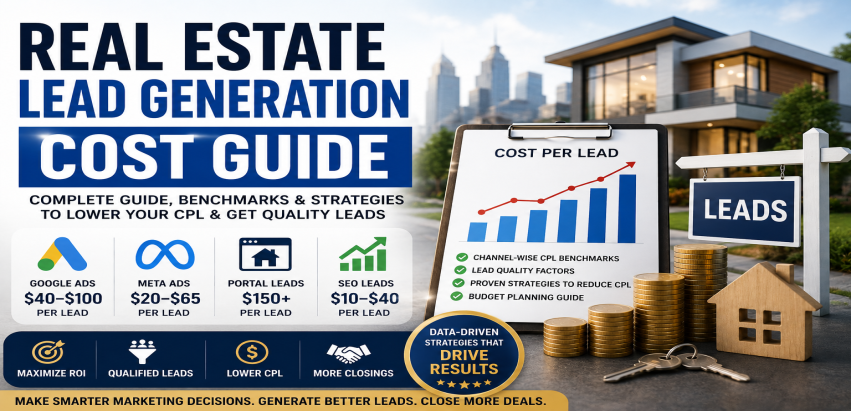
Real estate lead generation in the United States is among the most expensive digital advertising categories per lead, and for good reason. When a single closed transaction generates $8,000 to $30,000 in commission, every active agent and brokerage in the market is willing to pay aggressively to win that client first. The result is elevated CPL across every channel, in every major US market, at every price point.
The problem is not the cost of leads. It is that most realtors measure performance at the lead level rather than the closing level. A $25 Facebook lead that never returns a call costs infinitely more than a $180 Google Search lead that books a listing appointment and closes within 60 days. That distinction shapes every budget decision that actually produces ROI in US real estate.
This guide covers real estate lead generation cost across every major channel, state, and market segment in the United States, so realtors, brokerages, and real estate teams can build budgets around commissions rather than dashboards.
What Is Real Estate Lead Generation Cost in the USA?
Real estate lead generation cost, or cost per lead, is the total marketing spend divided by the number of inquiries received within a period. In the United States real estate market, this figure requires significant context because the commercial value of a lead varies enormously depending on whether it is a buyer lead, a seller lead, a luxury property inquiry, or a first-time homebuyer contact.
What Counts as a Qualified Real Estate Lead?
A qualified lead in US real estate is not simply anyone who submits contact information. It is a prospect who has demonstrated active purchase or selling intent, has a realistic timeline for transacting, and whose financial situation makes a transaction achievable within the next three to twelve months.
Most US real estate lead generation campaigns capture a wide spectrum of inquiry quality:
- Active buyers pre-approved for financing searching within a defined price range and ZIP code
- Homeowners considering listing who have requested a comparative market analysis
- Passive browsers who clicked an ad out of curiosity with no immediate transactional intent
- Renters who submitted a form for investor information without the financial position to purchase
- Competitors or out-of-market contacts submitting test inquiries
Without a qualification process that separates these populations, CPL is a meaningless benchmark for commission ROI.
Buyer Leads vs Seller Leads
The distinction between buyer leads and seller leads is one of the most important and least discussed variables in US real estate CPL benchmarking. Seller leads cost significantly more than buyer leads in almost every US market because the competition to win listing appointments is more concentrated among established agents and brokerages who understand the commission economics of representing inventory.
A seller lead, meaning a homeowner considering listing who has engaged with a home valuation tool, instant offer inquiry, or listing appointment request, typically costs 50 to 150 percent more than a buyer lead from comparable search intent. That premium is commercially justified because a listing agent earns commission on both sides of many transactions and controls the inventory that attracts buyers.
Why Real Estate CPL Is Higher Than Most Industries
Three forces push US real estate CPL higher than virtually every other consumer-facing digital advertising category. Commission scale, where a single residential transaction in California or New York generates $20,000 to $60,000 in gross commission income, attracts heavy advertiser competition at every auction. Sales cycle length, typically 30 to 180 days from first contact to closing, requires sustained follow-up investment that adds operational cost beyond media spend. And portal competition from Zillow, Realtor.com, and Redfin creates a structural market for shared leads that conditions buyers and sellers to expect immediate multi-agent contact, which reduces exclusivity and conversion probability for any individual advertiser buying portal leads. Commission-driven ROI is what makes high CPL commercially sustainable in US real estate when the downstream conversion funnel is properly managed.
Average Real Estate Lead Generation Cost in the USA (2026 Benchmarks)
US real estate CPL ranges from under $15 for organic search leads at scale to over $300 for exclusive seller leads from Google Search in competitive markets like Los Angeles, Manhattan, and Miami. The spread reflects the difference in who is being reached, what platform they are on, and how actively they are seeking to transact.
Average Google Ads CPL
Google Search Ads produce CPL between $50 and $150 for buyer leads in standard US residential markets and $80 to $250 for seller leads and luxury property inquiries. The higher cost reflects the value of intercepting high-intent Google searches from buyers and sellers who have already decided to act and are comparing their options at the moment the ad appears.
In premium markets including Beverly Hills, Manhattan, Aspen, and the Hamptons, Google Ads CPL for luxury listings inquiries routinely exceeds $300. Those costs remain commercially viable because a single luxury closing at $3 million to $10 million produces gross commission income that makes a $500 CPL look negligible.
Average Facebook and Meta Ads CPL
Meta Ads, covering Facebook and Instagram, produce US real estate leads between $20 and $80 for standard residential campaigns. Seller lead campaigns run higher, typically $60 to $150, because targeting homeowners with active selling intent requires more audience precision and higher creative specificity than reaching general home buyers.
The lower CPL reflects the passive nature of the Meta audience. A user served a real estate ad on Facebook is not actively searching for a home or considering listing. They are responding to creative messaging that caught their attention during unrelated browsing. That distinction determines how much qualification work is required after the lead arrives.
Seller Leads vs Buyer Leads
Seller leads are the most commercially valuable lead type in US residential real estate and the most expensive to generate across every channel. A realtor winning a listing appointment has the opportunity to earn on both sides of the transaction, control the property relationship through closing, and generate referral business from both buyer and seller. That value justifies the premium CPL.
Buyer leads are more accessible at lower cost but require longer nurturing cycles, higher follow-up investment, and often produce lower conversion rates because buyers in early research stages contact multiple agents before making a representation decision. The buyer lead-to-closing timeline in most US markets runs 45 to 120 days, with significant attrition at every stage of the funnel.
Luxury vs Residential Lead Cost
Luxury real estate lead generation in the United States occupies a fundamentally different economic category than standard residential. A luxury property agent in Palm Beach, Malibu, or the Upper East Side targeting buyers for $2 million to $10 million homes is reaching a narrow audience of high-net-worth individuals whose media consumption patterns, platform preferences, and decision-making timelines differ from first-time homebuyers in Phoenix or Atlanta.
Luxury CPL is higher in absolute terms, but the commission per closing justifies it. A $400 CPL that generates one closing at $5 million, producing $75,000 in commission, delivers ROI that most industries would find remarkable. The unit economics of luxury real estate make high CPL commercially sustainable in ways that general consumer products cannot match.
Why CPL Benchmarks Vary Across Markets
US real estate CPL varies because market competition density, property values, commission structures, and digital advertising adoption rates differ by state, metro, and even ZIP code. A realtor in Austin competing against 200 other agents for the same buyer demographic pays more per click and more per lead than a realtor in a mid-size southern market with a fraction of that competition. Market inventory levels, interest rate sensitivity, and seasonal demand cycles all layer additional CPL variation on top of baseline competition differences.
| Lead Source | Average CPL | Lead Intent | Conversion Potential |
|---|---|---|---|
| Google Search Ads | $50 to $150 (buyer), $80 to $250 (seller) | High | Strong, active market intent |
| Meta / Facebook Ads | $20 to $80 | Low to Medium | Requires qualification process |
| Property Portals (Zillow, etc.) | $181 to $300+ | Medium | Shared, lower exclusivity |
| Local SEO / Organic | $12 to $40 effective CPL | High | Strong, compounding over time |
| YouTube / Video Ads | $30 to $90 | Medium | Good for brand awareness and retargeting |
| Referral / Sphere of Influence | Near zero to $20 | Very High | Highest close rate of all sources |
Google Ads Cost Per Lead for Real Estate in the USA
Google Search Ads remain the highest-intent paid lead source available to US realtors and brokerages. A homeowner typing "sell my house fast in Dallas" or a buyer searching "3 bedroom homes for sale near Austin under $500k" is expressing active transactional intent at the precise moment a campaign can intercept them. That search behavior is what justifies higher CPL relative to social platforms where the audience is not actively looking for real estate.
Average Google Ads CPL by Market
US real estate Google Ads CPL varies significantly by metro market because CPC reflects how many competing advertisers are bidding for the same search queries simultaneously. In Los Angeles and Manhattan, average CPC for residential real estate keywords runs $8 to $25, producing CPL in the $100 to $300 range depending on landing page conversion rate. In markets like Atlanta, Phoenix, and Dallas, CPC typically falls between $4 and $12, with CPL between $50 and $150 for well-structured campaigns.
Austin has seen significant CPL increases over the past two years as population growth attracted both buyers and the agents competing to serve them. Austin real estate Google Ads CPC now ranges from $6 to $18 for non-branded residential keywords, with CPL between $70 and $160 for buyer leads and $120 to $220 for seller lead campaigns.
Seller Leads vs Buyer Leads
Seller lead campaigns require different keyword strategy, landing page design, and CPC investment than buyer lead campaigns. Seller-intent keywords, including home valuation, cash offer, selling a home, and listing appointment requests, attract more competitive bidding because winning a listing mandate is commercially more valuable than winning a buyer representation relationship at most price points.
A brokerage in Miami running a home valuation landing page campaign targeting homeowners in Coral Gables, Coconut Grove, and Brickell will pay CPC between $10 and $28 for seller-intent keywords, producing CPL between $90 and $220 per seller lead inquiry. The same brokerage running buyer lead campaigns for Miami Beach condos pays $5 to $14 CPC with CPL between $55 and $120.
Search Ads vs Performance Max
Standard Search campaigns give US realtors direct control over keyword targeting, match types, and negative keyword management, which is critical for excluding irrelevant traffic like rental searches, commercial property queries, and out-of-market location terms. Performance Max distributes spend across Google's full inventory, including search, display, YouTube, Gmail, and Maps.
For real estate brokerages in the USA, Search campaigns consistently produce higher quality leads because the targeting is demand-driven. A buyer or seller who actively searched a specific query and clicked a relevant ad is in a different purchase state than someone who saw a display ad while reading a news article. Performance Max can supplement volume but requires careful conversion signal quality and asset group structure to avoid allocating budget to low-intent placements.
Luxury Real Estate Google Ads Cost
Luxury real estate Google Ads campaigns in markets like Beverly Hills, Greenwich, Scottsdale, and Palm Beach operate at CPC levels that reflect the financial stakes of luxury transactions. Keywords targeting buyers for properties above $2 million see CPC from $15 to $45, with CPL ranging from $200 to $600 per qualified luxury inquiry.
The economics justify the investment at scale. An agent closing two luxury transactions per quarter at $5 million average price with a 2.5 percent commission earns $250,000 in gross commission income from four closings. At 50 leads per month at $300 CPL and a 3 percent lead-to-closing rate, that is 6 closings per year at $18,000 total monthly media spend. The ROI calculation is straightforward when commission value is the denominator.
Why CPC Is Higher in Competitive Markets
Google Ads auction pricing is determined by how many advertisers are competing for the same query at the same moment, weighted by Quality Score. In markets with dense realtor populations and high property values, including Southern California, South Florida, Greater New York, and major Texas metros, the number of competing advertisers bidding on the same residential keywords mechanically pushes CPC up regardless of individual campaign optimization. A realtor entering the Los Angeles market for the first time pays market entry rates because Quality Score history does not yet provide the discount that established campaigns receive over time.
How Realtors Lower Google Ads CPL
The most effective CPL reductions come from the conversion side rather than the bidding side. A landing page converting at 7 percent produces leads at half the cost of a landing page converting at 3.5 percent from the same traffic volume. Realtors running real estate Google Ads management services with proper negative keyword lists, location-specific ad groups, and conversion-optimized landing pages consistently achieve lower CPL than comparable campaigns without that infrastructure.
Local targeting at the ZIP code or neighborhood level, rather than broad metro or state targeting, reduces wasted spend from searchers outside the serviceable area. Ad scheduling that concentrates budget during hours when conversion rates are highest, typically weekday evenings and weekend mornings for residential real estate, also reduces CPL without reducing lead quality.
| Market | Average CPC | Average CPL | Competition Level |
|---|---|---|---|
| Los Angeles, CA | $10 to $28 | $120 to $300 | Very High |
| New York / Manhattan | $12 to $35 | $140 to $350 | Very High |
| Miami, FL | $8 to $22 | $90 to $220 | High |
| Austin, TX | $6 to $18 | $70 to $160 | High |
| Dallas, TX | $5 to $15 | $60 to $140 | Medium to High |
| Phoenix, AZ | $4 to $13 | $55 to $130 | Medium to High |
| Atlanta, GA | $4 to $12 | $50 to $120 | Medium |
| Charlotte, NC | $3 to $10 | $40 to $100 | Medium |
Facebook and Meta Ads Cost for US Real Estate Leads
Meta Ads generate more real estate leads per dollar spent than Google Search in most US markets. That statement is accurate in isolation and commercially misleading without the full context. The buyer who submits a Facebook lead form because a listing photo caught their eye during their morning scroll is in a fundamentally different purchase state than the buyer who Googled "homes for sale in Scottsdale under $600k" and clicked through to a dedicated property search page.
Average Facebook CPL for Realtors
Facebook real estate lead generation campaigns produce CPL between $20 and $60 for buyer-focused campaigns and $45 to $120 for seller-focused campaigns targeting homeowners. The lower buyer CPL reflects the larger addressable audience: homebuyers can be targeted by demographics, income estimates, and life events, producing a wider pool of potential respondents than the narrower homeowner-plus-selling-intent filter required for seller lead campaigns.
Instagram Ads for US real estate, particularly luxury property marketing in markets like Miami Beach, Beverly Hills, and the Hamptons, run slightly higher CPL than Facebook due to premium audience competition but produce stronger visual engagement with high-net-worth audiences who consume property content on the platform.
Lead Forms vs Landing Pages
Meta's native lead forms pre-populate contact information from the user's Facebook profile, minimizing friction and maximizing submission volume. That frictionless experience produces lower CPL and lower lead quality simultaneously. A user who submits a lead form in two taps while commuting has made a much smaller commitment than a user who clicked through to an external landing page, waited for it to load, reviewed property details, and actively filled out a contact form.
Landing page campaigns for US real estate typically produce CPL 40 to 80 percent higher than instant lead forms. They also produce appointment and closing rates that are two to four times higher from comparable lead volumes. For a brokerage focused on listing appointments rather than lead count, landing page campaigns almost always produce better commission ROI despite the higher headline CPL.
Why Cheap Leads Usually Convert Poorly
A real estate team in Atlanta generating 400 Facebook leads per month at $22 CPL with a 1.5 percent appointment rate is booking 6 appointments per month. The sales team is spending 30 to 50 hours per month on unqualified follow-up calls to reach those 6 appointments. The effective cost per appointment, including agent time at market rates, approaches $400 to $600, which is comparable to or higher than what Google Search delivers for similar appointment volume with a fraction of the unqualified contact effort.
Lead quality is not visible in the CPL figure. It becomes visible 30 to 60 days later when appointment and closing rates are compared across sources. Brokerages that track source-to-closing attribution consistently make better budget allocation decisions than those optimizing for lead count alone.
Retargeting and Seller Lead Campaigns
Retargeting campaigns on Meta reach audiences who have already visited the brokerage website, viewed a property listing, or engaged with a previous ad. These warm audiences demonstrate prior interest that cold audiences do not, which translates into meaningfully better appointment rates from lower total ad spend. Retargeting CPL in US real estate typically runs $30 to $70, higher than cold audience CPL but significantly lower in cost per appointment because conversion rates are two to four times better.
Seller lead retargeting campaigns that target website visitors who previously viewed home valuation tools, seller guides, or listing presentation pages produce some of the highest-ROI Meta campaigns available for US brokerages, because the audience has already demonstrated selling consideration without completing the conversion step.
Video Ads and Lead Quality
Video creative consistently outperforms static image ads for US real estate on Meta across residential, luxury, and investment property segments. A 30 to 60 second neighborhood tour, virtual walkthrough, or agent introduction video generates engagement from audiences with genuine property interest and reduces CPL from unqualified responders who would click any attention-catching image but have no real purchase intent.
Viewers who watch 50 to 75 percent of a real estate video before submitting a lead form demonstrate measurably higher appointment rates than those who respond to static creative. Video-qualified audiences can also be retargeted with specific property or listing content, creating a two-stage funnel that filters intent before requiring landing page traffic.
How Meta Ads Support Local Real Estate Funnels
Understanding the full range of real estate PPC campaign strategies that combine Meta awareness, retargeting, and Google Search intent capture gives US brokerages the most efficient blended CPL available across the full buyer and seller acquisition cycle. Meta works best as an awareness and retargeting channel feeding a broader funnel rather than as a standalone lead generation system for high-value transactions.
| Campaign Type | Average CPL | Lead Quality | Best Use Case |
|---|---|---|---|
| Instant Lead Form, Buyer | $20 to $45 | Low to Medium | Volume generation, large geographic reach |
| Landing Page Campaign, Buyer | $45 to $90 | Medium to High | Appointment-focused campaigns |
| Seller Lead Form Campaign | $55 to $120 | Medium | Homeowner valuation inquiries |
| Retargeting Campaign | $30 to $70 | High | Re-engaging warm website visitors |
| Video View + Retargeting | $35 to $80 | High | Two-stage intent qualification |
Real Estate Lead Cost in California, Texas, Florida, and New York
Real estate CPL in the United States is fundamentally a state-by-state and metro-by-metro reality. The same campaign structure produces dramatically different CPL outcomes in Los Angeles versus Charlotte, in Manhattan versus Albany, in Miami versus Tallahassee. State-level CPL benchmarks matter because they reflect the advertiser competition density, commission economics, and buyer behavior that determine how much efficient lead generation actually costs in each market.
California Real Estate CPL
California is the most expensive real estate advertising market in the United States. Los Angeles, San Francisco, San Diego, and the Bay Area all operate at the upper end of the US CPL range because median home prices are among the highest nationally, commissions on individual transactions are substantial, and the realtor population per capita is dense. Google Ads CPL for California residential real estate ranges from $100 to $350 across major metros, with luxury markets in Beverly Hills, Malibu, and Pacific Palisades pushing above $400 for seller lead campaigns.
Meta Ads in California markets run $35 to $100 for standard residential buyer campaigns, with seller lead campaigns targeting coastal homeowners reaching $80 to $180. Market competition in California means that even well-optimized campaigns face structural CPL floors that secondary market realtors do not encounter.
Texas Property Lead Cost
Texas real estate advertising has seen significant CPL increases over the past three years as population growth in Austin, Dallas, Houston, and San Antonio attracted both buyers and the agent community competing to serve them. Austin now operates at CPL levels approaching California secondary markets. Google Ads CPL in Austin runs $70 to $180 for buyer leads and $120 to $240 for seller lead campaigns. Dallas operates at $60 to $140 for buyer leads and $100 to $200 for seller leads.
Houston and San Antonio remain more accessible markets for mid-size brokerages, with Google Ads CPL between $45 and $110 for buyer leads and Meta Ads CPL between $20 and $60. Texas real estate advertising benefits from no state income tax positioning that attracts out-of-state buyer migration, creating a sustained demand pipeline that makes advertising investment consistently productive across major metros.
Florida Realtor Lead Generation Cost
Florida real estate CPL concentrates around Miami, Tampa, Orlando, and Jacksonville, with Miami and Palm Beach operating at premium CPL levels comparable to California secondary markets. Miami real estate Google Ads CPL runs $90 to $220 for residential buyer leads and $140 to $280 for seller lead campaigns in Coral Gables, Coconut Grove, and Brickell. The international buyer dimension in Miami, particularly for luxury condos and waterfront properties, adds targeting complexity that experienced agencies manage through separate campaign structures for domestic and international audiences.
Tampa and Orlando produce lower CPL in the $50 to $120 range for Google Ads buyer leads, making Florida a market where CPL varies as widely within the state as it does between states. Jacksonville is one of the most cost-accessible major Florida markets for new brokerage advertisers, with Google Ads CPL between $40 and $90.
New York Real Estate Advertising Cost
New York City, particularly Manhattan and Brooklyn, operates at the highest CPL in the United States for luxury and investment property lead generation. Google Ads CPC for Manhattan real estate keywords runs $15 to $45, producing CPL between $180 and $450 for luxury condominium and co-op buyer inquiries. Seller lead campaigns targeting Manhattan homeowners command CPC of $20 to $55 and CPL of $200 to $500 for listing appointment requests.
Upstate New York, Long Island, and New Jersey suburban markets operate at substantially lower CPL between $45 and $130 for Google Ads, reflecting lower advertiser density and more accessible property price points that reduce the economic justification for extreme bidding.
Phoenix and Atlanta Market Trends
Phoenix and Atlanta represent two of the most attractive mid-tier real estate advertising markets in the United States for brokerages seeking efficient CPL with strong conversion economics. Phoenix Google Ads CPL runs $55 to $130 for buyer leads with seller lead campaigns between $90 and $180. Population growth from California and other high-cost states maintains sustained demand that makes Phoenix advertising investment productive year-round.
Atlanta Google Ads CPL falls between $50 and $120 for buyer leads, making it one of the most cost-efficient major US markets for full-funnel real estate advertising. Atlanta's diverse neighborhood structure, from Buckhead luxury to Midtown and Decatur suburbs, allows brokerages to target micro-geographic audiences with specific property type creative at CPL levels that would be impossible in coastal markets.
Why Competitive States Have Higher CPL
High CPL states share three characteristics: large numbers of licensed realtors competing for the same buyer pool, median property values that justify aggressive per-lead bidding, and consistent demand that keeps advertising active year-round rather than seasonally. California, New York, and Florida meet all three criteria simultaneously, which is why their CPL benchmarks set the upper range of the national market. Commission size and local intent density together determine where any state sits in the national CPL hierarchy.
| State | Google Ads CPL | Meta Ads CPL | SEO Effective CPL |
|---|---|---|---|
| California | $100 to $350 | $35 to $100 | $15 to $45 |
| New York | $90 to $300 | $30 to $90 | $12 to $40 |
| Florida | $70 to $220 | $25 to $75 | $12 to $35 |
| Texas | $60 to $180 | $20 to $65 | $10 to $30 |
| Arizona | $55 to $130 | $18 to $55 | $10 to $28 |
| Georgia | $50 to $120 | $18 to $50 | $8 to $25 |
| North Carolina | $40 to $100 | $15 to $45 | $8 to $22 |
SEO vs Paid Ads Cost for Real Estate Leads in the USA
The choice between SEO and paid advertising for US real estate lead generation is not a binary decision. It is a timing and budget allocation question that most successful brokerages resolve by running both simultaneously with different performance expectations and different measurement timelines.
Short-Term vs Long-Term Lead Cost
Google Ads and Meta Ads generate leads immediately. Turn the campaign on and inquiries arrive within days. Turn it off and leads stop the same day. The CPL is direct and measurable, but it scales linearly with spend and never declines on its own. A brokerage spending $8,000 per month on Google Ads this month will spend approximately the same next month to generate approximately the same lead volume.
SEO builds an organic asset over 6 to 18 months that then generates leads at a declining effective CPL for years. A brokerage that invests $2,500 per month in local SEO for 12 months and reaches page one rankings for neighborhood search terms is then generating 40 to 80 organic inquiries per month at an effective CPL of $15 to $40, without any per-click cost exposure. That economics never becomes available from paid advertising regardless of how long campaigns run.
Why Organic Leads Convert Better
Organic search leads in US real estate convert at higher appointment and closing rates than paid search leads from comparable intent queries. A buyer who finds a brokerage through an organic search result for "best realtor in Austin neighborhoods" has encountered that brand in a context that implies editorial authority rather than purchased placement. That trust signal, however subtle, improves the probability of the initial contact converting to a representation relationship.
The difference is not dramatic, typically 10 to 20 percent better appointment rates for organic versus paid from similar intent searches. Over 12 months of lead volume, that difference compounds into meaningful commission revenue from the same total inquiry count.
SEO for Realtor Visibility
Local SEO for realtors covers Google Business Profile optimization, neighborhood and city page content targeting location-specific property searches, reviews management across Google and Zillow, and schema markup that helps search results display property and agent information prominently. These components together build the organic visibility that reduces a brokerage's dependence on paid CPL and portal lead packages over time.
Brokerages committed to real estate SEO strategies that include local content clusters, neighborhood guides, and Google Business Profile optimization see organic inquiry growth that continues independently of media spend once the foundational authority is established. In mid-competition markets like Charlotte, Nashville, and Denver, that foundation takes 6 to 10 months to produce significant organic lead volume.
Google Ads for Immediate Lead Flow
Google Ads are indispensable for any brokerage that needs listing appointments or buyer inquiries to flow immediately, whether for a new agent building their pipeline, a team launching in a new market, or an established brokerage capitalizing on a seasonal demand surge. No SEO programme generates leads on a two-week timeline. Google Ads does, which is why the two channels address genuinely different business requirements rather than competing for the same budget allocation.
Combining SEO and PPC
Brokerages running both SEO and Google Ads simultaneously typically achieve lower blended CPL over 12 to 18 months than brokerages running either channel alone. Paid campaigns cover immediate pipeline requirements while organic authority builds. As organic rankings improve, the reliance on paid CPL for the same search queries decreases, which reduces blended cost per closed deal without reducing total inquiry volume.
Businesses building that combined strategy with SEO growth campaigns alongside Google Ads programmes see blended CPL decline 25 to 40 percent over 12 months as organic leads supplement paid volume from the same buyer and seller searches.
Reducing Dependence on Zillow and Portals
US brokerages currently spending $2,000 to $10,000 per month on Zillow Premier Agent, Realtor.com leads, and similar portal packages face the same structural problem: those leads are shared with competing agents on the same platform. A buyer inquiring on Zillow about a listing may be contacted by five to eight agents simultaneously. The first agent to call typically wins the conversation. The remainder spend time on a prospect who has already committed their attention elsewhere.
Portal dependency is a business model that guarantees increasing CPL as portal pricing rises and exclusivity declines. Local SEO and owned digital channels, meaning the brokerage's own website capturing organic search traffic, produce exclusive inquiries that do not go to any competing agent. The investment timeline is longer but the acquisition economics over three to five years are substantially superior. Long-term acquisition planning for US real estate brokerages increasingly requires reducing portal dependency as a strategic objective rather than a cost-cutting exercise.
| Factor | SEO | Paid Ads |
|---|---|---|
| Time to first lead | 4 to 12 months | Days |
| Effective CPL at maturity | $12 to $40 | $50 to $250+ |
| Lead quality | High, intent-driven | High (Search), Variable (Social) |
| Portal independence | Yes, builds owned channel | No, platform-dependent |
| Lead exclusivity | Full, delivered to your site only | Full if direct campaign, shared if portal |
| Scalability | Slow but compounding | Fast but linear with spend |
| Best for | Long-term market authority | New agents, launches, urgent pipeline |
Why Cheap Real Estate Leads in the USA Usually Fail
The appeal of a $22 Facebook lead is obvious. The commercial reality becomes visible 60 days later when appointment and closing rates are compared across sources and the $22 leads produced $0 in commission income while the $140 Google Search leads generated three closings.
Low-Intent vs High-Intent Leads
Low-intent leads come from people who responded to advertising rather than people who were actively searching for real estate services. A homeowner who saw a Facebook ad about home values and submitted their address out of curiosity is in a fundamentally different position than a homeowner who typed "listing agent near me in Scottsdale" into Google and requested a consultation. Both are leads in the CRM. One is potentially months away from any transaction. The other may be ready to sign a listing agreement this week.
Treating both leads identically, which most real estate sales teams do by default, wastes agent time on the first while sometimes losing the second to a competitor who responded faster. Segmenting leads by source and intent level, and calibrating follow-up speed and intensity accordingly, is the foundational operational improvement that separates high-performing real estate teams from average ones.
Portal Leads vs Exclusive Leads
Zillow, Realtor.com, and similar portals distribute inquiries to multiple agents simultaneously. A buyer requesting information about a Zillow listing may trigger contact from the listing agent plus three to seven Zillow Premier Agents in the same market. The buyer's inbox and phone fill with agent outreach, and they respond to the first agent who provides the most useful immediate response. Every other agent invested contact time and portal fees in a prospect they will never close.
Cheap leads are not always profitable when lead exclusivity is factored into the calculation. An exclusive lead generated through the brokerage's own Google Ads campaign at $120 CPL that closes at 4 percent produces a cost per closing of $3,000. A portal lead package at $181 per lead with a 1 percent closing rate produces a cost per closing of $18,100 before accounting for the agent time spent on the 99 non-converting contacts.
Why Cheap Zillow-Style Leads Underperform
Portal leads underperform exclusive leads for two structural reasons beyond just the sharing problem. First, portal buyers are often in earlier research stages because the portal interface encourages browsing rather than commitment. A buyer on Zillow is typically comparing dozens of listings across an extended timeline, not actively narrowing to a decision. Second, portal lead distribution creates a competitive dynamic where every agent contact feels like a sales call to the buyer, which builds resistance rather than rapport before the first real conversation begins.
The Speed-to-Lead Problem
Research across US real estate markets shows that responding to an inquiry within five minutes produces dramatically higher contact and appointment rates than responding within one hour, and responding within one hour produces substantially better results than responding the following day. The five-minute window is when the buyer or seller has the highest recall of the specific action they just took and the highest engagement with hearing from the business they contacted.
Response speed changes conversion more reliably than almost any other operational variable in US real estate lead management. A brokerage with average follow-up speed of four hours is leaving a significant percentage of qualified leads to competitors who called within minutes. CRM automation that triggers immediate email, text, or voicemail sequences addresses this gap for inquiries that arrive outside business hours without requiring an agent to be available at every moment.
Lead Quality vs Cost Per Lead
The correct performance metric for US real estate lead generation is cost per listing appointment or cost per closing, not cost per lead. A brokerage tracking CPL alone will consistently make decisions that look efficient in quarterly reviews and underperform commercially because the downstream conversion funnel never closes at the rates that cheap CPL implies. Tracking source, CPL, appointment rate, and closing rate by channel gives a complete picture of which acquisition investments are actually producing commission income. Aarmus Marketing approaches US real estate campaign evaluation by starting with closing targets, working backward to required appointment volume, and then determining the lead volume and CPL that supports those targets.
Why Conversion Rate Matters More Than CPL
A realtor converting 5 percent of leads to listing appointments outperforms a realtor converting 1.5 percent regardless of CPL. If both are paying $80 per lead, the first realtor generates a listing appointment every 20 leads at $1,600 cost per appointment. The second generates one every 67 leads at $5,360 per appointment. The CPL is identical. The acquisition economics are completely different. Conversion rate improvement through better qualification scripts, faster response systems, and more targeted lead sources produces commission ROI improvements that no CPL reduction alone can match.
Factors That Increase Real Estate Lead Cost in the USA
Two brokerages running structurally identical Google Ads campaigns in the same US metro can produce CPL figures that differ by 100 percent. The difference is almost never the platform. It is the operational and strategic variables surrounding the campaign that determine how efficiently each dollar of media spend converts into appointments and closings.
Competition in Major Metro Markets
Auction-based advertising CPL is a direct function of how many competitors are bidding simultaneously for the same buyer or seller attention. Los Angeles, Manhattan, and Miami operate at structural CPL floors that new advertisers cannot undercut without sacrificing Quality Score or reach. Established brokerages in these markets with mature campaign history, strong Quality Scores, and well-converting landing pages pay less per click for the same impression than new entrants bidding at the same level. Local competition is the most significant factor in CPL variation between markets.
Seller Leads vs Buyer Leads
The CPL premium for seller leads over buyer leads reflects the commercial value of listing appointments. A listing gives a brokerage the opportunity to earn on both sides of the transaction, creates inventory that attracts buyers, and generates market presence that compounds into referral business. Advertisers who understand this value bidding against those who do not drives seller lead CPL to a consistently higher level than the buyer lead market in virtually every US metro.
Luxury Real Estate Marketing Costs
Luxury real estate lead generation requires narrower audience targeting that reaches a smaller pool of qualified high-net-worth buyers and sellers. Smaller audience pools mean higher frequency costs to maintain visibility, higher creative production requirements for the quality standards luxury buyers expect, and longer consideration cycles that require more touchpoints before a transaction progresses. All three factors push luxury CPL above standard residential benchmarks, which is commercially appropriate given the commission difference per transaction.
Landing Page Conversion Rate
Landing page conversion rate is the single most accessible CPL reduction lever available to any US realtor or brokerage because it operates independently of the ad platform and competitive auction environment. A landing page converting at 6 percent produces leads at half the cost of a page converting at 3 percent from identical traffic. Real estate landing pages that include specific neighborhood information, agent credentials, video walkthroughs, and prominent call-to-action elements consistently outperform generic contact forms regardless of what channel drives the traffic.
Local Targeting and ZIP Code Competition
ZIP code-level targeting in US real estate reflects the hyper-local nature of property search behavior. A buyer searching for homes in 78701 Austin is not the same prospect as a buyer searching in 78746. A brokerage targeting the entire Austin metro pays for impressions and clicks from buyers whose preferred ZIP codes are outside its competitive territory. Micro-geographic targeting at the neighborhood or ZIP code level reduces wasted spend and improves lead relevance simultaneously. Local targeting precision is one of the most consistent CPL improvement variables available in US real estate advertising.
CRM and Follow-Up Speed
Brokerages without automated CRM follow-up lose 25 to 40 percent of leads to simple non-contact: inquiries that were never reached, called once with no answer, and then forgotten in a growing lead queue. Every unworked lead represents wasted CPL. CRM automation that routes leads to agents within minutes, triggers immediate text and email sequences, and maintains a structured follow-up cadence for 30 to 90 days eliminates the manual process failures that make average real estate lead management so expensive relative to results. Speed-to-lead improvement through automation is the highest-leverage operational investment most US brokerages can make.
Retargeting and Funnel Quality
Brokerages without retargeting campaigns are re-paying to reach the same warm audiences through cold prospecting instead of capturing them more efficiently through targeted retargeting. A website visitor who browsed listing pages, viewed neighborhood content, or engaged with a home valuation tool has demonstrated intent that makes them a more valuable audience than a cold prospect. Retargeting that specific population costs less and converts better, reducing blended CPL across the full funnel.
Brand Trust and Reviews
Established brokerages with strong Google Business Profile review profiles, local market presence, and agent recognition see higher conversion rates from identical ad traffic than new or unknown market entrants. A realtor with 150 five-star Google reviews in a specific neighborhood converts a higher percentage of ad clicks into contact submissions than a realtor with 12 reviews and minimal market history in the same area. Review trust signals function as a conversion multiplier on every paid and organic impression, reducing the effective CPL of identical campaign structures for established versus new market participants.
How Realtors and Brokerages Reduce Real Estate Lead Cost
The most effective CPL reduction strategies for US real estate work on the funnel around the campaign rather than the bidding settings inside it. Platform-level optimizations produce incremental improvements. Funnel architecture improvements produce step-change improvements.
Improve Landing Page Conversion Rates
Every percentage point of landing page conversion rate improvement reduces CPL by the same proportion without touching media spend. A brokerage spending $10,000 per month on Google Ads with a 3 percent landing page conversion rate and a 5 percent rate will cut CPL by 40 percent from identical traffic. Specific improvements that move real estate landing page conversion rate in US markets include: placing the contact form or call-to-action above the fold, including the agent's photo and credentials prominently, displaying specific neighborhood price data or market reports, adding video walkthrough or agent introduction content, and ensuring mobile page load time is under three seconds for the mobile-first US audience.
Use Automated Lead Routing
Automated lead routing ensures every inquiry reaches a qualified agent within minutes regardless of when it arrives. Brokerages with geographic team structures can route leads by ZIP code to the agent with the strongest local knowledge and conversion history in that area. Automation that removes manual assignment from the lead intake process eliminates the five-minute to four-hour response gap that costs brokerages a measurable percentage of their qualifiable lead volume every month.
Retarget Website Visitors
Retargeting campaigns targeting prior website visitors, listing page viewers, and home valuation tool users produce appointment rates two to four times higher than cold audience campaigns from the same platforms. For a brokerage with 3,000 monthly website visitors, an $800 to $1,500 monthly retargeting budget can generate 15 to 30 additional inquiries per month at CPL rates 40 to 60 percent below cold audience campaign rates. Retargeting is consistently one of the highest-ROI media investments available to US real estate brokerages relative to budget required.
Optimize Local Market Targeting
ZIP code and neighborhood-level targeting reduces wasted impressions and clicks from buyers whose geographic requirements do not match the brokerage's service territory or inventory specialization. A Miami brokerage specializing in Coral Gables listings that targets all of Miami-Dade County is funding inquiries from buyers who want Brickell condos or Wynwood investment properties that fall outside their specialization. Precision targeting produces lower volume and lower CPL from a more commercially relevant audience segment.
Use CRM Automation
CRM automation that triggers immediate response sequences, schedules follow-up calls, and maintains lead engagement over 30 to 90 day nurture cycles dramatically improves the percentage of leads that reach appointment stage. Without this infrastructure, leads that arrived with genuine intent but did not connect on the first call are lost because there is no systematic process for re-engagement. Every lost qualifiable lead is a CPL dollar that produced no revenue. The full analysis of how Google Ads optimization and management costs connect to overall acquisition economics includes the CRM infrastructure cost as part of the true per-lead investment.
Respond Within Five Minutes
The five-minute response window is the most documented and most consistently ignored conversion lever in US real estate lead management. Implementing automated SMS and email sequences that trigger within 60 seconds of form submission, combined with agent notification systems that push mobile alerts for high-priority leads, addresses the response speed problem without requiring agents to monitor email continuously. Brokerages that solve the speed-to-lead problem at the operational level see 30 to 50 percent improvement in lead-to-appointment rate from the same lead volume without changing any aspect of their media campaigns.
Improve Lead Qualification
A structured qualification script that establishes timeline, financing status, geographic specificity, and motivation within the first conversation saves agent time on leads that are genuinely not ready to transact while identifying high-priority leads that require immediate attention. Agents who qualify every lead using a consistent framework convert higher percentages of their pipeline to appointments because they spend proportionally more time on leads with near-term transaction potential.
Build Local SEO Authority
Local SEO investment that builds organic rankings for neighborhood search terms, buyer and seller guides, and agent-specific query types produces long-term lead flow that reduces paid CPL dependency over time. A brokerage ranking organically for "top real estate agent in Buckhead Atlanta" or "best neighborhoods in Phoenix for families" receives exclusive inquiries from buyers and sellers who found them without any per-click cost. That organic inquiry channel, once established, generates leads at effective CPL of $12 to $40, dramatically below any paid channel equivalent. For the long-term analysis of long-term SEO acquisition cost versus ongoing paid media spend, the investment case for local SEO in competitive US markets becomes compelling by the 12 to 18 month mark for most mid-size brokerages.
How Much Should US Realtors Spend on Lead Generation?
The right marketing budget for a US realtor or brokerage is a function of closing targets, expected lead-to-closing conversion rate, and CPL achievable in the local market, not a round number benchmark adopted from a blog post. The calculation works backward from revenue goals.
Budget Recommendations for Solo Realtors
A solo realtor in a standard US residential market targeting 2 to 3 closings per month needs approximately 40 to 80 leads per month at a 3 to 5 percent lead-to-closing rate. At a blended CPL of $70 across Google Ads and Meta, that is a $2,800 to $5,600 monthly media budget. Including CRM tools, landing page software, and content creation, total monthly digital marketing investment for a productive solo realtor typically runs $1,500 to $5,000 per month.
ROI-focused budgeting for a solo realtor earning $12,000 to $20,000 per closing means that a $4,000 monthly budget producing 2 closings at $16,000 average GCI delivers 400 percent return on media spend in the month of closing. That economics sustains the investment through slower months.
Brokerage Marketing Budgets
Mid-size brokerages managing 10 to 30 agents need systematic lead generation across multiple channels and geographic areas. Brokerages in this tier typically operate on $5,000 to $20,000 per month in digital media spend, with additional investment in portal packages, CRM infrastructure, and content production. Google Ads and Meta together cover immediate pipeline needs. SEO investment at $2,000 to $5,000 per month builds the organic channel that reduces paid CPL dependency over 12 to 18 months.
Luxury Real Estate Advertising Budgets
Luxury real estate teams targeting $2 million to $10 million property transactions in markets like Beverly Hills, Palm Beach, and Greenwich need $20,000 to $75,000 per month in media spend to generate sufficient listing appointment volume at acceptable CPL. A $30,000 monthly budget in a luxury California market at $300 CPL produces 100 inquiries. At a 5 percent listing appointment rate, that is 5 listing appointments per month. At a 40 percent listing appointment-to-listing conversion and 70 percent listing-to-closing rate, that produces approximately 1 to 2 luxury closings per month at $60,000 to $120,000 in GCI. The budget justifies itself within a single transaction.
SEO vs Paid Ads Budget Allocation
US brokerages building long-term acquisition capacity typically allocate 60 to 70 percent of digital budget to paid campaigns for immediate lead generation and 30 to 40 percent to SEO for organic asset building. As organic traffic and rankings grow over 12 to 18 months, the paid-to-SEO ratio shifts. Mature brokerages with established organic lead flow often operate at 50 to 50 allocation, generating equal lead volume from paid and organic sources at dramatically different CPL levels.
How to Calculate Real ROI
Real ROI for US real estate marketing is calculated as total GCI generated by a channel divided by total spend on that channel over the same period. Tracking requires source attribution in the CRM from first contact through to closing. Without this data, budget allocation decisions are made on CPL alone, which consistently produces suboptimal commission outcomes. Brokerages that implement source-to-closing CRM attribution within the first six months of a marketing programme make better channel decisions from month seven onward than brokerages that never build that attribution capability.
| Business Type | Monthly Budget | Expected Lead Volume | Best Channels |
|---|---|---|---|
| Solo Realtor | $1,500 to $5,000 | 20 to 70 leads | Google Ads, Meta, local SEO |
| Small Team (2 to 5 agents) | $3,000 to $10,000 | 40 to 150 leads | Google Ads, Meta, retargeting |
| Mid-Size Brokerage | $8,000 to $20,000 | 80 to 300 leads | Google, Meta, YouTube, SEO |
| Luxury Real Estate Team | $15,000 to $50,000 | 30 to 150 leads | Google Search, programmatic, SEO |
| Large Brokerage / National Brand | $30,000 to $150,000+ | 300 to 2,000+ leads | Full channel mix, portals, programmatic |
Real Estate Lead Cost in the USA vs Canada vs UAE
US real estate CPL sits at the upper end of global benchmarks in absolute dollar terms, but relative to commission economics and transaction values, the figures are commercially comparable to what realtors in Canada and UAE pay when expressed as a percentage of per-transaction revenue. Understanding how CPL differs internationally helps US brokerages calibrate their expectations and identify opportunities for cross-border investment property campaigns.
USA vs Canada Real Estate CPL
Canadian real estate Google Ads CPL in major markets including Toronto, Vancouver, and Calgary typically ranges from CAD $60 to CAD $200 (approximately $44 to $148 USD), slightly below US tier-1 market benchmarks in absolute dollar terms. Vancouver luxury property CPL approaches US West Coast levels because of comparable property values and similar advertiser competition density. Toronto operates at CPL levels comparable to Dallas or Austin in the mid-market segment.
Market competition in Canada is less dense than the largest US metros, which produces marginally lower CPL despite comparable property values. The regulatory environment around real estate advertising in Canada, including CREA guidelines, creates different creative constraints than the US market.
USA vs UAE Lead Generation Cost
Dubai and Abu Dhabi real estate Google Ads CPL, expressed in USD, ranges from $135 to $545 for premium property inquiries, significantly above most US market benchmarks in absolute terms. The UAE luxury real estate market, particularly Dubai Marina, Palm Jumeirah, and Downtown Dubai, attracts international investor demand from dozens of countries simultaneously, which creates extreme auction competition that pushes CPL to levels US realtors typically do not encounter outside of Manhattan luxury.
The commission economics in UAE real estate, where agent commissions are typically 2 percent of transaction value on both sides and luxury transactions regularly exceed $2 million, justify the higher CPL at comparable ROI ratios to US markets. US brokerages serving NRI and international clients who invest in UAE property, or UAE-based investors purchasing in Florida and New York, need to understand both market CPL environments to manage cross-border campaign expectations correctly.
How Buyer Behavior Changes by Country
US real estate buyer behavior differs from Canadian and UAE markets in several commercially relevant ways. US buyers move faster from initial inquiry to representation agreement than Canadian buyers in comparable price ranges, partly because US mortgage pre-approval processes are more standardized and partly because US real estate brokerage culture emphasizes faster transactional pace. UAE buyers, particularly international investors, often make faster decisions for investment properties because they are evaluating yield economics rather than primary residence requirements, which reduces the emotional consideration cycle that extends US owner-occupier timelines.
Why Competition Impacts CPL Differently
The core driver of CPL in any national market is not platform pricing in isolation but the density of advertising competition relative to the buyer pool. New York and Los Angeles produce the highest US CPL because realtor population density and property values together justify aggressive bidding across thousands of competing advertisers. Secondary US markets like Charlotte, Nashville, and Denver produce lower CPL because the same property value increases have not yet attracted the same advertiser density that drives auction prices in coastal markets.
| Country | Google Ads CPL | Meta Ads CPL | SEO Effective CPL |
|---|---|---|---|
| USA (Major Metro) | $80 to $350 | $25 to $100 | $12 to $40 |
| USA (Mid-Tier Market) | $40 to $130 | $15 to $55 | $8 to $25 |
| Canada (Toronto, Vancouver) | $44 to $148 USD | $18 to $60 USD | $10 to $30 USD |
| UAE (Dubai, Abu Dhabi) | $135 to $545 USD | $35 to $120 USD | $25 to $80 USD |
| UK (London) | $85 to $260 USD | $25 to $75 USD | $15 to $50 USD |
Frequently Asked Questions About Real Estate Lead Generation Cost in the USA
What is a good CPL for real estate in the USA?
A good CPL for US real estate depends on market, lead type, and commission value. For buyer leads in mid-tier markets, $50 to $100 from Google Ads is a reasonable benchmark. For seller leads in competitive metros, $120 to $250 is typical and commercially viable given listing commission economics. The more useful benchmark is cost per listing appointment: $500 to $1,500 per appointment is considered productive for residential real estate in most US markets.
Why are seller leads more expensive?
Seller leads cost more because winning a listing appointment is commercially more valuable than winning buyer representation at most price points. A listing agent earns commission on both sides of many transactions, controls the property relationship, and generates market visibility that compounds into referral business. The higher commercial value of a listing mandate justifies more aggressive bidding from competing agents and brokerages, which mechanically raises seller lead CPL across every platform.
How much do Facebook real estate leads cost?
Facebook real estate leads in the USA typically cost $20 to $60 for buyer-focused campaigns and $55 to $120 for seller lead campaigns. Instagram Ads for luxury real estate run $40 to $100 per lead. Retargeting campaigns that target prior website visitors produce CPL of $30 to $70 with significantly better appointment rates than cold audience campaigns at comparable or slightly higher CPL.
Do Google Ads produce better real estate leads?
Yes. Google Search Ads produce higher-intent real estate leads than Meta Ads because buyers and sellers are actively searching at the moment the ad appears. Meta Ads intercept passive audiences during unrelated browsing. Both channels have a role, but Google Ads produce higher appointment rates per lead in most US markets and should be prioritized for campaigns where listing appointments or buyer representation agreements are the primary conversion objective.
Which US states have the highest CPL?
California, New York, and Florida consistently produce the highest real estate CPL in the United States. Los Angeles Google Ads CPL runs $120 to $350. Manhattan reaches $140 to $450. Miami runs $90 to $220. These states combine high property values, dense realtor populations, and year-round advertising activity that creates structural CPL floors. Arizona, Georgia, and North Carolina produce some of the most cost-efficient CPL among growing US real estate markets.
Do SEO leads convert better than paid leads?
SEO leads from organic search convert to appointments at slightly higher rates than paid leads from comparable intent searches, typically 10 to 20 percent better, because organic results carry implicit trust signals that paid placements do not. Both search-intent sources, organic and paid, convert substantially better than social media leads where the audience was not actively looking for real estate services at the time of exposure.
How can realtors lower CPL?
The highest-impact CPL reductions come from improving landing page conversion rate, implementing five-minute response automation, retargeting warm audiences rather than prospecting cold ones, tightening geographic targeting to relevant ZIP codes, and building local SEO authority that generates organic leads without per-click costs. Platform bidding optimization produces incremental improvement. Funnel architecture improvement produces step-change improvement.
Why are Zillow leads expensive?
Zillow Premier Agent leads cost $181 or more per lead in most US markets because Zillow operates at national scale with significant brand equity that attracts high volumes of buyer and seller traffic. The premium reflects that scale. However, Zillow leads are shared among multiple agents, significantly reducing exclusivity and conversion probability for any individual advertiser. Direct campaign leads at similar or lower CPL through Google Ads or Meta Ads are exclusively delivered to the advertiser's brokerage, which typically produces better appointment rates despite comparable lead cost.
What is the best source for seller leads?
Google Search Ads targeting seller-intent keywords, including home valuation, cash offer, and listing appointment request queries, consistently produce the highest-quality seller leads in US real estate because they intercept homeowners at the moment of active selling consideration. Home valuation landing pages with instant CMA offers are the most effective conversion mechanism for seller lead campaigns. Retargeting audiences who have previously visited seller resource pages produces the most cost-efficient seller leads at comparable quality.
How much should brokerages spend on marketing?
US brokerage marketing budgets should be set based on closing targets rather than arbitrary spend levels. A brokerage needing 10 closings per month at a 3 percent lead-to-closing rate needs approximately 333 leads. At a blended CPL of $80, that is a $26,640 monthly media budget. Working backward from commission goals produces rational investment decisions. Working forward from CPL alone produces dashboards that look efficient and revenue that falls short of targets.
How long does real estate SEO take?
Real estate SEO in competitive US markets including Los Angeles, Miami, and Austin typically requires 8 to 14 months before generating significant organic inquiry volume for high-competition neighborhood and buyer-intent keywords. Mid-tier markets including Charlotte, Nashville, and Denver compress this timeline to 5 to 9 months. Agent-specific and hyperlocal neighborhood content often ranks faster than broad city category terms, making local content a practical early-stage SEO strategy for most brokerages.
What is the best lead source for realtors?
There is no single best lead source for all US realtors because the answer depends on timeline, budget, market, and whether the priority is buyer leads or seller leads. Google Search Ads produce the highest-intent leads immediately. Local SEO produces the most cost-efficient leads over 12 to 24 months. Meta Ads produce the highest volume at the lowest CPL with the most variable quality. Referral and sphere of influence leads produce the highest close rates of all sources. The most effective real estate teams combine all four rather than choosing between them.
Final Thoughts on Real Estate Lead Generation Cost in the USA
US real estate lead generation costs are high relative to most consumer industries, and they are commercially justified at those levels when the downstream conversion funnel is managed correctly. The brokerages and realtors who build profitable lead generation programmes are not necessarily the ones with the lowest CPL. They are the ones with the clearest understanding of what their leads actually produce in commission income.
Focus on Closings Instead of Cheap Leads
Qualified leads that produce listing appointments and closings are worth three to five times their CPL cost when commission value is the measurement standard. A $150 Google Ads seller lead that generates a listing appointment and closes at $15,000 GCI has delivered 100x return on lead cost. A $25 Facebook lead that never returns a call has delivered zero, and cost the agent 20 minutes of follow-up time on top of the media spend.
Shifting measurement from CPL to cost per closing changes every campaign decision a brokerage makes. Targeting becomes more precise. Creative becomes more specific to buyer or seller intent. Lead routing becomes faster. Qualification becomes more structured. The result is fewer total leads, more total closings, and meaningfully better commission ROI from the same or lower total media investment.
- Track source attribution from first contact through to closing in CRM
- Measure cost per listing appointment and cost per closing by channel
- Implement five-minute response automation for every lead source
- Retarget warm audiences before prospecting cold ones
- Allocate 25 to 35 percent of digital budget to retargeting
Why SEO and PPC Work Better Together
Brokerages relying exclusively on paid advertising face permanent CPL exposure with no compounding asset building. Brokerages relying exclusively on SEO face slow early-stage lead flow that stalls pipeline for 6 to 12 months before organic leads arrive at volume. The combination, paid campaigns covering immediate listing appointment requirements while SEO builds organic authority for the same search terms, produces the most efficient blended CPL over 12 to 18 months and creates the lead ownership that reduces portal and paid dependency over time.
Long-Term Growth Requires Lead Ownership
The brokerages consistently outperforming their markets on commission-per-marketing-dollar have one thing in common: they own their lead channel. Their website ranks organically for the searches that matter in their local market. Their Google Ads campaigns generate exclusive inquiries that no competitor receives simultaneously. Their CRM captures and nurtures every contact across a 90-day follow-up cycle that converts interest into appointments. Long-term ROI in US real estate marketing lives in lead ownership, not in the cheapest available CPL from shared portal packages.
If your brokerage or real estate team is ready to build a lead generation programme measured in closings rather than lead count, Aarmus Marketing provides real estate marketing consultation covering channel mix, CPL benchmarking, and funnel design specific to your US market and property specialization.