


Ecommerce SEO cost in 2026 depends on far more than keyword rankings. Pricing is now shaped by technical SEO complexity, product catalog size, structured data implementation, AI-search visibility, category architecture, conversion tracking, and operational SEO workflows across large ecommerce websites.
Search engines no longer evaluate ecommerce stores only through traditional blue links. AI Overviews, conversational search systems, product recommendation layers, and transactional query interpretation have changed how ecommerce brands earn visibility. This shift has increased the amount of technical, analytical, and content work required to compete consistently in organic search.
Why Ecommerce SEO Pricing Has Changed in 2026
Ecommerce SEO pricing has increased because search visibility now depends on operational depth instead of isolated keyword optimization. Modern ecommerce websites manage thousands of product pages, category structures, schema relationships, Merchant Center integrations, and search intent variations across the customer journey.
AI-driven search experiences also reward websites with stronger entity relationships, structured product data, and reliable transactional relevance. Stores with weak technical foundations often struggle with indexing, duplicate URLs, thin category pages, and fragmented internal linking.
The Difference Between Standard SEO and Ecommerce SEO
Standard SEO campaigns cost usually focus on service pages, local visibility, and informational content. Ecommerce SEO operates at a larger scale where product inventory, faceted navigation, filters, variants, stock changes, and collection pages continuously affect organic performance.
A typical ecommerce SEO campaign may involve optimization across hundreds or thousands of URLs simultaneously. That workload includes crawl management, structured data validation, product page improvements, internal linking systems, GA4 tracking accuracy, and transactional search alignment.
Why Product-Driven Websites Need Operational SEO
Product-driven websites require ongoing SEO operations because inventory and search demand change constantly. New products enter the catalog, discontinued URLs create indexation risks, and category structures evolve as the business grows.
This is why ecommerce SEO pricing varies widely between businesses. A small store with 100 products requires a very different SEO process compared to a multi-category ecommerce brand managing 50,000 SKUs across multiple search intent layers.
Understanding these operational differences makes ecommerce SEO pricing easier to evaluate realistically, especially when comparing monthly retainers, technical SEO scope, and long-term growth expectations.
How Much Does Ecommerce SEO Cost in 2026?
Ecommerce SEO pricing in 2026 usually ranges from ₹25,000 to ₹5,00,000+ per month depending on catalog size, technical SEO complexity, content requirements, platform limitations, reporting depth, and business scale. Smaller ecommerce stores often invest in foundational SEO retainers, while enterprise brands require ongoing technical operations, CRO alignment, and large-scale content systems.
Pricing also changes based on how aggressively a business wants to compete in transactional search results. A local ecommerce brand targeting a narrow product category requires a different SEO workflow compared to a national or international store managing thousands of product pages across competitive search markets.
| Business Type | Typical Monthly SEO Cost | Operational SEO Scope |
|---|---|---|
| Small Ecommerce Store | ₹25,000 to ₹60,000 | Foundational SEO, product optimization, technical fixes, category improvements |
| Growing Ecommerce Brand | ₹60,000 to ₹1,50,000 | Content scaling, CRO alignment, structured data, advanced category SEO |
| Large Ecommerce Business | ₹1,50,000 to ₹3,50,000+ | Technical SEO operations, multi-category scaling, analytics integration, entity SEO |
| Enterprise Ecommerce Brand | ₹3,50,000 to ₹5,00,000+ | Dedicated SEO operations, large catalog management, AI-search optimization, development coordination |
SEO Pricing for Small Ecommerce Stores
Small ecommerce stores usually invest in foundational SEO systems first. This stage often includes technical audits, collection page optimization, product metadata improvements, internal linking cleanup, and schema implementation.
Stores with limited product inventory generally require fewer SEO resources because index management and crawl complexity remain manageable. Even then, transactional keyword targeting and category architecture still require strategic planning.
SEO Costs for Growing Ecommerce Brands
Growing ecommerce brands often see pricing increase because SEO becomes operational instead of page-based. Product inventory expands, category structures become deeper, and content production requirements increase across multiple search intent layers.
At this stage, SEO campaigns usually involve collection page optimization, structured data management, GA4 event tracking, search intent mapping, and content support for commercial investigation queries.
Enterprise Ecommerce SEO Pricing
Enterprise ecommerce SEO involves significantly larger workloads. Teams may manage tens of thousands of SKUs, multilingual content structures, faceted navigation systems, and complex indexation environments across multiple storefronts.
SEO retainers at this level often include technical SEO monitoring, server log analysis, crawl budget management, entity-driven content systems, development coordination, and AI-search visibility improvements.
Monthly Retainers vs Project-Based SEO Pricing
Monthly retainers are common for ecommerce SEO because search visibility requires ongoing operational maintenance. Product inventory changes, technical issues emerge regularly, and category pages need continuous optimization as search demand evolves.
Project-based SEO pricing is usually suitable for migrations, technical audits, schema implementation, or platform restructuring. Businesses with active growth goals generally require monthly SEO support rather than isolated one-time projects.
The reason pricing varies so widely becomes clearer when looking at the technical and operational workload behind ecommerce SEO campaigns.
Why Ecommerce SEO Costs More Than Traditional SEO
Ecommerce SEO costs more because the workload extends far beyond basic on-page optimization. Large product catalogs, technical SEO dependencies, category architecture, crawl management, and ongoing inventory changes create operational complexity that standard business websites usually do not face.
A service-based website may manage 20 to 50 pages. An ecommerce website can easily manage thousands of URLs across products, variants, filters, collections, and search-generated pages. That difference changes how SEO strategies are planned, executed, monitored, and maintained.
Large Product Catalogs Increase SEO Workload
Every product page creates additional SEO responsibility. Titles, descriptions, schema markup, image optimization, canonical tags, internal links, stock status handling, and search intent alignment must scale consistently across the entire catalog.
Large ecommerce stores also face indexation challenges. Search engines may ignore low-value pages, duplicate variants, or thin product URLs if content quality and site structure are not maintained properly.
This is one reason ecommerce SEO requires ongoing operational management instead of occasional page updates.
Technical SEO Complexity in Ecommerce Websites
Ecommerce platforms generate technical SEO challenges that rarely exist on smaller websites. Faceted navigation, parameter-based URLs, pagination, duplicate collections, JavaScript rendering, and crawl inefficiencies can affect search visibility at scale.
Technical SEO teams often spend significant time resolving canonicalization issues, crawl budget waste, redirect chains, broken product URLs, and Core Web Vitals problems that impact transactional search performance.
Businesses investing in technical and strategic SEO workflows usually focus on long-term search stability instead of temporary ranking spikes.
Why Category Pages Need Strategic SEO
Category pages often drive more ecommerce revenue than individual product pages because they target broader transactional search queries. These pages require structured internal linking, semantic relevance, optimized filtering systems, and strong content hierarchy.
Weak category structures create ranking fragmentation. Multiple pages may compete for the same search intent, while important commercial pages fail to build enough topical relevance for competitive keywords.
Ecommerce SEO teams therefore spend considerable effort improving collection structures, anchor relationships, contextual navigation, and search intent alignment across category ecosystems.
Inventory, Variants, and Indexation Challenges
Product variants create additional SEO complexity. Size, color, material, and regional versions can generate duplicate URLs and thin content if variant management is not handled carefully.
Ecommerce websites also experience constant inventory changes. Products go out of stock, seasonal collections rotate, and discontinued URLs create redirect and indexation decisions that affect organic traffic continuity.
These operational realities explain why ecommerce SEO pricing is usually tied to technical workload, content scaling requirements, and long-term maintenance demands rather than only keyword targeting.
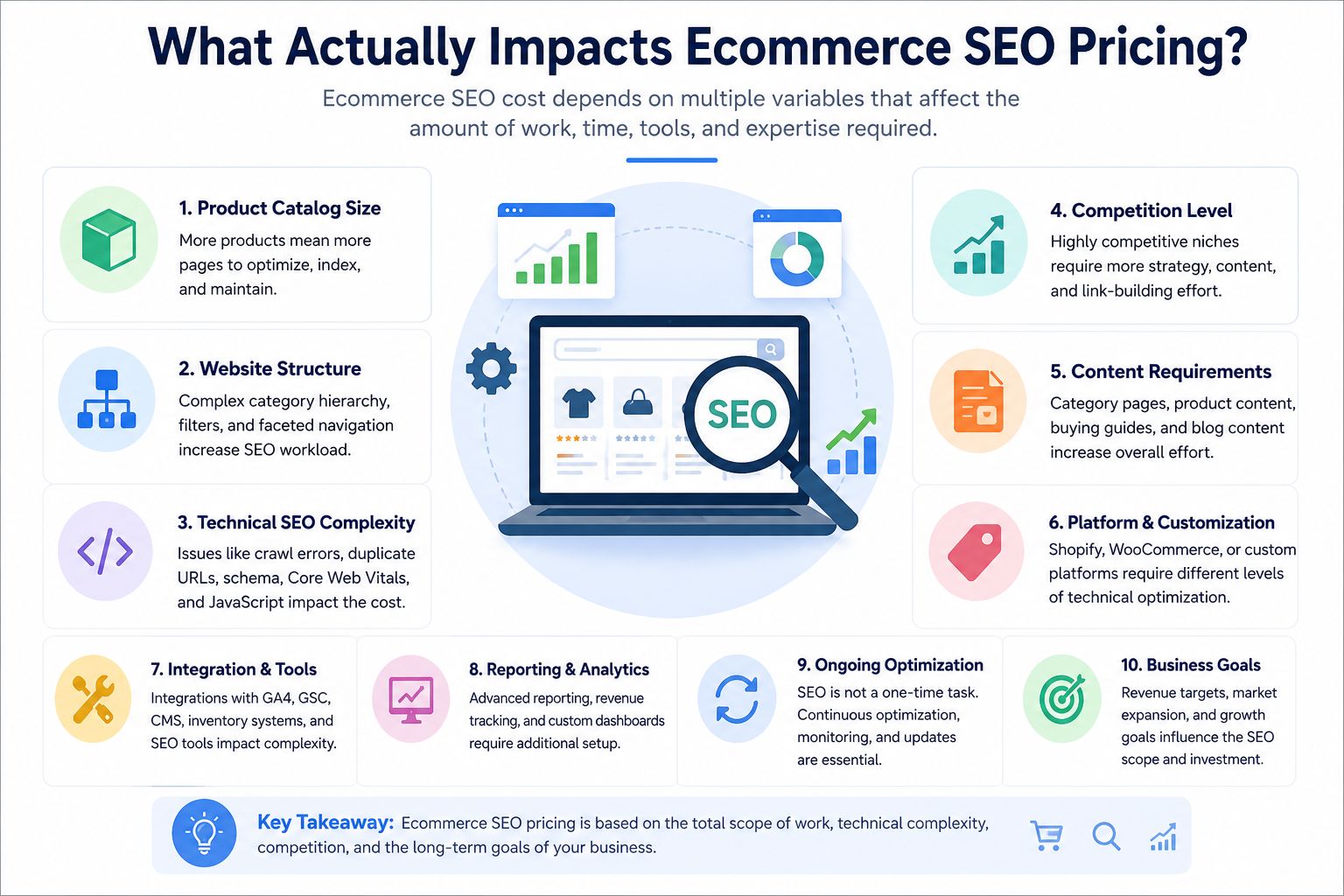
What Actually Impacts Ecommerce SEO Pricing?
Ecommerce SEO pricing depends on operational workload, technical complexity, content scale, platform limitations, analytics depth, and competitive search demand. Two ecommerce stores in the same industry can have completely different SEO costs based on how their website infrastructure, product inventory, and search visibility requirements are structured.
This is why fixed SEO packages rarely reflect the actual work involved. Ecommerce SEO campaigns are usually priced according to how much technical execution, content management, search optimization, and ongoing operational support the business requires.
| SEO Pricing Variable | How It Affects SEO Workload | Impact on Pricing |
|---|---|---|
| Product Catalog Size | More URLs, metadata, schema, and crawl management | High |
| Technical SEO Debt | Requires audits, fixes, and development coordination | High |
| Category Architecture | Needs search intent mapping and internal linking | Medium to High |
| Content Production | Requires commercial and informational content scaling | Medium to High |
| Competition Level | Increases SEO execution depth and authority requirements | High |
| Analytics and Tracking | Requires GA4 setup, attribution, and reporting systems | Medium |
| CRO Alignment | Needs conversion-focused optimization and testing | Medium |
How Product Catalog Size Changes SEO Cost
Product catalog size directly affects ecommerce SEO pricing because every indexed URL creates additional optimization and maintenance work. A store with 200 products operates very differently compared to a marketplace with 50,000 SKUs.
Larger catalogs require structured metadata systems, automated schema implementation, crawl optimization, image handling, duplicate URL management, and scalable internal linking strategies.
SEO teams must also prioritize which product pages deserve indexing, which pages should consolidate authority, and which low-value URLs should remain excluded from search engines.
Category Architecture and Internal Linking Complexity
Ecommerce websites depend heavily on category and collection pages for transactional visibility. Poor category structures weaken topical relevance and distribute authority inefficiently across the site.
SEO pricing often increases when category architecture requires restructuring. This process may involve URL hierarchy planning, collection consolidation, breadcrumb optimization, faceted navigation control, and contextual internal linking improvements.
Internal linking becomes especially important for large ecommerce websites because search engines use these relationships to understand product relevance, category depth, and transactional hierarchy.
Technical SEO Debt and Development Requirements
Technical SEO debt is one of the largest pricing variables in ecommerce SEO campaigns. Many stores accumulate unresolved issues over time through plugin conflicts, theme modifications, JavaScript rendering problems, and platform limitations.
Technical SEO work may include Core Web Vitals improvements, schema debugging, canonical corrections, crawl management, redirect cleanup, mobile rendering fixes, and structured data validation.
Some ecommerce businesses also require developer coordination for server-level fixes, template restructuring, checkout optimization, and advanced SEO implementation tasks.
Content Production Requirements for Ecommerce SEO
Ecommerce SEO content goes far beyond blog publishing. Product descriptions, buying guides, category introductions, comparison pages, FAQ content, and commercial landing pages all contribute to transactional search relevance.
AI-driven search systems now evaluate semantic depth, entity relationships, and contextual completeness more aggressively. Thin product content and repetitive manufacturer descriptions often struggle to gain consistent visibility.
Businesses with aggressive organic growth goals usually invest in ongoing content production to support commercial intent coverage across different stages of the buying process.
Competition Level and Search Demand
Competitive industries require more SEO resources because stronger websites already dominate transactional search visibility. Jewelry, fashion, electronics, furniture, and beauty ecommerce sectors often require deeper SEO execution compared to niche industries with lower competition.
Search demand also affects workload. High-volume transactional keywords usually require stronger authority signals, better category optimization, richer structured data, and stronger topical relationships across the website.
Ecommerce SEO pricing therefore increases when businesses compete against established marketplaces, national brands, or highly optimized category leaders.
Analytics, Attribution, and Revenue Tracking
Modern ecommerce SEO depends heavily on analytics accuracy. Businesses need visibility into organic revenue attribution, product-level performance, category conversion behavior, and search intent segmentation.
SEO teams often work with GA4, Search Console, Merchant Center, and conversion tracking systems to measure how organic traffic contributes to revenue generation instead of only measuring rankings.
Attribution complexity increases further when ecommerce brands operate across multiple channels including paid ads, marketplaces, email campaigns, and organic search simultaneously.
CRO Alignment and Conversion-Focused SEO
Ecommerce SEO is no longer isolated from conversion optimization. Traffic growth without conversion improvement creates weak commercial outcomes, especially for stores operating with high acquisition costs.
Conversion-focused SEO may involve improving category layouts, optimizing product page structure, refining transactional content, strengthening trust elements, and aligning search intent with buying behavior.
Businesses investing in SEO and CRO alignment usually focus on revenue efficiency instead of traffic volume alone. This operational depth is another major reason ecommerce SEO pricing varies between brands.
Shopify SEO Pricing vs WooCommerce SEO Pricing
Shopify SEO pricing and WooCommerce SEO pricing differ because both platforms operate with different technical structures, customization flexibility, plugin ecosystems, and development limitations. The amount of SEO work required often depends more on platform architecture than the business owner initially expects.
Some ecommerce platforms simplify technical maintenance but restrict advanced SEO customization. Others offer deeper control while increasing development workload and operational complexity. These differences directly affect monthly SEO retainers, technical execution time, and long-term scalability.
| SEO Factor | Shopify | WooCommerce |
|---|---|---|
| Technical Flexibility | Moderate | High |
| Platform Maintenance | Managed by platform | Requires ongoing management |
| SEO Customization | Limited in some areas | Extensive customization options |
| Plugin/App Dependency | High app dependency | High plugin dependency |
| Technical SEO Control | Restricted in certain system areas | Greater server and code control |
| Development Complexity | Lower for standard stores | Higher for advanced implementations |
| Typical SEO Cost | Moderate to High | Moderate to Enterprise-Level |
Why Shopify SEO Pricing Is Different
Shopify simplifies many ecommerce operations, but its hosted architecture creates certain SEO limitations. URL handling, collection structures, duplicate product paths, and restricted server-level access can require additional strategic planning during SEO implementation.
Many Shopify stores also rely heavily on third-party apps. While apps help extend functionality, they can introduce performance issues, JavaScript bloat, duplicate schema conflicts, and unnecessary code that affects Core Web Vitals and crawl efficiency.
Businesses investing in Shopify SEO optimization usually focus on category structure refinement, collection page optimization, schema improvements, and transactional search visibility across product ecosystems.
WooCommerce SEO Flexibility and Technical Cost
WooCommerce offers greater SEO flexibility because it operates within the WordPress ecosystem. Businesses can customize URL structures, schema implementation, content systems, server configurations, and technical SEO settings more deeply.
That flexibility also increases operational responsibility. Plugin conflicts, hosting quality, theme performance, database growth, and security maintenance all affect SEO stability over time.
SEO campaigns involving WooCommerce SEO structure often require deeper technical oversight, especially for stores managing large inventories, multilingual content, or custom product functionality.
Custom Ecommerce Platforms and SEO Complexity
Custom ecommerce platforms usually involve the highest SEO complexity. Development teams may create unique product systems, dynamic filtering structures, JavaScript frameworks, or custom rendering environments that require specialized technical SEO support.
These websites often require advanced crawl analysis, rendering diagnostics, schema engineering, server log monitoring, and custom indexation strategies. SEO retainers for custom platforms therefore tend to be significantly higher than standard ecommerce setups.
The advantage is that custom platforms can support highly specialized SEO structures when technical implementation is handled properly.
Which Ecommerce Platform Requires More SEO Work?
No ecommerce platform is automatically better for SEO in every situation. Shopify reduces maintenance overhead but limits some advanced technical customization. WooCommerce offers more control but increases operational management requirements.
The actual SEO workload depends on catalog size, search competition, technical condition, site architecture, and growth goals rather than the platform name alone.
Platform choice mainly changes how SEO teams execute technical improvements, manage scalability, and maintain long-term search visibility across growing ecommerce ecosystems.
What Is Included in Ecommerce SEO Services?
Ecommerce SEO services usually include technical SEO management, product page optimization, category page improvements, internal linking, structured data implementation, analytics reporting, and content support for transactional search visibility. The exact deliverables depend on the size of the ecommerce website, technical condition, and business growth goals.
Unlike standard SEO retainers that focus mainly on rankings and blog content, ecommerce SEO campaigns operate across multiple systems simultaneously. Search visibility, crawl efficiency, product discoverability, conversion tracking, and AI-search readiness all require ongoing operational management.
Businesses investing in ecommerce SEO services generally expect long-term support across technical infrastructure, category growth, transactional keyword visibility, and revenue-focused optimization.
| SEO Deliverable | Primary Purpose | Typical Frequency |
|---|---|---|
| Technical SEO Audits | Identify crawl, indexation, and performance issues | Monthly or Quarterly |
| Product Page Optimization | Improve transactional relevance and conversions | Ongoing |
| Category Page SEO | Strengthen commercial search visibility | Ongoing |
| Schema Markup Management | Support AI-search and rich result visibility | Ongoing |
| Internal Linking Optimization | Improve crawl flow and topical relationships | Monthly |
| Analytics and Reporting | Measure traffic, revenue, and conversions | Monthly |
| Content Production | Expand topical and transactional coverage | Monthly |
Technical SEO Audits and Monitoring
Technical SEO forms the operational foundation of ecommerce search visibility. Audits typically evaluate crawl errors, indexation issues, duplicate content, canonical conflicts, Core Web Vitals, schema validity, redirect chains, and rendering problems.
Ecommerce websites constantly change as inventory updates, plugins evolve, and new pages enter the site structure. Ongoing monitoring helps detect SEO issues before they affect transactional rankings or product discoverability.
Many ecommerce SEO campaigns also involve coordination with developers to implement technical fixes at template, server, or platform level.
Product Page SEO Optimization
Product page SEO focuses on improving transactional relevance, content depth, entity clarity, and conversion quality. This includes optimizing titles, descriptions, structured data, FAQs, image attributes, and internal linking relationships.
Ecommerce stores using manufacturer descriptions often struggle to differentiate product pages in search results. SEO teams therefore create unique contextual content that supports both organic visibility and buying intent.
Product optimization also supports AI-search retrieval because conversational search systems increasingly rely on structured product information and semantic clarity.
Category and Collection Page Optimization
Category pages are usually some of the highest-value URLs in ecommerce SEO campaigns. These pages target broader transactional queries with stronger search demand and higher revenue potential.
SEO work on category pages may include content expansion, filter management, internal linking refinement, search intent alignment, schema implementation, and collection hierarchy improvements.
Strong category structures help search engines understand topical relationships between products, collections, and commercial search intent layers.
Internal Linking and Site Architecture
Ecommerce websites depend heavily on internal linking systems to distribute authority across categories, collections, and products. Poor internal architecture often leads to crawl inefficiencies and weak ranking consistency.
SEO teams improve navigation structures, contextual links, breadcrumbs, related product systems, and collection relationships to strengthen topical relevance and crawl accessibility.
Site architecture also affects how efficiently search engines discover newly added products and prioritize important transactional pages.
Analytics, Tracking, and Reporting
Ecommerce SEO reporting extends beyond rankings and traffic charts. Businesses need visibility into revenue attribution, conversion behavior, category performance, assisted conversions, and product-level organic sales.
SEO teams commonly work with GA4, Search Console, Merchant Center, and ecommerce tracking systems to measure how organic visibility contributes to actual business outcomes.
Reporting also helps identify which categories, products, and search intents generate the strongest commercial value over time.
Content Production and Entity SEO
Ecommerce content systems support both search visibility and topical relevance. SEO campaigns often include buying guides, category support content, FAQs, comparison pages, and informational resources connected to transactional queries.
Entity SEO has become increasingly important as AI-driven search systems evaluate brand relationships, product associations, and contextual depth more aggressively.
Structured content ecosystems help ecommerce brands build stronger topical authority while improving discoverability across conversational search environments and AI-generated search experiences.
How AI Search Is Changing Ecommerce SEO in 2026
AI search is changing ecommerce SEO by shifting visibility from simple keyword rankings toward entity understanding, structured data quality, transactional relevance, and contextual trust signals. Search engines now generate AI-assisted answers, product recommendations, and conversational buying journeys directly inside search environments.
Ecommerce brands that previously depended only on traditional rankings are now adapting their SEO strategies for AI Overviews, conversational search systems, product retrieval models, and entity-driven search interpretation. This change affects how ecommerce websites structure content, organize product information, and build topical authority.
AI Overviews and Transactional Search Visibility
AI Overviews summarize product information, buying recommendations, comparisons, and commercial insights directly within search results. Ecommerce brands therefore compete not only for blue-link rankings, but also for inclusion inside AI-generated search experiences.
Transactional visibility increasingly depends on structured product information, strong category relevance, merchant trust signals, review consistency, and contextual completeness across ecommerce pages.
Product pages with weak schema markup, repetitive content, or unclear entity relationships often struggle to appear consistently within AI-assisted search layers.
What GEO Means for Ecommerce Brands
GEO, or Generative Engine Optimization, focuses on improving how AI systems retrieve, interpret, and reference website content during answer generation. In ecommerce SEO, GEO involves structuring product and category information in ways that support machine understanding alongside traditional rankings.
AI systems analyze semantic relationships between products, categories, brands, pricing signals, reviews, FAQs, and contextual buying information. Ecommerce websites with stronger entity clarity and structured content ecosystems generally perform better in conversational search environments.
GEO does not replace traditional SEO. Instead, it expands SEO into AI-search retrieval systems where content quality, entity relationships, and structured information influence visibility.
AEO and Conversational Product Discovery
Answer Engine Optimization, commonly called AEO, focuses on helping search systems deliver direct answers to conversational queries. Ecommerce searches increasingly resemble natural language questions instead of short keyword phrases.
Users now search with queries such as “best gold necklace for wedding gift” or “comfortable office chair for back pain under ₹15,000.” Search engines attempt to interpret intent, context, product attributes, and buying conditions simultaneously.
Ecommerce SEO strategies therefore require FAQ integration, concise product explanations, contextual category content, and conversational search alignment across commercial pages.
Structured Data and AI Search Retrieval
Structured data helps AI systems interpret ecommerce websites more accurately. Schema markup provides machine-readable information about products, pricing, reviews, stock status, shipping details, FAQs, and category relationships.
Ecommerce SEO campaigns in 2026 commonly involve Product Schema, FAQ Schema, Breadcrumb Schema, Review Schema, and Organization Schema implementation to strengthen search interpretation.
Structured data also supports richer search visibility through product snippets, merchant information, review displays, and AI-assisted product summaries inside search results.
Entity SEO and Brand Authority in AI Search
Entity SEO focuses on helping search systems understand relationships between brands, products, categories, industries, and commercial topics. AI-driven search environments rely heavily on these relationships when selecting sources for answer generation.
Ecommerce brands with consistent topical coverage, clear semantic structures, trustworthy merchant signals, and strong contextual relevance usually build stronger AI-search visibility over time.
Brand authority is no longer shaped only by backlinks and rankings. AI retrieval systems also evaluate content consistency, topical depth, product clarity, and semantic trust across the entire ecommerce ecosystem.
These changes are also creating a wider gap between low-cost SEO execution and operationally mature ecommerce SEO strategies.
Cheap Ecommerce SEO vs Strategic SEO Investment
Cheap ecommerce SEO and strategic SEO investment produce very different outcomes because the operational depth behind both approaches is rarely the same. Low-cost SEO services often focus on surface-level deliverables, while strategic ecommerce SEO involves technical execution, category optimization, structured content systems, analytics alignment, and long-term search infrastructure.
Ecommerce businesses usually discover this difference after experiencing unstable rankings, indexing problems, poor category visibility, or traffic growth that fails to generate revenue consistently.
| SEO Area | Cheap Ecommerce SEO | Strategic Ecommerce SEO |
|---|---|---|
| Technical SEO | Basic plugin-level fixes | Ongoing technical monitoring and issue resolution |
| Product Optimization | Generic metadata updates | Transactional intent and entity-focused optimization |
| Category SEO | Minimal optimization | Search intent mapping and structural improvements |
| Content Quality | Thin or AI-generated bulk content | Contextual and commercially aligned content systems |
| Reporting | Basic ranking reports | Revenue, conversion, and attribution reporting |
| SEO Workflow | Task-based execution | Operational SEO management |
| Long-Term Stability | Often inconsistent | Built for scalable organic growth |
What Low-Cost Ecommerce SEO Usually Misses
Low-cost ecommerce SEO services often prioritize visible activity over operational impact. Businesses may receive automated reports, basic keyword tracking, or bulk metadata updates without addressing deeper technical and structural issues.
Important SEO areas such as crawl optimization, category architecture, canonical management, schema validation, internal linking systems, and conversion alignment are frequently ignored because they require more specialized expertise and ongoing effort.
Some providers also depend heavily on scaled AI-generated content without improving topical relationships, transactional relevance, or product-level contextual depth.
Why Technical SEO Cannot Be Ignored
Ecommerce websites operate with far more technical dependency than standard business websites. Indexation errors, faceted navigation issues, duplicate product URLs, slow rendering, and weak mobile performance can directly affect organic visibility and revenue generation.
Technical SEO problems often remain invisible until search performance declines. This is why experienced ecommerce SEO campaigns involve continuous monitoring instead of one-time optimization checklists.
Businesses investing only in low-cost SEO frequently delay technical maintenance until traffic instability becomes more difficult and expensive to recover from.
The Difference Between Deliverables and Real SEO Operations
Many ecommerce businesses evaluate SEO providers based on deliverable lists alone. Monthly reports, blog counts, or keyword totals may appear useful, but they do not always reflect meaningful operational SEO work.
Real ecommerce SEO operations involve ongoing coordination between technical SEO, content systems, analytics, category optimization, structured data management, and search intent refinement.
The goal is not simply to publish more content or track rankings. Sustainable ecommerce SEO focuses on improving search visibility, crawl efficiency, transactional relevance, and revenue contribution across the entire ecommerce ecosystem.
How to Choose the Right Ecommerce SEO Agency
Choosing the right ecommerce SEO agency requires evaluating technical capability, operational transparency, reporting quality, and ecommerce-specific experience instead of focusing only on pricing or ranking promises. Ecommerce SEO affects revenue infrastructure, product discoverability, category visibility, and long-term acquisition costs, so the evaluation process should go beyond generic SEO checklists.
Many agencies can improve a few keywords temporarily. Fewer agencies can manage large product ecosystems, technical SEO complexity, AI-search readiness, and conversion-focused search optimization consistently over time.
Questions to Ask Before Hiring an Ecommerce SEO Agency
Ecommerce businesses should evaluate agencies based on operational process rather than presentation quality alone. The right questions usually reveal whether the agency understands ecommerce SEO at a technical and strategic level.
- How do you handle large product catalogs and indexation management?
- What technical SEO monitoring systems do you use?
- How do you optimize category and collection pages?
- How is GA4 and revenue attribution integrated into reporting?
- How do you approach AI-search visibility and structured data?
- Who handles technical implementation and developer coordination?
- How do you prioritize SEO tasks across large ecommerce websites?
Agencies with ecommerce experience usually explain workflows, technical reasoning, and operational priorities clearly instead of relying on vague ranking guarantees.
What Transparent SEO Reporting Looks Like
Transparent ecommerce SEO reporting focuses on business impact alongside search visibility metrics. Rankings alone rarely provide enough context for evaluating SEO performance properly.
Useful reporting typically includes organic revenue trends, category-level performance, product visibility, crawl health, conversion behavior, search intent segmentation, and technical issue tracking.
Businesses should also expect visibility into completed work, ongoing priorities, unresolved technical dependencies, and future SEO roadmap planning instead of receiving only automated dashboard exports.
Why Ecommerce Experience Matters in SEO
Ecommerce SEO differs significantly from local SEO or service-based SEO campaigns. Product inventory management, faceted navigation, variant handling, schema implementation, collection architecture, and transactional search intent all require specialized operational knowledge.
Agencies without ecommerce experience often underestimate technical complexity or rely on generic SEO tactics that do not scale effectively for large product-driven websites.
Experienced ecommerce SEO teams usually understand how search visibility connects with merchandising structures, conversion behavior, inventory changes, paid acquisition costs, and long-term organic revenue performance.
Why Businesses Work With Aarmus Marketing
Aarmus Marketing works with ecommerce businesses that need operational SEO support beyond surface-level optimization. The focus is placed on technical SEO systems, category visibility, transactional search intent, structured data implementation, and scalable content architecture aligned with ecommerce growth.
Ecommerce SEO campaigns are approached through technical analysis, search behavior evaluation, revenue-focused reporting, and long-term organic acquisition planning instead of isolated ranking activities.
This operational understanding becomes even more important when evaluating whether ecommerce SEO delivers sustainable business returns over time.
Is Ecommerce SEO Worth the Investment?
Ecommerce SEO is worth the investment for businesses that want sustainable organic acquisition, lower dependency on paid advertising, and long-term transactional visibility across search engines and AI-driven search environments. Unlike short-term traffic campaigns, ecommerce SEO compounds over time as category authority, product visibility, and search trust improve.
The value of ecommerce SEO is usually measured through organic revenue growth, customer acquisition cost reduction, category-level visibility, and long-term search stability rather than rankings alone.
How Ecommerce SEO Compounds Over Time
Ecommerce SEO builds momentum gradually. Well-optimized category pages, structured product ecosystems, strong internal linking, and semantically connected content continue attracting organic traffic long after initial optimization work is completed.
As search engines understand product relationships, category relevance, and brand authority more clearly, ecommerce websites often gain broader transactional visibility across multiple keyword variations and buying-intent searches.
This compounding effect becomes stronger when businesses continuously improve technical SEO, product content quality, and category depth over time.
SEO vs Rising Paid Advertising Costs
Paid advertising costs continue increasing across Google Ads, Meta Ads, shopping campaigns, and marketplace platforms. Ecommerce brands operating only through paid acquisition channels often experience unstable margins as click costs rise.
Organic search visibility helps balance acquisition costs by generating recurring traffic without paying for every individual visit. Strong category rankings and product discoverability can reduce pressure on paid campaigns for transactional keywords.
Ecommerce businesses commonly use SEO alongside paid advertising rather than treating both channels as competing systems.
Why Organic Visibility Creates Long-Term Revenue Stability
Organic search visibility creates revenue stability because traffic is distributed across products, categories, informational searches, and transactional queries simultaneously. This diversification reduces dependence on single acquisition channels.
Businesses with mature ecommerce SEO systems often build stronger resilience during seasonal advertising fluctuations, rising customer acquisition costs, or changes in paid campaign performance.
Industries with strong repeat purchasing behavior, including fashion, beauty, home decor, and jewelry ecommerce, often benefit significantly from long-term organic visibility. Many brands applying SEO strategies for ecommerce-driven jewelry brands focus heavily on category authority and transactional search consistency to improve recurring organic sales.
Ecommerce SEO rarely produces overnight growth, but businesses that approach SEO as acquisition infrastructure instead of a temporary ranking campaign usually see stronger long-term commercial value.
Frequently Asked Questions About Ecommerce SEO Pricing
How Much Should a Small Ecommerce Store Spend on SEO?
Small ecommerce stores usually spend between ₹25,000 and ₹60,000 per month depending on product count, competition level, and technical SEO requirements.
Why Is Shopify SEO More Expensive?
Shopify SEO can require additional work for collection structures, app-related performance issues, duplicate URLs, and technical customization limitations.
Can Ecommerce SEO Improve Product Sales?
Yes. Ecommerce SEO improves product visibility for transactional searches, which can increase qualified traffic, conversions, and organic revenue over time.
Does AI Search Affect Ecommerce SEO?
Yes. AI search systems use structured data, entity relationships, product relevance, and semantic context to generate product recommendations and search answers.
How Long Does Ecommerce SEO Take?
Most ecommerce SEO campaigns start showing measurable improvements within 3 to 6 months, depending on technical condition, competition, and website authority.
What Affects Ecommerce SEO Pricing the Most?
Product catalog size, technical SEO complexity, category structure, content requirements, and competition level are the biggest pricing factors.
Is Ecommerce SEO Better Than Paid Ads?
SEO and paid ads serve different purposes. SEO supports long-term organic acquisition, while paid ads generate immediate visibility and traffic.
Do Ecommerce Websites Need Technical SEO?
Yes. Ecommerce websites rely heavily on technical SEO for crawl efficiency, indexation control, structured data, and product discoverability.
Can SEO Help Shopify and WooCommerce Stores Equally?
Yes, but the SEO workflow differs because Shopify and WooCommerce operate with different technical structures and customization flexibility.
Why Do Large Ecommerce Stores Pay More for SEO?
Large ecommerce stores require more operational SEO work due to thousands of products, category complexity, crawl management, and ongoing technical maintenance.
Why Ecommerce SEO in 2026 Requires Long-Term Operational Strategy
Ecommerce SEO in 2026 is influenced by technical complexity, product inventory scale, category architecture, structured data quality, and AI-search visibility requirements. Search engines now evaluate ecommerce websites through transactional relevance, entity relationships, crawl efficiency, and contextual product understanding instead of rankings alone.
Businesses operating with large catalogs, competitive categories, and growing acquisition costs usually require ongoing SEO operations rather than isolated optimization tasks. Technical SEO monitoring, category refinement, internal linking systems, analytics accuracy, and content scalability all contribute to long-term organic performance.
AI-driven search experiences have also changed how ecommerce brands build visibility. Product discovery increasingly depends on structured information, semantic relevance, and conversational search alignment across category and product ecosystems.
The most effective ecommerce SEO strategies are usually built around operational consistency, technical stability, and long-term search visibility rather than short-term ranking fluctuations.