

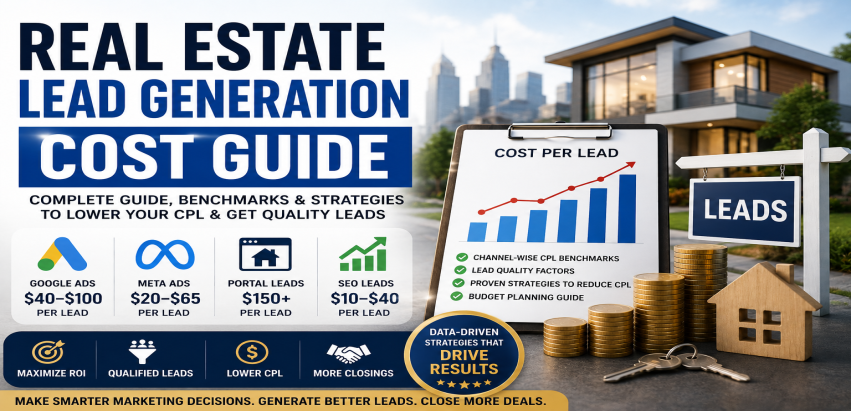
Real estate lead generation in India costs more than most builders expect and produces fewer qualified buyers than most dashboards suggest. A developer in Mumbai receiving 600 leads per month at Rs. 300 CPL is not necessarily doing better than a developer in Pune receiving 120 leads at Rs. 1,200 CPL, because the metric that actually drives revenue is site visits booked and bookings closed, not leads counted.
This guide breaks down real estate lead generation cost in India across every major channel, city, property segment, and market condition, so builders, brokers, and real estate marketing teams can plan budgets around actual acquisition economics rather than platform-reported CPL figures that hide more than they reveal.
What Is Real Estate Lead Generation Cost in India?
Real estate lead generation cost, or cost per lead, is the total digital marketing spend divided by the number of enquiries received. In the Indian property market, that number needs significant context before it means anything commercially useful.
What Counts as a Qualified Property Lead?
In Indian real estate, the word "lead" gets applied to a wide range of enquiry quality levels. Most campaigns report every form submission or WhatsApp message as a lead, regardless of how serious the buyer actually is. Qualified property leads are a much smaller subset of that total.
A qualified real estate lead in India typically meets at least three of the following criteria:
- Confirmed budget range matching the project price point
- Active property search with a defined timeline of three to six months
- Phone number that connects on the first or second call
- Geographic requirement matching the project location
- Willingness to schedule a site visit or attend a project presentation
Most lead generation campaigns in India produce a large number of enquiries and a much smaller number of genuinely qualified buyers. Measuring CPL without separating these two populations produces misleading budget decisions.
Why Real Estate CPL Is Higher Than Other Industries
Three structural factors keep real estate CPL higher than most other digital advertising categories in India.
First, transaction value. When a property sale generates Rs. 50,000 to Rs. 5,00,000 or more in brokerage or developer margin, every active competitor is willing to pay aggressively to intercept that buyer first. High-value transactions drive high auction competition across Google Ads and Meta Ads simultaneously.
Second, sales cycle length. Indian property buyers, particularly in the Rs. 50 lakh to Rs. 2 crore range, research for three to twelve months before transacting. That extended timeline means lead nurturing and multiple follow-up touchpoints are required after the initial enquiry, which increases the operational cost of conversion beyond just the media spend.
Third, category credibility challenges. Builder trust is a live concern for Indian buyers following project delays, regulatory changes, and RERA compliance complexity. Campaigns that generate volume without addressing credibility attract curious browsers rather than serious buyers, which inflates lead count without improving booking rate.
Why Site Visits Matter More Than Lead Volume
The metric that predicts revenue in Indian real estate is not CPL. It is cost per site visit and cost per booking. A developer converting 8 percent of leads into site visits is operating at a meaningfully different efficiency than a developer converting 1.5 percent, even if their CPL is identical.
Site visit conversion is the first commercial gate in the Indian real estate funnel. Everything before it, including CPL, is a vanity metric unless site visit ratio is tracked alongside it.
Average Real Estate Lead Generation Cost in India (2026 Benchmarks)
Across channels, Indian real estate CPL ranges from under Rs. 200 for low-intent social leads in tier-2 cities to Rs. 6,000 or more for qualified luxury property enquiries from Google Search in Mumbai or Gurgaon. The gap between these figures reflects the difference in who is being reached and how ready they are to transact.
Average Google Ads CPL in India
Google Search campaigns for Indian real estate typically produce CPL between Rs. 800 and Rs. 3,000 in tier-1 cities and Rs. 500 to Rs. 1,500 in tier-2 markets. The higher cost reflects the value of intercepting high-intent leads: buyers who are actively searching for specific property types in specific locations at the moment the ad appears.
Google Ads real estate CPL is not cheap, but the buyer intent quality it delivers is consistently higher than social channels. A developer receiving 80 Google Search leads at Rs. 1,500 CPL and converting 10 percent into site visits generates 8 site visits at Rs. 15,000 per visit. That is a commercially meaningful benchmark for projects in the Rs. 60 lakh to Rs. 2 crore range.
Average Meta Ads CPL in India
Meta Ads, covering Facebook and Instagram, produce Indian real estate leads at Rs. 150 to Rs. 800 for affordable and mid-segment properties and Rs. 500 to Rs. 2,000 for premium projects. The lower CPL is real. So is the qualification work required to extract commercial value from the volume it generates.
Meta lead quality varies significantly based on creative strategy, audience precision, funnel design, and how quickly and effectively the sales team follows up after enquiry submission. The same Rs. 300 CPL on Instagram can produce excellent site visit ratios from a well-structured campaign or near-zero booking rates from a broad-audience volume campaign running the same creative.
Luxury vs Affordable Housing Lead Cost
Luxury property campaigns in India, targeting buyers for projects priced above Rs. 1.5 crore, consistently produce higher CPL because the audience is narrow, the creative requirements are demanding, and the qualification cycle is longer. Google Ads CPL for luxury real estate in Mumbai, Gurgaon, and Bangalore typically ranges from Rs. 2,000 to Rs. 6,000 per lead.
Affordable housing and first-home buyer campaigns in tier-1 and tier-2 cities produce CPL from Rs. 150 to Rs. 600, but face greater portal competition, shared leads from aggregators, and a buyer demographic that requires more nurturing time before committing to a site visit.
Tier-1 vs Tier-2 City CPL
Tier-1 city real estate advertising in Mumbai, Delhi NCR, Bangalore, Hyderabad, and Pune operates in a high-competition auction environment where dozens of active builders and brokers bid simultaneously. Tier-1 city competition pushes Google Ads CPC to Rs. 40 to Rs. 150 and Meta CPM significantly above tier-2 market rates.
Tier-2 cities including Ahmedabad, Surat, Nagpur, Jaipur, Lucknow, Bhopal, and Coimbatore see Google Ads CPC in the Rs. 15 to Rs. 60 range and Meta CPL from Rs. 150 to Rs. 500. Lower competition produces lower CPL, and the buyer pool, while smaller, often contains a higher proportion of serious enquirers relative to casual browsers.
Why CPL Changes Across Indian Cities
CPL variation across Indian cities is driven by three factors working simultaneously. Auction density, meaning how many advertisers are competing for the same search queries or audience segments, pushes prices up in concentrated markets. Property price levels determine how aggressively developers are willing to bid, as higher-value projects justify higher acquisition spend. And local buyer behavior, including how residents in different cities engage with property advertising on different platforms, affects which channel delivers better CPL in each specific market.
| Channel | Average CPL | Lead Quality | Best Use Case |
|---|---|---|---|
| Google Search Ads | Rs. 800 to Rs. 3,000 | High | Active buyer acquisition, high-intent searches |
| Meta / Facebook Ads | Rs. 150 to Rs. 800 | Low to Medium | Volume lead generation, retargeting |
| Instagram Ads | Rs. 200 to Rs. 1,000 | Medium | Premium project awareness, luxury retargeting |
| YouTube Ads | Rs. 300 to Rs. 900 | Medium | Project walkthroughs, brand trust building |
| SEO / Organic | Rs. 150 to Rs. 500 effective CPL | High | Long-term lead flow, portal independence |
| Property Portals | Rs. 300 to Rs. 1,200 | Medium | Reach, though leads are shared |
Google Ads Cost Per Lead for Real Estate in India
Google Search Ads remain the highest-intent lead source available for Indian real estate developers. A buyer typing "2 BHK flats for sale in Thane" or "luxury apartments in Gurgaon below 2 crore" into Google has self-identified as an active property searcher at the precise moment that campaign can intercept them. That search intent quality is what justifies the higher CPL relative to social channels.
Average Google Ads CPL in Mumbai
Mumbai is the most competitive real estate Google Ads market in India. CPC for property searches in Mumbai ranges from Rs. 60 to Rs. 180 for standard residential keywords and Rs. 120 to Rs. 300 for luxury and waterfront searches. CPL for Mumbai real estate Google campaigns typically falls between Rs. 1,500 and Rs. 4,000, depending on property segment and targeting precision.
Suburbs including Thane, Navi Mumbai, Kalyan, and Andheri produce lower CPC and CPL than central Mumbai and South Mumbai campaigns because competition is less concentrated. A developer in Thane can generate leads at Rs. 900 to Rs. 2,000 CPL from Google Search while a comparable campaign targeting Worli or Bandra runs Rs. 2,500 to Rs. 5,000.
Google Ads CPL in Bangalore and Hyderabad
Bangalore real estate Google Ads campaigns produce CPL between Rs. 800 and Rs. 2,500 for mid-market projects and Rs. 2,000 to Rs. 5,000 for premium projects in Whitefield, Sarjapur Road, and Koramangala. The tech corridor buyer profile in Bangalore typically includes salaried IT professionals with clearer income certainty and shorter decision timelines than average, which improves lead-to-site-visit conversion rates relative to other metros.
Hyderabad has seen significant real estate growth in HITEC City, Gachibowli, and Kokapet, where Google Ads CPL for new launch projects ranges from Rs. 700 to Rs. 2,000. Lower competition than Mumbai and Bangalore produces more accessible CPL without sacrificing search intent quality.
Luxury Property Campaign Costs
Luxury real estate Google Ads campaigns targeting properties above Rs. 2 crore in Delhi NCR, Mumbai, and Bangalore face the highest CPL in the Indian market. CPC for luxury property keywords reaches Rs. 150 to Rs. 400, with CPL often ranging from Rs. 2,500 to Rs. 6,000 per enquiry.
The economics remain viable because a single luxury transaction generates Rs. 3 lakh to Rs. 20 lakh or more in developer margin or brokerage. A conversion rate of even 3 to 5 percent from lead to booking justifies a Rs. 3,000 to Rs. 4,000 CPL across campaign volumes of 50 to 100 leads per month.
Search Ads vs Performance Max
Standard Search campaigns give Indian real estate advertisers direct control over keyword targeting, match types, and negative keywords, which are critical for excluding irrelevant search queries like "property rental" or "plot for sale" when the campaign is promoting apartments. Performance Max uses Google's automation to distribute spend across search, display, YouTube, and Gmail.
For Indian real estate, Search campaigns typically produce higher lead quality because the targeting is demand-driven rather than audience-driven. Performance Max can supplement volume, but without careful asset group structure and strong conversion signal quality, it frequently allocates budget to low-intent inventory that distorts CPL benchmarks without improving site visit rates.
Why Broad Match Increases CPL
Broad match keywords in Indian real estate campaigns without adequate negative keyword coverage are one of the most common causes of rising CPL. A campaign running "apartments in Bangalore" on broad match will trigger for searches including "rental apartments in Bangalore," "apartments near Bangalore airport," and "1 RK in Bangalore," none of which match a buyer for a Rs. 80 lakh 2 BHK project in Whitefield.
Every irrelevant click inflates CPL without contributing to site visits. Location targeting at the pincode or micro-area level, combined with aggressive negative keyword lists, can reduce CPL by 25 to 40 percent in mature campaigns without reducing lead quality.
How Builders Reduce Google Ads CPL
The most effective CPL reductions in Google Ads come from the conversion side, not the bidding side. A landing page converting at 6 percent produces leads at half the cost of a page converting at 3 percent from the same traffic. For builders running real estate Google Ads campaign management with proper tracking, negative keyword discipline, and conversion-optimized landing pages, CPL stabilizes and declines over time as campaign learning improves.
Specific actions that reduce CPL in Indian real estate Google campaigns include: running exact and phrase match for high-converting keywords before broadening, setting up negative keyword lists covering rental, plot, commercial, and resale queries, using ad scheduling to exclude off-peak hours with low conversion rates, and ensuring call tracking is set up correctly so phone conversions are captured alongside form submissions.
| City | Average CPC | Average CPL | Competition Level |
|---|---|---|---|
| Mumbai | Rs. 60 to Rs. 180 | Rs. 1,500 to Rs. 4,000 | Very High |
| Delhi NCR / Gurgaon | Rs. 50 to Rs. 160 | Rs. 1,200 to Rs. 3,500 | Very High |
| Bangalore | Rs. 40 to Rs. 140 | Rs. 800 to Rs. 2,500 | High |
| Hyderabad | Rs. 30 to Rs. 110 | Rs. 700 to Rs. 2,000 | High |
| Pune | Rs. 30 to Rs. 100 | Rs. 600 to Rs. 1,800 | Medium to High |
| Ahmedabad | Rs. 20 to Rs. 70 | Rs. 400 to Rs. 1,200 | Medium |
| Surat | Rs. 15 to Rs. 55 | Rs. 350 to Rs. 900 | Low to Medium |
| Chennai | Rs. 25 to Rs. 90 | Rs. 500 to Rs. 1,500 | Medium |
Facebook and Meta Ads Lead Cost for Indian Real Estate
Meta Ads generate more real estate leads per rupee spent than any other channel in India. That is the accurate version of the story. The incomplete version, which most agency dashboards show, stops there. The more commercially important question is what percentage of those leads turn into site visits and bookings, because the answer changes the economics significantly.
Average Meta Ads CPL in India
Meta Ads CPL for Indian real estate ranges from Rs. 150 to Rs. 500 for affordable housing campaigns in tier-2 cities to Rs. 500 to Rs. 2,000 for premium projects in Mumbai, Gurgaon, and Bangalore. The lower CPL reflects the passive nature of the audience: Facebook and Instagram users are not searching for property when your ad appears. They are responding to creative that caught their attention while they were doing something else entirely.
That distinction matters enormously for how lead quality should be evaluated and what qualification infrastructure needs to exist before the CPL figure becomes commercially meaningful.
WhatsApp vs Lead Forms
Indian real estate campaigns use two primary Meta lead capture mechanisms. Lead forms pre-fill contact details from the user's Facebook profile, generating high submission volumes at low friction. WhatsApp click-to-chat campaigns send the user directly into a WhatsApp conversation instead of a static form.
WhatsApp qualification outperforms lead forms for Indian real estate in most market contexts because WhatsApp is the primary communication channel for Indian buyers at every income level. A buyer who messages on WhatsApp is more committed than a buyer who accidentally submitted a lead form while scrolling. WhatsApp also enables immediate qualification through automated chatbot flows that ask budget, timeline, and location questions before a sales executive joins the conversation.
Lead forms generate more submissions at lower CPL. WhatsApp campaigns generate fewer submissions at slightly higher CPL and produce significantly better site visit ratios in most Indian markets. The right choice depends on whether the development team is optimizing for lead volume or site visit conversion.
Why Cheap Leads Often Fail
A builder in Noida receiving 800 Meta leads per month at Rs. 200 CPL with a 1.2 percent site visit conversion rate is generating 9 to 10 site visits. The sales team is spending 40 to 60 hours per month on unqualified follow-up calls to reach those 10 site visits. The true cost of each site visit, including sales team time, is significantly higher than the Rs. 200 CPL suggests.
A competing builder running tighter Meta campaigns at Rs. 600 CPL with 8 percent site visit conversion generates the same 10 site visits from 125 leads, with one-sixth the unqualified call volume and dramatically lower sales team time cost. The headline CPL looks worse. The actual acquisition economics are substantially better.
Video Creatives and CPL Reduction
Video creatives consistently outperform static image ads for Indian real estate on Meta across all property segments. A 30 to 60 second project walkthrough video showing actual apartment interiors, amenities, and location connectivity generates significantly higher engagement from qualified audiences and lower CPL than static render images because video filters passive scrollers more effectively. Viewers who watch 50 to 75 percent of a property walkthrough video and then submit an enquiry are demonstrably more serious than viewers who clicked on a static ad in half a second.
Understanding the full range of real estate PPC funnel strategies that combine Meta creative optimization, landing page design, and WhatsApp qualification is essential for developers trying to improve site visit rates without simply increasing ad spend.
Tier-2 City Meta Ads Cost
Tier-2 city Meta Ads campaigns for Indian real estate produce some of the most cost-efficient CPL available in the market. Cities including Surat, Ahmedabad, Jaipur, Nagpur, Coimbatore, Indore, and Bhopal see Meta CPL from Rs. 150 to Rs. 400 for mid-market projects. Competition is lower, creative fatigue is lower, and buyers are often more decisive once engaged because they face less simultaneous competition from other developers.
The challenge in tier-2 markets is audience size. Small city targeting can exhaust the relevant audience pool quickly, causing creative fatigue and rising CPL within six to eight weeks unless new creatives are rotated and audience segments are refreshed regularly.
Retargeting and Lead Quality
Retargeting campaigns on Meta target Indian property buyers who have already visited the project website, watched a walkthrough video, or engaged with a previous ad. These warm audiences convert at two to four times the rate of cold audience campaigns because they have demonstrated prior project interest.
Retargeting CPL in Indian real estate typically ranges from Rs. 300 to Rs. 800, higher than cold audience CPL but significantly lower in effective cost per site visit. For developers with regular website traffic of 3,000 or more monthly visitors, retargeting is consistently the highest-ROI Meta campaign type available.
| Property Segment | Average CPL | Lead Quality | Conversion Potential |
|---|---|---|---|
| Affordable (below Rs. 40L) | Rs. 150 to Rs. 400 | Low to Medium | Moderate, high volume required |
| Mid-Market (Rs. 40L to Rs. 1Cr) | Rs. 300 to Rs. 800 | Medium | Good with WhatsApp qualification |
| Premium (Rs. 1Cr to Rs. 2.5Cr) | Rs. 500 to Rs. 1,500 | Medium to High | Strong with video and retargeting |
| Luxury (above Rs. 2.5Cr) | Rs. 800 to Rs. 2,500 | High | Requires structured qualification |
| Plots and Land | Rs. 200 to Rs. 600 | Variable | Moderate, investor-driven |
Real Estate Lead Cost in Mumbai, Delhi, Bangalore, Pune, and Ahmedabad
Indian real estate CPL is not a national figure. It is a city-by-city reality determined by local competition, property price levels, buyer demographics, and how aggressively developers in each market invest in digital advertising. The same campaign structure produces dramatically different CPL outcomes in Mumbai versus Surat, or in Gurgaon versus Jaipur.
Mumbai Real Estate CPL
Mumbai operates as the most expensive real estate advertising market in India across every digital channel. The combination of extremely high property prices, intense developer competition, and sophisticated buyer behavior pushes Google Ads CPL from Rs. 1,500 to Rs. 5,000 and Meta CPL from Rs. 400 to Rs. 1,500 for most residential segments. Metro city competition in Mumbai means that even well-optimized campaigns face structural CPL floors that do not exist in secondary markets.
Micro-area targeting within Mumbai produces meaningful CPL variation. A developer targeting Thane West specifically will pay less per lead than a developer targeting all of Mumbai, while reaching a more relevant buyer audience. Suburb-specific campaigns with location-matched landing pages consistently outperform broad geographic campaigns in Mumbai's competitive auction environment.
Delhi NCR and Gurgaon Lead Cost
Delhi NCR, covering Gurgaon, Noida, Greater Noida, Faridabad, and Ghaziabad, is the second most competitive real estate digital advertising market in India. Gurgaon luxury campaigns targeting Golf Course Road, DLF areas, and Dwarka Expressway produce Google Ads CPL from Rs. 2,000 to Rs. 5,000 for projects above Rs. 1.5 crore.
Noida and Greater Noida see lower CPL in the Rs. 600 to Rs. 2,000 range for mid-market projects, with several large developers and builder groups running consistent campaigns that maintain auction price pressure year-round. The Delhi NCR market also sees significant NRI buyer interest from UAE, UK, and USA-based buyers, which adds a different targeting dimension to campaigns that want to capture that audience segment alongside domestic buyers.
Bangalore Property Lead Cost
Bangalore is the fastest-growing real estate advertising market in India by volume and the most data-literate in terms of buyer behavior. The IT sector buyer profile means a significant portion of active property buyers in Bangalore are salaried professionals with pre-sanctioned home loans who are actively comparing projects across Whitefield, Sarjapur, Electronic City, and Yelahanka.
Google Ads CPL in Bangalore ranges from Rs. 800 to Rs. 2,500 for standard residential projects. The buyer intent variation in Bangalore is particularly strong for project-specific searches, meaning campaigns with project name and location-specific ad groups consistently outperform generic "apartments in Bangalore" targeting by 30 to 50 percent on CPL efficiency.
Pune and Hyderabad CPL Trends
Pune is one of the most consistent real estate digital advertising markets in India, with stable CPL ranges from Rs. 600 to Rs. 1,800 for Google Search and Rs. 250 to Rs. 700 for Meta campaigns across Hinjewadi, Wakad, Baner, and Kharadi micro-markets. IT corridor projects in Pune targeting working professionals in Hinjewadi and Kothrud produce above-average site visit ratios because the buyer pool is concentrated, financially stable, and geographically specific.
Hyderabad has seen significant CPL increase across HITEC City, Gachibowli, Kokapet, and Financial District micro-markets as new developer launches have driven auction competition higher over the past two years. Mid-market Google Ads CPL in Hyderabad now ranges from Rs. 700 to Rs. 2,000, up from Rs. 400 to Rs. 1,200 in earlier periods. The market remains more accessible than Mumbai and Delhi NCR while producing comparable buyer quality from IT corridor targeting.
Ahmedabad and Surat Real Estate Lead Cost
Ahmedabad and Surat represent the most cost-efficient tier-1 adjacent real estate advertising markets in India. Ahmedabad Google Ads CPL ranges from Rs. 400 to Rs. 1,200 for residential projects across South Bopal, Shela, Prahlad Nagar, and SG Highway corridors. Meta Ads CPL in Ahmedabad falls between Rs. 200 to Rs. 600, with strong engagement from business community buyers who dominate the Ahmedabad buyer demographic.
Surat sees some of the lowest CPL among growing Indian real estate markets, with Google Ads CPL from Rs. 350 to Rs. 900 and Meta CPL from Rs. 150 to Rs. 500. Developer competition in Surat, while growing, has not yet reached the auction density of Mumbai or Bangalore, making it one of the more accessible markets for new developer campaigns with moderate budgets.
Why Metro Cities Have Higher CPL
Metro city CPL is higher for three compounding reasons. Advertiser density means more developers and brokers are bidding simultaneously for the same buyer attention, raising auction prices. Property values in metro markets are higher, which means buyers research longer and the sales cycle is extended, requiring more touchpoints per conversion. And media consumption in metro markets is more fragmented across devices, platforms, and content formats, which means reaching the same buyer requires more creative frequency and therefore more spend per impression.
| City | Google Ads CPL | Meta Ads CPL | SEO Effective CPL |
|---|---|---|---|
| Mumbai | Rs. 1,500 to Rs. 5,000 | Rs. 400 to Rs. 1,500 | Rs. 300 to Rs. 700 |
| Delhi NCR / Gurgaon | Rs. 1,200 to Rs. 4,500 | Rs. 350 to Rs. 1,200 | Rs. 250 to Rs. 600 |
| Bangalore | Rs. 800 to Rs. 2,500 | Rs. 300 to Rs. 1,000 | Rs. 200 to Rs. 500 |
| Hyderabad | Rs. 700 to Rs. 2,000 | Rs. 250 to Rs. 800 | Rs. 180 to Rs. 450 |
| Pune | Rs. 600 to Rs. 1,800 | Rs. 250 to Rs. 700 | Rs. 150 to Rs. 400 |
| Ahmedabad | Rs. 400 to Rs. 1,200 | Rs. 200 to Rs. 600 | Rs. 120 to Rs. 350 |
| Surat | Rs. 350 to Rs. 900 | Rs. 150 to Rs. 500 | Rs. 100 to Rs. 300 |
| Chennai | Rs. 500 to Rs. 1,500 | Rs. 200 to Rs. 650 | Rs. 150 to Rs. 380 |
| Kolkata | Rs. 400 to Rs. 1,200 | Rs. 180 to Rs. 550 | Rs. 120 to Rs. 320 |
SEO vs Google Ads Cost for Real Estate Leads in India
The SEO versus Google Ads debate for Indian real estate is not a question of which channel wins. Both solve real problems but at different points in a developer's growth timeline and with different economic structures. Choosing one over the other without understanding that distinction leads to either slow early-stage lead flow or permanently high paid media dependency.
Short-Term vs Long-Term Lead Cost
Google Ads generates leads within days of campaign launch. Turn the campaign off and leads stop the same day. The CPL is direct, measurable, and scales with spend in both directions. SEO builds organic visibility over six to eighteen months and then generates leads at a declining effective CPL for years. The early investment in SEO produces low output relative to spend. The mature investment produces leads at a fraction of the paid cost from identical search queries.
A developer in Pune spending Rs. 80,000 per month on Google Ads generates leads immediately and predictably. The same developer investing Rs. 25,000 per month in SEO for 12 months builds an asset that, by month 15, may generate 60 to 100 organic enquiries per month at an effective CPL of Rs. 200 to Rs. 400. The paid dependency never disappears, but it reduces substantially.
Why SEO Leads Usually Convert Better
Organic search leads in Indian real estate convert at higher rates than paid search leads from comparable queries for two reasons. First, a developer appearing in organic results for "new flats in Hinjewadi Pune" is perceived as a category authority in a way that a paid ad above it is not, because Indian buyers have learned to distinguish between advertising and editorial search results. Second, organic visitors often arrive after multiple prior searches, meaning they are further along in their decision process by the time they make the first direct enquiry.
The gap is not enormous, typically 10 to 20 percent better conversion rate for organic versus paid from similar intent searches. But over months and years, that difference compounds into meaningful budget savings and better site visit efficiency.
Google Ads for Immediate Leads
Google Ads are indispensable for new project launches, seasonal campaign pushes, and any situation where a developer needs leads to flow into the pipeline immediately. No other channel matches Google Search's ability to intercept buyers at the precise moment of active intent. For developers launching a new project in Noida or Whitefield, a Google Ads campaign running from day one while the SEO programme builds authority is the only commercially viable approach to early-stage lead generation.
SEO for Sustainable Property Enquiries
Indian real estate developers who rely entirely on paid advertising and property portals for leads operate at the mercy of platform auction dynamics and portal pricing decisions. Every lead they generate has a direct per-lead cost that never declines. SEO, executed correctly for Indian real estate markets, builds organic visibility that reduces that dependence over time.
For real estate SEO growth strategies in competitive Indian markets like Mumbai, Bangalore, and Delhi NCR, the programme typically takes 8 to 14 months to produce significant organic lead volume. In tier-2 markets like Surat, Ahmedabad, or Nagpur, the timeline compresses to 4 to 8 months because domain authority requirements are lower in less competitive search environments.
Combining SEO and PPC
The most efficient Indian real estate marketing programmes run Google Ads and SEO simultaneously rather than as alternatives. Paid search covers the immediate pipeline requirement. SEO builds the organic foundation that reduces paid dependence. Together, they produce lower blended CPL over 12 to 18 months than either channel delivers independently.
Developers who commit to scalable SEO campaigns alongside their Google Ads programmes typically see blended CPL reduce by 25 to 45 percent over 12 months as organic leads begin supplementing paid volume from the same search queries. Portal dependency also decreases because organic rankings capture the same buyer attention that portals previously monopolized.
Organic Visibility vs Portal Dependency
Indian real estate developers currently paying Rs. 50,000 to Rs. 3,00,000 per month in portal listing fees and lead packages face a structural problem: those leads are shared with competing developers on the same platform. An organic search ranking for a project-specific keyword delivers an exclusive enquiry directly to the developer's website, with no competing listings on the same page and no portal intermediary taking margin.
Reducing long-term lead generation dependence on portals through SEO investment is one of the most strategically sound decisions an Indian real estate developer can make over a two to three year horizon, particularly as portal pricing continues to increase and exclusivity continues to decline.
| Factor | SEO | Google Ads |
|---|---|---|
| Time to first lead | 4 to 14 months | Days |
| Effective CPL at maturity | Rs. 150 to Rs. 500 | Rs. 700 to Rs. 3,000 |
| Lead quality | High, intent-driven | High, intent-driven |
| Budget risk | Low once established | Stops when budget stops |
| Portal independence | Yes, builds own channel | No, platform-dependent |
| Best for | Sustainable lead flow, resale listings | Project launches, immediate volume |
Why Cheap Real Estate Leads in India Usually Fail
The appeal of Rs. 200 CPL from a Meta campaign is obvious. 500 leads per month at that cost appears to be an efficient operation until the sales team reports that 480 of those leads either did not pick up the phone, were not in market, or had no budget alignment with the project. The 20 qualified leads had an effective cost of Rs. 5,000 each, a figure that changes the economics completely.
Low Intent vs High Intent Leads
Low-intent leads in Indian real estate come from buyers who responded to advertising rather than buyers who were actively searching for property. Someone who clicked on a Facebook carousel showing a project render because it looked attractive, submitted their number in a lead form, and immediately forgot about it is in a completely different purchase state than someone who searched "3 BHK apartment in Wakad below 80 lakhs" and clicked on the first result.
Both show up as leads in the dashboard. One is six months from being ready to visit a site. The other may be ready to schedule within the week. Treating them identically, which most sales teams do by default, wastes time on the first while sometimes losing the second to a competitor who responded faster.
The Problem With Broad Audience Targeting
Campaigns targeting "all adults aged 28 to 55 in Bangalore with household income above Rs. 8 lakh" will generate substantial lead volume because they are reaching a large audience. Most of that audience is not actively considering a property purchase. Cheap leads are not profitable when the qualification rate is low enough that the cost per qualified lead exceeds what a more targeted campaign would have produced with fewer, better enquiries.
Narrow audience targeting with project-specific creative, location precision, and strong intent signals in the ad format consistently produces lower volume at higher CPL and better site visit ratios. The headline CPL looks worse. The site visit economics are significantly better.
Portal Leads vs Exclusive Leads
Property portal leads in India are distributed to multiple developers and brokers simultaneously. A buyer enquiring about 2 BHK apartments in Navi Mumbai on a major portal may have their contact information shared with eight to twelve developers who all receive the same lead simultaneously. The first developer to call typically wins the conversation. The rest spend time and sales team effort on a buyer who has already committed their attention elsewhere.
Exclusive leads generated through your own website, landing pages, and WhatsApp campaigns deliver the enquiry only to you. No competitor receives the same buyer's information from the same campaign. That exclusivity justifies higher per-lead investment compared to portal packages.
Why Site Visit Ratios Matter
Site visit ratio, the percentage of total leads that agree to visit the project or attend a presentation, is the single most important indicator of campaign quality in Indian real estate. A campaign generating 200 leads at 7 percent site visit conversion produces 14 site visits. A campaign generating 600 leads at 1.5 percent conversion produces 9 site visits at three times the total lead cost. Site visit conversion matters more than lead volume at every meaningful level of the acquisition analysis.
The 5-Minute Follow-Up Rule
Research across Indian real estate markets consistently shows that buyers who receive a follow-up call within five minutes of submitting an enquiry convert to qualified conversations at significantly higher rates than buyers called 30 minutes, one hour, or four hours later. The window of peak interest is short. A buyer who submitted a lead form while looking at a project render on Instagram is most engaged in the two to five minutes following submission. After that, attention moves on.
The five-minute response rule is not a theoretical best practice. It is an operational requirement for any Indian real estate business serious about extracting commercial value from digital lead generation. WhatsApp automation that triggers within seconds of form submission addresses this requirement at scale without requiring a sales executive to be available every moment of the day.
Lead Quality vs CPL
The correct performance metric for Indian real estate lead generation is not CPL. It is cost per site visit, cost per booking, and revenue per marketing rupee by channel. A business measuring only CPL will consistently make decisions that look efficient on paper and underperform commercially because the downstream funnel never closes at the rates that cheap CPL implies. Aarmus Marketing's approach to real estate campaign evaluation always starts with site visit targets first, then works backward to the CPL and volume requirements that support those targets.
Factors That Increase Real Estate Lead Cost in India
Two builders running structurally identical Google Ads campaigns in the same city can produce CPL figures that differ by 100 to 200 percent. The difference is almost never the platform. It is the variables surrounding the campaign that determine how efficiently every rupee of media spend converts into genuine buyer enquiries.
City Competition and Auction Pressure
Mumbai, Gurgaon, and Bangalore operate at permanently elevated auction prices because developer competition is dense and year-round. Every major developer in these cities runs consistent digital campaigns, which means even a well-optimized campaign faces structural CPL floors that do not exist in tier-2 markets. A builder entering Mumbai real estate advertising for the first time will pay market entry prices, typically 30 to 50 percent higher than an established advertiser with better Quality Scores and campaign history in the same market.
Luxury vs Affordable Property Segments
Luxury property campaigns require more creative investment, narrower targeting, longer nurturing sequences, and higher per-impression costs to reach the right audience. A developer advertising Rs. 4 crore villas in Koramangala faces a smaller, more expensive audience pool than a developer advertising Rs. 60 lakh 2 BHK apartments in Electronic City. The luxury CPL is higher because the audience accessibility is lower, not because the campaigns are less efficient.
Landing Page Quality
Landing page conversion rate is the most powerful CPL lever available to any Indian real estate advertiser because it operates independently of the ad platform. A landing page converting at 5 percent from Google Ads traffic produces leads at half the cost of a page converting at 2.5 percent from identical traffic. Real estate landing pages that include project renders, floor plans, pricing ranges, location maps, and a prominent click-to-WhatsApp button consistently outperform generic enquiry pages.
WhatsApp Follow-Up Speed
Speed-to-lead in Indian real estate is determined largely by how quickly the WhatsApp follow-up reaches the buyer after enquiry. Developers using automated WhatsApp sequences that trigger within 30 seconds of form submission see qualification rates 40 to 60 percent higher than developers relying on manual callback processes. The cost of each qualified lead effectively decreases without changing CPL, because more leads from the same campaign volume reach the qualification stage.
CRM and Lead Tracking
Developers without proper CRM implementation lose 20 to 40 percent of leads to follow-up failure, meaning enquiries that were never contacted or were contacted once, received no response, and were never followed up again. Every lost lead represents wasted CPL. Local targeting improvements reduce the cost of generating leads. CRM discipline determines how many of those leads are actually worked to conversion.
Creative Quality and Video Ads
Ad creative quality affects both the CPL and the lead intent quality simultaneously. Generic project renders with price-point text produce volume. Project-specific walkthrough videos, real unit photography, and lifestyle imagery of amenities produce fewer clicks from unqualified audiences and more engagement from buyers with genuine interest in the specific project. Creative quality is both a CPL driver and a lead quality filter in the same creative decision.
Audience Segmentation
Campaigns targeting broad city-level audiences produce higher volume at lower CPL from audiences with widely varying intent levels. Campaigns targeting micro-geographies, specific employer bases, or interest clusters aligned with property buyer behavior produce lower volume at higher CPL from audiences with more concentrated purchase intent. The right balance depends on the project's price point, location specificity, and available audience size.
Builder Brand Trust
Established builders in any Indian city face lower CPL than new entrants because their brand recognition acts as a conversion multiplier. A buyer searching for "3 BHK in Wakad" who sees an ad from a builder they have heard of, seen hoardings for, or been recommended by a friend is more likely to engage than a buyer who sees an identical ad from an unknown developer. Brand investment through consistent digital presence, YouTube awareness campaigns, and earned media reduces CPL over time by increasing the trust response to every paid ad impression.
How Builders and Realtors Reduce Real Estate CPL in India
CPL reduction in Indian real estate requires working on the funnel architecture rather than just the bidding settings. The most effective CPL improvements come from outside the ad platform entirely.
Improve Landing Page Conversion Rate
The fastest available CPL reduction for most Indian real estate campaigns is landing page conversion rate improvement. Pages that include a visible WhatsApp chat button above the fold, show actual project renders or floor plans rather than stock photography, display location connectivity (nearest metro, airport, IT hub), and present clear pricing ranges reduce bounce rate and increase form or WhatsApp submission rates from the same traffic.
Moving from a 2 percent to a 4 percent landing page conversion rate halves CPL without changing a single aspect of the ad campaign. For a builder spending Rs. 1,50,000 per month on Google Ads, that landing page improvement is worth Rs. 75,000 per month in effective cost reduction from identical media spend.
Use WhatsApp Automation
Automated WhatsApp sequences triggered within 30 seconds of lead submission solve the speed-to-lead problem at scale. The first message acknowledges the enquiry and shares a project brochure. A second automated message 10 minutes later asks one qualification question: "Are you looking for ready-to-move or under-construction?" The response initiates a qualification branch that routes serious buyers to a sales executive while filtering unqualified enquiries into a nurture sequence.
This infrastructure does not reduce CPL directly. It increases the percentage of leads from the same campaign that reach qualified conversation status, which reduces cost per site visit significantly.
Retarget Property Visitors
Retargeting campaigns on Meta and Google Display targeting prior website visitors, video viewers, and enquiry page visitors consistently produce lower effective CPL than cold audience campaigns because the audience has demonstrated project interest. For a builder in Pune with 2,000 monthly website visitors, an Rs. 15,000 to Rs. 25,000 monthly retargeting budget can produce 20 to 40 additional enquiries per month at CPL rates 40 to 60 percent below cold audience campaign rates.
Improve Creative Quality
Project-specific creative that shows real units, actual amenities, and honest location context generates leads from audiences with genuine project interest. Generic renders with "Book Now" overlays attract click volume from mixed-intent audiences. Replacing static image creatives with 30 to 45 second project walkthrough videos on Meta typically reduces CPL by 15 to 30 percent while simultaneously improving lead-to-site-visit conversion because the video pre-qualifies the audience before they submit an enquiry.
Use CRM Automation
CRM automation ensures every lead is contacted, tracked, and followed up according to a defined cadence regardless of sales team workload. Integrating ad platform lead capture directly with a CRM that assigns leads to specific sales executives, triggers WhatsApp automation, and tracks pipeline stage eliminates the manual process failures that cause 20 to 35 percent of real estate leads to go cold before the first meaningful conversation.
For a full analysis of how Google Ads optimization and management efficiency connects to overall acquisition economics in Indian real estate, the infrastructure decisions made at the campaign level directly affect how many leads convert into commercial outcomes.
Focus on Site Visit Conversion
Optimizing campaigns toward site visits rather than raw lead volume changes every tactical decision a builder makes about targeting, creative, landing page design, and follow-up process. Site visit optimization means accepting slightly higher CPL in exchange for better-qualified buyers, tighter audience targeting, and stronger qualification filters before the sales team engages. The result is fewer total leads, more total site visits, and significantly lower cost per booking.
Reduce Fake Leads
Indian real estate campaigns routinely receive a percentage of fake leads from competitor testing, curiosity submissions, and data-harvesting bots. OTP verification at the lead form stage, where the user must confirm their mobile number before the lead is recorded, reduces fake lead volume by 30 to 60 percent in most Indian markets. The CPL rises because fewer total submissions are counted, but the CPL for genuine leads is actually unchanged and the sales team time wasted on invalid numbers is eliminated.
Optimize Location Targeting
Campaigns targeting entire cities deliver leads from buyers who may be geographically unsuitable for a project's micro-location. A developer in Sarjapur Road, Bangalore receives leads from buyers across the city, many of whom have no intention of considering properties this far from central Bangalore. Micro-area targeting within a 5 to 15 kilometre radius of the project site, combined with audience layering for relevant employer bases and income indicators, reduces wasted spend without reducing the qualified audience pool.
Businesses evaluating long-term organic lead acquisition economics alongside their paid campaigns will find that location-specific SEO content targeting micro-area searches produces some of the highest-converting organic enquiries available, because the buyer searching "2 BHK near Hinjewadi Phase 2" has already self-selected for the most commercially relevant geographic criterion.
How Much Should Indian Real Estate Companies Spend on Lead Generation?
The right marketing budget for an Indian real estate business is not a round number. It is a function of how many site visits are needed per month, what the lead-to-site-visit conversion rate is across current channels, and what CPL is achievable in the target city and property segment.
Monthly Budget for Affordable Housing Projects
An affordable housing developer in tier-2 cities like Surat, Ahmedabad, Nagpur, or Jaipur targeting Rs. 30 to Rs. 60 lakh properties can generate a consistent lead pipeline with Rs. 50,000 to Rs. 1,50,000 per month across Meta and Google Ads. At a blended CPL of Rs. 400 to Rs. 700, that budget produces 100 to 300 leads per month. A 5 to 8 percent site visit conversion produces 8 to 20 site visits monthly, which for a project converting 20 to 25 percent of site visitors into bookings generates 2 to 5 bookings per month.
Budget for Luxury Property Campaigns
Luxury developers in Mumbai, Gurgaon, or Bangalore targeting projects above Rs. 1.5 crore require Rs. 3,00,000 to Rs. 10,00,000 per month in media spend to generate sufficient lead volume at acceptable site visit ratios. At Rs. 2,500 to Rs. 4,000 CPL, a Rs. 5,00,000 monthly budget produces 125 to 200 leads. A 10 to 15 percent site visit conversion from a well-qualified audience generates 15 to 30 site visits. At a 20 to 30 percent site visit-to-booking conversion, that is 3 to 9 luxury bookings per month.
A single luxury transaction at Rs. 2 crore generating Rs. 4 to Rs. 8 lakh in developer margin or brokerage justifies a Rs. 5,00,000 monthly lead generation budget if even two bookings per month are achieved consistently. ROI-focused budgeting in luxury real estate requires calculating backward from transaction value, not forward from CPL.
Builder vs Broker Marketing Budgets
Builders advertising directly for project bookings need higher budgets than brokers generating leads across multiple projects because they are funding the full awareness and conversion cycle for a single project. Brokers can spread ad spend across multiple mandates, generating diverse lead types. A large broker firm in Mumbai or Bangalore typically spends Rs. 2,00,000 to Rs. 8,00,000 per month across multiple project campaigns. Individual brokers operate effectively on Rs. 20,000 to Rs. 80,000 per month with tightly targeted local campaigns.
SEO vs Ads Budget Allocation
Developers building long-term acquisition capacity typically allocate 60 to 70 percent of digital budget to paid campaigns for immediate lead generation and 30 to 40 percent to SEO for organic asset building. As organic traffic grows over 12 to 18 months, the paid-to-SEO ratio shifts, with some mature developers eventually operating at 50 to 50 as organic leads supplement paid volume from identical search queries. Long-term acquisition strategy requires investing in SEO before the need for cheaper leads becomes urgent.
How to Measure ROI Properly
ROI for Indian real estate marketing is measured in bookings per rupee spent, not leads per rupee spent. The measurement requires CRM tracking from lead source through to closed booking, which most Indian real estate sales teams do not implement consistently. Without source-to-booking attribution, developers cannot determine which channels are actually producing revenue and which are producing dashboard metrics that never convert.
| Business Type | Monthly Budget | Expected Leads | Best Channels |
|---|---|---|---|
| Individual Broker / Agent | Rs. 20,000 to Rs. 60,000 | 50 to 150 | Meta Ads, local SEO |
| Small Real Estate Agency | Rs. 60,000 to Rs. 2,00,000 | 100 to 400 | Google Ads, Meta, WhatsApp |
| Mid-Size Builder, Tier-2 City | Rs. 1,50,000 to Rs. 4,00,000 | 200 to 700 | Google Search, Meta, YouTube |
| Developer, Tier-1 City | Rs. 3,00,000 to Rs. 10,00,000 | 150 to 500 | Google Search, Meta, SEO, YouTube |
| Luxury Developer | Rs. 5,00,000 to Rs. 15,00,000 | 80 to 300 | Google Search, programmatic, SEO |
Real Estate Lead Cost in India vs USA vs UAE
Indian real estate CPL is among the lowest in the world in absolute rupee terms, but relative to Indian property values and commission economics, the figures are commercially comparable to what developers in the USA and UAE pay when expressed as a percentage of transaction value. Understanding global CPL context helps Indian developers calibrate their budgets against what international markets consider normal.
India vs USA Real Estate CPL
US real estate Google Ads CPL typically ranges from $80 to $300, equivalent to Rs. 6,700 to Rs. 25,000 at current exchange rates. That figure is three to eight times higher than Indian metro market CPL in absolute terms. The difference is explained by property values and commission structures: a US realtor earning $15,000 to $30,000 commission on a $500,000 home can justify $200 CPL in ways that are directly comparable to an Indian developer spending Rs. 2,000 per lead on a Rs. 80 lakh property with Rs. 4 to Rs. 6 lakh in margin. Competition affects CPL in both markets, but the underlying economic justification follows the same logic.
India vs UAE Property Lead Cost
Dubai and Abu Dhabi represent the highest CPL real estate market in the region, with Google Ads CPL for premium property searches ranging from AED 500 to AED 2,000, equivalent to Rs. 11,000 to Rs. 44,000. The UAE market combines high-value property transactions, concentrated international buyer demand, and intense developer advertising competition that pushes CPL well above Indian levels despite similar buyer intent dynamics.
Indian NRI buyers from the UAE represent a significant opportunity for Mumbai, Hyderabad, and Goa developer campaigns targeting diaspora audiences. That cross-border targeting dimension adds complexity but allows Indian developers to reach motivated buyers who combine UAE income with Indian market familiarity. Buyer behavior changes by market, and NRI buyers from UAE typically have clearer investment intent and faster decision timelines than domestic Indian buyers across comparable price points.
Why Buyer Intent Differs by Country
Buyer intent signals differ across markets because property purchasing culture, regulatory environments, and financing norms vary. Indian buyers often research for six to twelve months before committing because RERA compliance awareness, builder track record concerns, and financing timelines extend the decision cycle. US buyers move faster on average because title transparency and mortgage pre-approval processes are more standardized. UAE buyers, particularly investors, often make faster decisions because they are evaluating rental yield potential alongside capital appreciation rather than primary residence utility.
How Competition Impacts CPL
The core driver of CPL across every country is not platform pricing. It is how many advertisers are competing for the same buyer attention in the same market at the same time. Mumbai and Gurgaon have CPL structures comparable to secondary US cities because developer competition density, property transaction values, and buyer intent signals align the economic justification for bidding at similar levels relative to transaction value, even in different currency contexts.
| Country | Google Ads CPL | Meta Ads CPL | SEO Effective CPL |
|---|---|---|---|
| India (Tier-1 Cities) | Rs. 800 to Rs. 4,000 | Rs. 300 to Rs. 1,500 | Rs. 150 to Rs. 600 |
| India (Tier-2 Cities) | Rs. 350 to Rs. 1,500 | Rs. 150 to Rs. 600 | Rs. 100 to Rs. 350 |
| USA | $80 to $300 (Rs. 6,700 to Rs. 25,000) | $25 to $80 (Rs. 2,100 to Rs. 6,700) | $20 to $60 (Rs. 1,700 to Rs. 5,000) |
| UAE | AED 500 to AED 2,000 (Rs. 11,000 to Rs. 44,000) | AED 150 to AED 600 (Rs. 3,300 to Rs. 13,200) | AED 100 to AED 400 (Rs. 2,200 to Rs. 8,800) |
| UK | GBP 60 to GBP 200 (Rs. 6,300 to Rs. 21,000) | GBP 20 to GBP 65 (Rs. 2,100 to Rs. 6,800) | GBP 15 to GBP 50 (Rs. 1,600 to Rs. 5,200) |
Frequently Asked Questions About Real Estate Lead Generation Cost in India
What is a good CPL for real estate in India?
A good CPL for Indian real estate depends entirely on city, property segment, and what channel generated the lead. For Google Ads in tier-1 cities, Rs. 1,000 to Rs. 2,500 per lead is a reasonable benchmark. For Meta Ads on mid-market projects, Rs. 300 to Rs. 800 is typical. The more useful benchmark is cost per site visit: Rs. 3,000 to Rs. 8,000 per site visit is considered healthy for residential projects in the Rs. 50 lakh to Rs. 1.5 crore range.
Why are Mumbai real estate leads expensive?
Mumbai real estate leads are expensive because advertiser competition is the highest in India, property values and commissions justify high per-lead investment, and the buyer pool is sophisticated enough to require premium creative and precise targeting. Google Ads CPC in Mumbai reaches Rs. 80 to Rs. 250 for standard residential keywords, which mechanically produces higher CPL than lower-competition cities regardless of campaign efficiency.
How much do Meta Ads cost for property leads?
Meta Ads for Indian real estate property leads typically cost Rs. 150 to Rs. 500 in tier-2 cities and Rs. 300 to Rs. 1,500 in tier-1 cities like Mumbai, Gurgaon, and Bangalore. Luxury project campaigns on Instagram tend toward Rs. 600 to Rs. 2,000. WhatsApp click-to-chat campaigns often produce similar CPL to lead forms with meaningfully better site visit conversion rates.
Do Google Ads generate better property leads?
Yes. Google Search Ads generate higher intent property leads than Meta Ads because buyers are actively searching for property at the moment the ad appears. Meta Ads intercept buyers who are browsing social content rather than searching for property. Both channels have a role, but Google Ads produce higher lead-to-site-visit conversion rates in most Indian real estate markets and should be prioritized for high-intent acquisition.
Which city has the lowest real estate CPL in India?
Tier-2 cities including Surat, Nagpur, Indore, Bhopal, and Coimbatore consistently produce the lowest real estate CPL in India. Google Ads CPL in these markets ranges from Rs. 350 to Rs. 900, and Meta Ads CPL from Rs. 150 to Rs. 400. Lower advertiser density and smaller but more concentrated buyer pools make these markets highly cost-efficient for developers with the right project profile.
Do SEO leads convert better than Meta leads?
Yes, SEO leads from organic search convert at higher rates than Meta leads in Indian real estate. Organic search leads come from buyers actively searching for property, similar to Google Ads in intent quality, but with higher trust signals because they reached the developer directly through an editorial result rather than an advertisement. Meta leads require more qualification effort and convert at lower site visit rates in most Indian markets.
How can builders reduce fake leads?
OTP verification at the form submission stage, where buyers must confirm their mobile number before the lead is counted, reduces fake leads by 30 to 60 percent in most Indian campaigns. Setting minimum age and income targeting thresholds, using engagement-based custom audiences rather than interest-only targeting, and implementing Google reCAPTCHA on landing page forms also reduce unqualified submission volume.
Why are luxury property leads more expensive?
Luxury property leads cost more because the target audience is narrow, requiring higher bidding to reach the same person multiple times. Creative requirements for luxury campaigns demand higher production quality. And the buyer decision cycle is longer, meaning more ad impressions and touchpoints are required before a luxury buyer submits an enquiry compared to a mid-market buyer. The higher CPL is justified by the transaction margin on a single luxury booking.
Is WhatsApp better than lead forms?
WhatsApp campaigns generally produce better site visit conversion than standard lead forms in Indian real estate because WhatsApp is the primary communication channel for Indian buyers at every income level. The initial WhatsApp message creates an active conversation rather than a passive submission, which produces higher engagement and more genuine qualification. Lead forms generate higher submission volume at lower CPL. WhatsApp generates fewer but better-qualified conversations. For most Indian developers, combining both is more effective than choosing one exclusively.
How much should builders spend on marketing?
Indian real estate builders should budget based on booking targets, not arbitrary spend levels. A builder needing 5 bookings per month with a 25 percent site-visit-to-booking rate needs 20 site visits. At a 6 percent lead-to-site-visit conversion, that requires 330 leads. At a blended CPL of Rs. 700, the monthly media budget is approximately Rs. 2,31,000. Working backward from sales targets produces rational budgets. Working forward from CPL alone does not.
How long does SEO take for real estate?
Real estate SEO in competitive Indian metros typically requires 8 to 14 months before generating significant organic lead volume for high-competition keywords. Tier-2 city markets like Surat, Ahmedabad, or Nagpur compress this timeline to 4 to 8 months because domain authority requirements are lower. Project-specific and location-specific keywords often rank faster than broad city category keywords, making micro-area content a practical early-stage SEO strategy.
What is the best lead source for Indian real estate?
There is no single best lead source for Indian real estate because the answer depends on timeline, budget, property segment, and city. Google Search Ads produce the highest intent leads immediately. SEO produces the most cost-efficient leads over 12 to 24 months. Meta Ads produce the highest volume at the lowest CPL with the most variable quality. WhatsApp automation makes all three channels more commercially efficient by ensuring fast qualification. The most effective programmes combine Google Ads for intent-driven acquisition, Meta for volume and retargeting, and SEO for long-term organic growth.
Final Thoughts on Real Estate Lead Generation Cost in India
Indian real estate developers who chase the lowest CPL consistently underperform those who optimize for the lowest cost per booking. These are different objectives that produce different campaign structures, different channel choices, and different conversion outcomes.
Focus on Qualified Leads Instead of Cheap CPL
The most commercially successful Indian real estate marketing programmes share one characteristic: they measure performance at the site visit and booking level rather than the lead level. Qualified leads that produce site visits are worth three to five times the media investment that cheap leads require when total acquisition cost per booking is calculated.
Shifting measurement from CPL to cost per site visit changes every campaign decision. Targeting becomes tighter. Creative becomes more specific. Audience filters become stronger. The result is fewer total leads, more total site visits, and meaningfully lower cost per booking from the same or lower total media spend.
- Measure cost per site visit, not cost per lead
- Track source-to-booking attribution in CRM
- Invest in WhatsApp automation for speed-to-lead
- Use OTP verification to eliminate fake leads
- Allocate 25 to 35 percent of budget to retargeting
Why SEO and PPC Work Better Together
Developers relying exclusively on paid advertising face permanent CPL exposure. Developers relying exclusively on SEO face slow early-stage lead flow. The combination of Google Ads for immediate pipeline and SEO for long-term organic authority produces the most efficient blended CPL over 12 to 24 months.
The developers outperforming their local market on acquisition economics are almost universally running both: paid campaigns covering launch requirements and seasonal demand, and SEO programmes building organic visibility that reduces portal dependency and paid CPL over time. ROI-focused marketing in Indian real estate always leads to this conclusion eventually. Starting it earlier produces better outcomes sooner.
Long-Term Real Estate Growth Requires Funnel Optimization
The biggest CPL reductions available to Indian real estate businesses are not inside the ad platform. They are in landing page conversion rate, WhatsApp automation speed, CRM discipline, creative quality, and qualification infrastructure. A business that fixes its funnel architecture will see CPL drop 25 to 45 percent from the same media spend, with no changes to bidding strategy or audience targeting required.
Long-term acquisition in Indian real estate requires treating the marketing funnel as a system rather than a media spend decision. Aarmus Marketing works with Indian real estate developers and brokers across Mumbai, Delhi NCR, Bangalore, Hyderabad, Pune, Ahmedabad, and Surat to build integrated lead generation systems that combine paid performance with organic growth.
If your real estate business is ready to build a lead generation programme that measures and optimizes for bookings rather than leads, real estate marketing consultation that covers channel mix, funnel design, and CPL benchmarking specific to your city and property segment is where the planning process starts.