

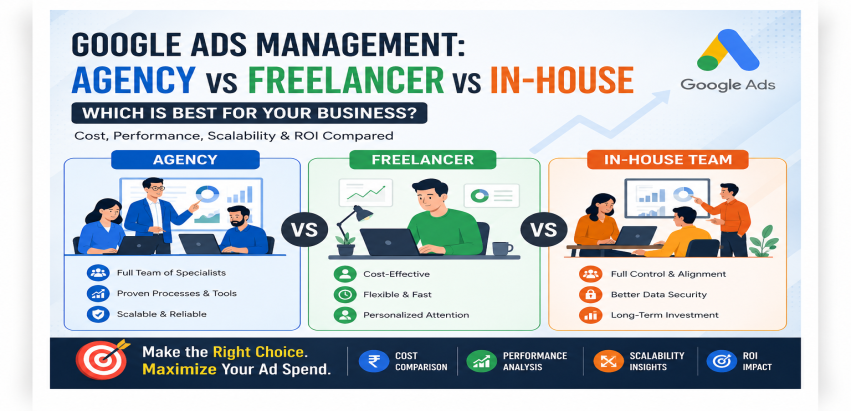
Most businesses do not lose money on Google Ads because of bad keywords. They lose it because the wrong person is managing the account.
A founder hires a freelancer to save costs. Three months later, campaigns are live but conversion tracking is broken, landing pages were never tested, and the budget keeps running while leads stop coming. Another business signs with an agency, pays ₹40,000 monthly, then discovers a junior executive manages the account and the senior strategist reviews it once a month. A third company builds an internal team, spends four months in setup, and by the time campaigns reach performance, a competitor has captured the market window.
These are not edge cases. WordStream research estimates businesses waste an average of 25% of their Google Ads budget on poor account management. At ₹5 lakh monthly spend, that is ₹1.25 lakh disappearing every single month. Not because ads do not work. Because the management model does not fit the business.
Why Choosing the Wrong Google Ads Management Model Quietly Wastes 15-30% of Ad Spend
Google Ads in 2026 is not the platform it was five years ago. Performance Max campaigns, AI bidding, audience signals, and cross-channel attribution have fundamentally changed what competent management requires. At the same time, management costs have risen. Agency retainers in India now range from ₹15,000 to ₹2,00,000 per month. Experienced freelancers charge ₹25,000 to ₹50,000 monthly. Building an internal PPC team costs ₹4 lakh to ₹18 lakh annually before tools and recruitment.
This guide gives you a complete decision framework covering exact cost comparisons across India and global markets, ROI benchmarks by industry, hidden costs most businesses discover too late, and a final decision matrix you can apply today.
Google Ads Agency vs Freelancer vs In-House: Quick Answer and Best Choice by Business Type
Need the Short Answer? Use This Framework
Spending under ₹2 lakh per month on Google Ads: a freelancer is usually the most cost-effective starting point. Spending between ₹2 lakh and ₹10 lakh monthly: a specialist agency will almost always produce better returns. Above ₹10 lakh: you need either a strong agency or a hybrid model combining internal oversight with external execution.
| Factor | Freelancer | Agency | In-House |
|---|---|---|---|
| Monthly management cost (India) | ₹5,000 to ₹50,000 | ₹15,000 to ₹2,00,000+ | ₹33,000 to ₹1,50,000+ (salary only) |
| Monthly management cost (USA) | $300 to $3,000 | $500 to $10,000+ | $4,000 to $12,500+ (salary only) |
| Best ad spend range | ₹50K to ₹2L/month | ₹2L to ₹30L/month | ₹25L+/month |
| Team size behind account | 1 person | 3 to 8 specialists | 1 to 4 internal hires |
| Scaling capability | Limited | High | Medium to High |
| Setup speed | Fast | Medium | Slow |
| ROAS optimization depth | Basic to moderate | Advanced | Depends on hire quality |
| Risk if manager leaves | Very High | Low | High |
| Ideal business type | Startup, local business, single product | Growth stage, multi-location, complex funnel | Enterprise, large brand, high complexity |
Best Choice Under ₹2L Per Month
An agency managing a ₹1 lakh monthly budget charges ₹15,000 to ₹40,000 in fees. That is 15% to 40% of total spend going to management before a single rupee reaches your audience. A competent freelancer at ₹10,000 to ₹20,000 monthly keeps proportionally more budget inside the platform where it produces data. At this stage, the goal is validating whether Google Ads works for your business at all. A SaaS startup at ₹80,000 monthly spend, a local dental clinic at ₹60,000, or a D2C brand testing its first acquisition channel at ₹1.5 lakh does not yet need a six-person agency team.
The risk is not choosing a freelancer. The risk is choosing the wrong one. Vet specifically for conversion tracking knowledge, GA4 setup experience, and attribution understanding before hiring.
Best Choice for ₹2L to ₹10L Monthly
At ₹5 lakh monthly spend you are running multiple campaign types, multiple audience segments, and multiple landing page variations. A freelancer managing 15 to 25 other accounts cannot deliver the weekly optimization frequency this complexity demands. ROAS deteriorates not because ads stop working but because management bandwidth runs out. A specialist agency at this tier brings a strategist, account manager, analyst, and designer working across your account. The management fee of ₹30,000 to ₹80,000 monthly is offset by improved CPA, better lead quality, and attribution reporting that actually explains performance.
When Hybrid Teams Beat Both
At ₹10 lakh and above, neither pure agency nor standalone freelancer gives full control and full execution capability simultaneously. An internal marketing manager owns strategy, brand direction, and vendor accountability. The agency handles campaign execution, optimization, creative testing, and reporting. The internal person knows the business deeply. The agency brings specialist depth. Enterprise businesses spending ₹30 lakh or more monthly almost universally operate this model.
Quick Industry Recommendation Matrix
| Industry | Recommended Model | Primary Reason | Watch Out For |
|---|---|---|---|
| Healthcare and IVF | Specialist agency | Compliance, lead quality, tracking complexity | Freelancers without healthcare PPC experience |
| Real Estate | Specialist agency | High-ticket leads, CRM integration, CPL management | Generic agencies without real estate experience |
| SaaS | Hybrid | Complex attribution, long sales cycles | Agencies without SaaS funnel experience |
| Ecommerce and D2C | Agency with CRO capability | Shopping campaigns, Performance Max, feed management | Freelancers without PMax experience |
| Education and Coaching | Freelancer to agency transition | Seasonal demand, budget sensitivity | Long agency retainers during slow seasons |
| Local Business | Freelancer | Lower budgets, simpler campaigns | Overpaying for agency overhead |
| Interior Design and Niche Services | Freelancer or boutique agency | Visual-led campaigns, niche targeting | Agencies without design-led ad experience |
Choosing the right model is not a permanent decision. The businesses that scale fastest recognize transition points early and move before performance deteriorates. If you are unsure which model fits your current spend and stage, a Google Ads management services review can identify exactly where your setup is losing money.
How Each Model Actually Works Behind the Scenes
Inside a Google Ads Agency
When you onboard with a specialist agency, your account moves through a defined workflow. A strategist audits existing campaigns and builds a 90-day performance plan. An account manager handles day-to-day optimization and bid adjustments. A designer produces ad creatives and landing page variations. An analyst monitors conversion tracking and attribution. A developer handles GA4 setup and CRM integrations. No single person carries all responsibilities.
| Agency Role | Primary Responsibility | Frequency |
|---|---|---|
| Account Strategist | Campaign structure, growth planning, budget allocation | Monthly strategy reviews |
| Account Manager | Daily optimization, bid management, A/B testing | Daily to weekly |
| Paid Media Analyst | ROAS tracking, CPA analysis, attribution reporting | Weekly reporting |
| Designer | Ad creatives, landing page assets, visual testing | Campaign launches, creative refreshes |
| Developer or Tracking Specialist | GA4, conversion tracking, CRM integration | Onboarding, tracking updates |
| Copywriter | Ad copy, headline testing, landing page copy | Campaign creation, copy testing cycles |
The specialist advantage is not just headcount. It is accumulated pattern recognition across hundreds of accounts in the same industry. An agency managing 40 healthcare accounts has seen which ad structures reduce CPL and which bidding strategies produce better lead quality for clinics versus hospitals. That institutional knowledge does not exist inside a freelancer working alone.
What Freelancers Handle Alone and Where Problems Start
A freelancer is one person managing strategy, campaign setup, bid optimization, ad copy, reporting, and client communication simultaneously. The average experienced PPC freelancer carries between 10 and 25 client accounts. At 20 accounts, each client receives roughly 8 to 12 hours monthly. That covers basic optimization on simple campaigns. It does not cover accounts running multiple campaign types, testing landing page variations, managing Performance Max alongside Search, and requiring weekly attribution analysis.
What gets ignored first is testing. The campaigns stay stable but stop improving. ROAS plateaus. The founder assumes Google Ads has reached its ceiling. In most cases, the management model has reached its ceiling, not the channel. The second problem is specialist gaps. A freelancer strong in Search structure may have limited experience with Performance Max feed optimization or GA4 conversion modeling. At lower budgets these gaps are manageable. At ₹5 lakh monthly spend they directly affect lead quality.
How In-House PPC Teams Operate
An in-house team gives the deepest possible product knowledge and fastest internal access. The in-house manager knows the brand, the sales team, customer objections, and seasonal patterns better than any external partner ever will. The operational challenge is cost and capability breadth. Most in-house PPC managers are generalists who manage campaigns, handle reporting, coordinate with designers, and brief developers. They rarely have deep expertise in all areas simultaneously.
| In-House Role | Annual Salary (India) | Annual Salary (USA) | Tools Required |
|---|---|---|---|
| PPC Manager | ₹4,00,000 to ₹10,00,000 | $50,000 to $90,000 | Google Ads, GA4, reporting tools |
| Senior PPC Specialist | ₹8,00,000 to ₹18,00,000 | $80,000 to $130,000 | Full attribution stack, CRM, automation tools |
| Graphic Designer (shared) | ₹3,00,000 to ₹6,00,000 | $45,000 to $75,000 | Creative tools, landing page software |
| Analytics and Tracking Specialist | ₹5,00,000 to ₹12,00,000 | $60,000 to $100,000 | GA4, Tag Manager, CRM, heatmaps |
| Total minimum team cost | ₹12,00,000 to ₹28,00,000 per year | $155,000 to $320,000 per year | Plus tools: ₹1.5L to ₹4L per year |
The Capability Gap Most Businesses Miss
| Capability Area | Freelancer | Agency | In-House |
|---|---|---|---|
| Conversion tracking and GA4 setup | Variable | Dedicated specialist | Requires separate hire or agency support |
| Creative testing and ad design | Limited, rarely has design support | In-house designer available | Depends on internal design resources |
| CRM and attribution integration | Basic | Advanced | Moderate to advanced |
| Backup if manager unavailable | None | Team covers account | Campaigns pause or underperform |
| Response when campaigns break | 24 to 72 hours | Same day | Immediate if manager available |
| Performance Max and automation | Variable | Advanced | Depends on specialist level |
What Businesses Actually Pay: Cost Comparison Across India, USA and Global Markets
Freelancer Pricing
In India, a beginner freelancer charges ₹5,000 to ₹15,000 per month. An experienced specialist charges ₹20,000 to ₹40,000 monthly. A vertical specialist in healthcare, real estate, or ecommerce commands ₹40,000 to ₹80,000 per month. In the USA: beginner $300 to $800, experienced $1,000 to $2,500, specialist $2,500 to $5,000 monthly. Most freelancer pricing covers campaign management only. Tracking setup, landing page optimization, creative production, and CRM integration are typically billed separately or not offered at all.
Agency Pricing Models
Fixed monthly retainers range from ₹15,000 for boutique agencies to ₹2,00,000 or more for premium full-service agencies in India. Percentage of ad spend pricing typically runs 10% to 20% of monthly spend. At ₹5 lakh monthly, a 15% fee means ₹75,000 in management costs. Performance-based pricing involves a lower base retainer plus a results bonus. Hybrid pricing combines a fixed base with a percentage above a threshold.
| Pricing Model | India Range | USA Range | Best For | Watch Out For |
|---|---|---|---|---|
| Fixed retainer | ₹15,000 to ₹2,00,000 | $500 to $10,000 | Stable budgets | Low service quality at lower tiers |
| Percentage of ad spend | ₹15,000 to ₹1,50,000+ | $500 to $8,000+ | Scaling businesses | Incentive to increase spend over efficiency |
| Performance-based | ₹10,000 base + bonus | $300 base + bonus | Businesses confident in their offer | Agencies may cherry-pick easier targets |
| Hybrid model | ₹20,000 to ₹80,000+ | $800 to $5,000+ | Mid-market growing accounts | Complexity in fee calculation |
| Setup fee (one-time) | ₹10,000 to ₹50,000 | $500 to $3,000 | New account builds | Often non-refundable |
True Cost of Building an In-House Team
| Cost Component | India Annual Cost | USA Annual Cost |
|---|---|---|
| PPC Manager salary | ₹4,00,000 to ₹10,00,000 | $50,000 to $90,000 |
| Employer costs and benefits | ₹60,000 to ₹1,50,000 | $10,000 to $20,000 |
| Reporting and analytics tools | ₹1,20,000 to ₹2,40,000 | $1,500 to $3,600 |
| Call tracking software | ₹36,000 to ₹84,000 | $600 to $2,400 |
| CRM and automation tools | ₹60,000 to ₹2,40,000 | $1,200 to $6,000 |
| Training and certifications | ₹30,000 to ₹80,000 | $500 to $2,000 |
| Recruitment cost (one-time) | ₹50,000 to ₹1,50,000 | $3,000 to $8,000 |
| Total Year 1 cost (single hire) | ₹7,16,000 to ₹18,64,000 | $67,700 to $134,400 |
Full Ownership Cost Matrix at ₹5L Monthly Ad Spend
| Expense Category | Agency (Annual) | Freelancer (Annual) | In-House (Annual) |
|---|---|---|---|
| Management fees or salary | ₹6,00,000 to ₹12,00,000 | ₹1,80,000 to ₹4,80,000 | ₹6,00,000 to ₹12,00,000 |
| Tracking and analytics tools | Included | ₹1,20,000 to ₹3,60,000 | ₹1,20,000 to ₹3,60,000 |
| Call tracking | Often included | ₹36,000 to ₹84,000 | ₹36,000 to ₹84,000 |
| Creative production | Partially included | ₹60,000 to ₹1,80,000 | ₹60,000 to ₹1,20,000 |
| Recruitment cost (annualized) | Not applicable | Not applicable | ₹60,000 to ₹1,50,000 |
| Total estimated annual cost | ₹6,00,000 to ₹12,00,000 | ₹4,96,000 to ₹11,64,000 | ₹10,66,000 to ₹21,74,000 |
A freelancer with full tool costs often approaches agency pricing at ₹5 lakh monthly spend. An in-house team almost always costs more than an agency once every real expense is counted. The in-house advantage only appears clearly above ₹20 lakh monthly spend. For an accurate picture of management costs for your business, see our detailed breakdown on Google Ads management cost.
Hidden Costs Most Businesses Discover Too Late
The Software Stack That Agencies Absorb
Running Google Ads competitively in 2026 requires more than a login. When you hire a specialist agency, most tools come bundled. When you hire a freelancer or build in-house, these costs land on you.
| Tool Category | Monthly Cost (India) | Monthly Cost (USA) | Who Usually Pays |
|---|---|---|---|
| Call tracking software | ₹3,000 to ₹7,000 | $50 to $150 | Freelancer: client. Agency: sometimes included |
| Heatmap and session recording | ₹0 to ₹5,000 | $0 to $100 | Freelancer: client. Agency: usually included |
| Reporting and dashboard tools | ₹0 to ₹6,000 | $0 to $180 | Freelancer: basic only. Agency: advanced included |
| Landing page builder | ₹3,000 to ₹12,000 | $80 to $400 | Freelancer: client. Agency: often coordinated |
| Competitor intelligence tools | ₹5,000 to ₹15,000 | $100 to $400 | Agency: included. Freelancer: rarely used |
| Total additional monthly cost if freelancer or in-house | ₹13,000 to ₹73,000 | $280 to $2,230 | Cost invisible in management fee comparisons |
A business comparing a ₹15,000 freelancer fee to a ₹50,000 agency retainer is often missing ₹20,000 to ₹40,000 in tool costs the agency absorbs. The real comparison is closer to ₹55,000 versus ₹50,000.
Why Cheap Freelancers Become Expensive Over Time
When conversion tracking is set up incorrectly, Google's Smart Bidding optimizes toward wrong signals. The algorithm learns from bad data and bids aggressively for the wrong audience. Three months later, lead quality has declined, CPL has climbed 30%, and correcting the training data takes weeks. Other hidden costs: poor attribution making profitable campaigns look unprofitable, no landing page testing keeping conversion rates flat while ad costs rise, no creative refresh causing ad fatigue that silently inflates CPC. Businesses switching from a ₹12,000 freelancer to a ₹55,000 agency after six months often discover they spent more total money on the cheaper option when lost revenue is included.
Employee Turnover Cost In-House Teams Ignore
Average tenure for in-house PPC managers in India is 18 to 24 months. In the USA, 14 to 20 months.
| Turnover Cost Component | India Estimate | USA Estimate |
|---|---|---|
| Recruitment and job board cost | ₹50,000 to ₹1,50,000 | $3,000 to $8,000 |
| Internal HR and interview time | ₹20,000 to ₹50,000 | $2,000 to $5,000 |
| Performance gap during transition | ₹30,000 to ₹2,00,000+ in lost ROAS | $2,000 to $15,000+ in lost ROAS |
| Total estimated turnover cost per event | ₹1,00,000 to ₹4,00,000 | $7,000 to $28,000 |
Agencies eliminate this cost entirely. Their internal turnover does not interrupt your campaign performance because account knowledge stays in the agency system, not with one individual. Before making any hiring decision, a Google Ads audit can identify exactly where your current setup is losing performance value.
Which Delivers Better ROI, ROAS and Lead Quality?
Average ROAS Benchmarks by Industry
| Industry | Typical ROAS Range | Average Lead Cycle | Primary Metric | Management Complexity |
|---|---|---|---|---|
| Ecommerce and D2C | 3x to 8x | Immediate to 7 days | Revenue ROAS | High |
| Healthcare and Clinics | 4x to 12x (appointment value) | 1 to 5 days | Cost per appointment | Very High |
| Real Estate | 5x to 20x (deal value) | 30 to 180 days | Cost per qualified lead | High |
| SaaS and B2B Tech | 3x to 10x (LTV basis) | 14 to 90 days | CAC and LTV ratio | Very High |
| Education and Coaching | 3x to 7x | 7 to 30 days | Cost per enrollment | Medium |
| Local Services | 4x to 10x | Same day to 7 days | Cost per call or visit | Low to Medium |
| Interior Design | 4x to 15x (project value) | 14 to 60 days | Cost per consultation | Medium |
Poorly managed campaigns in the same industries typically produce 30% to 60% lower returns. An agency with cross-account industry data and active optimization pushes accounts toward the upper range. A freelancer managing too many clients or an in-house team without specialist depth more often produces results in the lower half.
Case Example: Same Budget, Different Model
Two healthcare clinics both spending ₹4 lakh per month on Google Ads in the same city. Clinic A uses a freelancer at ₹18,000 monthly. Campaigns run on broad match with basic tracking. Reporting is a monthly PDF. ROAS after six months: 3.8x. Clinic B uses a specialist healthcare agency at ₹65,000 monthly. Tightly structured ad groups, weekly negative keyword updates, dedicated landing pages per treatment, call tracking, offline conversions uploaded from the clinic system. ROAS after six months: 7.2x.
Clinic A saves ₹47,000 per month on management. Clinic B generates ₹3.4 lakh more per month in attributed revenue from the same ad spend. The management fee difference is ₹5.64 lakh annually. The revenue difference is ₹40.8 lakh annually.
Lead Quality vs Lead Volume
A real estate developer receiving 200 leads at ₹800 CPL sounds better than 60 leads at ₹2,500 CPL until you discover only 4 of the 200 leads are qualified buyers while 22 of the 60 convert to site visits. Lead quality determines actual revenue.
| Lead Quality Metric | Agency | Freelancer | In-House |
|---|---|---|---|
| CRM integration for lead scoring | Usually configured | Rarely implemented | Often implemented internally |
| Landing page A/B testing | Structured testing cycles | Infrequent or absent | Depends on design resources |
| Offline conversion tracking | Often configured | Rarely implemented | Sometimes implemented |
| Lead quality feedback from sales | Monthly review with client | Informal, inconsistent | Strong (internal access to sales) |
| Audience exclusion management | Regular | Infrequent | Moderate |
Execution Speed, Optimization Frequency and Scaling
Campaign Launch Speed
| Activity | Freelancer | Agency | In-House |
|---|---|---|---|
| Simple Search campaign launch | 24 to 48 hours | 3 to 7 days | 2 to 5 days |
| Full funnel campaign with landing pages | 2 to 4 weeks | 1 to 2 weeks | 3 to 6 weeks |
| Performance Max setup with creative assets | 3 to 7 days | 5 to 10 days | 7 to 21 days |
| Conversion tracking implementation | 2 to 5 days if capable | 1 to 3 days dedicated specialist | 3 to 14 days developer dependency |
Freelancers launch fastest for simple campaigns. Agencies are faster on complex launches where specialists handle components simultaneously. In-house teams are consistently the slowest due to internal queues and cross-department approvals.
Optimization Frequency
A well-run agency account receives daily monitoring, weekly optimization for bids, keywords, and audience adjustments, monthly strategy reviews, and quarterly structural reviews. A freelancer at 20 clients divides 160 working hours monthly across all accounts. Each account receives roughly 8 hours. That covers email, reporting, and basic optimization. Deep structural work, creative testing, and landing page analysis rarely fit within that allocation. Freelancer-managed accounts at ₹2 lakh or more typically receive strategic attention twice per month rather than weekly. Over six months this optimization gap compounds into measurable CPA increases that never get attributed to management frequency.
Scaling Threshold Framework
| Monthly Spend Tier | Best Model | What Breaks at This Stage |
|---|---|---|
| Under ₹2L | Freelancer | Nothing if campaign structure is simple |
| ₹2L to ₹5L | Experienced freelancer or boutique agency | Freelancer bandwidth across multiple campaigns |
| ₹5L to ₹10L | Specialist agency | Freelancer hits optimization ceiling |
| ₹10L to ₹25L | Specialist agency or hybrid | Single account manager without specialist support |
| ₹25L to ₹50L | Hybrid (agency plus internal lead) | Pure agency without internal strategic direction |
| ₹50L and above | In-house plus specialist agency support | Any external provider without internal counterpart |
Best Model by Monthly Ad Spend and Business Stage
| Business Stage | Monthly Ad Spend | Team Size | Recommended Model | Primary Reason |
|---|---|---|---|---|
| Pre-validation startup | Under ₹1L | 1 to 5 people | Experienced freelancer | Low complexity, cost-effective testing |
| Early traction | ₹1L to ₹2L | 5 to 15 people | Freelancer or boutique agency | Validation ongoing |
| Growth stage | ₹2L to ₹5L | 10 to 30 people | Specialist agency | Complexity growing, optimization frequency critical |
| Scaling stage | ₹5L to ₹15L | 20 to 75 people | Specialist agency | Full funnel campaigns, landing pages, attribution |
| High growth | ₹15L to ₹30L | 50 to 150 people | Agency plus internal marketing lead | Business context needed alongside execution |
| Established enterprise | ₹30L to ₹75L | 100 to 500 people | Hybrid model | Strategic ownership internal, execution external |
| Large enterprise | ₹75L and above | 500 and above | In-house team plus specialist agency partners | Full internal P and L ownership |
Industry context always modifies spend-based recommendations. A healthcare business at ₹2 lakh monthly spend may need a specialist agency earlier than a local service business at the same spend because compliance, tracking complexity, and lead quality requirements justify the additional investment from a lower base.
Best Google Ads Management Model by Industry
Healthcare and IVF
Healthcare Google Ads is not standard PPC. Google's advertising policies restrict certain claims, require certification for specific categories, and limit retargeting under sensitive category rules. A freelancer without healthcare PPC experience frequently creates ads that trigger policy violations or builds retargeting audiences that violate sensitive category restrictions. These mistakes cost time and budget and can result in account-level restrictions that take weeks to resolve. For dental clinics, the key metric is cost per confirmed appointment, not cost per form fill. A ₹70,000 management fee reducing cost per qualified consultation from ₹8,000 to ₹3,500 generates significant financial returns in a single month.
Real Estate
Real estate produces one of the highest volumes of low-quality leads of any industry. Property inquiries attract speculative interest and casual browsers. Agencies with real estate experience build negative keyword lists excluding research-intent queries, use audience layering for in-market buyers, and integrate CRM data to identify which lead sources produce site visit bookings versus dead inquiries. For residential developers in India running campaigns for projects in the ₹60 lakh to ₹3 crore range, a single additional qualified lead converting to a booking is worth ₹1.5 lakh to ₹9 lakh. Management quality improving qualified lead rate by even 15% makes the agency retainer comparison irrelevant.
SaaS
SaaS Google Ads has the most complex attribution challenge. Standard last-click attribution systematically misattributes SaaS revenue. An internal growth manager owns the attribution model, feeds customer LTV data back to the agency, defines which conversion events actually predict revenue, and sets campaign strategy based on product analytics. The agency executes campaigns and handles the technical PPC workload. The hybrid model consistently outperforms either party operating alone.
Ecommerce
Ecommerce in 2026 is substantially a Performance Max and Shopping campaign management challenge. Feed quality is the foundation. A product feed with incomplete titles, missing attributes, or poor image quality underperforms regardless of bidding strategy or budget. Feed optimization is a specialist skill most freelancers have limited experience with. PMax expertise knowing how to structure asset groups, which audience signals improve performance, and how to interpret PMax insights reports differentiates agencies that compound ecommerce revenue from those that simply let the algorithm run.
Industry Recommendation Matrix
| Industry | Best Model | Expected ROAS Range | Common Mistake | Key Success Factor |
|---|---|---|---|---|
| Healthcare and Clinics | Specialist agency | 4x to 12x | Freelancer without compliance knowledge | Tracking to confirmed appointments |
| IVF and Fertility | Specialist agency | 6x to 18x | Optimizing for form fills instead of consultations | Sensitive category compliance |
| Real Estate Developers | Specialist agency | 5x to 20x | Volume over quality, no CRM integration | CRM attribution and site visit tracking |
| SaaS and B2B Tech | Hybrid | 3x to 10x | Last-click attribution misallocating budget | LTV data feeding campaign optimization |
| Ecommerce and D2C | Agency with ecommerce expertise | 3x to 8x | Poor feed quality, unstructured PMax | Feed optimization and asset group structure |
| Education and Coaching | Freelancer to agency at ₹2L spend | 3x to 7x | Ignoring seasonal demand cycles | Funnel-aware campaign structure |
| Local Services | Experienced freelancer | 4x to 10x | Overpaying for agency overhead | Local targeting precision and call tracking |
| Interior Design | Boutique agency or specialist freelancer | 4x to 15x | Generic creative, no pre-qualification | Visual landing pages and consultation funnel |
When In-House Starts Outperforming Agencies
The financial crossover for in-house Google Ads management in India typically appears between ₹15 lakh and ₹25 lakh monthly spend. Below this threshold, the fully loaded cost of internal management consistently approaches or exceeds quality agency management.
| Monthly Ad Spend | Recommended Model | In-House Cost as % of Spend | Agency Cost as % of Spend | Financial Verdict |
|---|---|---|---|---|
| Under ₹2L | Freelancer | 35% to 70% | 15% to 35% | In-house financially unjustifiable |
| ₹2L to ₹5L | Specialist agency | 20% to 40% | 10% to 20% | In-house significantly more expensive |
| ₹5L to ₹10L | Specialist agency | 12% to 25% | 8% to 15% | In-house more expensive with lower capability |
| ₹10L to ₹20L | Agency plus internal lead | 8% to 15% | 6% to 12% | Gap narrowing, hybrid most efficient |
| ₹20L to ₹40L | Hybrid or in-house | 5% to 10% | 5% to 10% | Financial crossover point |
| ₹40L and above | In-house plus specialist support | 3% to 7% | 4% to 8% | In-house can be more cost efficient |
In-house teams develop genuine advantages at maturity: brand knowledge depth that no agency briefing can fully capture, speed of internal decisions when pricing or inventory changes, and direct daily sales team integration for lead quality feedback. These advantages only produce returns above ₹20 lakh monthly spend where campaign complexity requires constant business intelligence. Below that threshold, the limitations of a single hire outweigh the benefits.
Many in-house teams fail in year two. The initial hire sets up campaigns and improves performance in year one. By year two the account needs structural evolution and new campaign types that push beyond what the manager learned in their first role. Without cross-account exposure that agency work provides, internal managers fall 12 to 18 months behind current best practices. Career-motivated specialists then leave for agencies offering more variety and learning, and the business restarts the hiring and training cycle at full cost.
Hybrid Models: When Agency Plus Internal Teams Wins
A hybrid PPC model combines an internal marketing resource with an external agency. The internal resource owns strategy, business intelligence, vendor accountability, and the connection between campaign performance and business outcomes. The external team owns campaign execution, optimization, creative production, and specialist depth.
| Responsibility Area | Internal Team Owns | Agency Owns |
|---|---|---|
| Campaign strategy and goals | Business objectives, budget P and L, performance standards | Campaign structure, keyword strategy, audience approach |
| Creative direction | Brand guidelines, messaging priorities, offer definition | Ad copy, creative production, A/B testing |
| Conversion tracking | CRM data, offline conversions, sales team feedback | Technical tracking setup, GA4 configuration |
| Budget management | Total allocation, channel priority decisions | In-channel distribution, bid strategy management |
| Vendor accountability | Performance review, contract management | Deliverable execution, optimization frequency |
| Monthly Spend | Recommended Hybrid Setup | Total Management Cost |
|---|---|---|
| ₹10L to ₹15L | Internal marketing manager (part PPC focus) plus specialist agency | ₹90,000 to ₹1,40,000 monthly |
| ₹15L to ₹25L | Dedicated internal performance lead plus specialist agency | ₹1,20,000 to ₹2,00,000 monthly |
| ₹25L to ₹50L | Internal performance team (2 people) plus agency execution | ₹2,00,000 to ₹3,50,000 monthly |
| ₹50L and above | Internal PPC team (3 to 5 people) plus specialist agency | ₹3,50,000 to ₹7,00,000 monthly |
When and How to Transition Between Models
Most businesses change management models reactively. A freelancer produces poor results and the business switches out of frustration. An agency delivers inconsistent reporting and the business considers going in-house. Reactive transitions involve performance gaps during handover, loss of campaign history context, and ramp-up costs. A business spending ₹8 lakh monthly that takes six weeks to complete a transition loses an estimated ₹3 lakh to ₹6 lakh in optimization opportunity during that window.
The signals that indicate it is time to move from freelancer to agency are specific: a ROAS or CPL plateau persisting for more than eight weeks despite budget increases, monthly spend consistently crossing ₹2 lakh, a tracking problem the freelancer cannot resolve within two weeks, or business expansion into new campaign types or geographies. The trigger for moving from agency to hybrid is the frequency of business intelligence decisions that need to flow into campaign strategy faster than monthly calls allow. The trigger for full in-house is monthly spend consistently above ₹20 lakh combined with a stable, proven campaign structure.
| Transition | Trigger Signal | Monthly Spend Indicator | Key Risk |
|---|---|---|---|
| Freelancer to boutique agency | ROAS plateau, spend crossing ₹2L, tracking issues | ₹1.5L to ₹3L | Choosing generalist over specialist agency |
| Freelancer to specialist agency | Campaign complexity growth, compliance needs | ₹2L to ₹5L | Long onboarding with no performance continuity |
| Agency to hybrid | Business intelligence gap, rapid business changes | ₹10L to ₹15L | Role confusion between internal and agency |
| Hybrid to in-house | Spend above ₹20L, stable structure, talent available | ₹20L to ₹30L | Losing specialist depth during ramp period |
Never end one management relationship before the new one has had two to four weeks of parallel access. Transitions skipping overlap consistently produce a six to ten week performance dip. Before any transition, request a complete account documentation package including campaign structure rationale, top performing keywords, negative keyword strategy, audience segment descriptions, and conversion tracking configuration details.
11 Founder Hiring Mistakes That Quietly Destroy Google Ads ROI
| Mistake | What It Actually Costs | The Fix |
|---|---|---|
| Hiring based only on price | A ₹12,000 saving on fees reducing ROAS from 5x to 3.2x on ₹5L spend costs ₹90,000 in monthly revenue | Compare total ownership cost and output per rupee of spend, not management fee alone |
| Assuming agency automatically means better results | A poorly run agency with junior managers and weak reporting consistently underperforms a skilled freelancer | Ask who manages your account daily, how many accounts they carry, and how they report CPA and ROAS |
| Expecting one freelancer to handle ads, landing pages, tracking and CRO simultaneously | Everything gets done at surface level and nothing gets done well | Scope clearly and hire for specific depth in one or two areas, not broad coverage |
| Building internal teams before reaching adequate scale | In-house hire at ₹3L monthly spend costs ₹79,000 monthly vs ₹45,000 agency retainer with less specialist depth | Apply spend threshold framework before hiring internally |
| Ignoring tracking and attribution during hiring | Smart Bidding optimizes toward wrong signals for months before anyone notices | Ask specifically about GA4, tag manager, offline conversions, and CRM integration before signing |
| Choosing providers without vertical industry experience | Their learning curve is paid from your ad budget | Require specific vertical account references, not just accounts at your spend level |
| Not asking about optimization frequency before signing | Monthly optimization produces 30% to 50% less performance improvement than weekly | Get optimization cadence in writing as part of the agreement |
| Comparing only management fees instead of total ownership cost | Hidden costs exceed the fee saving in most mid-market scenarios | Build a 12-month ownership cost model before deciding |
| Hiring before defining success metrics | Neither party has a framework to assess real performance, provider defines success on easy metrics | Define target CPA, ROAS, and lead quality threshold in writing before signing |
| Treating Google Ads like a set-and-forget channel | Account performing well six months ago without active optimization is almost certainly performing worse today | Share business intelligence regularly, give sales feedback, brief campaign changes ahead of launches |
| Refusing to change models as business grows | Performance ceiling at wrong spend level indefinitely attributed to channel not model | Schedule model review at every 100% spend increase |
Will AI Replace Google Ads Agencies, Freelancers or Internal Teams?
AI has already changed Google Ads management significantly. Smart Bidding handles real-time bid adjustments across millions of auctions simultaneously. Performance Max extends AI automation into ad serving decisions across Search, Shopping, Display, YouTube, Gmail, and Discover. Responsive Search Ads test headline and description combinations automatically. What AI does not do is decide what to optimize toward, interpret competitive changes, set creative strategy, or integrate campaign performance with business intelligence. These remain human decisions.
| Google Ads Task | AI Handles | Still Requires Human |
|---|---|---|
| Bid management | Real-time auction-level adjustments | Strategy selection, target setting |
| Audience targeting | Audience expansion, similar segments | Audience signal quality, exclusion strategy |
| Ad creative combination | RSA and PMax asset combination testing | Asset quality, copy strategy, brand voice |
| Keyword matching | Broad match intent interpretation | Negative keyword strategy, match type decisions |
Freelancers whose value was mechanical campaign setup and basic bid management are facing margin compression as those tasks automate. Specialist freelancers with deep vertical expertise, strong strategic capability, and advanced attribution knowledge remain highly valuable. Agencies gain advantage through cross-account learning, enterprise tool access, and creative team depth that produces higher quality inputs for AI-driven campaigns. Creative quality is the new bid optimization.
For businesses making model decisions now: prioritize providers with strategic and creative capability over execution volume, invest in conversion data quality so AI optimizes toward correct signals, and plan for the hybrid model as the long-term default where internal strategy ownership meets external specialist execution.
Questions to Ask Before Hiring and Red Flags to Avoid
Before Hiring a Freelancer
Ask specifically about conversion tracking setup and GA4 experience. A freelancer who hesitates reveals a gap that will cost months of misallocated spend. Ask how many clients they currently manage and what average monthly ad spend is across those accounts. Ask what their process is when a campaign underperforms for two consecutive weeks. A specific diagnostic answer means active management. A vague answer means reactive management.
Before Hiring an Agency
Ask directly who will manage your account day to day and request to meet that person before signing. Ask how many accounts the assigned manager currently carries. Ask for a sample report from an existing client in a comparable industry showing ROAS, CPA, and lead quality data, not just clicks and impressions. Ask whether you retain full account ownership if you end the relationship. Lock-in clauses that tie your account history to continued retainer payment are leverage, not standard practice.
Before Building an Internal Team
Ask whether your monthly spend is consistent year-round. A fixed salary cost against seasonal spend creates proportional overhead spikes. Ask what career growth you can offer. Average PPC manager tenure of 18 to 24 months means turnover costs recur regularly. Ask what tools budget you will provide. A PPC manager without proper reporting tools, call tracking, and CRM integration cannot perform at agency-team level regardless of individual skill.
Red Flags Across All Models
| Red Flag | What It Indicates | What to Do |
|---|---|---|
| Guaranteed specific ROAS or lead volume | Misleading sales practice | Decline and continue evaluating |
| No discovery process before quoting | Template management, not tailored to your business | Request discovery call before accepting any proposal |
| Reports show impressions and clicks but not CPA or ROAS | Managing perception not performance | Require outcome-focused reporting in writing |
| Resistance to sharing account access from day one | Creating account dependency | Insist on full account ownership documented in contract |
| Budget increase as primary optimization recommendation | Structural optimization capability is limited | Ask what structural changes they would make before increasing spend |
| Cannot explain tracking and attribution approach | Tracking knowledge is surface level | Test with specific questions about GA4 and offline conversions |
| Pressure to sign quickly or lock into long contracts | Confidence in contract retention not performance | Request a 3-month trial before committing to longer terms |
Vendor Evaluation Scorecard
Score each item from 1 to 5. A total below 30 is a signal to continue evaluating before signing.
| Evaluation Question | What a Strong Answer Looks Like | Score (1 to 5) |
|---|---|---|
| Proven experience in your specific industry? | References or case studies from your vertical with comparable spend | |
| Can demonstrate conversion tracking capability? | Specific GA4, tag manager, offline conversion, and CRM integration experience | |
| Named individual with verifiable account management history? | You have met and assessed the actual account manager | |
| Optimization frequency standard? | Weekly optimization with documented process | |
| Reporting shows ROAS, CPA, and lead quality? | Sample report confirms outcome-focused metrics | |
| Full account ownership retained on exit? | Yes, documented in contract | |
| Discovery process before quoting? | Asked specific questions about business, funnel, and current performance | |
| Transparent pricing with no hidden fees? | Clear breakdown of retainer, setup fee, and additional costs | |
| Clear process when campaigns underperform? | Specific diagnostic and escalation process with defined timeline | |
| Avoids making specific outcome guarantees? | Sets realistic targets not guarantees |
Final Decision Matrix
| Monthly Ad Spend | Industry | Growth Goal | Recommended Model |
|---|---|---|---|
| Under ₹2L | Local services, education, simple D2C | Validate and test | Experienced freelancer |
| ₹2L to ₹5L | Any except high-compliance verticals | Reduce CPL within 90 days | Specialist agency |
| ₹2L and above regardless of spend | Healthcare, IVF, Real Estate, Financial Services | Lead quality and compliance | Specialist agency with vertical experience |
| ₹5L to ₹15L | Ecommerce, SaaS, multi-location | Scale nationally, improve ROAS | Specialist agency |
| ₹10L to ₹25L | Any with fast-changing business decisions | Improve lead quality, business intelligence integration | Agency plus internal marketing lead |
| ₹20L to ₹40L | SaaS, enterprise ecommerce, large real estate | Build long-term internal capability | Hybrid model |
| ₹40L and above | Enterprise, multi-channel brands | Maximize ROAS on proven campaigns | In-house team plus specialist agency support |
Apply three questions in sequence before making your final decision. First: what is your monthly ad spend now and what will it be in six months? Choose the model that fits where you are going, not where you are today. Second: does your industry have compliance, tracking, or lead quality complexity requiring specialist vertical knowledge? If yes, apply the industry filter before the spend filter. Third: do you have internal capability to manage a management relationship effectively? An agency is only as good as the client relationship directing it. A business with no internal marketing oversight and no defined success metrics will underperform with any model.
Frequently Asked Questions
Is hiring a Google Ads agency worth the extra cost?
For most businesses spending above ₹2 lakh monthly, yes. At ₹5 lakh spend, an agency improving ROAS from 3.5x to 5x generates ₹7.5 lakh more in attributed monthly revenue. A management fee of ₹60,000 to ₹80,000 in that context is an investment, not a cost.
Are freelancers better for startups?
Generally yes under ₹2 lakh monthly spend, provided the freelancer has proven conversion tracking and GA4 experience. A cheap freelancer with weak tracking knowledge will produce worse results than a boutique agency at the same budget.
At what ad spend should companies hire agencies?
The consistent threshold is ₹2 lakh monthly. Healthcare, real estate, and compliance-sensitive industries should consider agencies from the first campaign regardless of budget because compliance and tracking complexity justify specialist management at any spend level.
When does in-house PPC become profitable?
When monthly ad spend consistently exceeds ₹15 lakh to ₹20 lakh in India. Below this threshold, the fully loaded cost of a single in-house hire typically equals or exceeds a specialist agency retainer while providing less depth and no team backup.
Can one freelancer manage ₹20L or more monthly spend?
No, not at a level of optimization intensity that justifies that budget. The weekly workload for proper management of ₹20 lakh in spend is a full-team workflow, not a one-person workflow.
Which model gives the highest ROAS?
The model that matches your spend level, campaign complexity, and industry. ROAS is a function of management quality within any model. Model selection sets the ceiling. Quality within that model determines what you actually achieve.
Should healthcare companies hire agencies?
Yes in almost all cases. Compliance violations, tracking errors, and sensitive category mistakes cost far more than any management fee saving, and specialist healthcare agencies handle these as standard practice.
Can AI replace Google Ads managers?
AI automates bid management, audience expansion, and creative combination testing. It cannot determine what to optimize toward, interpret competitive changes, or integrate campaign performance with business intelligence. The role is shifting toward strategy and creative, not disappearing.
How much does Google Ads management cost in India?
Freelancers: ₹5,000 to ₹80,000 monthly depending on experience. Boutique agencies: ₹15,000 to ₹40,000. Specialist agencies: ₹40,000 to ₹1,00,000. Premium agencies: ₹1,00,000 to ₹2,00,000 or more. Add ₹13,000 to ₹50,000 monthly in tools when using freelancers or building in-house.
What hidden costs come with internal PPC teams?
Employer costs adding 15% to 25% to headline salary, the full tool stack at ₹13,000 to ₹50,000 monthly, recruitment at ₹50,000 to ₹1,50,000 per hire, training at ₹30,000 to ₹80,000 annually, and turnover replacement costs of ₹1 lakh to ₹4 lakh every 18 to 24 months.
Still Unsure? Use This Simple Rule
Three variables determine the right model: how much you spend, what industry you operate in, and how complex your campaigns are. Under ₹2 lakh monthly with simple campaign structure, a competent freelancer is your most cost-effective starting point. Between ₹2 lakh and ₹15 lakh with growing complexity, a specialist agency almost always produces better returns than a solo operator. Above ₹15 lakh where business intelligence drives campaign decisions daily, the hybrid model delivers what neither pure agency nor pure in-house management can achieve alone.
The one rule that applies regardless of where you sit: never choose a management model based on the fee comparison alone. The performance difference between models at any spend level above ₹1 lakh is almost always larger than the fee difference. Choose for output per rupee of ad spend, not for management fee minimization.
If you want a direct assessment of which model fits your specific business, our Google Ads management services team reviews your account, spend level, and industry context and gives you a clear recommendation.