
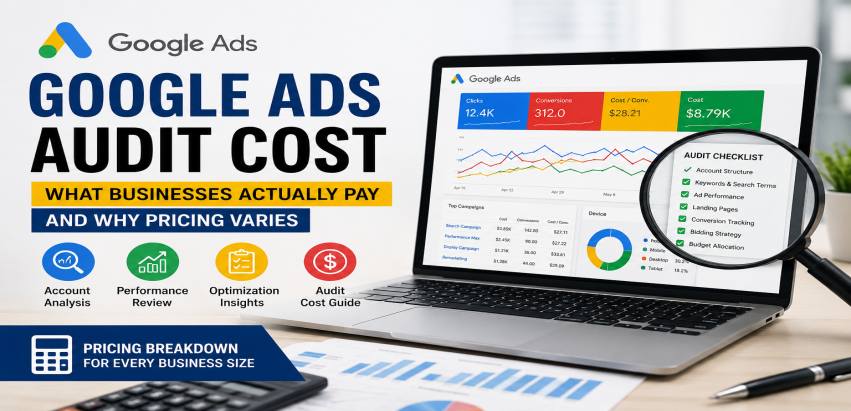
Google Ads audit pricing varies widely across agencies, consultants, and audit platforms. Some businesses receive free automated reports within minutes, while others invest thousands into detailed PPC account analysis.
The difference usually comes down to audit depth, campaign complexity, tracking accuracy, business size, and the level of strategic interpretation involved.
For businesses spending serious budgets on lead generation or ecommerce advertising, a surface-level audit often misses the real causes of wasted ad spend, poor ROAS, and unstable conversion performance.
That is why many companies invest in a professional Google Ads audit service before scaling campaigns further.
This guide explains what Google Ads audits typically cost, what affects pricing, what should be included in a professional PPC audit, and how businesses can evaluate the difference between automated reports and expert-led analysis.
What Is a Google Ads Audit?
A Google Ads audit is a detailed review of campaign performance, account structure, conversion tracking, targeting setup, bidding strategy, search terms, and overall PPC efficiency.
The goal is not only to identify weak campaign performance. A proper audit explains why campaigns underperform and what operational changes can improve CPA, ROAS, lead quality, and conversion rates.
What Happens Inside a Google Ads Audit
A manual Google Ads audit usually includes campaign structure analysis, GA4 validation, Google Tag Manager review, keyword analysis, negative keyword evaluation, landing page assessment, and attribution checks.
Experienced consultants also review Quality Score issues, audience targeting, search intent alignment, bid strategy conflicts, Performance Max behavior, and budget allocation inefficiencies.
In larger accounts, the audit may include device-level performance analysis, geographic segmentation review, offline conversion tracking validation, and cross-platform attribution evaluation.
Why Businesses Request PPC Audits
Businesses often request PPC audits after noticing rising CPC, declining ROAS, inconsistent lead quality, or increasing ad spend without corresponding revenue growth.
Others seek audits before changing agencies, restructuring campaigns, entering new markets, or scaling advertising budgets aggressively.
Aarmus Marketing regularly audits accounts where inaccurate conversion tracking has distorted reporting for months. In many cases, automated bidding strategies optimized campaigns around unreliable data signals.
That creates performance instability across bidding, attribution reporting, and overall campaign optimization.
How Much Does a Google Ads Audit Cost?
Google Ads audit pricing depends on campaign size, account complexity, business model, tracking setup, and the level of manual analysis required.
Smaller accounts with limited campaigns cost less to audit. Ecommerce brands, enterprise advertisers, and multi-market PPC accounts usually require far deeper operational analysis.
| Audit Type | Typical Cost | Complexity | Best For |
|---|---|---|---|
| Basic Automated Audit | $0 – $100 | Low | Surface-level issue detection |
| Freelancer Manual Audit | $300 – $1,000 | Medium | Small businesses and startups |
| Agency PPC Audit | $1,000 – $5,000+ | High | Growth-focused businesses |
| Ecommerce or Enterprise Audit | $5,000 – $20,000+ | Very High | Large-scale PPC operations |
Small Business Audit Pricing
Smaller businesses usually operate simpler PPC structures with fewer campaigns, lower search term volume, and less complicated attribution systems.
These audits often focus on keyword targeting, wasted ad spend reduction, landing page performance, negative keyword gaps, and conversion tracking validation.
Mid-Market Audit Pricing
Mid-market companies typically run campaigns across multiple channels including search, display, remarketing, YouTube, and Performance Max.
Their audits often require broader campaign performance analysis, audience segmentation review, attribution validation, and bidding strategy evaluation.
Ecommerce Audit Pricing
Ecommerce PPC audits usually cost more because analysts must review Merchant Center feeds, product segmentation, Performance Max campaigns, shopping search terms, and revenue attribution models.
Large product catalogs and international targeting structures increase operational complexity significantly.
Enterprise Audit Pricing
Enterprise PPC audits may involve multiple markets, extensive historical data, offline conversion systems, CRM integration, and layered attribution structures.
These audits often require collaboration across analytics teams, PPC specialists, and technical tracking consultants.
Why Google Ads Audit Pricing Varies So Much
Two Google Ads audits may appear similar externally while requiring completely different levels of work behind the scenes.
That is one of the main reasons pricing varies so heavily between freelancers, agencies, consultants, and automated audit platforms.
Campaign Complexity Changes Audit Scope
A local business running five campaigns is far easier to review than an international ecommerce advertiser managing hundreds of ad groups across multiple regions and languages.
Complex campaign structures increase the amount of manual review required for search terms, audience behavior, bidding logic, geographic segmentation, and budget distribution.
Accounts with years of historical performance data also require more strategic interpretation.
Tracking and Attribution Increase Audit Depth
Many businesses assume conversion tracking works properly until an audit reveals duplicate conversions, missing GA4 events, broken Google Tag Manager triggers, or inaccurate offline conversion imports.
Tracking validation alone can consume a large portion of audit time inside enterprise accounts.
Attribution problems also distort ROAS reporting and automated bidding behavior.
Performance Max Requires Specialized Analysis
Performance Max campaigns combine automation, audience signals, creative assets, shopping feeds, and machine learning into one campaign system.
Auditing these campaigns requires analysis of asset groups, search category behavior, audience signals, conversion quality, and feed performance.
In many accounts, Performance Max hides inefficient spend patterns beneath aggregated reporting structures.
Enterprise Accounts Need Cross-Platform Evaluation
Large businesses often operate across Google Ads, analytics platforms, CRM systems, ecommerce platforms, and offline sales tracking environments.
That creates additional complexity during attribution validation, conversion path analysis, and reporting consistency review.
Businesses comparing PPC operational expenses should also understand how campaign complexity influences broader Google Ads management cost.
What Is Included in a Professional Google Ads Audit?
A professional Google Ads audit goes far beyond automated recommendations or exported dashboards. The process combines technical validation, campaign diagnostics, strategic interpretation, and business-context analysis.
The goal is not only to identify visible performance issues but to uncover the operational reasons behind wasted ad spend, inconsistent conversions, and unstable campaign efficiency.
| Audit Area | What Gets Reviewed | Business Impact |
|---|---|---|
| Conversion Tracking | GA4 setup, attribution, event validation, offline conversions | Reliable reporting accuracy |
| Keyword Analysis | Search terms, match types, negative keywords | Reduced wasted spend |
| Landing Pages | Conversion flow, page relevance, messaging consistency | Higher conversion rates |
| Budget Allocation | Campaign prioritization and spend efficiency | Improved budget control |
| Bid Strategy Review | CPA targets, ROAS strategy, automation behavior | More stable campaign performance |
Conversion Tracking Review
Tracking validation is often one of the most valuable parts of a PPC audit because inaccurate data affects every optimization decision inside the account.
Consultants usually review GA4 configuration, Google Tag Manager setup, event duplication, attribution models, offline conversion tracking, and CRM integration accuracy.
In many accounts, automated bidding systems optimize campaigns around incomplete or unreliable conversion signals without businesses realizing it.
Search Query and Keyword Analysis
Search query analysis identifies where campaigns waste budget or attract low-intent traffic. It also reveals hidden targeting inefficiencies affecting lead quality and ROAS.
The audit may uncover weak negative keyword coverage, excessive broad match expansion, poor keyword grouping, duplicate targeting, or irrelevant search queries consuming spend.
For lead generation campaigns, search intent quality often matters more than raw conversion volume.
Landing Page Evaluation
Landing pages directly influence conversion rates, Quality Score, CPC efficiency, and campaign profitability.
A proper audit reviews message alignment, offer clarity, mobile usability, conversion friction, CTA positioning, page speed, and consistency between ads and landing pages.
Even strong campaigns can underperform when the landing experience creates hesitation or confusion for visitors.
Budget Allocation Review
Budget inefficiencies often appear when campaigns distribute spend unevenly across low-performing audiences, weak keywords, or low-converting regions.
Analysts usually review campaign prioritization, impression share allocation, bidding overlap, and spend concentration patterns.
In larger accounts, poor budget distribution can quietly reduce profitability despite healthy top-level metrics.
Audience and Bid Strategy Analysis
Audience targeting and bid strategies influence how efficiently campaigns acquire conversions over time.
The audit may evaluate audience layering, customer match usage, remarketing structure, smart bidding configuration, target CPA behavior, and ROAS optimization logic.
Aarmus Marketing frequently identifies accounts where conflicting bidding signals reduce automation efficiency significantly.
Cheap Automated Audit vs Manual Expert Audit
Many businesses receive free PPC audits generated through automated audit tools. Some reports are useful for detecting visible setup issues, but they rarely explain the actual causes of campaign inefficiencies.
That is where manual expert-led audits differ substantially.
| Manual Audit | Automated Audit |
|---|---|
| Business-specific interpretation | Rule-based recommendations |
| Human analysis of campaign behavior | Surface-level account scanning |
| Tracking validation | Limited tracking checks |
| Strategic optimization guidance | Checklist-style suggestions |
| Landing page and funnel analysis | Minimal business context |
| Cross-platform evaluation | Platform-limited review |
How Automated PPC Audit Tools Work
Automated audit tools scan campaign settings, compare accounts against predefined optimization rules, and identify visible configuration gaps.
These systems often detect missing ad assets, duplicate keywords, weak ad strength scores, limited negative keyword coverage, or bidding inconsistencies.
For quick operational reviews, automation can provide useful starting points.
Where Automated Reports Usually Fail
Automated systems struggle with business context, lead quality interpretation, customer profitability analysis, and attribution reliability.
They also fail to interpret nuanced issues like sales qualification problems, ecommerce margin differences, offline conversion quality, or landing page psychology.
Many reports generate generic recommendations that appear useful but create limited commercial impact.
Why Human Interpretation Still Matters
Experienced PPC consultants can connect campaign behavior with broader business outcomes instead of evaluating metrics in isolation.
That includes identifying hidden wasted spend patterns, attribution distortions, bid strategy conflicts, audience quality issues, and funnel breakdowns affecting profitability.
The audit team at Aarmus Marketing often reviews accounts where automated systems flagged minor optimization tasks while completely missing deeper tracking and conversion-quality problems.
When Automation Actually Helps
Automation still plays an important role inside modern PPC audits. AI-driven systems can identify anomalies, scan account structures quickly, and surface operational irregularities faster than manual reviews alone.
The strongest audits usually combine automated detection with strategic human analysis.
That balance improves efficiency without removing business-context interpretation from the process.
Google Ads Audit Cost by Business Type
Audit pricing changes significantly across industries and business models because campaign complexity, attribution requirements, and optimization challenges vary heavily between account types.
A local service business does not require the same audit depth as a multinational ecommerce brand running shopping campaigns across thousands of products.
| Business Type | Typical Audit Cost | Complexity Level |
|---|---|---|
| Local Service Business | $300 – $1,000 | Low to Medium |
| Lead Generation Business | $1,000 – $3,500 | Medium to High |
| Healthcare or Legal PPC | $2,000 – $5,000+ | High |
| Ecommerce Brand | $5,000 – $20,000+ | Very High |
| Enterprise PPC | $10,000+ | Advanced |
Local Service Business Audits
Local PPC audits usually focus on geographic targeting, call tracking accuracy, search intent alignment, lead quality, and local conversion performance.
Audit complexity remains relatively manageable unless the business operates across multiple cities, branches, or franchise locations.
Lead Generation PPC Audits
Lead generation audits require deeper analysis of conversion quality, CRM attribution flow, landing page performance, and keyword profitability.
Industries with high CPC competition often need more advanced search query evaluation and bidding analysis.
Lead quality matters far more than raw lead volume in these accounts.
Healthcare and Legal PPC Audits
Healthcare and legal campaigns usually involve expensive CPC environments, strict compliance considerations, and highly competitive search behavior.
Audits often require closer analysis of conversion intent, call quality, audience targeting, and localized campaign segmentation.
Small optimization mistakes in these industries can create substantial wasted spend quickly.
Ecommerce PPC Audits
Ecommerce audits involve Merchant Center diagnostics, shopping feed analysis, Performance Max evaluation, ROAS validation, and product-level segmentation review.
Large product catalogs increase operational complexity significantly, especially for brands operating internationally.
Enterprise PPC Audits
Enterprise PPC audits often involve layered attribution systems, multiple stakeholders, CRM integration, extensive historical data, and cross-platform conversion analysis.
These audits typically require strategic interpretation beyond standard account optimization recommendations.
Ecommerce Google Ads Audit Pricing
Ecommerce Google Ads audits are usually more expensive than standard lead generation audits because shopping campaigns involve far more operational complexity.
Performance problems inside ecommerce PPC accounts often originate from product feeds, attribution gaps, Merchant Center limitations, campaign segmentation issues, or inaccurate revenue tracking rather than ad copy alone.
Merchant Center Complexity
Merchant Center diagnostics can reveal feed disapprovals, missing product attributes, incorrect categorization, pricing inconsistencies, availability mismatches, and policy limitations affecting visibility.
Large ecommerce stores may require extensive feed-level analysis across thousands of products, variants, categories, and international inventory structures.
Consultants often review GTIN accuracy, title optimization, image quality, feed segmentation logic, and inventory synchronization during the audit process.
Performance Max Audit Challenges
Performance Max campaigns combine automation, audience signals, creative assets, shopping feeds, and machine learning into one campaign structure.
Auditing these campaigns usually requires asset group analysis, audience signal evaluation, search category interpretation, conversion quality assessment, and budget allocation review.
In many ecommerce accounts, Performance Max campaigns absorb large budgets while hiding inefficient spend behavior beneath aggregated reporting structures.
Feed Optimization Problems
Shopping feed quality directly affects visibility, CPC efficiency, click-through rates, and conversion performance.
Poorly structured feeds often reduce campaign efficiency even when bidding strategies appear healthy on the surface.
Audits may uncover weak product titles, missing attributes, category conflicts, low-quality product images, or segmentation problems limiting campaign performance.
Attribution and ROAS Analysis
Many ecommerce brands struggle with inaccurate ROAS reporting due to duplicate transactions, missing purchase events, broken attribution paths, or inconsistent GA4 implementation.
Tracking problems can distort campaign optimization completely, especially when automated bidding systems rely heavily on conversion accuracy.
Aarmus Marketing frequently audits ecommerce accounts where attribution inconsistencies quietly reduced profitability for months before the business recognized the operational impact.
Freelancer vs Agency Google Ads Audit Pricing
Businesses comparing PPC audit providers often focus heavily on pricing. The more meaningful comparison is usually audit depth, operational capability, strategic reasoning, and long-term reliability.
Both freelancers and agencies can deliver high-quality audits depending on experience, specialization, and analytical process.
| Freelancer | Agency |
|---|---|
| Usually lower pricing | Broader specialist access |
| Direct consultant communication | Structured audit workflows |
| Suitable for smaller accounts | Better for complex PPC systems |
| Limited operational bandwidth | Collaborative multi-specialist analysis |
| Depends heavily on individual expertise | Often includes analytics and tracking specialists |
When Freelancers Make Sense
Freelancers are often suitable for startups, local businesses, and smaller PPC accounts with moderate campaign complexity.
Many businesses prefer direct consultant access, lower pricing flexibility, and faster communication workflows.
Experienced freelancers can deliver strong audits when campaign structures remain manageable.
When Agencies Add More Value
Agencies are often better suited for enterprise PPC accounts, ecommerce brands, multi-market advertisers, or businesses requiring technical tracking expertise.
Some audits involve specialists across analytics, CRO, feed optimization, attribution modeling, landing page evaluation, and campaign architecture.
That collaborative structure can improve audit depth significantly in larger accounts.
Differences in Audit Process
Freelancer audits are usually more dependent on one person's workflow, experience, and interpretation style.
Agency audits often involve layered review processes, structured deliverables, tracking validation systems, and collaborative analysis between multiple PPC specialists.
The process difference becomes more noticeable as account complexity increases.
How Ongoing Support Usually Changes
Some freelancers focus primarily on one-time audit projects, while agencies may provide broader optimization support after the audit phase.
Businesses planning long-term campaign scaling often benefit from providers that can support implementation, testing, attribution fixes, and ongoing optimization after recommendations are delivered.
The best provider choice usually depends on business size, campaign complexity, internal resources, and growth goals.
Hidden Problems Most Google Ads Audits Miss
Many PPC audits identify visible optimization gaps but fail to uncover deeper operational issues affecting profitability, attribution accuracy, and conversion quality.
Those hidden problems often continue distorting campaign performance long after surface-level optimizations are completed.
Tracking Problems Hidden Inside GA4
GA4 tracking issues are far more common than many businesses realize. Duplicate conversions, missing events, incorrect attribution settings, and broken cross-domain tracking can distort reporting significantly.
Some accounts also contain conflicting event structures between GA4, Google Ads, CRM systems, and ecommerce platforms.
When tracking data becomes unreliable, automated bidding systems start optimizing around inaccurate signals.
Search Query Waste Most Reports Ignore
Many automated audits focus heavily on keywords while ignoring deeper search query behavior.
That creates blind spots around low-intent traffic, weak commercial intent alignment, irrelevant broad match expansion, and wasted spend patterns hidden inside search term reports.
Manual search query analysis often reveals inefficiencies that surface-level PPC reports completely overlook.
Attribution Errors That Distort ROAS
Attribution inconsistencies can create misleading ROAS reporting across campaigns, channels, and devices.
Some businesses overvalue branded campaigns, undervalue remarketing, or misinterpret assisted conversions because attribution paths are incomplete or incorrectly configured.
The consultants at Aarmus Marketing regularly review accounts where attribution distortions caused businesses to scale the wrong campaigns while reducing budget on profitable traffic sources.
What Businesses Should Expect From a Paid Audit
A paid Google Ads audit should provide more than a list of optimization suggestions or automated recommendations.
The real value comes from identifying what limits campaign performance, why those problems exist, and how they affect lead quality, ROAS, CPA, and long-term scalability.
What a Good Audit Should Reveal
A strong PPC audit usually uncovers wasted ad spend sources, conversion tracking gaps, poor search intent alignment, weak campaign segmentation, inefficient bidding strategies, and landing page friction.
The findings should connect directly to measurable business outcomes instead of focusing only on platform-level metrics.
Businesses should clearly understand which operational problems create the largest performance limitations inside the account.
How Recommendations Should Be Structured
Professional audits usually organize recommendations by implementation priority, expected business impact, and operational difficulty.
This structure helps businesses decide which fixes require immediate action and which improvements can be implemented gradually over time.
Well-structured audits also explain the reasoning behind recommendations instead of presenting disconnected optimization checklists.
What Happens After the Audit
Some businesses implement recommendations internally using in-house marketing teams. Others continue with consultants or agencies for optimization support and campaign execution.
The audit phase often becomes the foundation for broader PPC restructuring, attribution correction, landing page improvements, and budget reallocation.
Implementation quality usually determines how much value businesses actually gain from the audit process.
Why Ongoing Optimization Still Matters
Google Ads performance changes constantly due to competition shifts, search behavior changes, bidding dynamics, and platform updates.
That means even well-optimized campaigns require ongoing monitoring, testing, and refinement over time.
Businesses that need long-term execution support often combine audit recommendations with broader Google Ads management services to maintain campaign efficiency after the audit is completed.
Can AI Tools Replace Manual Google Ads Audits?
AI-powered PPC audit tools have improved rapidly over recent years. Many systems can now detect campaign setup issues, bidding inconsistencies, keyword conflicts, and optimization gaps within minutes.
That speed makes automation useful for operational scanning. The limitation appears when businesses need strategic interpretation rather than automated observations alone.
| AI Audit Tools | Human Audit Analysis |
|---|---|
| Fast account scanning | Business-context interpretation |
| Rule-based recommendations | Strategic optimization reasoning |
| Automated anomaly detection | Commercial performance analysis |
| Limited attribution understanding | Cross-platform evaluation |
| Generic optimization suggestions | Prioritized implementation guidance |
| Surface-level campaign review | Deep operational diagnosis |
What AI Tools Detect Well
AI systems are effective at identifying missing ad assets, weak ad strength scores, duplicate keywords, limited negative keyword coverage, tracking inconsistencies, and unusual campaign behavior patterns.
Some platforms also provide anomaly detection, predictive trend analysis, and automated optimization suggestions based on historical account data.
For routine account monitoring, these tools can save considerable time.
Where Human Strategy Still Wins
AI systems still struggle with customer intent interpretation, lead quality analysis, attribution nuance, and broader commercial decision-making.
A platform may detect declining ROAS without understanding whether the problem originates from pricing changes, poor sales qualification, low-margin products, weak landing experiences, or CRM reporting inconsistencies.
Experienced PPC consultants can connect campaign behavior with broader business outcomes instead of interpreting metrics in isolation.
Aarmus Marketing often audits accounts where automated systems identified minor optimization tasks while completely missing deeper attribution errors and conversion-quality problems.
How AI Will Change PPC Audits
AI will continue improving operational efficiency inside PPC audits, especially for anomaly detection, account scanning, and performance monitoring.
The strongest audit processes will likely combine AI-driven diagnostics with human strategic interpretation rather than replacing consultants entirely.
Businesses still need commercially aware analysis when making decisions around scaling budgets, restructuring campaigns, and evaluating profitability.
How to Choose the Right Google Ads Audit Provider
Choosing a Google Ads audit provider involves more than comparing pricing alone. The largest differences usually appear in analytical depth, tracking expertise, reporting clarity, and strategic reasoning.
Some providers rely heavily on automated exports. Others perform extensive manual analysis across attribution systems, campaign architecture, search behavior, and conversion quality.
Questions Businesses Should Ask
Businesses should ask how the audit process works, what areas are reviewed manually, how conversion tracking is validated, and what deliverables are included.
It is also useful to ask whether the provider has experience with similar industries, ecommerce structures, lead generation models, or enterprise PPC environments.
Good consultants usually explain their methodology clearly instead of relying on vague promises.
Red Flags in Cheap PPC Audits
Extremely cheap audits often depend heavily on automated exports with minimal strategic interpretation.
Reports filled with generic recommendations, repetitive screenshots, or platform-generated suggestions usually provide limited operational insight.
Another warning sign appears when providers avoid discussing attribution validation, landing page analysis, search intent quality, or conversion tracking verification.
Strong audits require meaningful manual analysis. That process takes time.
What Strong Audit Providers Usually Show
Experienced audit providers typically explain problems clearly, connect findings with business outcomes, and prioritize recommendations based on commercial impact.
Their reports usually include implementation reasoning instead of disconnected optimization lists.
Businesses should also look for transparency around scope, audit limitations, implementation expectations, and tracking methodology.
How to Evaluate Audit Quality
Businesses evaluating audit providers should review sample deliverables, reporting clarity, implementation detail, and analytical depth.
A good audit should create a practical optimization roadmap instead of overwhelming teams with generic platform suggestions.
The best providers help businesses understand why campaign problems happen, not just where they appear inside the account.
Google Ads Audit Cost FAQs
How Much Should a Google Ads Audit Cost?
Google Ads audit pricing can range from free automated reports to enterprise-level audits costing several thousand dollars.
The final cost usually depends on campaign complexity, account size, tracking systems, ecommerce requirements, attribution depth, and the level of manual analysis involved.
Smaller lead generation accounts generally cost far less to audit than large ecommerce or multi-market PPC environments.
Are Free Google Ads Audits Worth It?
Free audits can be useful for identifying visible setup issues and basic optimization gaps.
Most free reports, however, rely heavily on automated systems and provide limited strategic interpretation or business-context analysis.
They are often useful as an initial review but rarely sufficient for diagnosing deeper campaign inefficiencies.
How Long Does a PPC Audit Take?
Smaller PPC accounts may take a few hours to review, while enterprise or ecommerce audits can require several days depending on campaign scale and tracking complexity.
Accounts with attribution problems, CRM integrations, or large historical datasets usually require additional analysis time.
Audit timelines also vary depending on the level of documentation and implementation detail included in the final deliverables.
Can PPC Audits Improve ROAS?
A strong PPC audit can improve ROAS by identifying wasted ad spend, poor search intent alignment, weak bidding strategies, conversion tracking errors, and landing page inefficiencies.
The actual performance improvement depends heavily on how effectively the recommendations are implemented afterward.
Audits provide the diagnosis. Optimization execution determines long-term results.
Do Ecommerce Accounts Need Specialized Audits?
Yes. Ecommerce PPC accounts involve Merchant Center feeds, shopping campaigns, Performance Max systems, product segmentation, and attribution challenges that require specialized analysis.
Standard lead generation audit frameworks often miss operational issues specific to ecommerce advertising environments.
Large product catalogs also increase audit complexity significantly.
What Is the Difference Between Audit and Management?
A Google Ads audit is a diagnostic review of campaign performance, tracking systems, targeting structure, and optimization problems.
Google Ads management involves ongoing optimization, testing, bid adjustments, reporting, campaign scaling, and implementation work over time.
An audit identifies what needs improvement. Management focuses on executing and refining those improvements continuously.
How Often Should Businesses Audit Google Ads?
Most businesses benefit from a professional PPC audit at least once or twice per year, especially when budgets are increasing or campaign performance becomes unstable.
Businesses undergoing rapid growth, restructuring, platform migrations, or ecommerce expansion may require more frequent audits.
Audits are also valuable after major changes to tracking systems, attribution models, or campaign architecture.
Can AI Tools Replace PPC Consultants?
AI tools can automate campaign scanning, anomaly detection, and operational monitoring very effectively.
They still struggle with strategic interpretation, customer intent analysis, conversion quality evaluation, and broader commercial reasoning.
Most businesses still benefit from human analysis when making decisions around scaling budgets, restructuring campaigns, and improving long-term profitability.
Final Thoughts on Google Ads Audit Cost
Google Ads audit pricing varies because PPC accounts vary in complexity, tracking quality, business objectives, and operational scale.
A small local campaign does not require the same level of analysis as an enterprise ecommerce account managing Performance Max campaigns, shopping feeds, CRM attribution, and multi-market advertising.
That is why businesses should evaluate audit depth and strategic quality instead of comparing providers only on price.
A detailed PPC audit can uncover wasted spend, inaccurate conversion tracking, weak search intent alignment, landing page inefficiencies, bidding conflicts, and attribution problems that quietly reduce profitability over time.
The most valuable audits usually combine technical validation with commercially aware interpretation. They explain not only what is wrong inside the account but why those issues affect lead quality, ROAS, and campaign scalability.
Aarmus Marketing approaches Google Ads audits with a focus on tracking accuracy, operational clarity, strategic prioritization, and practical optimization guidance rather than generic automated recommendations.
For businesses investing serious budgets into Google Ads, a professional audit often becomes the foundation for more stable performance, smarter budget allocation, and better long-term decision-making.