

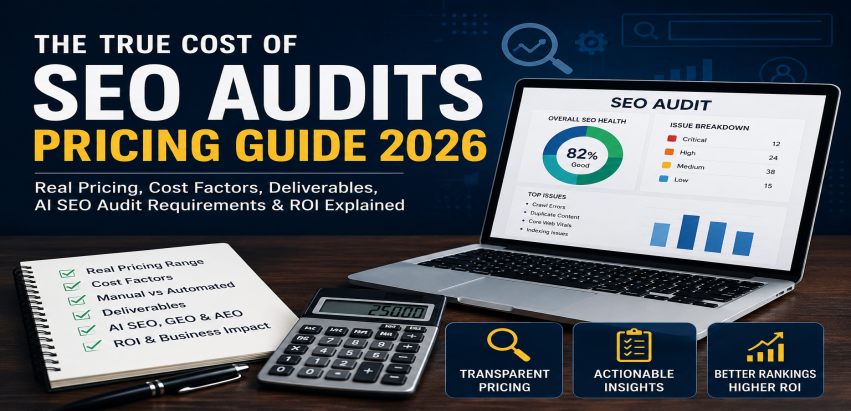
One business paid $150 for an SEO audit last year. They received a 180-page PDF with 340 flagged issues and no clarity on what to fix first. Six months later, organic traffic had dropped another 23%. A second business paid $1,200 for a manual technical audit from Aarmus Marketing. Within 90 days of implementing the prioritized fixes, their indexed pages increased by 38% and lead form submissions from organic search doubled.
The difference was not the price. The difference was what actually happened inside the audit.
SEO audit cost in 2026 ranges from $200 to $15,000 and above depending on website size, technical complexity, crawl depth, business goals, and the level of manual analysis involved. But pricing alone tells you almost nothing about audit quality.
Some audits are generated in minutes through automated tools. Others involve weeks of crawl diagnostics, rendering investigation, indexing analysis, Core Web Vitals evaluation, semantic SEO review, and business-impact prioritization across thousands of URLs.
Search visibility in 2026 has also changed significantly. SEO audits now extend beyond rankings and metadata checks. Businesses increasingly need AI search visibility analysis, entity SEO evaluation, structured data validation, indexing diagnostics, and readiness assessments for conversational search systems like Google AI Overviews.
This guide from Aarmus Marketing breaks down how SEO audit pricing actually works, what increases audit cost, what deliverables businesses should demand, and how to tell the difference between an automated report and a genuinely useful technical investigation.
Aarmus Marketing is a performance marketing agency based in Surat, Gujarat, India. We have audited websites across ecommerce, healthcare, hospitality, manufacturing, and professional services sectors for clients in the US, UK, Canada, Australia, and India. The pricing context, deliverable breakdowns, and quality signals in this guide come from that direct operational experience.
1. Why SEO Audit Pricing Varies So Much
Two agencies can quote $300 and $5,000 for what both call an SEO audit. The price gap is not arbitrary. It reflects how much actual technical investigation, manual analysis, and business-impact thinking goes into the work.
Many low-cost audits are generated through automated software exports. A specialist enters a URL, the tool crawls the site, and a report is produced within hours. These reports can run 150 pages and flag hundreds of issues. The problem is that automated tools identify symptoms. They rarely explain which problems are hurting rankings, why those problems exist, or which fixes deserve priority given the specific business context.
Manual SEO audits work differently. Technical specialists review crawl behavior, rendering conditions, indexation patterns, semantic relationships, internal linking structures, and search visibility risks across the entire website. This process requires significant time, multiple tools used in combination, and genuine expertise to interpret what the data means for that specific website and business.
The pricing difference reflects operational depth rather than report length.
Automated SEO Reports vs Manual Technical Audits
Automated SEO tools like Screaming Frog, Ahrefs, SEMrush, and Sitebulb are genuinely useful for detecting surface-level technical issues. Missing metadata, broken links, redirect chains, duplicate titles, crawl errors, and structured data warnings can all be identified at scale through software crawls.
These tools become a problem when the output is delivered directly as the audit without any human interpretation layered on top. Automated reports frequently generate false positives. They flag issues that are intentional, low-risk, or technically irrelevant to how that particular website works.
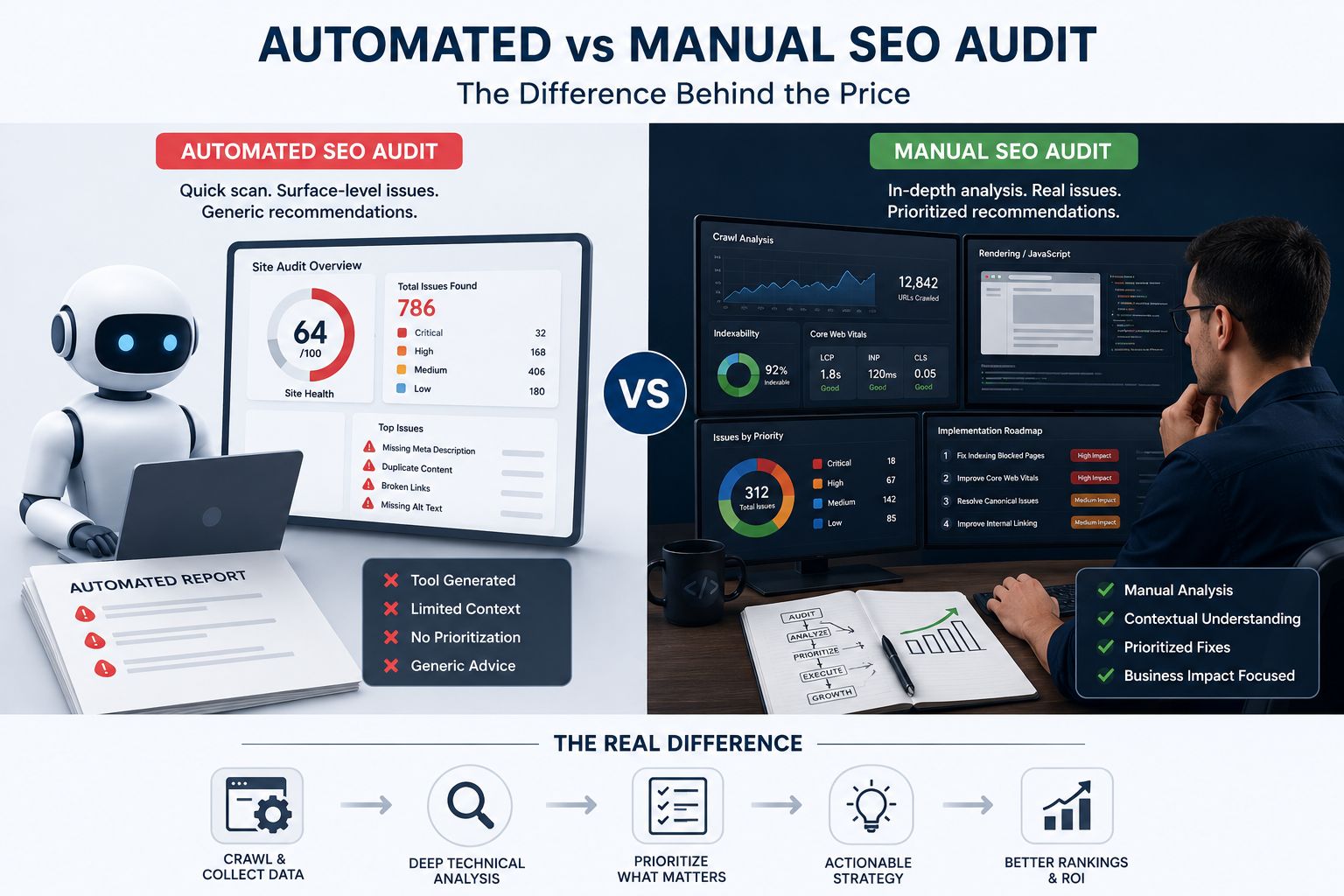
Manual audits filter that noise. A technical specialist validates which reported issues are real, assesses their severity in context, identifies problems the software missed entirely, particularly around JavaScript rendering, crawl budget allocation, and semantic content structure, and organizes findings into a prioritized action plan based on business impact.
| Audit Type | Automated SEO Audit | Professional Manual SEO Audit |
|---|---|---|
| Data Collection | Software-generated | Manual analysis combined with tool diagnostics |
| Technical Interpretation | Limited to what the software flags | Contextual and tied to business outcomes |
| Priority Recommendations | Generic severity scoring | Risk and impact-based prioritization |
| JavaScript SEO Review | Minimal coverage | Advanced rendering diagnostics |
| AI Search Evaluation | Usually absent | Entity SEO and GEO readiness review |
| Business Relevance | Low | High |
How Agencies Calculate Audit Scope
Agencies that do this work properly calculate audit pricing based on technical workload, not just page count. Two websites with 500 pages each may require completely different audit effort depending on platform architecture, crawl behavior, JavaScript dependencies, and the amount of accumulated technical debt.
At Aarmus Marketing, audit scoping begins with a pre-audit technical review. Before quoting a price, we assess crawl behavior, indexation status, platform type, rendering environment, and visible technical complexity. A Shopify store with 800 product pages and faceted filters requires significantly more investigation than an 800-page informational blog with a clean URL structure.
Audit scope typically includes crawl analysis, indexation review, Core Web Vitals investigation, internal linking evaluation, schema validation, content structure analysis, and competitive search visibility review. Some engagements also include stakeholder meetings, implementation planning sessions, and developer coordination as part of the audit delivery.
SEO Tools, Crawl Costs, and Analysis Time
Professional SEO audits rely on multiple technical tools simultaneously. Screaming Frog, Ahrefs, SEMrush, Google Search Console, server log analyzers, rendering diagnostic tools, and Core Web Vitals platforms all play different roles in the investigation process.
Large-scale website crawls consume processing resources, software licensing credits, and analyst time. Enterprise websites with hundreds of thousands of URLs may require segmented crawl strategies and multiple validation passes to get accurate data.
Manual investigation is the most expensive part of the audit process. Technical specialists spend time validating false positives, identifying crawl inefficiencies that software misses, reviewing rendering inconsistencies, and prioritizing risks based on actual business impact. This work cannot be replaced by automation alone, which is why high-quality audits cost more than software reports.
Why Enterprise Websites Require More Audit Resources
Enterprise SEO audits involve significantly larger operational complexity. These websites often contain layered navigation systems, parameter-based URLs, regional content structures, faceted filters, dynamic rendering environments, and large-scale index management challenges.
Enterprise audits may also require coordination between SEO teams, developers, analytics teams, UX stakeholders, and content managers to understand how technical problems affect business performance across different departments.
Large websites frequently experience crawl budget waste, duplicate indexing, orphan pages, inconsistent canonicalization, and rendering instability across page templates. Investigating these issues requires far deeper analysis compared to smaller business websites, which explains why enterprise audit pricing sits at a completely different level.
2. How Much Does an SEO Audit Cost in 2026?
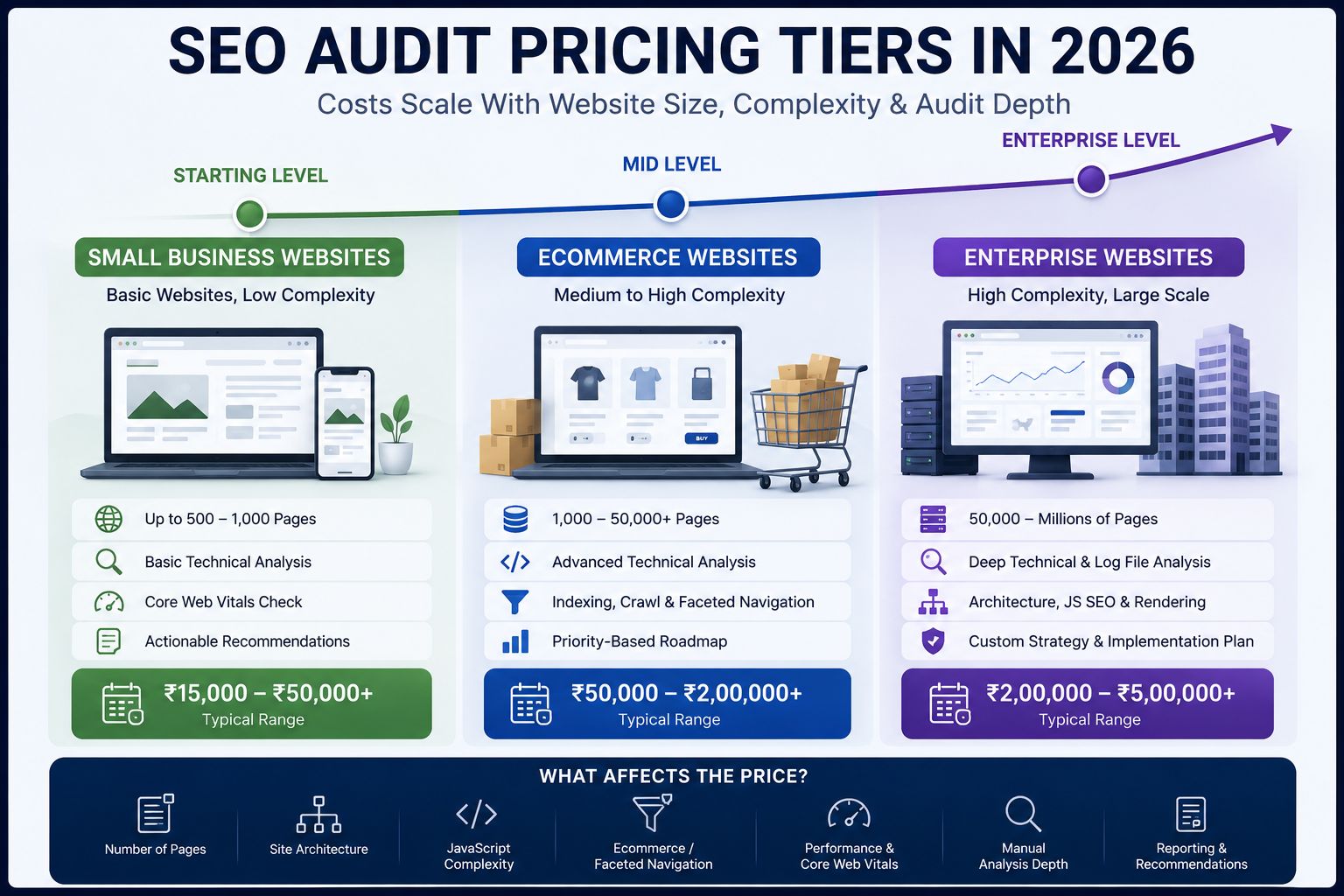
SEO audit cost in 2026 typically falls between $200 and $15,000 and above. The range is wide because the operational workload varies enormously between a 20-page local business website and a 50,000-product ecommerce platform. Pricing also varies by country. Agencies in the US, UK, Canada, and Australia typically charge more per hour than agencies in other regions, even for equivalent levels of technical quality.
For businesses in India, equivalent pricing typically runs from ₹15,000 for small business audits to ₹12,00,000 and above for enterprise engagements. India-based agencies like Aarmus Marketing can often deliver audit quality comparable to US and UK firms at significantly lower pricing due to operational cost differences, which is why international clients increasingly work with Indian SEO teams for technical audit engagements.
For businesses evaluating offshore or remote audit providers, the relevant question is not where the agency is based but what the audit actually delivers. A well-scoped manual audit from a remote agency often produces stronger commercial results than an automated report from a local firm at three times the price.
| Website Type | USD | GBP | INR | Audit Scope |
|---|---|---|---|---|
| Small Business Website | $200 to $800 | £160 to £650 | ₹15,000 to ₹65,000 | Basic technical SEO, on-page review, indexing analysis |
| Medium Business Website | $800 to $3,000 | £650 to £2,400 | ₹65,000 to ₹2,50,000 | Technical diagnostics, content review, Core Web Vitals, schema analysis |
| Ecommerce Website | $2,000 to $7,000 | £1,600 to £5,500 | ₹1,60,000 to ₹5,75,000 | Product indexing, crawl budget review, category structure, filter management |
| Enterprise Website | $6,000 to $15,000+ | £4,800 to £12,000+ | ₹5,00,000 to ₹12,00,000+ | Advanced technical SEO, rendering diagnostics, large-scale crawl analysis, team coordination |
SEO Audit Pricing for Small Business Websites
Small business websites usually need foundational SEO audits focused on indexing, crawlability, metadata structure, page hierarchy, internal linking, and Core Web Vitals evaluation. These audits are less expensive because website architecture is simpler and crawl complexity is lower.
Even at this price point, businesses should expect manual analysis rather than a fully automated export. For businesses where organic visibility directly drives phone calls, bookings, or lead form submissions, the quality of the audit determines whether the investment produces results.
A $400 audit that surfaces one critical indexing issue causing a key service page to be excluded from Google can be worth considerably more than its price. A $400 audit that lists 200 minor metadata warnings provides almost no commercial value.
Technical SEO Audit Cost Explained
Technical SEO audits are priced according to investigation depth. Websites with rendering problems, crawl inefficiencies, JavaScript SEO issues, duplicate indexing, or unstable Core Web Vitals require significantly more analysis time than clean, simple platforms.
Advanced technical audits include server-log evaluation, Googlebot crawl behavior analysis, structured data validation, rendering diagnostics, canonical review, and mobile rendering investigations. Each of these areas requires different tools and different expertise to assess properly.
Websites using React, Next.js, Vue, or Angular frameworks, or those using client-side rendering, typically increase audit cost because technical validation becomes more complex. Googlebot may see a completely different page than a human visitor, and diagnosing that gap requires rendering-specific testing workflows.
Ecommerce SEO Audit Pricing
Ecommerce SEO audits cost more because product catalogs, faceted navigation, category hierarchies, and inventory-based indexing issues create significantly larger technical workloads. A Shopify or WooCommerce store with 5,000 products and 20 filter facets can generate hundreds of thousands of crawlable URL combinations, most of which should never be indexed.
Ecommerce audits from Aarmus Marketing cover crawl budget analysis, orphan product detection, duplicate URL review, structured product data validation, collection page evaluation, pagination handling, and transactional search analysis. Each of these areas requires specific technical workflows that automated tools cannot complete independently.
Businesses researching SEO cost for ecommerce websites often underestimate how much technical work exists beneath the product catalog. The visible storefront represents a fraction of the actual SEO complexity.
Enterprise SEO Audit Cost
Enterprise SEO audits sit at the highest pricing range because large websites require deeper technical investigation and operational coordination across multiple teams and systems. Enterprise environments often contain multilingual structures, regional subdirectories, dynamic rendering systems, large-scale pagination, parameterized URLs, and millions of indexed pages.
Audits at this level commonly require structured collaboration between SEO analysts, developers, analytics teams, and business stakeholders before findings can be properly prioritized. A technical issue that appears minor in isolation may be causing significant revenue impact when its effect on high-value transactional pages is understood in full context.
Freelancer vs Agency SEO Audit Pricing
Freelancers usually offer lower SEO audit pricing because operational overhead is smaller. Some freelancers have strong technical expertise, particularly for smaller websites or focused technical reviews on a specific platform.
Agencies typically charge more because audits involve multiple specialists, broader software stacks, QA validation across findings, structured reporting workflows, and strategic prioritization frameworks that draw on experience across many different website types and industries.
| Factor | Freelancer SEO Audit | Agency SEO Audit |
|---|---|---|
| Pricing | Lower | Higher |
| Team Involvement | Single specialist | Multi-specialist workflow |
| Technical Resources | Limited tool stack | Broader software ecosystem |
| Scalability | Suitable for smaller sites | Suitable for enterprise and ecommerce platforms |
| Reporting Depth | Varies significantly | Usually more structured and validated |
3. What Actually Increases the Cost of an SEO Audit
SEO audit cost is not determined by page count alone. Two websites with similar traffic levels and similar page counts can require completely different audit resources depending on crawl behavior, platform architecture, JavaScript dependencies, content structure, and how much technical debt has accumulated over time.
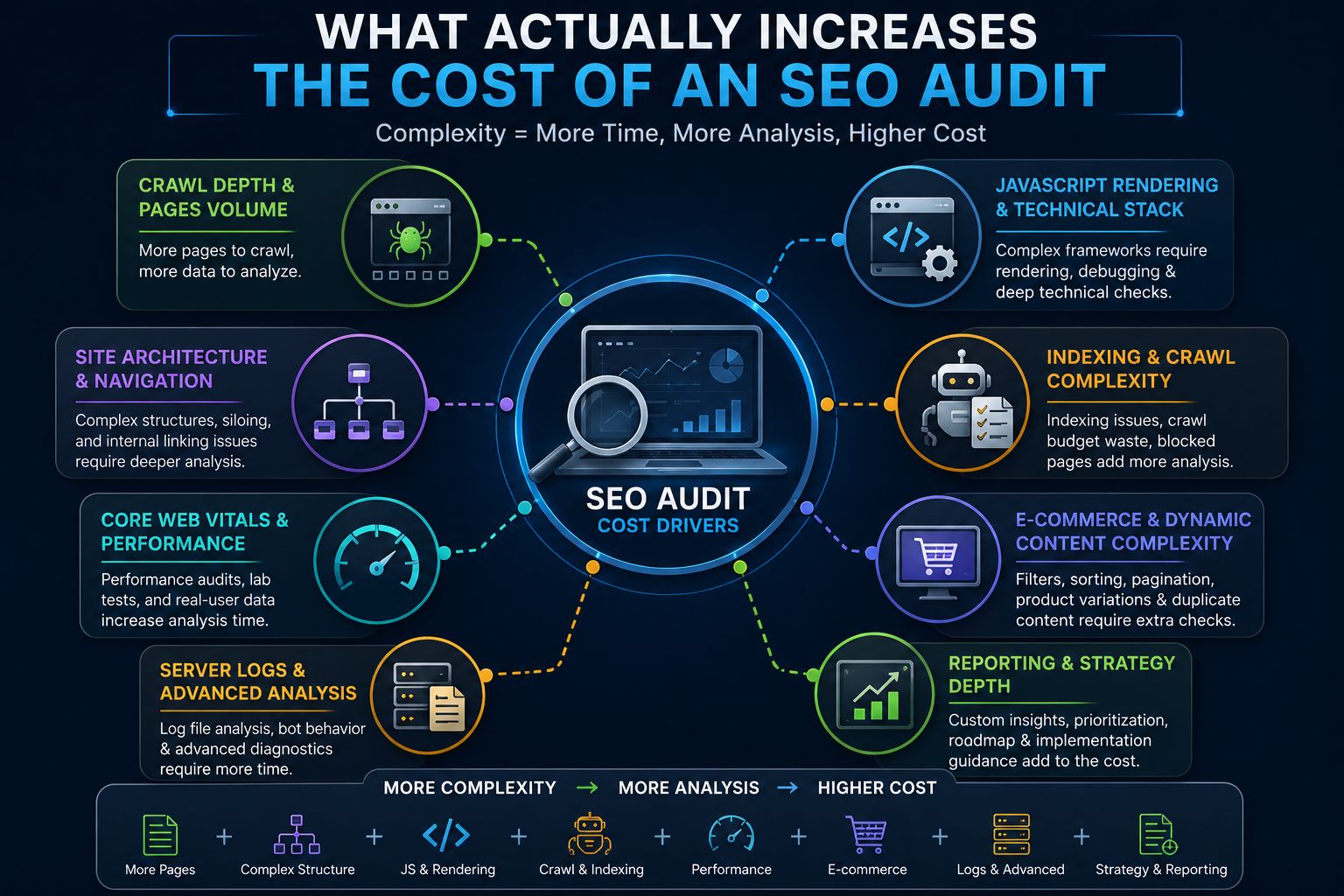
In Aarmus Marketing's audit engagements, some of the most involved scoping decisions have nothing to do with how large the website looks on the surface. A 300-page website built on a poorly configured headless CMS with client-side rendering can require more investigation hours than a 3,000-page static website with clean architecture.
| Cost Factor | Why It Increases Audit Workload | Impact on Pricing |
|---|---|---|
| Large URL Volume | Requires deeper crawl analysis and index review | High |
| JavaScript Rendering | Needs rendering diagnostics and Googlebot testing | High |
| Ecommerce Architecture | Creates category, filter, and duplicate indexing complexity | High |
| Technical SEO Debt | Requires manual validation and prioritization of accumulated issues | Medium to High |
| Core Web Vitals Problems | Needs performance analysis across multiple page templates | Medium |
| Enterprise Infrastructure | Involves cross-team technical coordination | High |
Large Site Architecture and Crawl Complexity
Large websites create crawl management challenges because search engines do not crawl every page on every visit. Googlebot allocates crawl budget based on signals including page authority, internal linking, crawl efficiency, and server response behavior. Websites that waste crawl budget on low-value pages, redirect chains, or parameter-generated duplicate URLs may find that their most important pages receive infrequent or inconsistent crawl attention.
Technical audits for large websites involve crawl segmentation, index coverage analysis, orphan page detection, canonical review, and internal linking evaluation across thousands of URLs. Identifying where crawl budget is being misallocated requires log file analysis alongside crawl data, a process that takes significantly more time than a standard automated scan.
Why Ecommerce Websites Need Deeper SEO Analysis
Ecommerce websites generate SEO complexity that static content sites rarely face. Category pages with sorting options, price filters, color filters, and size filters can each produce unique URLs. Without proper canonical configuration, these filter combinations create thousands of indexable duplicate pages that fragment ranking signals and waste crawl budget.
Product pages introduce their own challenges. Variants such as size, color, and material may generate separate URLs. Out-of-stock products may need to remain indexed or be properly redirected. Seasonal products require different handling than permanent catalog items. Pagination on category pages must be handled correctly to avoid content duplication.
None of these issues are identifiable through a generic automated scan. Each requires contextual investigation to determine the correct technical resolution for that specific platform and catalog structure.
Technical SEO Problems That Require Manual Investigation
Some SEO problems cannot be diagnosed accurately through software alerts alone. Automated tools flag symptoms without identifying the underlying technical cause. A page showing as "indexed but not submitted in sitemap" in Search Console could indicate a sitemap configuration error, a canonical mismatch, a robots.txt conflict, or an intentional decision that is no longer appropriate. Software cannot determine which explanation is correct.
Manual investigation is required for rendering inconsistencies, canonical conflicts, mobile indexing instability, JavaScript crawl blocking, partial indexation patterns, and server response anomalies. Technical specialists validate issues through browser rendering tests, Search Console analysis, log file reviews, and direct crawl behavior comparisons.
This manual verification process is one of the primary reasons advanced SEO audits require more analyst time and higher pricing than automated report generation.
Rendering, Indexing, and JavaScript SEO Challenges
Modern websites increasingly rely on JavaScript frameworks that affect how Googlebot renders and indexes content. SEO audits for JavaScript-heavy websites require additional diagnostics to confirm whether critical content, internal links, and structured data remain accessible during the rendering process.
Technical analysts investigate hydration delays, blocked resources, lazy-loaded content, rendering mismatches, and client-side navigation behavior that can impact search visibility. A common scenario is a website that appears fully functional to human visitors but where Googlebot is seeing a partial or empty page because JavaScript has not finished loading before the crawler moves on.
Indexing instability adds another layer of complexity. Some websites experience partial indexing where pages appear crawled in Search Console but fail to maintain stable search visibility due to technical inconsistencies in page rendering or canonicalization. Diagnosing these issues requires considerably more expertise than standard metadata checks.
Business Risk Prioritization and SEO Impact
Professional SEO audits prioritize findings based on business impact rather than listing every technical warning with equal weight. A broken canonical structure affecting the top revenue-driving pages carries far greater urgency than isolated metadata inconsistencies on low-traffic informational pages.
At Aarmus Marketing, audit findings are scored across two dimensions: technical severity, meaning how broken the issue is, and business impact, meaning how significantly it affects traffic, conversions, and revenue. A medium-severity technical issue on a high-traffic transactional page will always outrank a critical-severity issue on a page that receives almost no organic visits.
This business-impact prioritization is one of the most meaningful differences between strategic audits and shallow automated reports. It is also one of the factors that makes professional audits more costly and considerably more useful.
4. Automated SEO Audits vs Manual SEO Audits: What Businesses Need to Know
Automated SEO audits and manual SEO audits are not interchangeable. Automated tools help detect technical patterns quickly at scale. Manual audits focus on contextual interpretation, business impact analysis, and issue prioritization within real search environments.
Many businesses assume SEO software can fully replace manual analysis. In practice, most automated reports identify what exists on a page rather than explaining why rankings, indexing, crawl behavior, or organic visibility are producing the results they are.
What Automated SEO Tools Can Detect
SEO tools are genuinely effective at identifying technical patterns across websites at scale. Missing metadata, redirect chains, broken links, duplicate titles, crawl errors, structured data warnings, and internal linking gaps can all be detected more efficiently through software than through manual review of individual pages.
This data collection function is valuable. The output of a crawl tool gives specialists a starting point for investigation rather than a finished analysis. Used correctly, automated tools make professional SEO audits faster and more thorough. Used incorrectly, they produce large reports that overwhelm clients without informing decisions.
What SEO Software Usually Misses
Automated SEO tools frequently miss contextual interpretation and business-impact analysis. Software cannot determine which problems are actually hurting rankings, conversions, or revenue performance.
Tools also struggle with rendering inconsistencies, JavaScript indexing behavior, search intent mismatches, semantic relevance evaluation, and AI search visibility analysis. Many automated reports generate false-positive warnings without understanding whether an issue is intentional, low-risk, or technically irrelevant within the website's architecture.
This is why businesses sometimes receive 200-page SEO reports filled with hundreds of alerts but cannot determine what to actually do next.
Why Manual Technical Analysis Still Matters
Manual SEO audits connect technical issues with actual search performance. Analysts review indexing patterns, crawl behavior, rendering diagnostics, content relationships, and ranking volatility within the broader business context.
Technical specialists also validate whether reported issues genuinely affect Googlebot accessibility, page quality signals, Core Web Vitals, or transactional search visibility. An issue that a tool flags as critical may be architecturally intentional. An issue the tool does not flag may be quietly causing significant ranking losses.
| Factor | Automated SEO Audit | Manual SEO Audit |
|---|---|---|
| Data Collection | Fast and scalable | Validated manually |
| Issue Prioritization | Generic severity scoring | Business-impact focused |
| JavaScript SEO Analysis | Limited | Advanced rendering review |
| AI Search Evaluation | Usually absent | Entity and GEO review possible |
| False Positives | Common | Filtered through technical validation |
| Business Recommendations | Minimal | Strategic and prioritized |
How Businesses Can Spot Low-Quality SEO Audits
Many low-quality SEO audits are produced primarily as lead generation tools rather than genuine technical investigations. These reports often rely on automated exports with minimal manual analysis or business-specific interpretation layered on top.
Common warning signs include ranking guarantees attached to the audit scope, generic recommendations that do not reference anything specific about the website, inflated issue counts that mix dozens of trivial warnings alongside genuinely critical problems, and reports that contain no prioritization framework or implementation guidance.
Businesses should also question audits that focus heavily on minor metadata issues while ignoring crawl behavior, indexing stability, rendering diagnostics, internal architecture, or search intent alignment. These deeper areas are where most significant ranking problems originate.
A credible SEO audit explains why each issue matters, how it affects organic visibility, and which fixes deserve attention first based on the specific website's commercial context.
5. What a Professional SEO Audit Should Actually Include
A professional SEO audit delivers technical diagnostics, indexing analysis, crawl evaluation, content assessment, internal linking review, and prioritized business recommendations. The goal is not to produce a list of everything that could be improved. The goal is to identify which problems are affecting search visibility most significantly and explain how they should be resolved.
Strong audits separate low-priority warnings from issues that directly affect rankings, crawl efficiency, user experience, and organic acquisition. This separation is what makes the audit actionable rather than overwhelming.
| SEO Audit Area | What Should Be Included |
|---|---|
| Technical SEO | Crawl analysis, indexing review, Core Web Vitals, rendering diagnostics |
| On-Page SEO | Metadata review, heading structure, semantic relevance, content gaps |
| Internal Linking | Architecture review, orphan pages, contextual link flow analysis |
| Structured Data | Schema validation and rich-result eligibility review |
| Authority Analysis | Backlink quality, toxic link patterns, authority distribution across key pages |
| SEO Prioritization | Business-impact scoring and phased implementation roadmap |
Technical SEO Audit Deliverables
Technical deliverables form the foundation of a credible audit. Analysts review crawlability, indexation patterns, XML sitemaps, canonical structures, Core Web Vitals, structured data implementation, response codes, and mobile rendering behavior as standard components.
Larger websites also require JavaScript rendering analysis, crawl budget evaluation, server response diagnostics, and duplicate index investigation across templates and parameterized URLs. Each of these areas requires specific tooling and expertise that not all agencies carry.
Good technical deliverables explain the severity of each issue clearly and provide enough context for a developer to understand both what the problem is and how to address it correctly.
On-Page and Content Analysis
Professional SEO audits evaluate how content aligns with search intent, semantic relevance, entity relationships, and topical structure. This process goes beyond reviewing title tags and keyword placement.
Analysts review thin pages, duplicate content, content cannibalization between similar URLs, weak category structures, missing semantic depth, and low-value indexed pages that pull down overall site quality signals. A website with 200 strong pages and 800 thin or duplicate pages will face quality-related ranking suppression across its entire domain.
Modern SEO audits also evaluate whether content supports AI search retrieval, conversational search interpretation, and entity-driven visibility patterns that are becoming more prominent in 2026 search environments.
Backlink and Authority Analysis
Authority analysis helps businesses understand how backlinks influence rankings, crawl trust, and competitive search visibility. Professional audits review backlink quality, referring domain relevance, toxic link patterns, anchor text distribution, and how authority is concentrated or distributed across important pages.
Technical specialists also evaluate whether internal authority distribution supports strategic categories, lead generation pages, or transactional search targets. A website with strong external backlinks pointing to the homepage may still underperform on product or service pages if internal link architecture does not distribute that authority effectively.
Internal Linking and Semantic SEO Review
Internal linking affects how search engines discover, prioritize, and understand content relationships across a website. Professional audits review navigation structures, contextual links within content, orphan pages that receive no internal links, breadcrumb systems, and authority flow across critical sections of the website.
Semantic SEO review focuses on topical relationships, entity coverage, search intent alignment, and contextual depth across the content ecosystem. A website that covers a topic with ten pages but leaves significant informational gaps may lose topical authority signals to a competitor that covers the same topic more thoroughly.
Priority-Based SEO Roadmaps
Strong audits close with a priority-based implementation plan. Businesses need to understand which issues require immediate attention, which problems can be addressed in a second phase, and which recommendations will produce the highest SEO impact relative to the implementation effort required.
At Aarmus Marketing, audit roadmaps are organized into three implementation tiers: immediate fixes with high impact and low development complexity, planned fixes that address significant technical debt, and optimization improvements that are valuable but not urgent.
| Issue Severity | SEO Impact | Typical Priority |
|---|---|---|
| Critical | Direct indexing or ranking loss | Immediate |
| High | Strong crawl or visibility impact | Short-term |
| Medium | Performance or optimization limitation | Planned implementation |
| Low | Minor optimization opportunity | Optional |
6. SEO Audit Deliverables Every Business Should Ask for Before Paying
SEO audit quality is determined by what is actually inside the deliverable, not by the page count or the price. Many businesses pay for audits and receive automated screenshots and technical warnings with no implementation guidance, no prioritization, and no explanation of business impact.
Before approving an audit engagement, businesses should confirm exactly what technical analysis, strategic recommendations, and actionable outputs will be included.
| Deliverable Type | What Businesses Should Expect |
|---|---|
| Technical SEO Analysis | Crawl diagnostics, indexing review, Core Web Vitals evaluation with page-level evidence |
| Content Evaluation | Search intent alignment review and semantic content gap analysis |
| Internal Linking Review | Authority flow mapping and orphan page identification |
| Priority Roadmap | Issue severity scoring and phased implementation sequence |
| Business Recommendations | SEO actions tied to traffic and lead generation impact |
| Implementation Guidance | Developer-ready technical instructions and SEO execution notes |
Technical Deliverables
Technical deliverables should include crawl analysis with URL-level evidence, indexation diagnostics, Core Web Vitals evaluation across page templates, mobile usability review, canonical analysis, redirect chain validation, schema markup checks, and rendering diagnostics where the platform requires it.
Businesses should expect screenshots, crawl evidence, Search Console data, and concrete examples explaining how technical issues affect search visibility. Vague software warning lists without supporting evidence are not sufficient deliverables for a professional audit.
Enterprise and ecommerce websites may also require crawl budget analysis, parameter indexing review, JavaScript SEO validation, and server response evaluation as additional technical deliverables.
Strategic Deliverables
Strategic deliverables help businesses understand what to fix first and why it matters commercially. Strong audits prioritize recommendations by ranking impact, crawl efficiency improvement, user experience, and lead generation value.
Strategic analysis may also include semantic SEO review, content gap analysis, internal linking optimization recommendations, search intent alignment review, and authority distribution evaluation across key pages. Good audits also explain how technical fixes connect with broader SEO growth opportunities rather than isolating recommendations into disconnected tasks.
Business-Focused Recommendations
Professional SEO audits connect technical findings with business outcomes. Businesses need clarity about which SEO problems affect traffic loss, conversion performance, crawl waste, or visibility instability most significantly.
Recommendations should also account for operational limitations. Development-heavy fixes may require phased implementation depending on internal resources and competing priorities. A good audit acknowledges this and sequences recommendations accordingly.
Questions to Ask Before Paying for an SEO Audit
- Will the audit include manual technical analysis or is it primarily automated?
- How are SEO issues prioritized and by what criteria?
- Are Core Web Vitals and rendering diagnostics part of the scope?
- Will the audit explain business impact clearly for each finding?
- Are implementation recommendations included for developers?
- Does the audit evaluate AI search visibility and structured data?
- Who specifically will perform the manual analysis?
- What happens if issues discovered during the audit expand the original scope?
Credible SEO auditors explain their methodology clearly and without vague language. If an agency cannot describe how they differentiate real issues from false positives, that is a meaningful signal about the quality of work to expect.
7. Cheap SEO Audits vs Strategic SEO Audits: Why the Difference Matters
The gap between a cheap SEO audit and a strategic SEO audit is not primarily a pricing difference. It is a difference in how useful the output is for making real decisions about a real website.
A cheap audit produces a list. A strategic audit produces a plan.
Why Free SEO Audits Are Lead Generation Tools
Free SEO audits are almost always designed for lead generation. The audit is generated through an automated tool in minutes, formatted to look thorough, and delivered to create urgency by surfacing a large number of issues regardless of their actual significance.
This approach works as a sales tactic because it creates the impression that the website is in worse condition than it may actually be. Once a business feels their site is broken, they are more likely to engage with the agency offering the free audit.
Some free audits do surface legitimate issues worth investigating. The problem is that without prioritization and context, businesses cannot distinguish between a critical technical problem and a software warning that has no meaningful impact on search performance.
The Real Cost of Shallow SEO Analysis
Shallow SEO audits fail to identify the underlying reasons behind ranking loss, crawl inefficiencies, indexing instability, or stagnant organic growth. Businesses may spend months and significant development resources fixing low-priority issues while more damaging technical problems remain completely unaddressed.
Automated reports also tend to focus on metadata warnings while ignoring rendering behavior, semantic relevance, crawl budget waste, internal architecture, and search intent alignment. These are typically the areas where the most significant ranking problems actually originate.
In some cases, businesses invest in implementation work from a shallow audit that produces almost no measurable search improvement because the underlying problems were never correctly identified.
How Strategic SEO Audits Improve Decision-Making
Strategic SEO audits help businesses allocate their technical resources more effectively. Instead of overwhelming development teams with disconnected warnings, the audit explains which issues affect visibility most significantly and sequences fixes in a way that produces measurable improvement in a realistic timeframe.
Aarmus Marketing's audit clients frequently report that the most valuable part of the engagement is the prioritized roadmap rather than the diagnostic findings themselves. Knowing what is broken is useful. Knowing what to fix first, in what order, and why is what drives actual organic growth.
| Factor | Cheap SEO Audit | Strategic SEO Audit |
|---|---|---|
| Analysis Depth | Surface-level automated scan | Technical and contextual manual investigation |
| Data Source | Mostly automated tool exports | Manual investigation combined with diagnostics |
| Issue Prioritization | Generic severity scoring | Business-impact focused |
| AI SEO Review | Usually absent | Entity SEO and GEO considerations included |
| Implementation Guidance | Limited or generic | Detailed, phased, and developer-ready |
| Business Value | Often unclear | Commercially aligned throughout |
What Businesses Regret About Cheap Audits
The most common regret Aarmus Marketing hears from businesses that previously purchased cheap audits is that they spent several months having their development team implement changes from the report and saw no measurable improvement in organic traffic. When the audit was reviewed as part of a new engagement, the original report had missed the actual cause of their visibility problems entirely.
Low-cost audits may appear financially attractive upfront. Businesses frequently spend more correcting overlooked technical problems later or paying for a second audit that addresses what the first one missed.
8. AI SEO, GEO, and AEO Audit Requirements in 2026
SEO audits in 2026 need to evaluate AI search visibility, entity relationships, structured data quality, and conversational search readiness alongside traditional technical SEO signals. Google AI Overviews, Perplexity, ChatGPT search, and similar systems now generate answers directly inside search environments by pulling from websites they assess as authoritative and semantically relevant.
A website can rank well in traditional blue-link results and still be almost entirely absent from AI-generated search responses. These are increasingly separate visibility problems that require separate evaluation.
How AI Overviews Are Changing SEO Audits
AI Overviews change SEO audits because traditional ranking position no longer captures the full picture of search visibility. Search systems summarize information directly inside results using content extracted from sources they assess as credible, well-structured, and semantically relevant to the query.
SEO audits that incorporate AI visibility evaluation review whether website content supports concise answer extraction, structured information retrieval, and contextual search interpretation. This includes assessing FAQ structure clarity, heading hierarchy, entity consistency, and topical depth across the content ecosystem.
Entity SEO and GEO Optimization
Generative Engine Optimization, commonly referred to as GEO, focuses on improving how AI systems retrieve and interpret website content during answer generation. This area of SEO audit work evaluates entity relationships, semantic structure, and contextual clarity across the content ecosystem rather than individual page-level signals.
Entity SEO analysis in a professional audit covers topical coverage evaluation, brand entity consistency across pages and structured data, schema markup validation, semantic internal linking review, and search intent alignment at the content cluster level.
Websites with fragmented content structures or weak topical relationships may struggle to appear consistently within AI-assisted search environments even when traditional keyword rankings remain stable. This is one reason why some websites experienced traffic disruption from AI Overview rollouts despite maintaining their ranking positions.
AI Visibility Tracking and Brand Monitoring
AI visibility tracking has become an emerging component of advanced SEO audits in 2026. Businesses increasingly need to monitor whether their brand, products, services, and expertise appear inside AI-generated search responses and conversational discovery platforms.
Technical analysts evaluate citation patterns, brand mention frequency, structured data consistency, semantic relevance signals, and content formatting that influences AI retrieval systems. Some businesses discover that competitors with weaker traditional rankings are receiving stronger AI Overview visibility due to content structure differences rather than domain authority differences.
| Audit Area | Traditional SEO Audit | AI SEO Audit |
|---|---|---|
| Keyword Rankings | Primary focus | One layer of multiple visibility signals |
| Technical SEO | Core focus | Still essential |
| Entity Relationships | Limited evaluation | Major focus area |
| Structured Data | Rich result optimization | AI retrieval support |
| Conversational Search | Rarely analyzed | Frequently reviewed |
| AI Visibility Tracking | Usually absent | Growing importance |
What Traditional SEO Audits Still Miss in 2026
Many traditional SEO audits continue to overlook semantic search interpretation, AI answer extraction readiness, and entity-level trust evaluation. A website may perform well on all standard technical SEO metrics and still be largely absent from AI-assisted search experiences because its content structure does not support how AI systems extract and synthesize information.
Audits that do not evaluate these areas are providing an incomplete picture of search visibility in 2026. For businesses in competitive informational or transactional categories, AI Overview presence can represent a significant share of potential organic traffic that a traditional audit would not identify as an opportunity.
9. Are SEO Audits Worth the Cost for Businesses?
SEO audits are worth the cost when organic traffic matters to business outcomes. That applies to most businesses with a website in 2026, which means the question is usually not whether to invest in an audit but when and at what depth.
The value of an SEO audit is not limited to the technical findings themselves. Businesses gain clarity about what is actually affecting their search visibility, which fixes deserve priority, and where genuine growth opportunities exist in their search channel.
How SEO Audits Help Recover Lost Rankings
Ranking declines are frequently connected to technical instability, indexing problems, rendering inconsistencies, crawl inefficiencies, or weakened content relevance rather than to competitive pressure alone. SEO audits uncover the underlying causes behind visibility losses that analytics platforms do not explain.
Technical investigations commonly identify issues such as blocked pages, canonical conflicts, broken internal linking structures, duplicate indexing, slow-loading page templates, or low-quality indexed pages that are suppressing domain-wide quality signals. Businesses recovering from traffic drops frequently discover that unresolved technical debt had been affecting rankings for months before the decline became visible in their analytics.
In one Aarmus Marketing audit engagement with an ecommerce client, a faceted navigation issue was generating over 12,000 crawlable duplicate URLs that were consuming the website's entire crawl budget. Key product category pages were receiving Googlebot visits less than once per week. Resolving this through proper canonical configuration and robots directives resulted in a 64% increase in crawl frequency for priority pages within 60 days.
The Cost of Ignoring Technical SEO Problems
Ignoring technical SEO problems creates compounding visibility issues over time. Crawl budget waste, unstable indexing, rendering failures, and Core Web Vitals problems can gradually weaken rankings even when content quality and backlink profiles remain strong.
Ecommerce websites and large content platforms are particularly vulnerable because technical issues affect thousands of URLs simultaneously. A single misconfigured canonical tag on a category template can cause hundreds of pages to lose their ranking signals.
Some businesses continue investing in content production or paid advertising without realizing technical limitations are restricting organic growth underneath the surface. The content investment produces weaker returns than expected, but the actual cause is technical rather than editorial.
| SEO Issue | Potential Business Impact | Risk Level |
|---|---|---|
| Indexing Problems | Loss of organic visibility for affected pages | High |
| Slow Core Web Vitals | Reduced user engagement and ranking suppression | Medium to High |
| Broken Internal Linking | Weak crawl flow and poor authority distribution | Medium |
| JavaScript Rendering Errors | Incomplete indexing and crawl instability | High |
| Duplicate Content | Ranking fragmentation across similar URLs | Medium |
When Businesses Should Invest in SEO Audits
Businesses should invest in SEO audits before website migrations, major platform redesigns, traffic declines that cannot be explained by content or link changes, ecommerce scaling projects, or large content expansions. Each of these scenarios introduces technical risk that an audit can identify and prevent before it creates ranking damage.
Audits are also valuable when rankings stagnate despite consistent SEO activity, or when technical SEO has not been formally reviewed in over 12 months. Websites accumulate technical debt over time as platforms update, content grows, and developer changes introduce unintended SEO consequences.
Growing businesses use SEO audits as planning tools to improve technical stability, search visibility, and long-term acquisition efficiency before scaling further into content or paid channels.
Request an SEO audit from Aarmus Marketing to understand exactly what is limiting your organic growth and receive a prioritized fix plan built around your specific business goals.
10. How to Identify a High-Quality SEO Audit Before Hiring an Agency
SEO audit quality varies significantly between providers. The most reliable way to evaluate quality before committing is to ask specific questions about process and deliverables rather than reviewing proposal documents that describe services in general terms.
Questions to Ask Before Hiring an SEO Auditor
- Will the audit include manual technical analysis or is it primarily software-generated?
- How are SEO issues prioritized once identified?
- Are JavaScript rendering diagnostics part of the scope for our platform?
- Will business impact be explained clearly for each finding?
- How are crawl and indexing problems validated beyond what the tool reports?
- Are AI search and entity SEO factors reviewed?
- Will implementation guidance be included for our development team?
- Can we see a sample audit report or deliverable structure?
Credible SEO auditors explain their methodology clearly and without vague language. If an agency cannot describe how they differentiate real issues from false positives, that is a meaningful signal about the quality of work to expect.
SEO Audit Red Flags to Avoid
Reports generated within minutes of URL submission are automated exports. Ranking guarantees attached to audit deliverables are not credible claims. Inflated issue counts that mix dozens of trivial warnings alongside genuinely critical problems indicate no prioritization logic was applied.
Also be cautious of audits that do not mention crawl behavior, rendering diagnostics, or indexation quality. These areas are where most significant technical SEO problems originate, and their absence from an audit scope suggests the investigation will not reach the underlying causes of visibility problems.
What Transparent SEO Agencies Provide
Transparent SEO agencies explain how data was collected, which technical tools were used, how findings were validated, and why specific issues were prioritized over others. Strong audits include screenshots, crawl evidence, Search Console data, issue severity scoring, and implementation recommendations tied to business impact.
Aarmus Marketing provides audit deliverables that include a structured technical report, a prioritized implementation roadmap, developer-ready fix documentation, and a walkthrough session with the client's team to ensure findings can be acted on immediately. The audit is the starting point for measurable SEO improvement, not the end of the engagement.
| Evaluation Factor | Weak SEO Audit | High-Quality SEO Audit |
|---|---|---|
| Issue Prioritization | Generic severity scoring from software | Business-impact based with commercial context |
| Technical Validation | Tool-generated only | Manually reviewed and validated |
| Implementation Guidance | Minimal or generic | Detailed, phased, and developer-ready |
| AI SEO Review | Usually absent | Entity and AI search considerations included |
| Business Relevance | Weak connection to revenue or traffic goals | Commercially aligned throughout |
11. Frequently Asked Questions About SEO Audit Pricing
How much should a professional SEO audit cost?
Professional SEO audits typically cost between $200 and $15,000 and above depending on website complexity, technical workload, crawl depth, and business requirements. In India, equivalent pricing runs from ₹15,000 for small business audits to ₹12,00,000 and above for enterprise engagements.
Are free SEO audits worth it?
Free SEO audits can surface basic technical issues but are almost always automated and limited in contextual analysis, prioritization, and implementation guidance. They are more useful as a starting conversation than as an actionable technical investigation.
How long do SEO audits take?
Small website audits may take a few business days. Ecommerce and enterprise SEO audits typically require two to six weeks depending on technical complexity, crawl volume, and the depth of manual analysis required.
Can AI tools replace SEO audits?
AI tools assist with diagnostics and pattern detection but cannot replace manual technical analysis for prioritization, rendering evaluation, and business-impact interpretation. They are useful components of the audit workflow rather than substitutes for it.
Do ecommerce websites need separate SEO audits?
Yes. Ecommerce websites require deeper audits because product indexing, faceted navigation, crawl budget management, and category architecture create technical complexity that does not exist in most non-ecommerce websites.
How often should businesses perform SEO audits?
Most businesses should perform SEO audits at least once every 6 to 12 months, or before major redesigns, platform migrations, or significant ecommerce scaling projects.
What tools are used during SEO audits?
SEO audits commonly use Screaming Frog, Ahrefs, SEMrush, Google Search Console, server log analyzers, PageSpeed Insights, and rendering diagnostic platforms. Professional audits use multiple tools in combination rather than relying on a single platform.
Do SEO audits improve rankings immediately?
SEO audits do not improve rankings on their own. Improvements happen after the technical fixes, content optimizations, and structural changes identified in the audit are implemented and indexed by search engines.
Why do enterprise SEO audits cost more?
Enterprise audits involve larger crawl analysis volumes, rendering diagnostics across multiple template types, indexation evaluation at scale, technical coordination across multiple teams, and prioritization across thousands of URLs. The operational complexity is significantly higher than for small or medium business websites.
What is included in a manual SEO audit?
Manual SEO audits include technical diagnostics, indexing analysis, content evaluation, internal linking review, structured data validation, rendering investigation where applicable, and priority-based implementation recommendations.
Can SEO audits detect traffic loss causes?
Yes. Professional audits identify indexing problems, crawl inefficiencies, rendering issues, algorithm-related quality signals, and technical SEO weaknesses that affect visibility. Traffic loss investigation is one of the most common use cases for a technical SEO audit.
Are automated SEO reports accurate?
Automated reports are useful for detecting technical patterns at scale but frequently require manual validation to confirm severity, relevance, and actual business impact. Many automated warnings are false positives that require no action.
What makes Aarmus Marketing's SEO audits different?
Aarmus Marketing is based in Surat, Gujarat, India, and works with clients across the US, UK, Canada, Australia, and India. We conduct fully manual technical audits with business-impact prioritization built into every deliverable. Each audit includes a structured technical report, a phased implementation roadmap, developer-ready fix documentation, and a walkthrough session with your team. We have audited websites across ecommerce, healthcare, hospitality, manufacturing, and professional services sectors. Learn more about our SEO audit service.