

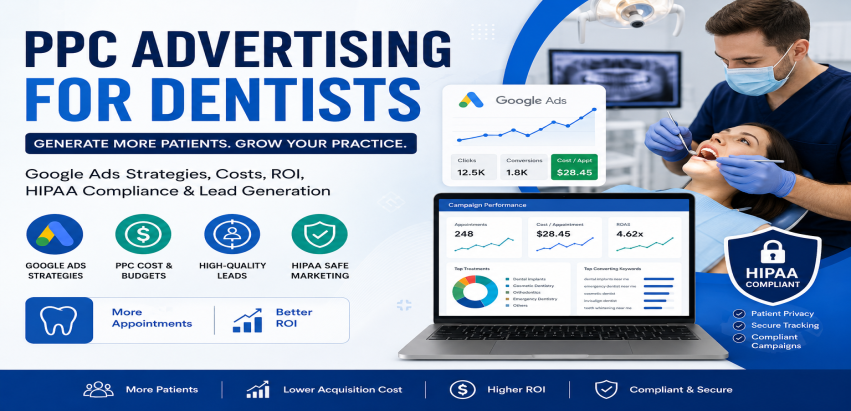
Referral-based patient acquisition works until it does not. For most dental clinics, word of mouth builds a practice to a comfortable level and then plateaus. The next patient after that plateau requires a different approach, one where the clinic actively appears in front of people who are already searching for treatment rather than waiting to be recommended by someone who already knows them.
Pay-per-click advertising solves exactly this problem. It places a dental clinic at the top of search results the moment a potential patient types a treatment-related query, before any organic ranking has been earned and before any referral has been made. The patient is already looking. PPC makes sure your clinic is what they find.
This guide explains how PPC works for dental clinics, when it generates strong patient acquisition returns, when it does not, and how to make the right decision for your specific practice type, growth stage, and treatment mix.
What Is PPC Advertising for Dentists?
The Core Definition
PPC stands for pay-per-click advertising. A dental clinic creates ads that appear at the top of search engine results pages when potential patients search for relevant treatment terms. The clinic pays a fee each time a patient clicks the ad. The fee varies based on how competitive the keyword is, how well the ad matches the search query, and the quality of the landing page the ad points to.
Unlike traditional advertising where a clinic pays for placement regardless of whether anyone responds, PPC charges only for engagement. A patient who searches for a dentist, sees the ad, and clicks it generates a cost. A patient who sees the ad but does not click generates no cost. This makes PPC highly accountable as a marketing channel because every expense ties directly to an action taken by a potential patient.
How PPC Differs From Traditional Dental Marketing
Traditional dental marketing, which includes print advertising, billboards, direct mail, and radio, broadcasts a clinic's message to a broad audience on the assumption that some percentage of that audience will eventually need dental care. The timing is passive. The targeting is demographic at best.
PPC advertising is the opposite in every important respect. It reaches a patient at the exact moment they have expressed intent to seek dental treatment. A patient who searches "emergency dentist near me" at 9 PM is not browsing casually. They have a dental problem and need a solution right now. A patient searching "dental implants consultation" is actively evaluating where to receive a specific treatment. PPC puts a dental clinic's message in front of this patient at the precise moment of highest relevance, not at a random moment when they happen to see a billboard on the way to work.
The Patient Journey in Dental PPC
When a patient searches for dental care, the search engine displays paid ads at the top of results above organic listings. The patient sees the ad, reads the headline and description, and clicks through to a landing page. On that landing page, they read treatment information, see social proof such as patient reviews and before-and-after results, and take a conversion action: call the clinic, fill out an appointment request form, or use an online booking tool. That conversion is a patient lead. The clinic's job is to follow up quickly and convert that lead into a booked appointment.
Why Dental Clinics Use PPC to Get New Patients
Speed to First Patient
Organic search rankings take months or years to build. A new dental clinic or a clinic entering a new service area cannot wait twelve months for organic visibility to develop while appointment slots sit empty. PPC generates visibility within hours of campaign launch. A properly structured search campaign can appear at position one for high-intent dental queries within 24 hours of going live. No other patient acquisition channel delivers this speed.
Capturing Patients Who Are Ready to Book
The fundamental advantage of search-based PPC over every other form of dental advertising is intent. A patient who types "orthodontist for adults near me" is not casually curious. They have likely been considering treatment for some time, they have reached the point of active evaluation, and they are comparing providers right now. Reaching this patient with a relevant, well-structured ad and a strong landing page is the highest-probability patient acquisition scenario available to any dental clinic.
Patients acquired through high-intent search queries book faster, show up for consultations at higher rates, and require less pre-appointment persuasion than patients acquired through awareness-stage advertising channels. The quality of the initial intent filters out a significant proportion of low-commitment patients before any clinic staff time is invested.
Competing With Larger Established Clinics
An established dental clinic with strong organic rankings, a large review base, and deep community roots has significant advantages over a newer or smaller competitor. PPC is the mechanism through which a smaller or newer clinic can appear above those established competitors on search results pages for specific treatment queries. The established clinic's organic strength does not affect paid search position. A well-structured campaign with strong ad relevance and a quality landing page can outrank a competitor spending more per click. PPC creates a competitive entry point that organic channels cannot provide in the same timeframe.
How Google Ads Generate Dental Appointments
The Acquisition Funnel
Understanding the path from search query to booked appointment clarifies where campaigns succeed and where they fail. Each stage of the funnel has specific requirements for the next stage to function.
| Stage | Patient Action | Campaign Goal |
|---|---|---|
| Search | Types treatment or clinic query | Appear at top of results for relevant query |
| Ad impression | Sees ad headline and description | Ad relevance earns the click |
| Click | Clicks through to landing page | Landing page matches the ad promise |
| Engage | Reads treatment info and social proof | Content builds enough trust to act |
| Convert | Calls, fills form, or books online | Conversion tracked and attributed |
| Book | Confirms appointment with reception | Cost per booked appointment measured |
The Role of Landing Pages in Patient Conversion
The landing page is where the majority of dental PPC campaigns either succeed or fail. A well-funded campaign pointing to a generic practice homepage consistently underperforms a smaller campaign pointing to a dedicated treatment landing page. The reason is relevance and friction. A patient who clicked an ad for dental implants and arrives at a homepage about the clinic's full range of services has to work to find the information they were looking for. Most patients do not do that work. They press the back button and click a competitor's ad.
An effective dental landing page contains the treatment name in the headline matching the ad, the clinic location prominently displayed, patient testimonials specific to that treatment, a visible phone number and booking mechanism above the fold, and a clear single call to action. Every element that does not directly help the patient decide to contact the clinic is a distraction that reduces conversion rate.
Call Conversions vs Form Conversions
In dental advertising, phone calls are typically higher-intent conversions than form submissions. A patient who picks up the phone to call a clinic is closer to booking an appointment than a patient who fills out a contact form and waits for a callback. Campaigns should track both call conversions and form submissions separately to understand the true volume and quality of patient contacts being generated. Campaigns that track only form submissions systematically undercount actual lead volume, which causes bidding algorithms to underinvest in the keywords and audiences that are producing the most patient contacts.
When PPC Works Best for Dentists
New Clinics With No Organic Presence
A brand new dental clinic has no organic search rankings, no review history on Google, and no existing patient base to generate referrals. PPC is not optional for new clinics in competitive markets. It is the primary mechanism for generating patient flow while organic channels take months or years to develop. The alternative is waiting, which means empty appointment slots generating no revenue to fund ongoing operations. The return on investment from PPC at this stage does not need to be exceptionally high. It needs to exceed the cost of an empty chair.
Growing Practices Adding New Treatment Lines
A general dentistry clinic that adds implants, Invisalign, or cosmetic services faces the same visibility problem as a new clinic, but for those specific treatments. Existing patients may not be aware of the new capability. Organic visibility for new treatment keywords takes time to develop. PPC fills this gap by creating immediate treatment-specific visibility before the practice's website has enough content authority to rank organically for new treatment queries.
High-Ticket Treatments With Favorable Acquisition Economics
Dental implants, full arch restorations, Invisalign, and cosmetic case work all share one characteristic that makes PPC economics strongly favorable: the revenue per patient is high enough that even relatively expensive paid leads produce substantial margins. A practice where the average treatment value per new patient is ten to thirty times the cost of acquiring them through advertising has enormous flexibility in what it can spend per lead and still operate profitably. High-ticket specialty treatments are the strongest use case for dental PPC at almost any budget level.
Multi-Location Practices Filling New Locations
When a dental group opens a new location, it inherits none of the organic authority, review reputation, or referral network of the existing locations. Each new location effectively starts from zero on patient acquisition. PPC provides location-specific visibility immediately and can be structured to target the catchment area around each new location precisely, generating patients in the specific geographic zone the new location needs to serve.
When PPC May Be a Bad Fit for Dental Practices
No Tracking or Measurement in Place
A dental clinic running PPC without conversion tracking is spending advertising budget without any mechanism to determine which searches, ads, or landing pages generate patient contacts. This is not a minor operational gap. It means the campaign's bidding algorithm has no performance signal to optimize toward and will allocate budget based on incomplete data. Campaigns running without proper tracking do not generate poor results occasionally. They consistently generate poor results because optimization is impossible without measurement.
Landing Pages That Cannot Convert Traffic
A clinic with a slow-loading website, no mobile-optimized design, and no treatment-specific pages should address those technical and content foundations before investing in paid traffic. PPC drives patients to wherever the ad points. If the destination cannot convert visitors into contacts, increasing the budget only increases the rate at which money is wasted. The landing page problem must be solved before the traffic problem is worth addressing.
Budgets Too Small to Generate Meaningful Data
There is a minimum viable budget below which dental PPC campaigns do not generate enough clicks and conversions to provide the data Google's Smart Bidding algorithms need to optimize effectively. In competitive dental markets, campaigns running at minimal daily budgets exhaust their spend before noon, miss searches throughout the day, and accumulate conversion data so slowly that meaningful optimization takes months rather than weeks. A campaign that cannot reach the optimization threshold is not a failed channel. It is an underfunded channel. The failure mode here is budget allocation, not channel fit.
Unrealistic Timeline Expectations
Dental PPC campaigns require a learning period of four to six weeks before Smart Bidding algorithms accumulate enough conversion data to optimize efficiently. Practices that evaluate campaigns at week two, determine they are not producing the expected volume, and pause them have interrupted the optimization cycle before it can complete. The pause resets the algorithm's learning, creating a cycle where the campaign never reaches its potential because it is never given enough time to do so.
How Much Does PPC Cost for Dentists?
What Drives Dental PPC Costs
Dental PPC costs are determined by the intersection of three primary variables: keyword competition, treatment type, and geographic market density. Understanding what drives cost helps practices budget realistically and evaluate campaign performance against appropriate benchmarks rather than against global averages that may not reflect their specific market conditions.
| Cost Factor | Effect on Campaign Cost |
|---|---|
| Geographic competition | More competing advertisers in the area increases CPC for all advertisers |
| Treatment type | High-value treatments attract more advertiser competition, raising CPC |
| Keyword intent specificity | High-intent keywords cost more but convert at higher rates |
| Ad Quality Score | Higher relevance scores reduce CPC; poor relevance increases it |
| Landing page quality | Strong landing pages improve Quality Score and lower effective CPC |
| Time of day and day of week | Peak search hours attract more bidders and higher CPCs |
| Device type | Mobile and desktop CPCs differ; mobile typically dominant in dental search |
| Match type | Exact match keywords typically cost more but produce better lead quality |
The Relationship Between Cost and Lead Quality
The most important realization about dental PPC costs is that cost per click is the wrong metric to optimize. The metric that determines whether a campaign is profitable is cost per booked appointment, which is cost per click multiplied by the number of clicks it takes to generate a patient contact, divided by the percentage of contacts that become booked appointments. A higher CPC keyword that converts at twice the rate of a cheaper keyword produces appointments at a lower total cost despite the higher per-click price.
High-intent keywords for implants, emergency dentistry, and Invisalign typically cost more per click than general dentistry keywords. They also convert at significantly higher rates because the search intent is more specific and the patient is further along in their decision process. The result is that specialty treatment campaigns often produce appointments at comparable or lower cost per appointment than lower-CPC general dentistry keywords, despite having higher CPC.
How Treatment Value Reframes Cost Concerns
The question is not whether dental PPC is expensive in absolute terms. It is whether the cost of acquiring a patient through PPC is justified by the revenue that patient generates. A practice where a new implant patient generates ten to twenty times their acquisition cost through treatment revenue has enormous margin to work with. Evaluating PPC cost without comparing it to patient lifetime value systematically underestimates the channel's financial merit for high-ticket treatment providers.
General dentistry practices with lower per-visit revenue need to be more precise about cost management because the acquisition-to-revenue margin is narrower. These practices benefit most from tight keyword targeting, strong negative keyword lists, high-converting landing pages, and aggressive location targeting to ensure budget reaches only genuinely reachable local patients.
What Makes Dental PPC Expensive?
Competition Intensity
Every dental clinic advertising on Google in the same geographic area is competing in the same auction for the same searches. The more advertisers compete, the higher CPCs rise for everyone. Dense urban markets with many active dental advertisers produce significantly higher CPCs than smaller markets with fewer competing advertisers. This is not a feature of dental advertising specifically. It is how all auction-based advertising works. The practical implication is that a practice's location relative to the competitive density of its market is the single largest determinant of base advertising costs.
Treatment-Driven Intent Signals
Certain dental treatments generate search queries with extremely high purchase intent. A patient searching for "full arch implant restoration" or "Invisalign provider" is not at the beginning of an awareness journey. They are at the end of a research journey and are evaluating specific providers to contact. Advertising platforms recognize this high intent and price these keywords accordingly because multiple advertisers are willing to pay a premium to reach a patient who is this close to booking. High-intent keywords produce expensive clicks and high-quality leads. Lower-intent informational keywords produce cheaper clicks and patients who need more nurturing before they book.
Mobile-First Search Behavior
The majority of dental searches occur on mobile devices. Mobile search has structural characteristics that affect campaign costs. Patients on mobile convert through phone calls more frequently than through form submissions. Call conversions typically represent higher intent than form submissions because calling requires active engagement. Campaigns that optimize for call conversions in mobile-heavy dental markets allocate more of their budget toward mobile-first placements, which affects CPC dynamics differently than purely desktop campaigns.
Quality Score as a Cost Lever
Quality Score is Google's rating of the relevance and quality of keywords, ads, and landing pages. A high Quality Score reduces the CPC a clinic pays for any given position. A low Quality Score increases CPC for the same position. This means two clinics bidding the same amount can pay significantly different CPCs based on the quality of their ad-to-landing-page relevance chain. Investing in ad relevance, specific match types, and dedicated landing pages is not just a conversion optimization exercise. It is a cost reduction strategy with measurable impact on campaign economics.
Best Google Ads Campaign Types for Dentists
| Campaign Type | Best Use Case | Lead Quality | Best For |
|---|---|---|---|
| Search Campaigns | High-intent treatment and location queries | Very High | All practice types, primary patient acquisition |
| Call-Only Campaigns | Emergency dentistry and same-day bookings | Very High | Emergency practices, mobile-heavy markets |
| Performance Max | Multi-channel AI-driven reach and optimization | Medium to High | Established practices with strong conversion data |
| Remarketing | Re-engaging visitors who did not book | High | Implant and high-consideration treatment practices |
| Display Campaigns | Brand awareness in local area | Low to Medium | New clinic launches, supporting existing campaigns |
Search Campaigns: The Primary Patient Acquisition Tool
Search campaigns are the foundation of dental PPC for one reason: they capture patients at the exact moment of treatment intent. No other campaign type matches the specificity of reaching a patient who has just typed a treatment query with your clinic's ad. Search campaigns allow complete control over which keywords trigger ads, what geographic area sees the ads, what time of day they appear, and what landing page patients arrive at. This precision makes Search campaigns the highest-intent patient acquisition tool available to dental practices.
Call-Only Campaigns for Emergency Dentists
Call-only campaigns display a phone number and call button directly in the search result rather than directing patients to a landing page. For emergency dental situations, removing the landing page step from the patient journey significantly increases same-day appointment conversion rates. A patient with a dental emergency is not going to read a landing page, evaluate credentials, and then decide to call. They want to speak to a person right now. Call-only campaigns match this urgency directly and consistently produce lower cost per booked appointment for emergency dental queries compared to standard Search campaigns directed to landing pages.
Performance Max for Established Practices
Performance Max campaigns use Google's AI to serve ads across Search, Display, YouTube, Gmail, and Maps simultaneously. The campaign type is powerful for practices that have accumulated enough conversion data for the algorithm to optimize effectively, typically at least 50 to 100 monthly conversions. For practices with insufficient conversion data, Performance Max allocates budget across placements based on limited signal and often produces inconsistent results. Established practices with proven conversion tracking and strong monthly lead volume benefit most from adding Performance Max to supplement Search campaigns.
Remarketing for High-Consideration Treatments
Not every dental patient books on the first visit to a clinic's website. Implant patients, orthodontic patients, and cosmetic cases typically involve research periods of weeks or months where patients visit multiple clinic websites before selecting a provider. Remarketing campaigns show ads to patients who visited the clinic's website but did not convert, keeping the clinic visible throughout their research journey. For high-ticket treatments where the patient decision cycle extends over multiple weeks, remarketing is an efficient way to maintain presence without paying full Search CPC for every subsequent exposure.
PPC Strategy by Treatment Type
| Treatment | Search Intent | Competition Level | Lead Quality | Recommended Campaign Type |
|---|---|---|---|---|
| Dental implants | Very High, late-stage decision | Very High | Very High | Search + Remarketing |
| Emergency dentistry | Urgent, immediate need | High | Very High (books same day) | Call-Only + Search |
| Orthodontics and braces | High, evaluation stage | High | High | Search + Remarketing |
| Invisalign | Very High, brand-aware searchers | Very High | Very High | Search + Performance Max |
| Cosmetic dentistry | High, aspirational and comparison | High | High | Search + Display |
| Root canal | High, pain-driven urgency | Medium to High | Very High (needs immediate care) | Search + Call Extensions |
| Teeth whitening | Moderate, cosmetic consideration | Medium | Medium | Search, smaller budget allocation |
| General dentistry | Mixed, local neighborhood intent | Medium | Medium | Search with tight location targeting |
Dental Implants: The Highest-Value PPC Treatment
Implant campaigns require the largest investment and produce the strongest ROI for specialist practices. The search queries are highly commercial. Patients searching for implant consultations have typically researched the treatment, understand the general cost range, and are evaluating specific providers. A dedicated implant campaign with a consultation-focused landing page, patient case results, fee transparency, and a clear booking mechanism consistently outperforms general campaigns that include implant keywords alongside general dentistry terms. The competition intensity is high but so is the acquisition-to-revenue ratio, which justifies the investment across most markets.
Orthodontics and Invisalign: Long Decision Cycles
Orthodontic patients and Invisalign candidates take longer to convert than emergency or root canal patients. The treatment commitment is significant both financially and in terms of treatment duration. Campaigns for these treatments benefit from remarketing that keeps the practice visible during the extended consideration period and landing pages that address common concerns about treatment duration, cost, and lifestyle impact alongside the treatment process itself. Practices that address these concerns directly in their landing page content see consistently higher consultation booking rates than those that provide only general treatment descriptions.
Root Canal: Pain-Driven Same-Day Urgency
Root canal searches are almost always pain-driven, which creates a dual characteristic: very high urgency and very high conversion readiness. A patient searching for root canal treatment is not comparing options in the same reflective way an implant patient is. They are in pain and they need relief. Campaigns for root canal and emergency dental searches should emphasize availability, proximity, and same-day or next-day scheduling in ad copy and landing pages. The friction of a complex landing page reduces conversions. The simplest possible path from search to booked appointment produces the best results.
Emergency Dentistry Ads vs Cosmetic Dentistry Ads
| Factor | Emergency Dentistry | Cosmetic Dentistry |
|---|---|---|
| Patient decision speed | Immediate, same-day decision | Weeks to months of consideration |
| Primary search trigger | Pain, discomfort, dental accident | Appearance goal, social event, life milestone |
| Best campaign type | Call-only or Search with call extension | Search plus Remarketing |
| Landing page priority | Availability, location, call button prominent | Before-after results, treatment details, consultation CTA |
| Optimization speed | Fast (conversions accumulate quickly) | Slow (longer patient decision cycle) |
| Lead volume vs lead value | Higher volume, lower per-patient value | Lower volume, higher per-patient value |
| Budget allocation approach | Location-tight targeting, always-on scheduling | Broader targeting, remarketing investment |
| Key negative keywords | DIY treatments, home remedies, supplies | Cheap options, free consultations, student clinics |
| ROI timeline | Immediate, first month measurable | Three to six months for stable ROI measurement |
Many dental practices need both campaign types operating simultaneously. The emergency campaigns generate consistent monthly volume and rapid data accumulation that feeds algorithmic optimization. The cosmetic campaigns build a higher-value patient pipeline over a longer timeline. Running them as separate campaigns rather than blending keywords together ensures each campaign's budget and bidding strategy matches the specific behavior of the patients it is targeting.
SEO vs PPC for Dentists: Which Generates Patients Faster?
What Each Channel Does Well
SEO and PPC are complementary channels that serve different stages of a dental practice's growth. Understanding what each does well and where each falls short helps practices allocate resources appropriately rather than treating the choice as binary.
PPC delivers speed. A campaign can generate patient enquiries within days of launch. The visibility is immediate, the targeting is precise, and the performance is measurable from day one. PPC reaches patients who are actively searching for treatment right now. Its weakness is sustained cost: paid visibility requires ongoing spend. The moment a campaign is paused, the clinic disappears from those search positions.
SEO delivers compounding returns. Organic rankings, once established, generate patient traffic at zero incremental cost per click. A practice that ranks first organically for "dental implants [city]" receives that patient traffic continuously without paying per click. SEO's weakness is time. Building competitive organic rankings in established dental markets typically requires six to twelve months or more of consistent effort before meaningful organic traffic develops for high-value treatment keywords.
| Factor | SEO | PPC |
|---|---|---|
| Time to first patients | 6 to 12 months for competitive keywords | 24 to 72 hours after campaign launch |
| Cost structure | Agency or time investment, zero per-click cost | Management fee plus per-click ad spend |
| Long-term cost efficiency | Improves over time as rankings compound | Consistent per-click cost throughout |
| Control over visibility | Limited, algorithm-dependent | Full control, immediate on and off |
| Treatment-specific targeting | Through dedicated treatment pages | Ad group and keyword level precision |
| Best for new clinic | No, too slow for immediate needs | Yes, fills schedule while SEO develops |
| Best for established clinic | Yes, compound returns over time | Yes, for specific treatments and growth |
| Impact of pausing | Rankings persist for a period | Visibility stops immediately |
Why Most Successful Practices Run Both Channels
The strongest patient acquisition strategy for dental practices combines PPC and SEO operating in parallel. PPC captures immediate appointment-ready patients for high-value treatments while SEO builds the long-term organic authority that reduces per-patient acquisition costs over a 12 to 24 month horizon. Practices that run only PPC face permanently recurring acquisition costs that never compound. Practices that run only SEO wait too long for results in competitive markets and miss the immediate patient acquisition opportunity.
For dental practices ready to build an organic patient acquisition foundation alongside paid campaigns, our Dental SEO Guide covers the strategy, content, and technical requirements for building treatment-specific organic visibility. Our Dental SEO Services for Dentists and Clinics provides full implementation support for practices that want both channels working simultaneously.
Google Ads vs Referrals vs Organic Search
Every dental practice uses some combination of referrals, organic search visibility, and potentially paid advertising to generate patients. Each source has different characteristics in terms of speed, scalability, cost, and patient quality. Understanding the profile of each source helps practices balance their acquisition mix rather than over-relying on any single channel.
| Factor | SEO (Organic) | PPC (Google Ads) | Referrals |
|---|---|---|---|
| Speed to first patient | Months | Days | Ongoing but unpredictable |
| Scalability | Gradual, compounds over time | Immediate with budget increase | Limited, depends on existing patient base |
| Cost structure | Agency or time investment | Ongoing ad spend | Primarily incentive or reputation cost |
| Patient trust level on first contact | Moderate (clinic found via search) | Moderate (ad identified practice) | High (referred by trusted contact) |
| Predictability | Medium (rankings fluctuate) | High (performance measurable and controllable) | Low (depends on patient satisfaction and social behavior) |
| Treatment-specific control | Through content strategy | Complete at keyword level | None (patients refer for any treatment) |
| Geographic reach | Local with content investment | Precise to radius or neighborhood | Local, personal networks |
| Patient quality | High (intentional searchers) | High for intent-matched campaigns | Very High (pre-qualified by referrer) |
Referrals produce the highest-trust patients but scale only as quickly as the existing patient base grows. They cannot be directed toward specific treatments, specific geographic areas, or specific appointment slots. PPC provides the scalability and precision that referrals cannot, while SEO provides the compounding efficiency that PPC's per-click cost structure cannot. Practices that rely exclusively on referrals cap their growth at the rate their current patients choose to refer. Practices that add PPC remove that cap.
Single Location vs Multi-Location Dental Clinics: Does PPC Change?
Single-Location Clinics
For a single-location dental practice, PPC simplicity is a significant advantage. One set of campaigns targets one catchment area. Geographic targeting focuses tightly on the neighborhoods from which the clinic realistically draws patients. The campaign structure is straightforward: separate ad groups for different treatment types, each pointing to a dedicated landing page, each tracked independently for conversion performance. Optimization decisions are clear because all data comes from one practice's patient acquisition funnel.
The most important decision for single-location clinics is catchment area precision. Running ads too broadly wastes budget on patients who will not travel to the clinic's location. A general dentistry clinic should target its immediate neighborhood with high precision. A specialty implant clinic can target a broader radius because patients travel further for specialty treatments than for routine care.
Growing Practices
A practice transitioning from one to two or three locations introduces campaign complexity that single-location management does not require. Each location needs its own campaign set targeting its specific catchment area. Ad copy should reference each location's neighborhood or city to maintain relevance for local searches. Conversion tracking should distinguish which location each lead is contacting so performance can be evaluated per location rather than blended across the practice group.
Blending locations in a single campaign is one of the most common structural mistakes in multi-location dental PPC. When campaign performance is aggregated across locations, high-performing locations mask underperforming ones. Budget allocates across the group based on blended averages rather than per-location efficiency. Each location should be a distinct campaign entity with its own budget, geographic targeting, and performance tracking to enable accurate per-location optimization decisions.
Multi-Location Chains and Dental Groups
Dental groups operating five or more locations require campaign management at a level of operational complexity that significantly exceeds what most internal teams can sustain alongside practice management responsibilities. Campaign structures, negative keyword lists, Quality Score maintenance, landing page testing, and performance reporting multiply with each location added. The optimization workload grows proportionally. Practices at this scale typically see the strongest return from dedicated external PPC management with experience in multi-location dental campaign architecture.
Common Reasons Dental PPC Campaigns Fail
Broad Keywords That Attract Non-Patient Traffic
A campaign targeting the keyword "dentist" on broad match will show ads to people searching for dental school admissions, dental supply companies, dental assistant job listings, and dental history facts alongside potential patients. Every non-patient click consumes budget. Over a monthly campaign period, broad keyword waste can consume a substantial portion of a dental clinic's advertising investment without generating a single patient contact. Keyword targeting should focus on appointment-intent searches: treatment names, "near me" modifiers, consultation requests, and location-specific queries.
Missing Negative Keywords
Negative keywords exclude searches that should not trigger ads. For dental campaigns, an ongoing negative keyword list is not an optional optimization. It is a budget protection mechanism. Without regular negative keyword management, campaigns serving treatment ads will appear for student searches, employment searches, DIY treatment queries, and supply procurement searches that consume budget without producing patient contacts. Negative keyword maintenance should be a weekly campaign management task, not a one-time setup step.
Sending All Traffic to the Homepage
A patient who clicks an ad for teeth whitening and arrives at a practice's full-service homepage is not on a dedicated path to booking a teeth whitening appointment. They are on a general information page that requires navigation to find what they were looking for. Most patients do not navigate. They press the back button and click a competitor's ad that takes them directly to a whitening page. Treatment-specific landing pages are not a luxury for dental PPC campaigns. They are a functional requirement for converting paid traffic into patient contacts at an acceptable cost.
Tracking Only Clicks
Campaigns that report on impressions, clicks, and click-through rates without tracking actual patient contact conversions have no data on which the campaign can optimize. Clicks are not patients. An ad that generates 500 clicks and zero patient contacts is not performing well regardless of what the click-through rate shows. Conversion tracking that captures phone calls, form submissions, and appointment requests is the minimum viable measurement framework for evaluating whether a dental PPC campaign is generating actual patient leads.
Pausing Campaigns During Slow Periods
Pausing a campaign to save budget during a traditionally slow month resets Smart Bidding's learning and removes the practice from search visibility during the pause period. Competitors who maintained their campaigns during the same period accumulate additional optimization data and impression share. Restarting a paused campaign requires another learning period before performance recovers. A better approach during genuinely slow periods is reducing budget rather than fully pausing, which maintains campaign momentum and algorithmic learning while lowering spend.
How to Improve Lead Quality From Dental PPC
Tighten Keyword Match Types
Moving from broad match to phrase match and exact match keywords for the most important treatment queries immediately reduces irrelevant traffic. Exact match targeting for queries like "dental implants near me" or "Invisalign consultation" ensures ads only appear for searches that precisely match the treatment and intent. The tradeoff is reduced impression volume. The benefit is higher conversion rate because every impression is from a patient searching specifically for what the clinic offers.
Improve Landing Page Specificity
A landing page that addresses the specific treatment the patient searched for, answers the primary concerns of a patient at the consideration stage of that treatment decision, and provides a friction-free path to contact consistently produces higher conversion rates than generic practice pages. Each major treatment category the clinic advertises should have its own dedicated landing page. Shared pages across multiple treatments dilute relevance and reduce Quality Score, which increases CPCs and reduces conversion rates simultaneously.
Implement Complete Conversion Tracking
Complete conversion tracking captures every channel through which a patient can make contact: phone calls from the ad, phone calls from the landing page, form submissions, online appointment bookings, and any other contact mechanism the clinic makes available. When the campaign tracks all contact types rather than only form submissions, it optimizes toward the full scope of patient acquisition events rather than a subset. This typically produces meaningfully more efficient budget allocation and better overall campaign performance without any change to spend levels.
Use Ad Scheduling to Match Patient Behavior
Dental patients search at specific times. Emergency searches spike in evenings and weekends when pain becomes intolerable. Routine treatment searches are heavier during working day hours. Cosmetic and elective searches occur throughout the week with no strong pattern. Ad scheduling that concentrates budget during the hours when search-to-appointment conversion rates are highest for each treatment type can significantly reduce cost per booked appointment without reducing total impressions across the day.
Agency vs Freelancer: Who Should Manage Dental PPC?
| Factor | Specialist Agency | Freelancer |
|---|---|---|
| Dental industry experience | Specialist agencies have cross-account vertical data | Varies significantly by individual history |
| Optimization frequency | Weekly standard across dedicated team | Depends on client load and individual capacity |
| Team backup if manager unavailable | Account continuity maintained by team | Single point of failure, no backup |
| Creative and landing page support | Often included or coordinated | Rarely offered, outsourced if at all |
| Conversion tracking expertise | Dedicated tracking specialists available | Variable, depends on individual capability |
| Reporting quality | Dashboard reporting with appointment-level metrics | Basic spreadsheet or PDF reporting |
| Management cost | Higher monthly fee | Lower monthly fee |
| Best for | Multi-treatment clinics, specialty practices, growth-stage campaigns | Simple single-treatment campaigns, early-stage clinics |
| Scaling capability | Strong as campaign complexity grows | Diminishes as campaign complexity increases |
| Pattern recognition from other accounts | Cross-account dental industry data available | Limited to individual's client history |
When a Freelancer Makes Sense
A freelancer is the appropriate choice for a single-location general dental practice running one or two simple search campaigns at modest budget levels where the campaign structure is straightforward and the primary need is basic campaign management and reporting. At this scale and complexity, the performance gap between a competent freelancer and a specialist agency is smaller than the fee difference.
When a Specialist Agency Is the Better Choice
The value of a specialist agency becomes clear when campaigns span multiple treatment types, multiple locations, or higher budgets where the cost of underperformance exceeds the agency fee difference. Cross-account industry data from a specialist dental PPC agency means benchmark awareness that a freelancer without a comparable client base cannot provide. An agency that has managed implant campaigns across dozens of practices knows which keyword structures, landing page formats, and bid strategies produce the strongest results for that treatment type. This pattern recognition is not a premium. It is the primary source of performance differentiation between generalist and specialist management.
Signs Your Clinic Needs Professional PPC Management
Your campaigns generate clicks but the front desk reports few new patient calls. The traffic exists. The conversion mechanism is broken. This is almost always a landing page problem, a tracking problem, or a keyword targeting problem that allows non-patient searches to consume budget.
Your cost per lead keeps rising month over month without a corresponding increase in local competition. A well-optimized campaign should see stable or improving cost efficiency over time. Rising CPL without an external competitive explanation means optimization is not keeping pace with the natural efficiency decay that occurs in unmanaged campaigns.
You cannot tell which keywords are generating patient appointments versus which are generating low-quality contacts. If this distinction cannot be made from campaign reporting, conversion tracking is incomplete or performance data is being reported at the wrong level of granularity.
Your campaigns have not been actively optimized in the past two weeks. A Google Ads campaign running without weekly negative keyword review, bid adjustments, ad copy testing, and landing page analysis is declining in efficiency. The competitive environment around the campaign is changing continuously. Static campaigns lose ground to actively managed competitors every week they go without optimization.
You are spending on ads without treatment-specific landing pages. Every treatment your clinic advertises through paid search deserves its own dedicated landing page. If campaigns point to a homepage or a single general page, a significant portion of the click budget is converting patients who were ready to book into patients who bounced and called a competitor.
For clinics at any of these stages, professional management that combines dental industry expertise with proper conversion tracking, treatment-specific campaign structure, and weekly optimization discipline produces measurably better results than the current approach. Our PPC Management Services team works with dental practices on campaigns built specifically for patient acquisition rather than general advertising metrics.
How to Choose a Dental PPC Agency
Questions to Ask Before Committing
| Question | Why It Matters |
|---|---|
| Have you managed Google Ads for dental clinics offering our specific treatments? | Dental PPC strategy varies significantly by treatment type; generalist experience does not transfer equally to all treatment categories |
| How do you structure campaigns across multiple treatment types? | Separate campaign structures for different treatments produce better performance than blended campaigns; the answer reveals campaign architecture capability |
| What conversion events do you track and how do you attribute patient appointments? | Agencies that track only form submissions miss a significant portion of patient contacts; the answer reveals tracking completeness |
| How often are campaigns actively optimized and what does that process include? | Weekly optimization covering negative keywords, bids, ad copy, and landing page performance is the minimum standard; monthly reviews are insufficient |
| What does your monthly reporting include beyond clicks and impressions? | Reports should show cost per booked appointment by treatment and keyword, not just engagement metrics |
| Do we retain full ownership of our Google Ads account? | Account ownership must stay with the clinic; any agency that retains account access on exit holds the practice's campaign history hostage |
Red Flags That Predict Poor Performance
An agency that guarantees a specific number of patient leads before reviewing campaign structure, market competition, landing page quality, and conversion tracking setup is making a commercial promise that the advertising auction cannot support. Lead volume is influenced by budget, competition, keyword quality, and landing page performance. None of these are fully within any agency's control. Guaranteed lead counts are a sales technique that should prompt skepticism rather than confidence.
Agencies that report monthly on impressions and click-through rate without showing cost per patient contact are measuring campaign activity rather than patient acquisition performance. The reporting format an agency uses in its standard reporting reveals what it considers success. If success metrics are clicks and CTR rather than appointments and cost per booked patient, the optimization focus is likely in the same place.
Any agency that cannot clearly describe its optimization process at a specific level of detail, including what is reviewed weekly, what triggers a strategy change, and how negative keywords are maintained, is either not actively managing campaigns at the required frequency or cannot explain its process in terms that reveal genuine expertise.
Final Decision Framework: Is PPC Worth It for Your Dental Practice?
When PPC Consistently Produces Strong Returns
Specialty practices offering implants, Invisalign, full arch restoration, and cosmetic services produce strongly positive acquisition economics from Google Ads because treatment revenue per patient is large relative to lead acquisition cost. New practices need PPC because no other channel generates patient appointments on the timeline a new practice requires. Practices entering new geographic markets or adding new treatment lines need PPC to fill the visibility gap that organic channels cannot close quickly enough.
When SEO Should Accompany or Precede PPC
Established practices with stable patient volume benefit from building SEO alongside PPC to create a compounding organic channel that reduces per-patient acquisition costs over time. A practice ranking first organically for its highest-value treatment keywords while running PPC for immediate patient volume operates the most cost-efficient patient acquisition system available in search marketing.
The Final Recommendation
Apply three questions in sequence. First: does the average revenue from a new patient over twelve months significantly exceed the cost of acquiring them through PPC? For specialty practices the answer is almost always yes. For general dentistry practices the answer depends on local market costs. Second: is there a functional conversion tracking setup that connects ad spend to actual patient contacts? If not, that foundation must be built before campaign investment scales. Third: is there a treatment-specific landing page for each major campaign? If not, the click budget is converting at a fraction of its potential.
When all three answers are positive, dental PPC consistently produces measurable patient acquisition returns. When any of the three is negative, address it before increasing spend. The channel works for dental clinics that approach it with the right infrastructure. The clinics that report poor results from Google Ads are almost always the ones that invested in clicks without first building the conversion foundation that turns those clicks into booked appointments.
Frequently Asked Questions
Does PPC work for dentists?
Yes, when campaigns are structured around appointment-intent keywords, treatment-specific landing pages, and complete conversion tracking. PPC reaches patients at the exact moment they are searching for dental treatment, producing higher lead quality than awareness-stage advertising channels.
How much does dental PPC cost?
Dental PPC costs depend on geographic competition, treatment type, and keyword intent. High-value treatment keywords like implants and Invisalign carry higher costs per click but typically produce better cost per booked appointment than lower-cost general dentistry keywords due to stronger search intent and higher patient commitment.
How long before PPC generates patients?
First patient enquiries typically arrive within 24 to 72 hours of campaign launch. Stable, optimized performance where cost per appointment becomes predictable takes four to six weeks as Smart Bidding completes its learning phase using initial conversion data.
What budget should dentists spend on PPC?
Budget requirements depend on market competition and treatment focus. The minimum viable budget for meaningful results in competitive markets is higher than many practices initially anticipate because campaigns below the data accumulation threshold cannot optimize effectively. A dental PPC specialist familiar with your specific market can give an accurate budget recommendation based on local competition levels and treatment goals.
SEO or PPC for dentists?
New clinics and practices needing immediate patient acquisition should prioritize PPC because SEO takes six to twelve months to produce competitive results for most dental keywords. Established practices benefit from running both channels simultaneously: PPC for immediate high-intent patient acquisition and SEO for long-term compounding cost efficiency.
What are the best dental keywords?
The strongest performing dental keywords are treatment-specific, location-qualified, and appointment-intent queries. Examples include "dental implants near me," "Invisalign consultation," "emergency dentist open now," and "orthodontist [city]." Informational keywords like "how much do implants cost" attract research intent rather than appointment intent and convert at lower rates for the same click spend.
Do emergency dentists need PPC?
Emergency dental practices are among the strongest use cases for PPC because emergency searches carry immediate conversion intent. A patient with a dental emergency is ready to book the moment they click an ad. Call-only campaigns that allow patients to call directly from search results produce particularly strong same-day appointment conversion rates for emergency dental practices.
When should dentists hire an agency to manage PPC?
When campaigns span multiple treatment types, the optimization workload exceeds what a single person can manage at the required weekly frequency. When cost per lead is rising without a clear external explanation. When conversion tracking is incomplete and the practice cannot identify which keywords generate actual patient appointments. Any of these signals indicates the campaign needs specialist management rather than continued self-management or generalist oversight.
Not Sure Where to Start? Use This Simple Rule
Every dental practice that wants to grow patient volume beyond what referrals and existing organic visibility can provide will eventually evaluate PPC. The question is not whether to use the channel. It is whether to approach it with the infrastructure it requires to work.
A practice with treatment-specific landing pages, complete conversion tracking, and a realistic budget for its market is positioned to generate positive ROI from dental PPC consistently. A practice without those foundations will generate traffic, spend budget, and produce frustrating results regardless of how well the campaign is configured. Build the foundation first. Fund the campaigns second. Evaluate performance against cost per booked appointment, not cost per click.
Aarmus Marketing works with dental practices globally on campaign structures built specifically for patient acquisition. If you want a direct assessment of whether your current setup is positioned to generate positive returns from dental PPC, the starting point is a campaign review that identifies what is working, what is wasting budget, and what changes would produce the strongest improvement in patient acquisition efficiency.