

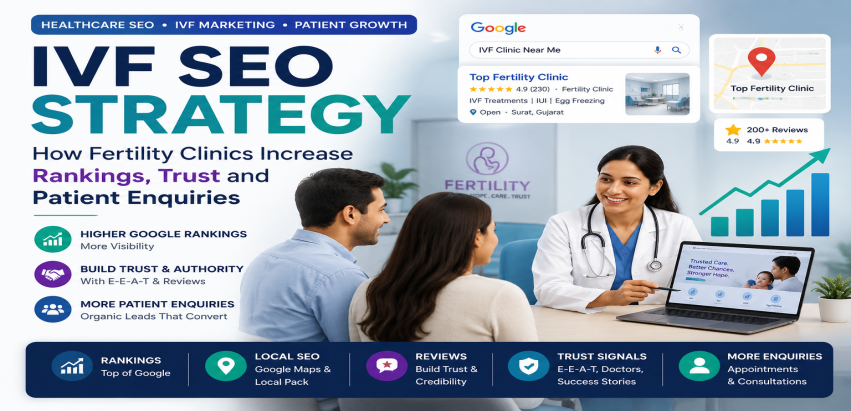
IVF SEO Strategy: How Fertility Clinics Increase Rankings, Trust and Patient Enquiries
A fertility clinic with outstanding success rates, experienced embryologists, and state-of-the-art laboratory facilities loses patients every day to a competitor ranking higher on Google. The patient never learns about the clinical quality difference. They called the clinic that appeared first, felt confident based on what they found online, and booked a consultation. The superior clinic received no enquiry because it was not visible at the moment the patient searched.
This is the specific problem IVF SEO solves. Not visibility for its own sake, but visibility at the exact moments in a deeply personal, emotionally complex search journey where fertility patients are evaluating clinics, forming trust, and deciding who to call.
This guide covers every layer of SEO strategy that fertility clinics need: how IVF patients actually search before choosing a clinic, why Google holds fertility websites to stricter standards than most healthcare sites, how to build the trust architecture that converts rankings into consultation bookings, and what technical and content foundations determine whether a fertility clinic's website ranks or remains invisible in an increasingly competitive search landscape.
What Is IVF SEO and Why Every Fertility Clinic Needs an Organic Search Strategy
IVF SEO is the process of optimising a fertility clinic's website and online presence to rank in organic search results for the queries that prospective patients use throughout their fertility treatment research and clinic selection journey, generating consistent enquiries without paying per click.
For a fertility clinic, SEO operates differently from general healthcare SEO and fundamentally differently from ecommerce or service business SEO. The patient searching for IVF treatment is not making a spontaneous purchase decision. They are navigating a process that is emotionally demanding, financially significant, medically complex, and deeply personal. Their search behavior reflects this. They research extensively before making contact. They read success stories, evaluate doctor credentials, compare success rates, and assess whether a clinic's online presence communicates the level of care and competence they need to trust with their fertility journey.
A fertility clinic that ranks well for the searches patients use throughout this journey earns patient trust incrementally at each stage of the research process. A clinic that only appears for final purchase-intent searches misses the opportunity to build familiarity and credibility during the weeks of research that precede a consultation booking. That missed opportunity is not a minor revenue gap. It is the difference between a clinic that fills its consultation calendar from organic search and one that depends entirely on paid advertising to generate enquiries at escalating cost per acquisition.
How IVF SEO Differs From General Medical SEO in Practice
A GP clinic can rank for "doctor near me" with a well-optimised Google Business Profile and a functional website. A fertility clinic competing for "IVF treatment in [city]" needs to demonstrate that it understands the clinical, emotional, and practical dimensions of infertility treatment well enough to earn the trust of a patient who has likely been on a difficult journey before reaching the point of searching for an IVF clinic. General medical SEO optimises for appointment bookings, local visibility, and symptom-driven searches. IVF SEO requires all of that plus a trust architecture that addresses the specific anxieties and hopes of fertility patients, and a topical authority framework that demonstrates comprehensive expertise across a connected cluster of fertility-related topics rather than isolated service descriptions.
Why Google Holds Fertility Clinic Websites to Stricter Standards Than Most Healthcare Sites
Google classifies fertility clinic content as YMYL, which stands for Your Money or Your Life. This classification applies to content that could significantly affect a person's health, financial wellbeing, or life decisions. Fertility treatment decisions involve significant emotional investment, financial cost, and medical risk. Google evaluates YMYL content through the lens of E-E-A-T: Experience, Expertise, Authoritativeness, and Trustworthiness.
A fertility clinic website that lacks clear signals of medical expertise, physician credentials, institutional authority, and patient trust will not rank well for competitive IVF search terms regardless of how well its technical SEO is executed. A fertility clinic competing against established medical institutions needs every element of its online presence to signal clinical credibility: doctor qualifications prominently displayed, treatment information written to medical accuracy standards, success data presented transparently, and patient testimonials verified rather than generic.
Why Emotional Complexity Makes Fertility SEO Uniquely Demanding
A patient choosing a fertility clinic is placing their hope for a family in the hands of a clinical team they have never met, spending tens of thousands of rupees or dollars on a treatment with uncertain outcomes, and managing significant emotional vulnerability throughout the process. Content that addresses only clinical procedures without acknowledging the emotional experience of fertility patients ranks for clinical terms but fails to convert those rankings into consultation bookings. The clinics that convert organic traffic into consultations at the highest rates produce content that makes patients feel understood, not just informed.
How Google's Medical Content Standards Affect Ranking Decisions
Google's search quality evaluator guidelines specifically identify medical content as requiring the highest standards of expertise and trustworthiness. A fertility clinic blog post written by a non-medical content writer without physician review will consistently underperform medically reviewed content authored or validated by the clinic's specialists. This is a quality signal Google's algorithm actively evaluates. Patients can detect the difference between clinical content that demonstrates genuine expertise and content that is generically assembled about a topic without clinical depth, and their engagement signals reflect that difference in ways that affect rankings.
How IVF Patients Search Before Choosing a Clinic: The Three-Stage Journey
The fertility patient who books a consultation through organic search has typically been searching for weeks. Their journey begins long before they type "IVF clinic near me" and passes through multiple stages of information gathering, emotional processing, and trust evaluation. Understanding each stage is the foundation of effective IVF SEO because each stage requires different content, different page types, and different trust signals.
Awareness Stage: When Patients Begin to Understand Their Situation
The awareness stage begins when a person starts to suspect they may be facing fertility challenges. Searches at this stage are symptom-driven and emotionally charged. The patient is not yet searching for a clinic. They are searching to understand what is happening to them and what options might exist. A fertility clinic that creates thorough, medically accurate, empathetically written content addressing these questions captures potential patients at the earliest stage of their journey, before any clinic preference is formed.
| Awareness Stage Search | Patient Question Being Asked | Content Type to Target |
|---|---|---|
| Unable to conceive after one year | Is something wrong with me? | Educational blog, symptom guide |
| Signs of PCOS infertility | Could my condition be causing this? | Condition-specific educational page |
| What causes male infertility | Could this be a male factor issue? | Male infertility resource page |
| Can PCOS affect pregnancy | What does my diagnosis mean for conception? | PCOS fertility blog or FAQ |
| Is IVF the only option for infertility | What treatments exist beyond IVF? | Treatment comparison guide |
| Fertility tests for women | Where do I start the diagnostic process? | Fertility testing guide, service page |
| How do I know if I need IVF | Am I at the point where IVF is necessary? | Diagnostic criteria blog, consultation CTA |
| Infertility symptoms in women | Am I experiencing infertility? | Symptom guide with next steps |
The patient at this stage is not ready to book a consultation. They are building an understanding of their situation. The clinic that appears consistently and helpfully during this research stage earns a familiarity advantage that influences every subsequent stage of the search journey, including the final clinic selection decision.
Consideration Stage: Evaluating Treatment Options, Costs and Outcomes
The consideration stage begins when a patient has accepted that they may need medical intervention and starts researching treatment options, costs, and realistic expectations. Searches at this stage are more specific and include comparative and financial intent. Content optimised for these searches must go beyond basic treatment descriptions. It must address cost transparency, realistic success rate expectations, treatment comparison guidance, and the practical experience of undergoing treatment.
| Consideration Stage Search | Patient Question Being Asked | Content Type to Target |
|---|---|---|
| IVF cost in [city] | Can I afford this treatment? | Transparent pricing page with breakdown |
| IVF success rate by age | What are my realistic chances? | Success rate educational content |
| IVF vs IUI which is better | Which treatment is right for my situation? | Treatment comparison blog or guide |
| How many IVF cycles does it take | How long could this process be? | Patient journey blog, FAQ page |
| Best fertility clinic in [city] | Which clinics are worth considering? | About page, trust signals, reviews |
| IVF with donor eggs cost | What does donor treatment involve and cost? | Donor IVF service page with pricing |
| Egg freezing price | Is fertility preservation an option for me? | Egg freezing service page |
| Fertility clinic reviews | What do other patients say? | Reviews page, GBP optimisation |
| What happens during IVF cycle | What will the experience actually be like? | Step-by-step IVF process guide |
Decision Stage: Shortlisting Local Clinics and Preparing to Call
The decision stage is when a patient who has done extensive research is evaluating specific clinics and preparing to book a consultation. At this stage, local SEO, Google Business Profile optimisation, review quality and volume, and the consultation booking experience on the clinic's website determine conversion. The content that brought the patient to this point has done its job. The local presence and booking experience close the appointment.
| Decision Stage Search | Patient Question Being Asked | Asset to Optimise |
|---|---|---|
| IVF clinic near me | Which clinic is closest and credible? | Google Business Profile, local pack |
| Fertility specialist in [city] | Who are the qualified doctors in my area? | Doctor profile pages, local landing page |
| Book IVF consultation | How do I get started? | Consultation booking page, CTA optimisation |
| Best IVF doctor in [city] | Who is the most trusted specialist locally? | Doctor profile, GBP, review volume |
| [Doctor name] IVF specialist | Is this doctor who I was referred to? | Individual doctor profile page with schema |
| Top fertility clinic [neighbourhood] | Is there a reputable clinic within reach? | Location-specific landing page |
| Search Stage | Example Query | Patient Need |
|---|---|---|
| Awareness | Signs of infertility in women | Understanding symptoms and causes |
| Awareness | PCOS and pregnancy chances | Understanding condition impact on fertility |
| Awareness | Male infertility causes and treatment | Exploring options before clinic search |
| Consideration | IVF cost in [city] | Financial planning and budget assessment |
| Consideration | IVF success rate by age | Setting realistic outcome expectations |
| Consideration | IVF vs IUI which is better for PCOS | Comparing treatment options for condition |
| Consideration | Best fertility clinic reviews | Social proof and trust evaluation |
| Decision | IVF clinic near me | Shortlisting local providers |
| Decision | Book fertility consultation [city] | Ready to make contact and book |
| Decision | [Doctor name] IVF specialist | Validating a specific practitioner |
The IVF Emotional Search Framework: Fear, Hope and Trust Drive Patient Decisions Before Commercial Intent Does
The most significant competitive gap in IVF clinic SEO is the widespread failure to address the emotional dimension of fertility patient search behavior. Most fertility clinic websites are built around clinical information and call-to-action buttons. They optimise for the final commercial search and largely ignore the weeks of emotionally driven research that precede it. A patient searching "can I still get pregnant with low AMH" is not looking for a clinic brochure. They are frightened and looking for honest, compassionate information that helps them understand their situation. A fertility clinic whose website answers this question with genuine clinical depth and emotional sensitivity does not just rank for that term. It becomes the clinic the patient trusts by the time they reach the consultation booking stage.
Fear Drives the First Searches and Must Be Met With Clarity, Not Sales Language
Fear is the dominant emotional driver at the awareness stage. Fear of infertility, fear of treatment, fear of failure, fear of the financial burden, and fear of the emotional cost of an unsuccessful cycle. SEO content that acknowledges these fears without amplifying them, and that provides honest, medically grounded information that helps patients understand their situation, builds a level of trust that purely clinical content cannot achieve. The clinic that appears at the moment of maximum fear and responds with calm, evidence-based clarity wins the patient's confidence before any competitor has a chance to make an impression.
Hope Sustains the Consideration Journey and Must Be Grounded in Honest Data
As patients move from awareness to consideration, hope becomes the sustaining emotional driver. They are looking for evidence that treatment can work for people in their situation. Success stories, realistic success rate data presented honestly, and content that helps patients understand what positive outcomes might look like for their specific circumstances all serve this function. Fertility clinics that present success rates without context, or that avoid discussing treatment limitations, destroy the very trust they are trying to build. A patient who discovers that a clinic's claimed success rates were misleading is not just lost. They leave a negative review that harms every subsequent patient's first impression of the clinic.
Trust Determines the Final Clinic Selection When Two Clinics Appear Equally Competent
At the decision stage, trust is the determining factor between clinics that appear equally competent based on online research. Patients at this stage are assessing which clinic they feel safe enough to call. That assessment is made through doctor profiles, patient testimonials, review quality and volume, the visual professionalism of the clinic's online presence, and the warmth and clarity of the content encountered throughout the research journey. Trust is built progressively across the entire search journey. A single persuasive call to action at the end of a website cannot compensate for a research journey during which the clinic was absent, generic, or clinically superficial.
Keyword Strategy for IVF and Fertility Clinics: Mapping Search Intent to the Right Page
An IVF clinic's keyword strategy should map specific keyword types to specific page types based on search intent. Using a single page to target keywords from multiple intent stages reduces the effectiveness of each page for its primary purpose and signals to Google that the page's topical focus is unclear. The four keyword categories below each serve a distinct function and should each target a distinct page type.
Service Keywords: Targeting Patients Who Know What Treatment They Need
Service keywords directly name the treatments and procedures a fertility clinic offers. Patients searching these terms are evaluating treatment options rather than seeking educational information. Each major treatment deserves a dedicated, comprehensive service page. A single "our treatments" page that lists all services without depth is not competitive against clinics that have created individual authority pages for each treatment category.
| Service Keyword | Search Intent | Target Page Type |
|---|---|---|
| IVF treatment | Treatment evaluation, high commercial intent | Dedicated IVF service page |
| IUI treatment | Treatment evaluation, moderate commercial intent | Dedicated IUI service page |
| Egg freezing | Fertility preservation, commercial intent | Egg freezing service page with pricing |
| Embryo transfer | Procedural understanding, mid-funnel | Embryo transfer explanation page |
| Donor egg IVF | Specific treatment, high commercial intent | Donor IVF service page |
| ICSI treatment | Male factor treatment, commercial intent | ICSI service page |
| Fertility testing | Diagnostic, entry-level commercial intent | Fertility testing service page |
| Fertility preservation | Planning-oriented, moderate commercial intent | Fertility preservation service page |
Location Keywords: Capturing Patients in the Active Clinic Selection Phase
Location keywords combine treatment terms with geographic modifiers and represent the highest commercial intent in IVF SEO because they indicate a patient who has moved beyond general research into active clinic evaluation within a specific area. Multi-location fertility clinic groups need location-specific landing pages for each clinic rather than a single generic locations page. Each location page should contain location-specific content, not duplicated copy across all sites.
| Location Keyword Format | Example | Target Page Type |
|---|---|---|
| IVF clinic in [city] | IVF clinic in Mumbai | Location-specific IVF landing page |
| Fertility specialist in [area] | Fertility specialist in Bandra | Doctor profile or location page |
| Best IVF doctor in [city] | Best IVF doctor in Delhi | Doctor profile pages, GBP |
| IVF treatment cost in [city] | IVF treatment cost in Bangalore | Pricing page with city-specific data |
| Fertility clinic near me | Fertility clinic near me | Google Business Profile, local pack |
| IVF centre in [neighbourhood] | IVF centre in Andheri | Neighbourhood-specific location page |
Question Keywords: Capturing Patients During Weeks of Research Before Clinic Selection
Question keywords represent the research questions patients ask throughout their journey and are best addressed through blog content, FAQ pages, and educational resource pages. These keywords typically contain "what," "how," "can," "does," "is," and "why" constructions and represent the highest volume of searches in the awareness and consideration stages. They also represent the greatest opportunity to build brand familiarity before a patient is ready to compare clinics.
| Question Keyword | Search Stage | Target Page Type |
|---|---|---|
| How many IVF cycles does it typically take | Consideration | Blog post or patient journey guide |
| What is the success rate of IVF after 40 | Consideration | Success rate educational page |
| Can IVF help with unexplained infertility | Consideration | Unexplained infertility service or blog |
| Is IVF painful | Awareness to consideration | Patient experience blog or FAQ |
| What happens if IVF fails | Consideration | Emotional support blog, next steps guide |
| Does insurance cover IVF treatment | Consideration | Financing and insurance guide page |
| How does egg freezing work | Awareness | Egg freezing educational page |
| Can PCOS be treated with IVF | Awareness to consideration | PCOS fertility service or blog page |
Long-Tail IVF Keywords: Lower Competition, Higher Conversion Readiness
Long-tail keywords are specific, multi-word queries with lower individual search volume but very high purchase intent and lower keyword competition. A patient searching a long-tail fertility keyword has typically already completed general research and is now looking for answers to a very specific situation. These patients convert at higher rates than broad keyword searchers because their search specificity signals decision proximity.
| Long-Tail Keyword | Why It Converts Well | Best Page Type |
|---|---|---|
| IVF with PCOS success rates | Condition-specific, highly qualified patient | PCOS IVF blog or service page |
| IVF success rate age 42 | Age-specific research, high decision intent | Age-specific IVF success guide |
| Cost of IVF with donor eggs | Specific treatment type, commercial intent | Donor IVF pricing page |
| Natural cycle IVF cost | Protocol-specific, informed buyer | Natural IVF service page |
| IVF for unexplained infertility | Diagnosis-specific, mid to late funnel | Unexplained infertility service page |
| How to prepare for IVF cycle | Pre-treatment intent, high trust building | IVF preparation guide blog |
| Can low AMH affect IVF success | Clinical specificity, high-anxiety buyer | AMH and IVF educational blog |
| IVF after failed IUI | Previous treatment history, decision-ready | IVF after IUI guide or blog |
Local SEO for IVF Clinics: The Fastest Route to Improved Patient Visibility
A fertility patient who has completed their research and is ready to book a consultation typically searches "IVF clinic near me" or "fertility specialist in [their city]." These searches trigger Google's local pack, the map-based results appearing at the top of the results page showing nearby clinics with ratings, reviews, contact information, and distance. A fertility clinic that does not appear in the local pack for these high-intent searches is invisible to patients at the most commercially valuable moment of their search journey.
Local SEO for fertility clinics is the fastest-impact category of IVF SEO because improvements to Google Business Profile and local citation consistency can produce visible ranking changes within weeks rather than the months required for organic content and link building. For clinics that need immediate improvement in patient enquiry volume, local SEO is the correct starting priority.
Why Local Pack Visibility Outranks Organic Position One for Fertility Searches
For location-specific searches, the local pack appears above organic results. A clinic ranking in the local pack for "IVF clinic near me" has greater visibility than a clinic ranking in organic position one for the same search. Local pack visibility is determined by different signals than organic ranking: Google Business Profile completeness, proximity to the searcher, review quantity and quality, local citation consistency, and engagement signals including call clicks, direction requests, and website visits from the GBP listing. A fertility clinic investing equally in both organic SEO and local SEO will see local results faster, and once local pack visibility is established, organic rankings create a second layer of dominance on the same results page.
Local Citation Building Creates the Citation Consistency Google Requires
Local citations are mentions of a clinic's name, address, and phone number on external websites including business directories, healthcare platforms, and local listings. Citation consistency, meaning the clinic's NAP data is identical across all listings, is a direct local ranking signal. A fertility clinic whose name is formatted differently across directories, or whose address varies between listings, sends inconsistent entity signals that suppress local pack ranking. Healthcare-specific directories including Practo, Lybrate, and JustDial provide relevant citation opportunities for Indian fertility clinics. Internationally, Healthgrades and Zocdoc serve similar citation functions and also generate direct referral traffic.
Google Business Profile Optimisation: The Asset That Determines Whether Patients Call or Scroll Past
The Google Business Profile is the single most important local SEO asset a fertility clinic has. An incomplete or poorly optimised GBP directly costs patient enquiries by reducing local pack visibility, lowering the click-through rate from local results, and failing to provide the trust signals patients use to evaluate clinics before making contact.
How to Set Up a Fertility Clinic GBP for Maximum Local Pack Performance
The clinic name on the GBP must exactly match the name used on the website and across all citations. The primary category should be "Fertility Clinic" where available, or the most clinically accurate equivalent available in the market. Secondary categories should include relevant medical specialty designations. The description field should be used to its full available character count, covering the clinic's specialisations, treatments offered, years of experience, and the specific patient populations it serves. Incomplete descriptions leave ranking signal value unused.
Individual Practitioner Profiles Strengthen Entity Recognition in Local Search
Where the GBP platform allows it, individual practitioner profiles for the clinic's fertility specialists should be created and linked to the clinic's main profile. A patient who encountered a specific doctor through blog content or a referral and then searches that doctor's name needs to find a strong, consistent online presence that validates the recommendation. Doctor profiles on Google provide an additional layer of E-E-A-T signal that supports the clinic's overall authority in local search results and creates an entity connection in Google's knowledge graph that independent doctor profiles and clinic profiles do not achieve in isolation.
Review Strategy for Fertility Clinics: Managing Volume, Quality and Sensitive Responses
Reviews are among the most powerful trust signals a fertility clinic can accumulate and among the most sensitive to manage given the emotionally complex nature of IVF treatment outcomes. A systematic review generation process that reaches out to patients following positive consultation experiences and successful treatment outcomes, with empathetically timed review requests, produces review volume that improves both local pack ranking and the trust perception of prospective patients. Negative reviews in fertility care require particularly thoughtful responses because they often reflect the emotional experience of patients who experienced treatment disappointment. A professional, empathetic response that acknowledges the patient's experience without violating confidentiality demonstrates the standard of care that prospective patients are evaluating when they read a clinic's review profile.
| GBP Optimisation Item | Importance Level | Expected Ranking and Trust Impact |
|---|---|---|
| Complete name, address, phone number | Critical | Local pack eligibility and citation consistency |
| Correct primary and secondary categories | Critical | Appears for relevant medical specialty searches |
| Full business description with treatment keywords | High | Relevance signals for fertility-specific searches |
| Services listed with individual descriptions | High | Treatment-specific visibility and patient information |
| Regular photo updates of clinic, team, facilities | High | Trust building and higher click-through rate |
| Weekly posts and patient updates | Medium | Engagement signals, content freshness indicator |
| Q and A section actively managed | Medium | Patient questions answered, trust and relevance signal |
| Systematic review generation and response | Critical | Local ranking signal and patient trust conversion |
| Active appointment booking link | High | Direct conversion from local pack result |
Healthcare E-E-A-T for IVF Websites: Building the Trust Architecture Google and Patients Both Require
E-E-A-T, Google's framework evaluating Experience, Expertise, Authoritativeness, and Trustworthiness, is more consequential for fertility clinic websites than for almost any other category of health website. The patient stakes are high, the content is medically complex, and Google's quality evaluators hold YMYL medical content to standards that require genuine clinical expertise to satisfy.
Experience: Content Must Reflect First-Hand Clinical Knowledge, Not Assembled Medical Information
Experience in the E-E-A-T framework refers to first-hand experience relevant to the content being published. For a fertility clinic, this means that content about IVF treatment outcomes, patient experiences, and clinical procedures should reflect the genuine experience of the clinic's practitioners. Content that includes the clinic's own success rate data, the specific protocols used in its laboratory, and the nuanced clinical judgment of its specialists demonstrates the first-hand experience that distinguishes authentic clinical authority from assembled medical content. A page about IVF success rates that cites only external studies without connecting those studies to the clinic's own clinical experience fails this standard even if the external citations are accurate.
Expertise: Medical Credentials and Authorship Attribution Are Non-Negotiable
Every piece of clinical content on a fertility clinic website must be attributed to a qualified medical professional. Content attributed to "the editorial team" or published without authorship signals fails the expertise requirement for YMYL medical content. Doctor bylines on blog posts, treatment page authorship attribution with credentials listed, and physician-reviewed content labels provide the authorship signals that Google's quality evaluation system looks for on medical content. A fertility clinic that publishes content without medical attribution is asking Google to trust clinical information that has no verifiable medical source. Google does not do that for YMYL pages.
Authoritativeness: External Validation Builds the Signal Internal Content Cannot Create Alone
Authoritativeness is built through external validation: other credible sources recognising and referencing the clinic or its practitioners as knowledgeable voices in fertility medicine. Editorial mentions in health publications, citations in patient guides on established health platforms, participation in fertility research, and inclusion in professional medical directories all contribute to the authoritative signals that distinguish a genuinely expert fertility clinic from one that only claims expertise within its own content. A clinic that is never mentioned outside its own website has no external validation of the authority it claims internally.
Trustworthiness: Transparency in Success Rates, Fees and Clinical Limitations
Trustworthiness for a fertility clinic is built through operational transparency: clear contact information, verifiable clinic credentials, honest presentation of success rates with appropriate context, transparent fee information, patient confidentiality policies, and content that acknowledges treatment limitations rather than only presenting optimistic outcomes. A fertility clinic that presents unrealistically high success rate claims without age-specific or protocol-specific context fails the trustworthiness standard. Patients who discover inflated claims mid-research do not just leave. They actively distrust the clinic and sometimes share that distrust in review platforms.
Doctor Branding as a Primary IVF Ranking Signal: Why Physician Authority Transfers to Clinic Visibility
A fertility specialist who publishes medically reviewed content, maintains an active professional presence across LinkedIn and medical platforms, earns media mentions in health publications, and appears in podcasts or videos discussing fertility topics builds an entity identity in Google's knowledge graph that directly benefits the clinic's website rankings. Google's entity understanding connects individual practitioners to their affiliated institutions. A fertility specialist recognised by Google as an authoritative voice in fertility medicine confers authority to the clinic website they are associated with, creating a ranking benefit that no amount of generic content production can replicate.
What a High-Authority Doctor Profile Page Must Include
A comprehensive doctor profile page serves both as a trust resource for prospective patients and as a structured data entity that connects the doctor's identity to the clinic in Google's knowledge graph. It must include the physician's full name and credentials, their specialty qualifications, years of experience in fertility medicine, any subspecialty expertise, research publications where applicable, professional associations, media appearances or expert commentary, and a professional photograph. Missing any of these elements weakens both the patient trust function and the entity recognition function the page is designed to serve.
How to Build Doctor Reputation as a Deliberate SEO Strategy
Doctor branding as SEO strategy means creating comprehensive physician profile pages with structured data markup, building the doctor's presence on medical platforms and professional directories, facilitating media opportunities where the specialist provides expert commentary on fertility topics, publishing research or expert opinion content under the doctor's byline, and ensuring consistent name and credential formatting across all platforms. Consistency matters because Google connects entity signals across sources. A doctor whose name appears in ten different formats across ten different platforms is harder for Google to consolidate into a single authoritative entity than one whose identity is uniformly presented everywhere.
Building Topical Authority for IVF Websites: The Content Cluster Architecture That Compounds Rankings
Topical authority in fertility SEO means Google recognises a clinic's website as comprehensively authoritative for fertility-related topics rather than a source that has published isolated pieces of content about specific keywords. A website with topical authority ranks for dozens of related fertility searches because Google trusts its coverage of the topic domain. A website without it ranks only for the specific terms individual pages directly target, leaving the majority of the fertility search landscape to competitors who have invested in coverage depth.
The Content Cluster Model for Fertility Websites
Topical authority is built through content clusters: a pillar page covering a broad fertility topic comprehensively, supported by cluster pages that address specific sub-topics in depth, all internally linked to demonstrate the relationship between pieces and the comprehensive nature of the site's coverage. An IVF cluster, for example, would include a comprehensive IVF pillar page covering the complete treatment process, supported by cluster pages on IVF success rates, IVF cost, preparing for IVF, what happens during an IVF cycle, IVF for specific conditions, what to do when IVF fails, and the emotional experience of treatment. Each cluster page links to the pillar page and to related cluster pages, creating the content web that signals comprehensive topical coverage.
Fertility Content Clusters That Build Ranking Authority Across the Full Topic Domain
| Primary Cluster Topic | Supporting Sub-Topics for Cluster Pages | Primary Search Benefit |
|---|---|---|
| IVF Treatment | Success rates, cost, process, preparation, failure, emotional journey | Dominates IVF search cluster across all intent stages |
| IUI Treatment | IUI vs IVF, success rates, cost, process, who it suits | Captures patients considering less invasive options |
| Egg Freezing | Cost, process, success rates, best age, storage | Captures fertility preservation search cluster |
| Male Infertility | Causes, diagnosis, ICSI, sperm quality, treatment options | Captures male factor searches often ignored by clinics |
| PCOS and Fertility | PCOS symptoms, PCOS IVF, PCOS treatment, success rates | High-volume condition-specific traffic and trust |
| Endometriosis and Fertility | Endometriosis diagnosis, fertility impact, IVF outcomes | Captures underserved condition-specific search cluster |
| Donor Egg and Sperm IVF | Process, cost, legal considerations, success rates | High-value commercial treatment search cluster |
| Recurrent Pregnancy Loss | Causes, testing, PGT, treatment options, emotional support | High-empathy content cluster with strong trust building |
Internal Linking Architecture: Directing Authority From Traffic Pages to Revenue Pages
The internal linking structure of a fertility website should deliberately direct authority from high-traffic content toward the highest-value conversion pages: treatment service pages and consultation booking pages. An educational blog post about IVF success rates that receives significant organic traffic should link to the IVF service page and the consultation booking page, passing its traffic and link equity toward the pages that generate patient enquiries. Without deliberate internal linking architecture, a fertility clinic can accumulate substantial blog traffic that produces almost no patient enquiries because readers have no clear path from educational content to the conversion action.
Content Strategy for IVF Clinics: Publishing What Patients Need Before They Are Ready to Enquire
The content strategy that produces the strongest patient acquisition results for fertility clinics is not a content calendar built around keywords. It is a content architecture built around the fertility patient journey, ensuring that the clinic has authoritative, empathetic, and medically accurate content at every stage of the research process patients go through before they are ready to book a consultation.
Educational Content at the Awareness Stage Builds the Familiarity That Wins the Consultation
Educational content at the awareness stage addresses the questions patients are asking before they know they need IVF. Content about fertility testing, what causes infertility, when to seek fertility help, what different fertility conditions mean for treatment options, and what the process of getting a fertility diagnosis looks like captures patients at the earliest stage of their journey. This content does not immediately generate consultation bookings. It generates the brand familiarity that makes patients more likely to choose this clinic when they reach the decision stage weeks later. The clinic that answered the patient's frightening early questions becomes the clinic they trust when they are ready to call.
Comprehensive Treatment Pages Convert Consideration Stage Research Into Consultations
Comprehensive treatment explanation content answers the specific questions patients have when evaluating treatment options: what does IVF involve, what is the recovery like, how long does a treatment cycle take, what are the realistic success rates for my age and situation. This content should be written to the depth that a well-informed patient wants, not simplified to the point of being unhelpful, and must be attributed to the clinic's medical specialists to satisfy YMYL content requirements. A treatment page that does not answer the specific questions a patient is researching at that stage loses the patient to a competitor whose page does.
Patient Success Stories Provide the Social Proof That Moves Patients From Research to Contact
Patient success stories demonstrate that treatment works for real people, make the experience of treatment emotionally navigable, and provide the social proof that prospective patients need to feel confident enough to make contact. Success stories should be genuine, specific, and published with patient permission. Anonymised stories that protect patient privacy while conveying the emotional reality of the treatment journey are consistently among the most-read content on fertility clinic websites. A clinic with ten detailed patient success stories will outconvert a clinic with a generic "we have helped thousands of patients" statement every time.
For a broader understanding of how content strategy integrates with paid acquisition and other digital marketing channels for fertility clinics, see the guide to digital marketing for IVF clinics.
Technical SEO Checklist for Fertility Clinic Websites
Technical SEO addresses the foundational infrastructure that determines whether Google can efficiently crawl, index, and rank the clinic's pages. A fertility clinic with excellent content and strong E-E-A-T signals loses ranking potential if its technical foundation has problems that prevent Google from accessing and understanding the site effectively. A technically broken fertility website is like a credible doctor working from an office that no one can find.
| Technical SEO Task | Priority | Outcome If Fixed |
|---|---|---|
| Mobile responsiveness audit and fix | Critical | Majority of fertility searches are mobile; non-responsive sites rank poorly and lose patients immediately |
| Core Web Vitals optimisation | Critical | LCP, FID, and CLS scores affect ranking directly as confirmed page experience signals |
| Page speed optimisation across all pages | Critical | Slow pages increase bounce rate before trust is built; fertility patients leave and do not return |
| HTTPS security verification | Critical | YMYL sites without HTTPS face ranking penalties and lose patient trust at first visit |
| XML sitemap submission to Search Console | High | Ensures all key pages are crawled and indexed promptly |
| Canonical tag implementation | High | Prevents duplicate content issues across similar treatment pages and location variants |
| Structured data and schema markup | High | Rich results eligibility, knowledge graph recognition, enhanced search appearance |
| Internal link audit and optimisation | High | Authority distributed to key service pages and consultation booking pages |
| 404 error and redirect audit | Medium | Prevents link equity loss and eliminates poor patient navigation experience |
| Image compression and alt text audit | Medium | Page speed improvement and image search visibility for clinical photography |
Why Mobile Page Speed Is a Revenue Issue for Fertility Clinics, Not Just a Technical Score
Fertility patients frequently conduct research on mobile devices during private moments when they are away from shared computers. A fertility clinic website that loads slowly on mobile is losing patients at the most vulnerable and time-sensitive moments of their research journey. A slow-loading mobile page does not create a second chance. The patient presses back, clicks the next result, and that competitor's clinic gets the consultation booking that your clinic should have received.
Medical Schema Markup Every IVF Website Must Implement to Compete in YMYL Search
Schema markup provides structured data that helps Google understand the entities and relationships on a fertility clinic website: that the clinic is a medical facility, that its practitioners are qualified physicians, that its FAQ content addresses specific patient questions, and that its content is medically authored and reviewed. These structured data signals contribute to E-E-A-T evaluation, rich result eligibility, and knowledge graph entity recognition.
MedicalClinic schema should be implemented on the clinic's main page and all location pages, identifying the facility type, medical specialties, address, contact information, opening hours, and associated physicians. This schema type directly communicates to Google that the website represents a legitimate medical facility offering specific healthcare services rather than a general health information site.
Physician schema should be implemented on every doctor profile page, identifying the physician's name, credentials, specialty, affiliated institution, and professional identifiers. Where practitioners have published research or have notable professional recognition, this information strengthens the entity's knowledge graph profile and improves the probability of a knowledge panel appearing for the doctor's name in search.
FAQPage schema should be implemented on all pages containing frequently asked questions about fertility treatments and patient processes. FAQ schema enables rich results in Google search, displaying question-and-answer pairs directly in the search result before the patient clicks. For fertility clinics, FAQ schema on treatment pages is particularly valuable because the patient's primary need at the consideration stage is getting specific questions answered efficiently, and rich result visibility for those questions generates significantly higher click-through rates than standard blue-link results.
Article schema with medical reviewer attribution should be implemented on all medically authored blog content, connecting the content to its author entity and signaling to Google that the content has been produced with the level of medical oversight appropriate for YMYL health content.
Why IVF Clinic Websites Fail to Rank Despite Investment in Content and Design
Most fertility clinic websites that struggle to rank share a consistent set of structural problems. None are difficult to identify in a thorough audit, but all require deliberate effort to correct because they reflect foundational decisions made when the website was built rather than easily fixable surface errors.
Treatment pages that describe procedures without addressing patient questions. A fertility clinic service page for IVF treatment containing three paragraphs about the treatment process and a contact form is competing against pages with comprehensive treatment explanations, clinical detail, patient FAQs, success rate data, and physician-authored content. No optimisation technique makes a thin page rank above a genuinely more useful one for a YMYL medical search.
Clinical content published without physician attribution. Blog posts published without doctor attribution fail Google's E-E-A-T requirements for YMYL medical content. A fertility clinic generating monthly blog posts without connecting them to the expertise of its clinical team is producing content that Google treats with suspicion rather than authority, regardless of how technically well-optimised those posts are.
Generic keyword targeting without intent mapping across page types. Targeting "IVF" as a single keyword across multiple pages without differentiating intent stage produces keyword cannibalisation where multiple pages compete against each other for the same term rather than each page clearly owning a specific stage of the search journey.
No local SEO foundation despite strong content. A fertility clinic with a strong organic content strategy but a neglected Google Business Profile and inconsistent citations misses the local pack entirely, losing visibility to patients at the decision stage who are the most ready to book a consultation.
Review volume too low to compete in local pack results. Review volume is a significant local ranking signal and a critical patient trust factor. A fertility clinic with 12 reviews competing against one with 340 reviews faces both a ranking disadvantage and a trust conversion disadvantage that no amount of content quality can overcome in local search results.
Strong rankings that fail to convert because the booking experience is inaccessible. A fertility clinic can rank in position one and convert poorly if its website makes consultation booking unnecessarily difficult: no visible phone number above the fold, no WhatsApp or callback option for patients who prefer not to call during work hours, and no indication of what the consultation process involves. Rankings generate visits. Conversion architecture generates the enquiries those visits should produce.
SEO vs Google Ads for IVF Clinics: Which Channel Builds a More Sustainable Patient Acquisition System?
A fertility clinic running Google Ads without building organic SEO is generating patients from a channel that stops the moment the budget stops. A fertility clinic investing only in SEO without running ads waits months for the organic results a paid campaign produces within days. The clinics that grow fastest and most sustainably combine both: paid ads for immediate patient acquisition while SEO builds the organic infrastructure that permanently reduces acquisition cost over time.
| Factor | SEO | Google Ads |
|---|---|---|
| Time to first patient enquiry | 3 to 9 months for competitive terms | Immediate, within hours of campaign launch |
| Cost per enquiry over time | Falls as rankings compound and traffic grows | Consistent or rising as competition increases CPC |
| Patient trust perception | Higher: organic results perceived as earned authority | Lower: clearly identified as paid placement |
| Revenue when investment stops | Continues from established organic rankings | Stops immediately when budget is paused |
| Awareness stage reach | Strong: educational content captures early-journey searches | Limited: ads primarily capture decision-stage searches |
| Content asset value | Builds permanent website authority and topical credibility | Generates no permanent asset value |
| E-E-A-T contribution | Directly builds medical authority and trust signals | No contribution to E-E-A-T signals |
| Best application for new clinics | Start immediately but allow 3 to 6 months for results | Generates immediate enquiries while SEO authority develops |
The financially optimal strategy for a fertility clinic at any growth stage uses Google Ads to generate immediate consultation volume while SEO builds the organic infrastructure that permanently lowers the cost of generating those same enquiries. A clinic that has invested consistently in SEO for 18 months while running paid ads will find that organic enquiries supplement or reduce paid enquiry costs, improving overall patient acquisition economics. The earlier SEO investment starts, the earlier that cost reduction begins.
How Long IVF SEO Takes Before Fertility Clinics See Measurable Patient Enquiries
IVF SEO produces patient enquiries at different timescales depending on the starting point, the competitiveness of the target market, and the consistency of the optimisation investment.
In the first three months, technical SEO corrections, Google Business Profile optimisation, and local citation building produce the fastest visible improvements. Local pack visibility improvements often occur within six to twelve weeks of GBP optimisation. Long-tail keyword content begins ranking in lower positions, generating initial organic impressions. Review generation starts building the volume needed for competitive local presence.
Between three and six months, treatment page optimisations and educational content begin ranking for lower-competition keyword variations. Organic traffic increases meaningfully as content coverage expands. First organic consultation bookings typically appear during this period for clinics in moderately competitive markets.
Between six and twelve months, topical authority from consistent content production begins to compound. Primary service page rankings improve for competitive terms. Organic enquiry volume becomes a meaningful percentage of total clinic enquiries. In highly competitive markets such as major metropolitan areas with many established fertility clinics, full competitive ranking for primary IVF terms may require twelve to eighteen months of consistent investment.
Beyond twelve months, established topical authority means new content ranks faster, existing content continues improving in position, and organic enquiry volume represents a growing and increasingly cost-efficient share of total patient acquisition. The SEO investment made in month three generates compounding returns at month eighteen without requiring proportional additional spend to maintain those returns.
Common IVF SEO Mistakes That Suppress Organic Enquiry Volume
Treating SEO as a one-time website project. A website optimised during its build three years ago is not an SEO-optimised website today. Search algorithms, competitor content, and patient search behavior all change continuously. SEO is an ongoing investment with compounding returns, not a one-time project deliverable with a completion date.
Publishing clinical content without physician authorship. Blog posts and treatment pages without doctor attribution fail E-E-A-T requirements and consistently underperform against medically authored content from competitor clinics. Every piece of clinical content needs a qualified medical author or reviewer attributed to it before it is published.
Competing for broad national IVF terms before establishing local authority. Competing for "IVF" at the national level against major established fertility institutions before establishing local authority is a losing strategy for most regional clinics. Building location-specific authority first and expanding from there is the correct sequencing. Local pack dominance creates a foundation that organic ranking campaigns can build on.
Ignoring the awareness stage in content planning. A content strategy that only targets consultation-ready searches misses the majority of the fertility patient search journey. Educational content addressing awareness-stage questions builds the familiarity advantage that makes decision-stage conversion far more likely and far less dependent on paid advertising.
Failing to track organic enquiries separately from other acquisition channels. A fertility clinic that cannot attribute specific patient enquiries to specific organic search terms cannot make informed decisions about where to invest more SEO effort. Conversion tracking from organic search to consultation booking is a foundational measurement requirement. Without it, SEO budget allocation is based on ranking data rather than revenue data.
Reproducing medical content from other websites. Duplicate medical content from other sources fails both the originality requirement for content quality and the E-E-A-T requirement for first-hand clinical experience. Google identifies copied medical content and does not reward the sites that republish it. Every page that carries copied content is actively underperforming what an original page covering the same topic would achieve.
IVF SEO Audit: A Complete Checklist to Review Visibility, Trust and Conversion
| Audit Area | Specific Check | Status |
|---|---|---|
| Local Visibility | Does the clinic appear in the local pack for "IVF clinic near me" in its primary city? | Check / Fix / Not Started |
| Google Business Profile | Is GBP complete with correct category, all services listed, photos, and active booking link? | Check / Fix / Not Started |
| Review Volume and Recency | Does the clinic have competitive review volume and are new reviews being generated monthly? | Check / Fix / Not Started |
| Citation Consistency | Is NAP data identical across all directories, healthcare listings, and social platforms? | Check / Fix / Not Started |
| E-E-A-T Signals | Do all treatment pages and blog posts carry physician authorship attribution with credentials? | Check / Fix / Not Started |
| Doctor Profile Pages | Does each practitioner have a comprehensive profile page with credentials, experience, and schema? | Check / Fix / Not Started |
| Treatment Page Depth | Do service pages have comprehensive content addressing patient questions at the consideration stage? | Check / Fix / Not Started |
| Keyword Intent Mapping | Is each page optimised for a specific intent stage with no cannibalisation between pages? | Check / Fix / Not Started |
| Topical Cluster Coverage | Does the site have comprehensive coverage for IVF, IUI, egg freezing, male infertility, and PCOS? | Check / Fix / Not Started |
| Technical SEO Foundation | Are Core Web Vitals passing, site mobile optimised, HTTPS secure, and sitemap submitted? | Check / Fix / Not Started |
| Medical Schema Markup | Is MedicalClinic, Physician, FAQPage, and Article schema implemented and validated? | Check / Fix / Not Started |
| Internal Linking Architecture | Does content link deliberately from educational pages to service pages and booking pages? | Check / Fix / Not Started |
| Conversion Architecture | Is the consultation booking mechanism visible above the fold and available across multiple contact channels? | Check / Fix / Not Started |
| Organic Enquiry Tracking | Is conversion tracking configured to attribute consultation bookings to organic search by keyword? | Check / Fix / Not Started |
When Fertility Clinics Should Engage Professional SEO Support
A fertility clinic whose organic enquiries represent less than 20 percent of total patient acquisition, whose Google Business Profile is not appearing in the local pack for city-level IVF searches, or whose treatment pages are not ranking on the first page for primary service keywords has an SEO gap that is costing it a quantifiable volume of patient enquiries every month. The longer that gap remains unaddressed, the more those missed enquiries compound into competitor growth rather than clinic growth.
The decision to engage professional SEO support should be anchored to a specific growth objective: generating a defined number of additional consultation bookings monthly through organic search, reducing paid acquisition cost by a specified percentage as organic share grows, or achieving top-three local pack visibility for the clinic's primary geographic market. An SEO engagement without a defined outcome target produces activity without accountability, which is precisely the problem clinics are trying to solve when they start looking for specialist support.
Fertility clinic SEO requires a combination of technical competence, healthcare E-E-A-T understanding, IVF patient psychology knowledge, and content strategy capability that generalist SEO agencies rarely bring to a medical client. The agency or consultant engaged should demonstrate specific healthcare or medical SEO experience, understanding of YMYL content requirements, and familiarity with the patient journey dynamics that distinguish fertility marketing from other healthcare categories.
If your fertility clinic is ready to build a systematic organic patient acquisition program, our SEO services team works with healthcare and fertility clients on strategies that address the full patient acquisition journey from awareness-stage content through local pack visibility and consultation conversion.
Frequently Asked Questions
What is IVF SEO?
IVF SEO is the process of optimising a fertility clinic's website and online presence to rank in Google search results for the queries prospective IVF patients use during their research and clinic selection journey. It includes local SEO, content strategy, technical optimisation, E-E-A-T building, and conversion architecture specifically designed for the emotional and clinical complexity of fertility patient search behavior.
Why is SEO important for fertility clinics?
Fertility patients conduct extensive online research before choosing a clinic, often across weeks of searching that begins long before they are ready to book. A clinic not visible during this research journey loses patients to competitors who rank higher, regardless of clinical quality differences. SEO ensures that a clinic appears consistently throughout the patient's search journey, building trust and familiarity that converts into consultation bookings.
How long does IVF SEO take to produce results?
Local pack visibility improvements typically appear within six to twelve weeks of Google Business Profile optimisation. Organic content rankings for lower-competition keyword variations begin within three to six months. Competitive rankings for primary IVF service terms in major markets typically require nine to eighteen months of consistent optimisation investment to achieve and maintain.
How do IVF clinics rank on Google?
IVF clinics rank on Google through a combination of local SEO including Google Business Profile optimisation and citation building, E-E-A-T signals including physician-authored content and doctor profile pages, topical authority built through comprehensive treatment and educational content clusters, technical SEO foundations including mobile speed and schema markup, and off-page authority built through editorial links from relevant healthcare and lifestyle sources.
Can SEO increase patient enquiries for fertility clinics?
Yes. SEO directly increases patient enquiries by making the clinic visible throughout the fertility patient search journey, from awareness-stage educational searches to decision-stage local searches. Clinics that invest consistently in IVF SEO typically see organic enquiry volume grow as a share of total patient acquisition over 12 to 18 months, reducing dependence on paid advertising and lowering blended patient acquisition cost.
Do fertility clinics need Google Business Profile?
Yes. Google Business Profile is the primary driver of local pack visibility for location-specific fertility searches. A clinic without an optimised GBP does not appear in local pack results for "IVF clinic near me" searches, missing the highest-commercial-intent patients at the moment they are ready to make contact. GBP optimisation is the highest-priority immediate action for most fertility clinics starting an SEO program.
Does local SEO matter for IVF clinics?
Local SEO is the most commercially impactful category of IVF SEO because the majority of fertility patients choose a clinic within a geographic area they can reasonably access. Local pack visibility for city-level IVF searches captures patients at the decision stage who are ready to book. Local SEO also produces results faster than content-based organic SEO, making it the correct starting priority for clinics that need immediate visibility improvement.
How often should IVF clinics publish content?
A fertility clinic building topical authority should aim to publish at least two to four pieces of physician-reviewed content monthly. Consistency matters more than frequency. Publishing high-quality, medically accurate content every two to three weeks consistently outperforms publishing large volumes of thin content at irregular intervals. Content should be planned around the fertility patient search journey stages rather than around generic content calendars.
What keywords should IVF clinics target?
IVF clinic keyword strategy should include four categories: service keywords for each treatment offered targeting dedicated service pages, location-modified keywords for the clinic's geographic market targeting local landing pages, question-based educational keywords targeting blog and FAQ content, and long-tail condition-specific keywords such as IVF with PCOS or natural cycle IVF cost targeting highly specific patient segments with very high conversion readiness.
Can SEO reduce a fertility clinic's dependence on paid advertising?
Yes, over time. A fertility clinic that invests consistently in SEO for 18 to 24 months typically sees organic enquiries grow as a percentage of total acquisition, reducing the paid advertising budget required to maintain the same total enquiry volume. The reduction is gradual because organic authority compounds over time. Clinics that build both channels simultaneously reduce their paid acquisition cost most efficiently because organic authority accumulates during the period when paid ads are generating the immediate volume the clinic needs to sustain operations.