


Fashion ecommerce has moved far beyond simple online catalogs. Modern fashion brands now compete through product discovery experience, mobile usability, personalization, conversion optimization, search visibility, and performance marketing readiness.
A fashion ecommerce website is no longer just a storefront. It works as a growth system that connects customer experience, SEO, paid marketing, analytics, retention, inventory management, and scalability into one connected ecosystem.
This is where many fashion brands struggle. They invest heavily in attractive website designs but ignore the operational systems that influence conversion rates, repeat purchases, product discoverability, and ad performance. A visually appealing website alone does not improve revenue if navigation is weak, tracking is inaccurate, filters are poor, or mobile shopping experience creates friction.
Fashion ecommerce also behaves differently from standard ecommerce categories. Customers often browse multiple collections before making decisions. They compare colors, fits, fabrics, styling inspiration, reviews, delivery timelines, and product variants across devices before purchasing. This browsing behavior creates additional complexity in navigation, filtering, search systems, recommendation engines, and checkout architecture.
Mobile commerce has become the dominant traffic source for most fashion brands. This changes how category pages, product detail pages, sticky actions, filters, image galleries, and checkout systems should function. Fast-loading mobile experiences now influence both conversion rates and organic visibility through Core Web Vitals and mobile-first indexing.
The complexity increases further once brands begin scaling through Google Shopping, Meta Ads, Instagram Shop, marketplaces, influencer campaigns, and WhatsApp commerce. Product feeds, Merchant Center compliance, Meta catalogs, structured product data, server-side tracking, attribution systems, and catalog synchronization become operational requirements instead of optional upgrades.
Fashion ecommerce in 2026 is increasingly influenced by AI-driven personalization, predictive product discovery, visual search, recommendation engines, and adaptive shopping experiences. Many retailers are investing in AI shopping assistants, real-time personalization systems, and visual commerce technologies to improve customer engagement and conversion efficiency.
Visual search and AI-assisted discovery are becoming more important as younger shoppers increasingly search through images instead of keywords. Recommendation systems are also becoming more behavior-driven, using browsing patterns, revisits, preferences, and interaction signals to personalize shopping experiences in real time.
Most blogs focus heavily on homepage layouts, design inspiration, or generic ecommerce functionality. They rarely explain how ecommerce architecture impacts SEO scalability, Merchant Center approvals, Meta catalog performance, tracking accuracy, personalization systems, or long-term growth efficiency.
This guide breaks down the important features a fashion ecommerce website should include in 2026, covering not only design and user experience, but also the SEO, performance marketing, analytics, retention, AI personalization, and scalability systems required to grow a modern fashion ecommerce brand.
Why Fashion Ecommerce Websites Need Different Features Than Regular Ecommerce Stores
Fashion ecommerce behaves differently from most other ecommerce industries because customers rarely purchase immediately after discovering a product. In electronics ecommerce, users often search with specific intent such as storage capacity, processor type, or screen size. Fashion shopping is more exploratory. Customers compare styles, colors, fabrics, fits, and occasions before making decisions.
Fashion customers browse before they buy. This browsing-heavy behavior changes how ecommerce websites should be structured. Product discovery, category navigation, filters, mobile usability, recommendation systems, visual presentation, and search experience all become more important because shoppers are exploring rather than searching for one exact item.
This is where many fashion websites struggle. Most ecommerce guides treat fashion stores like generic ecommerce websites and focus only on design layouts or visual appearance. In reality, fashion ecommerce is heavily influenced by browsing psychology, repeat visits, mobile commerce behavior, and personalization systems.
Visual discovery plays a major role in fashion ecommerce. Customers often discover products through Instagram, Pinterest, influencer content, Meta Ads, Google Shopping, short-form videos, and recommendation feeds before visiting a website. Once users land on the store, the website should continue that discovery experience instead of forcing rigid navigation paths.
Fashion ecommerce also involves high variant complexity. A single product may contain multiple colors, sizes, fits, patterns, sleeve types, fabric variations, and styling combinations. This affects not only user experience, but also inventory management, product feeds, SEO structure, recommendation systems, and catalog scalability.
Sizing uncertainty creates another challenge unique to fashion ecommerce. Return rates remain significantly higher in apparel because customers cannot physically try products before purchasing. Research around fashion ecommerce continues to show that size and fit issues remain one of the biggest reasons behind returns and customer dissatisfaction.
Mobile commerce has amplified these challenges further. Fashion shoppers now spend most of their browsing time on mobile devices, where navigation space is limited and attention spans are shorter. Mobile ecommerce behavior increasingly depends on faster discovery systems, smooth filtering, visual browsing, and low-friction interactions. Industry reports show fashion and apparel continue to dominate mobile shopping behavior across ecommerce markets.
Customer expectations are also changing rapidly. Modern shoppers now expect personalized experiences across websites, social platforms, and shopping apps. AI-driven recommendations, visual search, predictive personalization, and omnichannel shopping journeys are becoming part of mainstream fashion ecommerce infrastructure.
This is why fashion ecommerce websites require specialized architecture focused on product discovery, browsing behavior, personalization, scalability, and conversion optimization. Before discussing advanced SEO systems, paid marketing integrations, or retention automation, the foundation starts with understanding how fashion users interact with ecommerce stores during the discovery journey. That experience begins from the homepage and collection browsing structure.
Homepage Features That Improve Product Discovery and Conversion
The homepage plays a much larger role in fashion ecommerce than many brands realize. It is not only the first impression of the brand, but also the starting point of product discovery, collection exploration, and buying journeys. Many fashion websites still depend heavily on generic sliders or large banners without guiding users toward relevant categories, trending products, or personalized shopping paths.
Your homepage should reduce browsing friction immediately. Fashion shoppers rarely arrive with a fully finalized buying decision. Most users are exploring collections, comparing styles, checking trends, or discovering products based on occasion, season, pricing, or inspiration. The homepage should help users move naturally into those discovery paths instead of overwhelming them with disconnected visuals.
This becomes even more important in mobile commerce, where screen space is limited and attention spans are shorter. Mobile shopping behavior increasingly depends on faster navigation, quick discovery systems, and low-friction browsing experiences. Industry reports continue to show strong growth in mobile-driven ecommerce behavior across fashion retail.
Strategic Hero Banners Instead of Generic Sliders
Most ecommerce homepages still use rotating sliders without clear discovery intent. In fashion ecommerce, hero sections should guide users into collections, campaigns, or seasonal categories instead of acting as decorative banners.
For example, a homepage banner during festive season should direct users toward festive wear collections, wedding outfits, or trending seasonal categories rather than displaying random promotional visuals. Focused navigation improves browsing continuity and reduces confusion.
Homepage banners should also prioritize mobile visibility. Important text, product imagery, and calls-to-action should remain visible without forcing users to zoom or scroll excessively.
Collection-Based Navigation Improves Discovery
Fashion shoppers usually think in collections and occasions rather than exact product names. Categories such as “Summer Collection,” “Wedding Wear,” “Office Looks,” “Streetwear,” or “New Arrivals” help users browse naturally based on intent and lifestyle.
This type of collection discovery improves engagement because users can immediately explore products aligned with their interests instead of manually searching through large catalogs.
Modern fashion ecommerce increasingly depends on curated shopping journeys where customers move between collections, trends, and recommendations rather than isolated product pages.
Homepage Trust Signals Reduce Early Drop-Off
Trust indicators should appear early within the homepage experience, especially for first-time visitors. Fashion customers often evaluate return policies, shipping speed, payment options, reviews, and authenticity before continuing deeper into the store.
Simple trust elements such as “Easy Returns,” “Cash on Delivery,” “Fast Shipping,” “Secure Payments,” or “Verified Reviews” help reduce hesitation during the first browsing session.
Personalized Product Discovery Is Becoming Standard
Modern fashion ecommerce websites increasingly use personalized homepage experiences to improve engagement and product discovery. Recommendation blocks such as “Trending Now,” “Recently Viewed,” “Recommended for You,” and “Popular in Your Size” help users continue browsing without restarting the discovery process.
AI-driven personalization and behavior-based recommendations are becoming part of mainstream ecommerce infrastructure as brands focus more on customer retention and personalized shopping journeys.
A homepage should not function as a static landing page. It should guide users toward collections, categories, trends, and personalized discovery journeys that make browsing easier. Once users move deeper into the store, the next layer influencing product discovery and engagement becomes the product listing page experience.
Product Listing Page Features Fashion Brands Often Miss
Product listing pages play a major role in both product discovery and ecommerce SEO. In fashion ecommerce, category and collection pages often receive significantly more browsing activity than individual product pages because shoppers usually explore multiple products before making decisions.
Many fashion brands still treat product listing pages as simple product grids. In reality, they function as discovery engines that influence browsing behavior, conversion rates, mobile usability, and search visibility simultaneously.
Weak filtering systems silently reduce conversion rates. Users no longer manually browse hundreds of products one by one. Modern shoppers expect websites to help narrow choices quickly based on size, color, fit, style, fabric, price, occasion, and trend preferences.
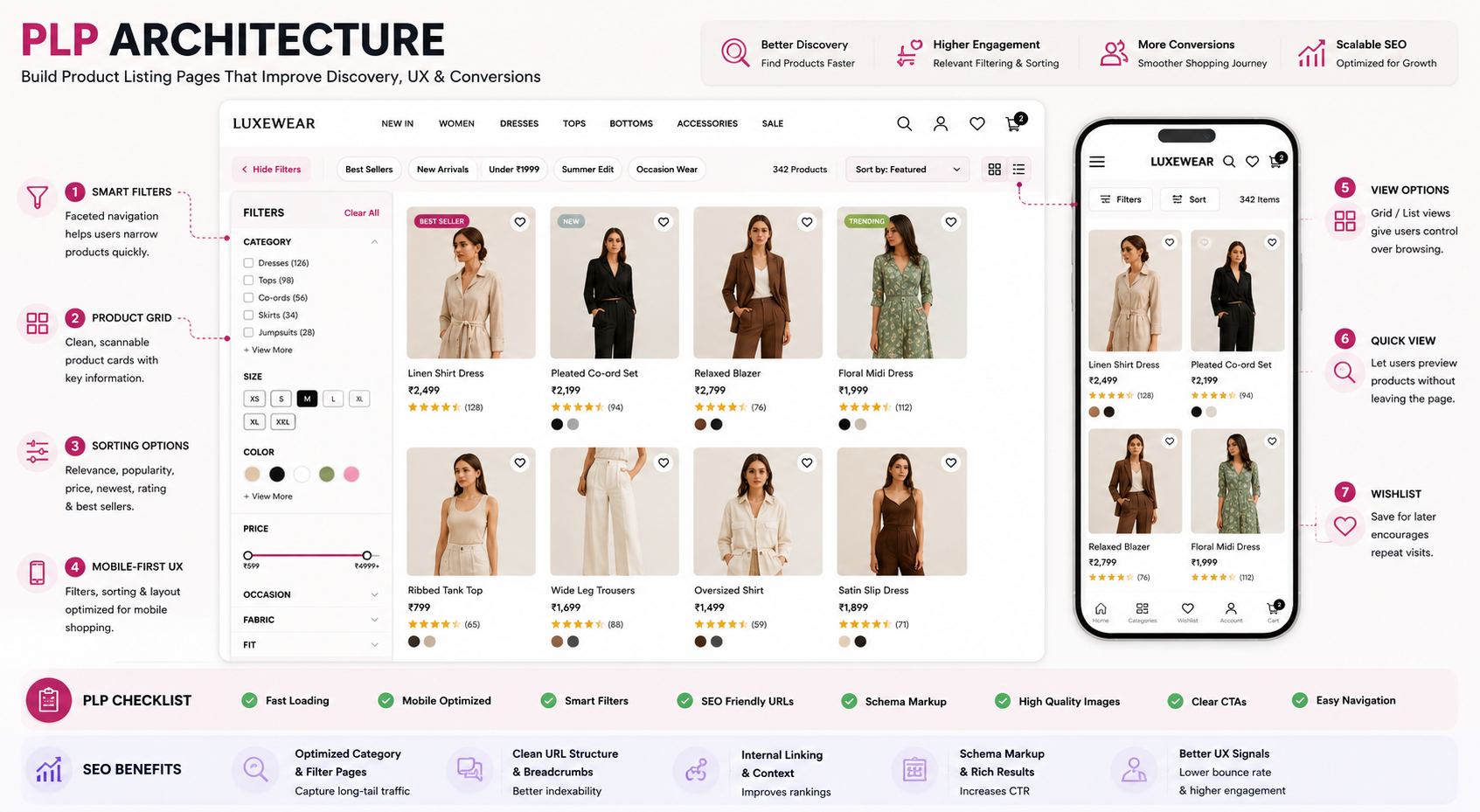
This becomes even more important for large or growing catalogs where poor navigation creates browsing fatigue. Fashion ecommerce increasingly depends on fast product discovery experiences instead of endless scrolling through unstructured collections.
Advanced Filters Improve Product Discovery
Filters are one of the most important components of modern fashion ecommerce websites. Customers should be able to refine collections based on multiple attributes such as size, color, price range, sleeve type, fit, fabric, occasion, brand, and availability.
This filtering experience is often called faceted navigation. Proper faceted navigation improves usability because shoppers can narrow large catalogs into highly relevant product selections within seconds. Research around ecommerce SEO and product discovery continues to show that faceted navigation significantly improves browsing efficiency when implemented correctly.
Many websites guides still offer limited filters or poorly organized filter systems that create friction during browsing. Fashion customers expect filtering systems to work instantly, especially on mobile devices.
Faceted Navigation Also Impacts SEO
Product listing pages are not only UX elements. They also affect category SEO, crawl efficiency, and organic visibility.
When faceted navigation is poorly implemented, ecommerce websites can accidentally create thousands or even millions of duplicate URLs through filter combinations. This creates crawl budget waste, duplicate content problems, and indexation issues. Ecommerce SEO guides increasingly identify faceted navigation as one of the biggest technical SEO challenges for large ecommerce stores.
For example, filtered combinations like:
- /dresses?color=red
- /dresses?size=m
- /dresses?color=red&size=m
- /dresses?sort=price-low
can rapidly multiply into thousands of crawlable URLs if not managed correctly.
This is why fashion ecommerce websites need SEO-aware faceted navigation systems with proper canonical handling, indexation controls, and scalable URL structures.
Quick View and Variant Preview Reduce Browsing Friction
Quick view functionality helps shoppers preview products without repeatedly opening and closing individual pages. This improves browsing continuity, especially for mobile users exploring large collections.
Variant previews are also becoming more important in fashion ecommerce. Customers increasingly expect to preview colors, patterns, or style variations directly from collection pages instead of opening separate product pages for every variation.
This reduces unnecessary navigation friction and helps users compare products faster.
Visual Browsing Matters More in Fashion Ecommerce
Fashion ecommerce depends heavily on visual browsing behavior. Features such as hover images, alternate product views, short product videos, and model previews improve engagement because customers want faster visual understanding before opening a product page.
Visual-first browsing is becoming more important as mobile commerce and social commerce continue influencing fashion shopping behavior. Many users now expect ecommerce experiences similar to social media discovery feeds rather than static catalogs.
Sorting Logic Influences Buying Behavior
Sorting systems also affect product discovery significantly. Sorting products by popularity, trending products, newest arrivals, discounts, or best-selling collections helps guide users toward relevant inventory faster.
Many fashion websites still use basic sorting systems without considering customer intent. Smart sorting logic improves both browsing efficiency and inventory visibility.
A strong product listing page should help users discover products quickly while supporting scalable SEO architecture and mobile usability. Once users narrow their choices through category pages and filters, the next critical layer influencing buying decisions becomes the product detail page experience.
Product Detail Page Features That Increase Conversion Rate
Product detail pages have one primary responsibility in fashion ecommerce: reducing uncertainty before purchase. Once shoppers move from collection pages into individual products, they start evaluating sizing, fit, fabric, styling, quality, delivery expectations, and return risk. If the product page fails to answer these questions clearly, conversion rates drop and return rates increase.
Most fashion returns happen because the PDP failed to answer questions. Many fashion brands still focus heavily on product photography while ignoring sizing clarity, fit communication, user-generated content, material details, and buying confidence signals. High-quality images alone are not enough anymore.
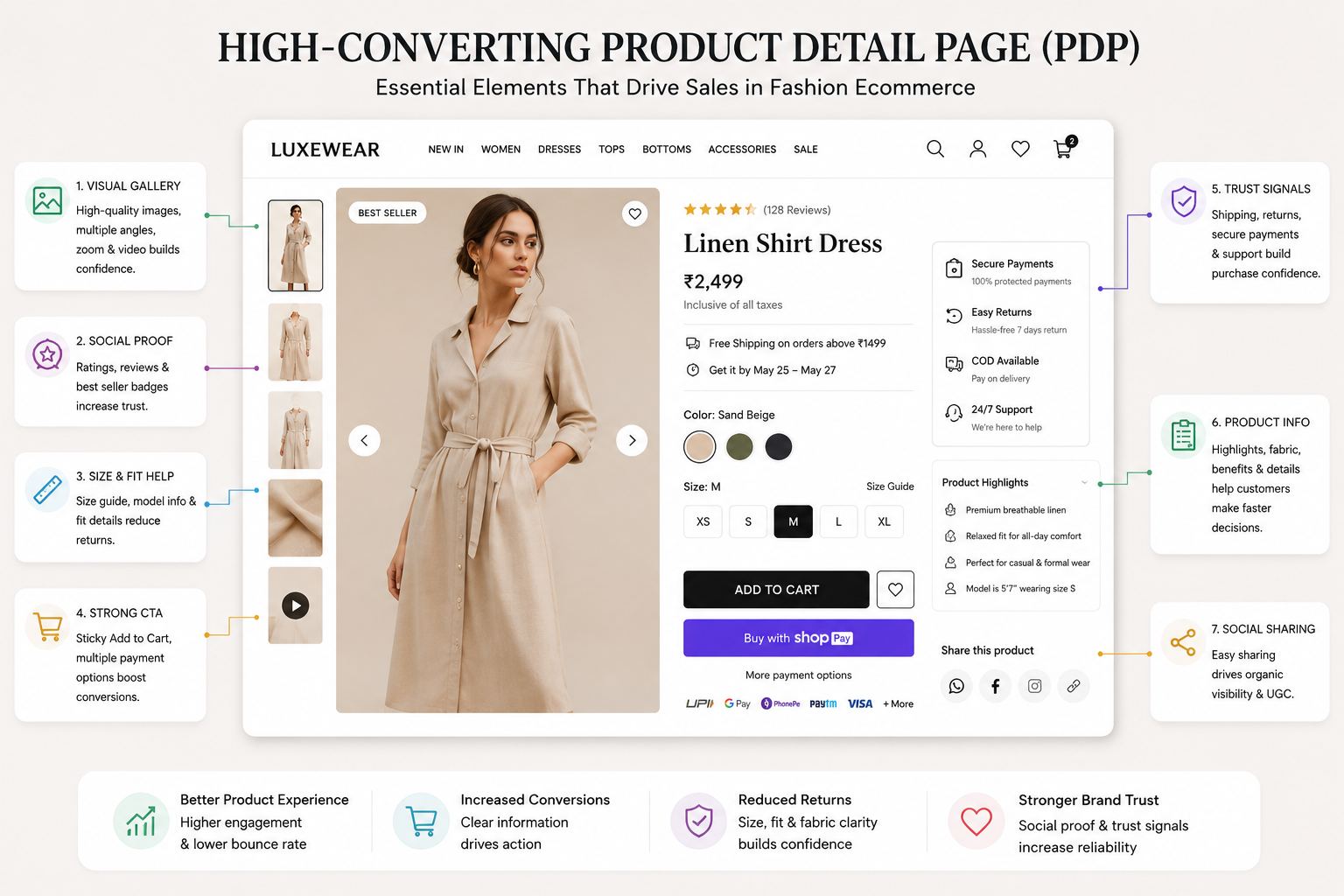
Fashion ecommerce continues to face some of the highest return rates among ecommerce industries, largely due to fit and sizing uncertainty. Multiple industry studies in 2025 and 2026 continue showing that apparel return rates remain significantly higher than many other ecommerce categories because shoppers cannot physically try products before purchasing.
Product Images Should Reduce Purchase Hesitation
Fashion customers want more than studio product photos. They want visual confidence before purchasing. Modern fashion PDP optimization increasingly depends on multiple image angles, zoom capability, fabric texture visibility, model shots, close-up views, and short product videos.
Showing products on different body types, lighting conditions, and styling combinations helps customers understand fit and appearance more realistically. This reduces uncertainty and improves buying confidence.
Short-form product videos are also becoming more important because customers want to understand movement, drape, stretch, and real-world appearance before making decisions.
Size Guides and Fit Information Reduce Returns
Sizing clarity has become one of the most important conversion and retention factors in fashion ecommerce. Generic size charts alone are often insufficient because customers struggle to interpret measurements consistently across brands.
Modern fashion websites increasingly include:
- Detailed measurement guides
- Fit descriptions
- Model height and wearing size
- Stretch and fabric behavior notes
- Recommendations like “runs small” or “oversized fit”
- AI-assisted sizing suggestions
Research around fashion ecommerce continues to show that inconsistent sizing and fit uncertainty remain major drivers of abandoned purchases and product returns.
Many brands are now using AI-based sizing systems and fit recommendation tools to improve purchase confidence and reduce wrong-size orders. Studies around AI-assisted try-on systems and sizing guidance show measurable improvement in conversion performance when shoppers feel more confident about fit decisions.
User-Generated Content Builds Trust Faster
User-generated content has become one of the strongest trust signals in fashion ecommerce. Customers trust real usage photos, reviews, styling examples, and customer feedback more than polished marketing visuals alone.
Reviews containing fit feedback, fabric quality comments, delivery experience, and styling suggestions help reduce hesitation because shoppers can compare their expectations with real customer experiences.
Modern fashion shoppers increasingly expect:
- Photo reviews
- Video reviews
- Verified purchase reviews
- Fit-related review filters
- Ratings by size or comfort
These trust layers help reduce uncertainty before purchase and improve decision confidence.
Sticky Add-to-Cart Improves Mobile Usability
Mobile browsing behavior continues to dominate fashion ecommerce traffic. Long product pages can create friction if users need to repeatedly scroll back to purchase buttons after reviewing product details.
Sticky add-to-cart functionality helps maintain buying momentum by keeping primary actions visible throughout the browsing session. This becomes especially useful on mobile devices where navigation space is limited.
Fashion ecommerce conversion optimization increasingly depends on reducing interaction friction during mobile browsing experiences. Industry research continues to show that even small usability improvements can significantly influence fashion ecommerce conversion performance.
Structured Product Information Improves Buying Confidence
Product information should answer practical buying questions clearly and quickly. Important details usually include:
- Fabric composition
- Wash care instructions
- Fit type
- Stretch behavior
- Transparency level
- Delivery timelines
- Return policy summary
Many fashion websites still hide important buying information behind tabs or collapsible sections that customers rarely open. Modern PDP optimization focuses on making confidence-building information easier to access during browsing.
A strong product detail page should reduce hesitation, improve trust, and help customers make faster purchase decisions with greater confidence. Once product pages become easier to browse and understand, the next important layer influencing product discovery and conversion becomes the onsite search experience.
Search Features Your Fashion Ecommerce Website Must Have
Search has become one of the highest-converting features in modern ecommerce because users who actively search usually have stronger buying intent than casual browsers. In fashion ecommerce, onsite search no longer functions as a basic keyword tool. It now acts as a product discovery engine that directly influences conversion rates, browsing efficiency, and customer satisfaction.
Many fashion websites still use traditional keyword-based search systems that fail when users type natural language queries, spelling variations, trend-based searches, or style-focused phrases. A basic search bar is not enough in 2026. Modern shoppers expect search systems to understand intent, context, visual preferences, and browsing behavior.
This challenge becomes larger for fashion brands managing thousands of SKUs, variants, collections, and seasonal products. Without intelligent onsite search, users struggle to discover relevant products quickly, especially on mobile devices where browsing space is limited.
Search users usually have the highest buying intent. Ecommerce research continues to show that users interacting with onsite search convert at significantly higher rates compared to standard browsing sessions. AI-powered ecommerce search systems are increasingly improving conversion performance because they reduce friction during product discovery.
Predictive Search Improves Product Discovery Speed
Predictive search helps users discover products before completing full search queries. As shoppers type, the system should dynamically suggest:
- Products
- Collections
- Categories
- Trending searches
- Popular keywords
- Brand suggestions
This reduces typing effort and helps users move toward relevant inventory faster. Predictive search also minimizes zero-result experiences, which silently reduce ecommerce revenue.
Modern AI-powered search systems increasingly use behavioral learning to improve autocomplete suggestions based on search intent and conversion data rather than exact keyword matching.
AI Search Understands Intent Instead of Exact Keywords
Fashion shoppers often search using descriptive phrases rather than exact product names. Queries like:
- “boho summer dress”
- “oversized black hoodie”
- “wedding guest outfit”
- “co-ord set for vacation”
require semantic understanding rather than literal keyword matching.
AI search systems increasingly use natural language processing, semantic search, and intent recognition to understand style preferences, occasions, color intent, and product relationships. Fashion ecommerce platforms using advanced AI search systems continue reporting strong conversion improvements because search becomes more discovery-oriented instead of mechanically keyword-driven.
AI-driven commerce infrastructure is also becoming more common across the fashion industry as brands invest in conversational commerce, adaptive shopping experiences, and personalized discovery systems.
Visual Search Is Becoming More Important in Fashion Ecommerce
Visual search allows users to upload images and discover visually similar products from the catalog. This is becoming increasingly valuable in fashion ecommerce because many customers discover styles through Instagram, Pinterest, influencer content, or screenshots rather than text searches.
AI-powered visual search systems can analyze color, pattern, silhouette, and style similarities to surface matching products faster. Industry research around AI visual commerce shows that visual discovery increasingly improves conversion efficiency and customer engagement in fashion ecommerce environments.
Search Analytics Reveal Hidden Customer Intent
Search behavior provides direct insight into customer demand. Queries, refinements, no-result searches, and filter usage help fashion brands understand what shoppers are actively trying to find.
For example, if users repeatedly search for terms like “linen co-ord set” or “oversized Korean fit shirt” without finding results, the business gains immediate visibility into potential inventory gaps or merchandising opportunities.
Modern AI search analytics systems increasingly connect onsite search behavior with merchandising decisions, product planning, and category optimization.
A strong onsite search system should help users discover products quickly while reducing browsing friction across large catalogs. Once shoppers find relevant products through search and collection browsing, the next stage influencing conversion performance becomes the cart and checkout experience.
Cart and Checkout Features That Reduce Cart Abandonment
Cart abandonment continues to be one of the biggest revenue leaks in fashion ecommerce. Many shoppers add products to the cart with strong buying intent but leave before completing the purchase. In most cases, the problem is not the product itself. The friction usually appears during the checkout experience.
A complicated checkout silently kills conversions. Long forms, forced account creation, hidden shipping costs, slow mobile experiences, limited payment options, and unclear delivery timelines often create hesitation during the final stage of the buying journey.
Industry studies in 2025 and 2026 continue showing global cart abandonment rates remaining close to 70%, with fashion ecommerce experiencing even higher abandonment due to sizing uncertainty, browsing behavior, and mobile shopping friction.
Many fashion brands focus heavily on driving traffic through Meta Ads, influencer campaigns, and Google Shopping, but lose a significant portion of potential revenue because the checkout experience creates unnecessary obstacles.
Guest Checkout Reduces Friction Immediately
One of the most common conversion mistakes in ecommerce is forcing users to create accounts before purchasing. Fashion shoppers often want a faster buying experience, especially during impulse purchases or mobile browsing sessions.
Guest checkout removes an unnecessary barrier and allows users to complete purchases quickly. Customers can always create accounts later after trust has been established.
Modern ecommerce checkout optimization increasingly focuses on reducing required actions during purchase flows instead of collecting excessive user information upfront.
Mobile-First Checkout Experience Is Critical
Fashion ecommerce traffic is now heavily mobile-driven, which changes how checkout systems should function. Mobile users expect:
- Fast-loading checkout pages
- Minimal typing effort
- Auto-filled form fields
- Sticky checkout actions
- Simple address selection
- One-tap payment methods
Slow or cluttered mobile checkout experiences create immediate drop-offs because users often shop during short browsing sessions or while multitasking.
Mobile commerce research continues showing significantly higher abandonment rates on smartphones compared to desktop shopping sessions, largely due to friction during navigation and payment processes.
Flexible Payment Options Improve Conversion Confidence
Fashion ecommerce websites should support multiple payment methods to reduce purchase hesitation across different customer segments.
For Indian ecommerce brands, common payment expectations now include:
- UPI payments
- Credit and debit cards
- Wallet payments
- Cash on Delivery
- EMI options
- Buy Now Pay Later services
Limited payment flexibility can reduce conversion rates because users prefer different payment behaviors depending on order value, trust level, and urgency.
Transparent Shipping Information Prevents Last-Minute Drop-Offs
Unexpected shipping costs remain one of the biggest reasons behind checkout abandonment. Customers want clarity around:
- Delivery timelines
- Shipping charges
- Return availability
- Exchange process
- Estimated arrival dates
When this information appears late during checkout, hesitation increases. Transparent communication earlier in the buying journey improves trust and reduces surprise-driven abandonment.
WhatsApp Cart Recovery Is Becoming Standard in Fashion Ecommerce
Many competitor articles still focus only on email-based cart recovery, but fashion ecommerce increasingly depends on WhatsApp recovery systems because mobile shoppers engage faster through conversational channels.
Modern D2C brands now use automated WhatsApp recovery flows to remind users about incomplete purchases, answer product questions, share payment links, and recover abandoned carts in real time. Multiple industry case studies in 2025 and 2026 continue reporting significantly higher engagement and recovery rates through WhatsApp compared to traditional email-only recovery systems.
Effective recovery systems usually combine:
- Cart reminders
- Direct checkout links
- Product images
- Size assistance
- Limited urgency messaging
- Customer support access
Discounts alone do not reduce abandonment. Many customers abandon carts because of uncertainty, distractions, sizing concerns, or delayed decision-making rather than pricing alone.
A strong checkout experience should remove hesitation, reduce friction, and help customers complete purchases quickly across devices. Once checkout systems become smoother, the next major opportunity for fashion ecommerce growth comes from improving repeat visits and retention behavior through wishlist and save-for-later systems.
Wishlist and Save-for-Later Features That Increase Repeat Purchases
Fashion ecommerce depends heavily on repeat browsing behavior. Unlike necessity-driven purchases, fashion shopping often involves delayed decisions, comparison browsing, trend exploration, and emotional buying patterns. Many shoppers discover products during one session and return later to purchase after comparing styles, checking prices, or waiting for the right moment.
Fashion customers rarely purchase in the first session. This is why wishlist systems and save-for-later functionality have become far more important than simple convenience features. They now act as retention and re-engagement systems that help brands bring users back into the buying journey.
Most ecommerce websites still treat wishlist functionality as a small secondary feature hidden inside product pages. In reality, wishlist systems provide valuable behavioral signals while improving repeat visits, customer retention, and conversion opportunities.
Industry research around ecommerce retention continues showing that saved-product behavior strongly correlates with future purchase intent because users often revisit products multiple times before completing transactions. Wishlist reminder systems also help reduce browse abandonment by allowing customers to continue their shopping journey later instead of restarting product discovery from scratch.
Save-for-Later Features Support Natural Shopping Behavior
Fashion browsing behavior is rarely linear. Customers frequently:
- Compare multiple outfits
- Check products across devices
- Wait for salary cycles or seasonal sales
- Discuss purchases with friends
- Save products for upcoming occasions
- Revisit products after social media exposure
Save-for-later functionality supports this natural decision-making process without forcing users to repeat browsing sessions from the beginning.
Modern ecommerce systems increasingly allow shoppers to save products directly from collection pages, search results, and mobile browsing experiences because reducing friction during product discovery improves long-term engagement.
Wishlist Systems Improve Repeat Visits
Wishlist systems help fashion brands create continuous engagement beyond the first browsing session. When users save products, the website gains an opportunity to reconnect shoppers through reminders, stock updates, or personalized follow-ups.
This becomes especially important in fashion ecommerce where trends, availability, and pricing frequently change. Customers often revisit saved products multiple times before purchasing.
Many modern fashion brands now use:
- Wishlist synchronization across devices
- Logged-in wishlist history
- Recently saved collections
- Cross-device browsing continuity
- Mobile app save systems
Repeat browsing continuity has become increasingly important as shoppers move between mobile devices, apps, desktops, and social commerce platforms during the buying journey.
Price Drop Alerts Increase Re-Engagement
Price-sensitive shoppers frequently wait before purchasing fashion products. Price drop notifications help bring those users back once products become more attractive financially.
Modern ecommerce retention systems increasingly trigger automated alerts when:
- Wishlist products go on sale
- Limited-time discounts become active
- Seasonal offers begin
- Bundle pricing changes
These alerts create timely re-engagement opportunities without requiring customers to manually revisit the website repeatedly.
Real-time merchandising systems and price-triggered notifications are becoming common retention strategies in modern fashion ecommerce environments because they reconnect users during active buying windows.
Back-in-Stock Notifications Recover Lost Demand
Out-of-stock products are common in fashion ecommerce because sizing and inventory fluctuate rapidly. Without back-in-stock notifications, brands often lose customers permanently once products become unavailable.
Back-in-stock systems allow users to subscribe for updates when specific sizes, colors, or variants return to inventory. This helps recover demand that would otherwise disappear entirely.
These systems also provide valuable inventory insights by revealing which products and variants generate the strongest delayed demand.
Wishlist Features Are Becoming Part of Retention Infrastructure
Wishlist systems are no longer just optional ecommerce add-ons. They are becoming part of broader customer retention infrastructure connected with mobile commerce, personalized engagement, WhatsApp notifications, email reminders, and browsing continuity.
Many blogs still discuss wishlist functionality only from a UI perspective while ignoring its role in repeat visits and re-engagement. In modern fashion ecommerce, wishlist behavior provides important signals about purchase intent, trend demand, and customer preferences.
Once brands improve repeat browsing systems and customer re-engagement, the next major opportunity comes from recommendation engines that personalize product discovery and increase average order value across the ecommerce journey.
Recommendation Engine Features That Increase Average Order Value
Recommendation engines have become one of the most influential systems in modern fashion ecommerce because they directly affect product discovery, average order value, browsing depth, and customer engagement. Many ecommerce stores still rely on static “related products” sections that show random or manually selected items without understanding customer behavior or shopping intent.
Recommendation systems silently influence buying decisions. In fashion ecommerce, customers rarely purchase products in isolation. A shopper viewing a kurta may also need matching bottoms, footwear, accessories, or styling combinations. Intelligent recommendation systems help surface those additional products naturally during the browsing journey.
Modern recommendation systems are no longer limited to simple cross-selling widgets. AI-driven personalization engines increasingly analyze browsing behavior, clicks, purchase history, style preferences, category interactions, device behavior, and product affinity signals to personalize product discovery in real time.
Industry research around ecommerce personalization continues showing measurable impact on both conversion rates and average order value. Studies in 2025 and 2026 report that personalization systems can improve revenue, increase basket size, and significantly improve customer engagement when implemented correctly.
Complete-the-Look Recommendations Increase Basket Size
Fashion ecommerce works especially well with styling-based recommendations because customers often buy coordinated products together. Complete-the-look recommendation sections help users discover matching items without manually searching through the catalog.
For example, a shopper viewing a blazer may also see:
- Matching trousers
- Recommended shirts
- Footwear suggestions
- Accessories
- Layering products
This type of styling-based cross-selling improves average order value because it reduces the effort required to build complete outfits.
Many fashion brands now treat recommendation systems as digital merchandising tools rather than simple upsell widgets. AI-assisted styling and product bundling continue becoming more important across modern ecommerce platforms.
Behavior-Based Recommendations Improve Product Discovery
Traditional recommendation systems often show the same products to every visitor. Modern recommendation engines increasingly personalize results based on behavioral signals such as:
- Recently viewed products
- Browsing categories
- Favorite colors
- Purchase history
- Price sensitivity
- Trending product interactions
- Session behavior
Behavior personalization improves discovery because users see products aligned with their actual preferences instead of generic catalog suggestions.
Research around AI-powered ecommerce personalization shows that personalized recommendations continue generating strong improvements in conversion performance and customer engagement across ecommerce industries.
Recently Viewed Products Reduce Browsing Friction
Fashion shoppers frequently revisit products multiple times before purchasing. Recently viewed product systems help users continue browsing without restarting the discovery process from the beginning.
This becomes especially useful for mobile commerce where users often move between social apps, search engines, and ecommerce websites during product research sessions.
Recently viewed sections also help recover interrupted browsing journeys by allowing customers to quickly return to products they explored earlier.
AI Recommendations Are Replacing Static Product Widgets
AI recommendation engines increasingly adapt in real time based on customer interactions. Instead of relying only on historical purchases, modern systems now analyze session behavior, click patterns, category interest, and engagement signals dynamically.
This allows recommendation systems to respond faster to changing fashion trends, seasonal demand, browsing patterns, and customer intent.
Industry studies around recommendation engines continue reporting significant improvements in average order value and product engagement when customers interact with personalized recommendations instead of generic product blocks.
Amazon-style recommendation systems have strongly influenced customer expectations across ecommerce. Modern shoppers increasingly expect websites to understand preferences and surface relevant products automatically instead of forcing manual browsing through large catalogs.
Recommendation Placement Matters Across the Customer Journey
Recommendation systems should appear naturally throughout the ecommerce journey instead of being limited to product pages only.
Modern fashion ecommerce websites increasingly use recommendations across:
- Homepage discovery sections
- Collection pages
- Product detail pages
- Cart experiences
- Wishlist systems
- Email campaigns
- WhatsApp recovery flows
This creates continuous product discovery opportunities throughout the customer lifecycle.
Many guides still discuss recommendation systems as simple “related products” widgets while ignoring behavior personalization and AI-driven merchandising logic. In modern fashion ecommerce, recommendation engines influence not only conversion rates, but also retention, browsing depth, average order value, and customer experience quality.
Once product discovery and personalization systems become stronger, the next major layer affecting long-term ecommerce growth is SEO architecture. Fashion ecommerce websites must support scalable SEO systems capable of handling large catalogs, variants, category structures, and search visibility efficiently.
SEO Features Every Fashion Ecommerce Website Must Have
Fashion ecommerce websites often invest heavily in visual design, branding, photography, and user experience while ignoring technical SEO architecture. This creates a major long-term growth problem because search visibility depends not only on content and products, but also on how search engines crawl, understand, index, and organize the ecommerce website.
A fashion ecommerce website without SEO architecture struggles to scale organically. Product uploads alone do not create SEO visibility. Modern ecommerce SEO depends on structured category systems, scalable internal linking, crawl management, page performance, product data optimization, and technical consistency across large catalogs.
This challenge becomes much more complex in fashion ecommerce because stores often contain thousands of products, variants, filters, collections, seasonal pages, and dynamic URLs. Without proper SEO systems, large sections of the website can become difficult for search engines to crawl and understand efficiently.
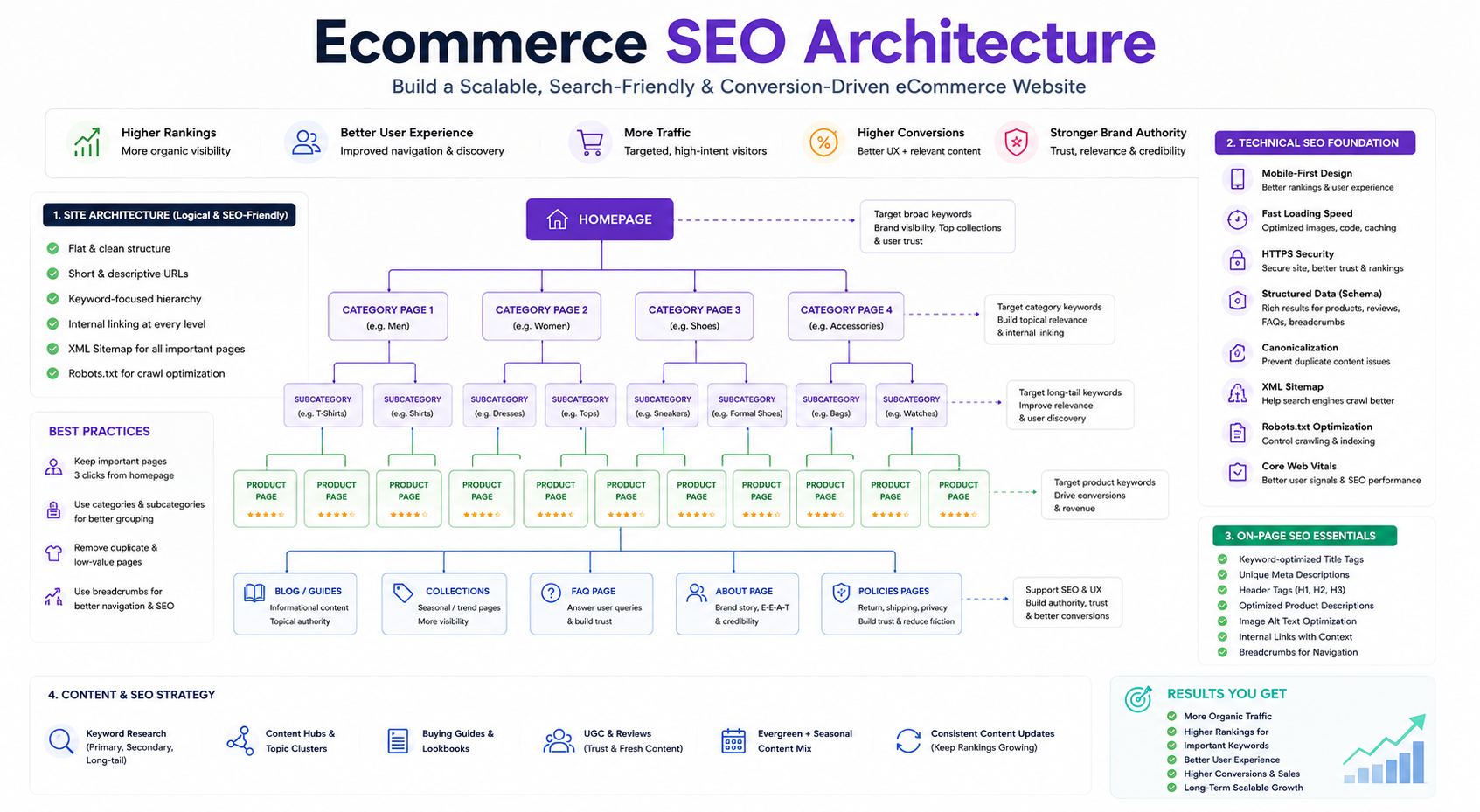
Most competitor articles focus mainly on design layouts and frontend visuals while barely discussing technical SEO infrastructure. In reality, ecommerce SEO should be built into website architecture from the beginning instead of being treated as a separate marketing layer later.
Modern ecommerce SEO increasingly focuses on crawl efficiency, structured product understanding, AI-driven search interpretation, and user experience signals across mobile devices. Ecommerce SEO frameworks in 2026 continue emphasizing technical foundations, structured architecture, and scalable indexing systems for long-term visibility growth.
SEO-Friendly URL Structure Improves Crawl Efficiency
URL structure affects both user experience and search engine understanding. Fashion ecommerce websites should maintain clean, readable, category-focused URLs that help search engines understand product hierarchy clearly.
For example:
- /women/dresses/maxi-dress
- /men/kurtas/linen-kurta
- /footwear/sneakers/white-sneakers
are far more understandable than dynamically generated URLs filled with parameters and tracking strings.
Logical hierarchy also improves internal linking and category relevance signals across the ecommerce website.
Faceted Navigation Needs SEO Control
Faceted navigation is one of the most important usability systems in fashion ecommerce because shoppers frequently filter products by size, color, fit, price, style, and occasion.
At the same time, faceted navigation can become one of the biggest technical SEO risks if not managed properly. Every filter combination can generate new URLs, which rapidly multiplies crawlable pages across the website.
Research around ecommerce SEO continues identifying faceted navigation as one of the most common causes of duplicate URLs, crawl waste, and indexation problems in large ecommerce stores.
Modern fashion ecommerce websites increasingly use:
- Canonical tags
- Noindex controls
- Controlled crawl parameters
- SEO-friendly filter logic
- Static landing pages for high-intent categories
to prevent crawl inefficiencies while preserving strong filtering experiences for users.
Canonical Tags Help Manage Product Variants
Fashion ecommerce stores often create multiple URLs for the same product because of color variants, size combinations, and parameterized pages.
Without canonical tags, search engines may struggle to determine the preferred version of a product page. This can dilute ranking signals and create duplicate content issues across the website.
Canonical management becomes especially important for apparel stores where one product may contain dozens of variant combinations.
Core Web Vitals Affect Both SEO and Conversion Rates
Page speed and user experience signals continue playing an important role in ecommerce SEO. Core Web Vitals measure loading speed, responsiveness, and visual stability across devices.
Fashion ecommerce websites often become slower because of:
- Large product images
- Heavy JavaScript
- Animation-heavy themes
- Third-party apps
- Video assets
- Tracking scripts
Core Web Vitals remain highly important in 2026 because they directly influence user experience, mobile usability, and competitive SEO performance in crowded ecommerce niches.
Modern ecommerce platforms increasingly move toward lighter frontend architectures, partial hydration systems, and faster rendering techniques to improve performance.
Schema Markup Helps Search Engines Understand Products
Structured data helps search engines interpret important ecommerce information such as:
- Product pricing
- Availability
- Ratings
- Reviews
- Variants
- Breadcrumb hierarchy
Product schema markup improves eligibility for rich results and shopping-related search experiences. Modern ecommerce SEO increasingly depends on structured product understanding because AI-driven search systems rely heavily on machine-readable product data.
Internal Linking Strengthens Ecommerce Hierarchy
Internal linking helps search engines understand relationships between categories, collections, products, and informational content.
Fashion ecommerce websites should create strong semantic connections between:
- Categories
- Subcategories
- Collections
- Trending pages
- Seasonal landing pages
- Buying guides
- Product pages
Strong internal linking improves crawlability while distributing authority across important commercial pages.
Content Capability Helps Ecommerce SEO Scale
Modern ecommerce SEO extends beyond product pages. Fashion brands increasingly publish:
- Style guides
- Trend articles
- Buying guides
- Seasonal fashion content
- Fabric education pages
- Occasion-based collections
This content layer helps ecommerce websites target informational and mid-funnel search intent while strengthening topical authority around fashion-related queries.
A strong SEO foundation helps fashion ecommerce websites scale organic visibility across categories, collections, products, and informational searches. Once SEO architecture becomes technically stable, the next major system influencing search visibility and ecommerce growth is Google Merchant Center integration and product feed optimization.
Features Needed for Google Merchant Center Approval
Google Merchant Center has become one of the most important systems in modern fashion ecommerce because it powers product visibility across Google Shopping, Search, Images, YouTube, Discover, and AI-driven shopping experiences. Many fashion brands focus heavily on ad campaigns while ignoring the product infrastructure required for Merchant Center approval and long-term Shopping Ads performance.
Google Shopping performance depends heavily on product data quality. Merchant Center approval does not depend only on uploading products. It depends on whether the ecommerce website provides accurate, structured, policy-compliant, and consistently synchronized product information across the website and product feeds.
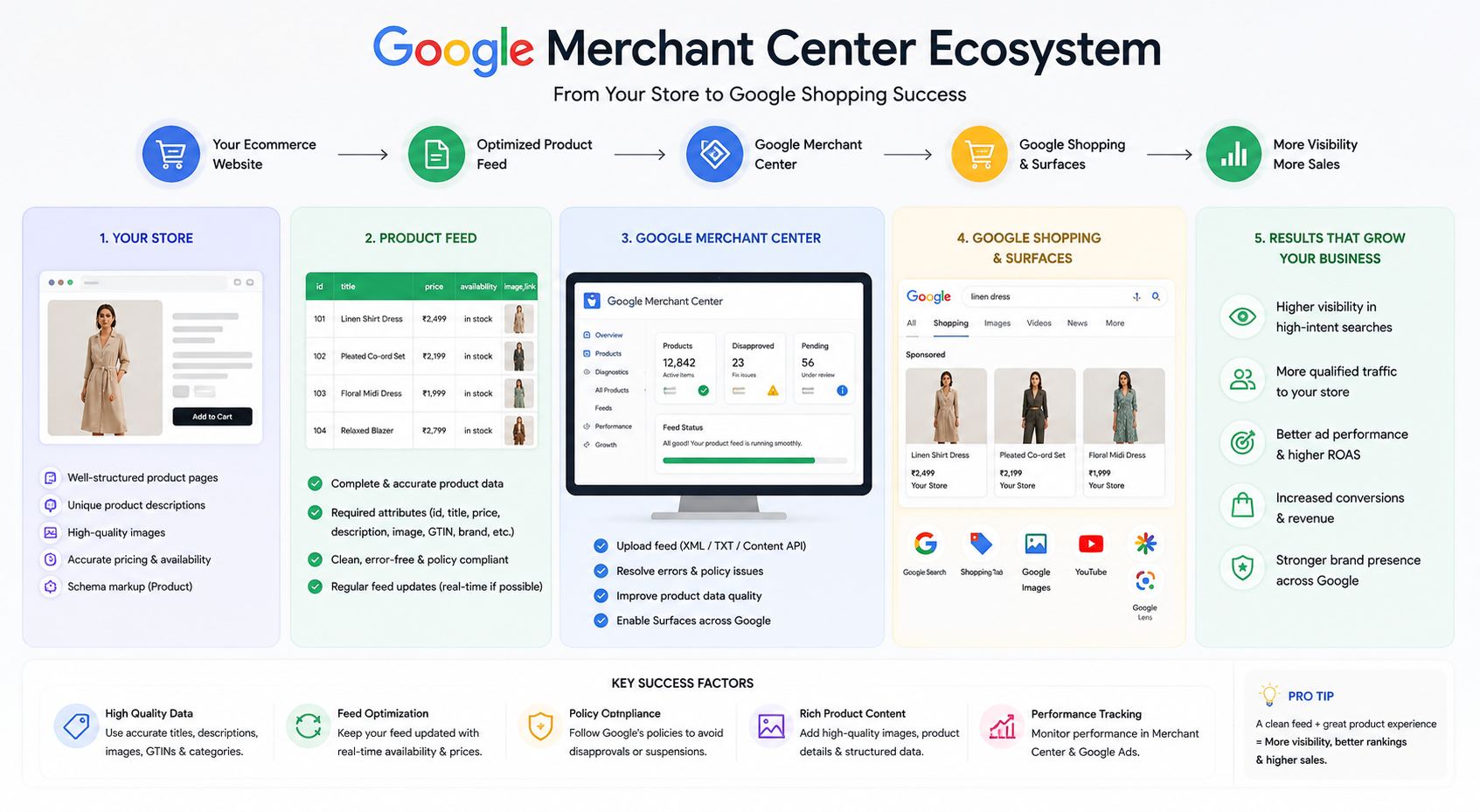
Modern Google Shopping ecosystems increasingly depend on structured product data, feed completeness, image quality, shipping transparency, and product accuracy because Google’s AI-driven commerce systems rely heavily on machine-readable product information. Multiple 2026 Merchant Center updates continue expanding product-level requirements around shipping data, video assets, image quality, and feed precision.
Product Feed Structure Is the Foundation of Merchant Center
A product feed acts as the communication layer between the ecommerce website and Google Merchant Center. It provides Google with important product information such as:
- Product titles
- Descriptions
- Pricing
- Availability
- Images
- GTIN values
- Brand details
- Product categories
- Shipping information
Weak product feeds often create:
- Disapproved products
- Low Shopping visibility
- Feed mismatches
- Poor click-through rates
- Limited AI shopping eligibility
Google’s product data specification guidelines continue emphasizing feed accuracy and structured attribute completeness because Google matches products to search intent primarily through feed data.
GTIN and Product Identifiers Improve Product Matching
Global Trade Item Numbers (GTINs) help Google identify products accurately across the ecommerce ecosystem. For branded fashion products, missing or incorrect GTIN values can significantly reduce Shopping visibility and approval consistency.
Merchant Center systems increasingly use:
- GTIN
- Brand
- MPN
- Product type
- Google product category
to improve product classification and search matching quality.
Google Merchant Center documentation and ecommerce feed optimization studies continue highlighting proper product identifiers as one of the most important feed quality signals for Shopping performance.
Product Data Must Match Website Information
Google continuously compares feed data with website content to verify accuracy. Product prices, availability, shipping details, and variant information must remain synchronized between the ecommerce website and Merchant Center feed.
Common disapproval causes include:
- Price mismatches
- Outdated inventory status
- Broken product pages
- Unavailable landing pages
- Incorrect shipping information
- Policy violations
This is why real-time inventory synchronization and automated feed updates have become important operational requirements for scaling ecommerce brands.
Modern feed systems increasingly support automated syncing through APIs, scheduled feed generation, and ecommerce platform integrations to maintain consistency across large catalogs.
High-Quality Product Images Affect Both Approval and Performance
Product images are one of the strongest performance drivers in Google Shopping because Shopping ads are highly visual.
Google continues tightening image quality requirements to improve shopping experiences across AI-powered commerce surfaces. Recent Merchant Center specification updates introduced stronger image quality standards and larger minimum resolution requirements for future enforcement cycles.
Fashion ecommerce brands should use:
- High-resolution product images
- Clean backgrounds
- Accurate product representation
- Multiple product angles
- Variant-specific visuals
- Consistent image formatting
Product images alone do not ensure Merchant Center approval, but weak images can reduce visibility, click-through rate, and Shopping performance significantly.
Shipping and Return Transparency Matters More in 2026
Google increasingly evaluates shipping accuracy and customer experience signals during Merchant Center reviews. Ecommerce websites should clearly display:
- Shipping charges
- Delivery timelines
- Return policies
- Exchange conditions
- Business contact information
Merchant Center updates in 2026 introduced additional shipping-related attributes at the product level, including handling cutoff times and minimum order value requirements for shipping eligibility.
These changes show that Google is moving toward more detailed fulfillment transparency within ecommerce ecosystems.
Product Schema Markup Supports Feed Accuracy
Structured product schema helps search engines understand product information directly from the website. Product schema usually includes:
- Pricing
- Availability
- Ratings
- Reviews
- Brand data
- Variant information
This structured data improves consistency between website content and Merchant Center feeds while helping Google verify product information more efficiently.
Modern ecommerce SEO and Shopping ecosystems increasingly overlap because Google uses both structured data and product feeds to improve shopping accuracy across search surfaces.
Merchant Center readiness now starts from ecommerce architecture itself rather than only feed uploads. Fashion brands planning Google Shopping campaigns must build websites capable of supporting structured product data, synchronized inventory systems, policy compliance, and scalable feed management from the beginning.
Once Google Shopping infrastructure becomes stable, the next major growth layer for fashion ecommerce brands involves Meta catalog systems, dynamic product ads, and social commerce integrations across Instagram and Facebook ecosystems.
Meta Ads and Catalog Features Fashion Websites Must Support
Meta Ads have become one of the most important growth channels for fashion ecommerce brands because platforms like Instagram and Facebook heavily influence fashion discovery, trend consumption, and impulse buying behavior. Many shoppers now discover products through reels, influencer content, story ads, and dynamic product recommendations before visiting ecommerce websites directly.
This is why Meta commerce infrastructure has become much more technical than simply running boosted posts. Modern Meta commerce performance depends heavily on catalog quality, product feed accuracy, event tracking, audience signals, and dynamic personalization systems.
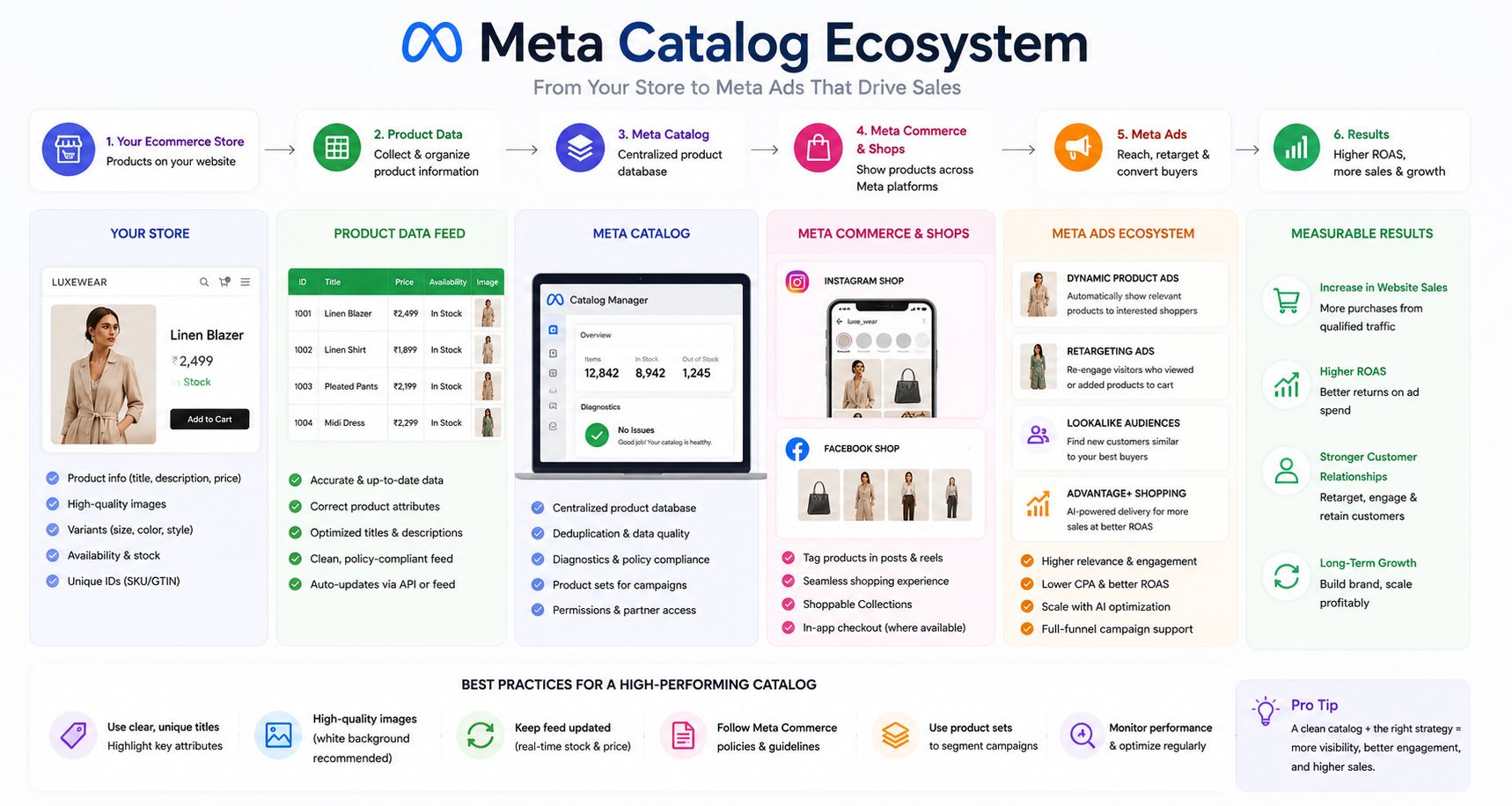
Poor catalog structure reduces Meta Ads performance significantly. Many ecommerce websites still operate with incomplete product catalogs, missing attributes, weak event tracking, inconsistent product feeds, or disconnected Commerce Manager setups. These issues silently reduce dynamic ad quality, retargeting efficiency, audience learning, and campaign scalability.
Many guides available focus mainly on ad creatives or targeting strategies while ignoring the ecommerce architecture required for scalable Meta commerce performance. In reality, fashion ecommerce websites must support structured catalog systems and reliable behavioral tracking from the beginning.
Meta’s ecommerce ecosystem in 2026 increasingly depends on AI-driven catalog ads, dynamic personalization, automated product matching, and machine-learning optimization systems. Advantage+ shopping and catalog campaigns are becoming core infrastructure for ecommerce advertisers running large product inventories.
Meta Catalog Structure Powers Dynamic Commerce
A Meta catalog acts as the product database powering:
- Instagram Shop
- Facebook Shop
- Dynamic product ads
- Catalog sales campaigns
- Advantage+ shopping campaigns
- Retargeting systems
The catalog contains structured product information such as:
- Product titles
- Descriptions
- Pricing
- Availability
- Images
- Product links
- Variants
- Inventory data
Meta increasingly relies on catalog quality and feed completeness to personalize ad delivery automatically. Dynamic catalog systems now generate thousands of personalized product combinations across Facebook and Instagram using machine-learning optimization.
Dynamic Product Ads Depend on Behavioral Tracking
Dynamic product ads have become one of the strongest revenue drivers in fashion ecommerce because they automatically show users products based on browsing behavior and purchase intent.
For example, if a shopper views a specific dress category but leaves without purchasing, Meta can automatically retarget that user with:
- Previously viewed products
- Similar styles
- Variant recommendations
- Price-drop products
- Best-selling alternatives
This type of retargeting depends heavily on event tracking quality and catalog synchronization.
Modern Meta catalog campaigns increasingly use AI-driven personalization systems to determine which products should appear for specific users based on intent and engagement patterns.
Meta Pixel Still Plays an Important Role
The Meta Pixel helps websites send behavioral signals back into Meta’s advertising ecosystem. These signals include:
- Page views
- Product views
- Add-to-cart actions
- Initiate checkout events
- Purchases
- Search behavior
These event signals help Meta optimize campaigns, improve retargeting accuracy, and build audience intelligence over time.
Fashion ecommerce websites should ensure event tracking works accurately across:
- Mobile devices
- Product variants
- Dynamic URLs
- Collection pages
- Checkout flows
- Catalog products
Weak event implementation can reduce optimization quality and make campaign scaling unstable.
Conversion API Is Becoming More Important After Privacy Changes
Privacy restrictions and browser tracking limitations have reduced the reliability of browser-only tracking systems. This is why Meta increasingly recommends combining browser tracking with server-side event sharing through Conversion API integrations.
Industry case studies and Meta ecommerce strategies continue reporting stronger attribution accuracy and event recovery when Conversion API works alongside the Meta Pixel.
Many modern ecommerce platforms now support hybrid tracking systems combining:
- Meta Pixel
- Conversion API
- Catalog events
- Server-side tracking infrastructure
to improve campaign optimization and attribution consistency.
Instagram Shop Integration Improves Product Discovery
Instagram has become a major product discovery platform for fashion ecommerce. Many users now discover products directly through:
- Reels
- Influencer collaborations
- Creator content
- Tagged products
- Shoppable feeds
- Story placements
Instagram Shop integration allows fashion brands to connect their product catalogs directly with social commerce experiences.
This creates smoother discovery-to-purchase journeys where users can move from content consumption into product exploration without manually searching products again.
Meta’s AI-driven commerce ecosystem continues moving toward more automated, personalized, and product-aware advertising systems across Instagram and Facebook platforms. Recent industry reports indicate Meta is aggressively expanding AI-driven commerce automation and personalized ad infrastructure heading into 2026.
Catalog Quality Influences Campaign Scalability
Many fashion brands underestimate how strongly product feed quality influences Meta Ads performance. Weak product titles, poor imagery, missing attributes, inconsistent availability data, and broken product mappings reduce campaign efficiency significantly.
Modern Meta commerce systems increasingly reward:
- Clean product feeds
- High-quality visuals
- Consistent variant data
- Strong event tracking
- Structured catalog organization
- Real-time inventory synchronization
Boosting posts is not a scalable Meta commerce strategy anymore. Fashion ecommerce growth increasingly depends on structured catalog systems capable of powering dynamic ads, AI-driven personalization, retargeting automation, and omnichannel product discovery across Meta platforms.
Once Meta commerce infrastructure becomes stable, the next important layer for fashion ecommerce growth involves broader paid marketing systems including attribution, enhanced conversion tracking, remarketing infrastructure, and performance marketing architecture across platforms.
Paid Marketing Features Your Fashion Ecommerce Website Must Support
Performance marketing has become deeply dependent on tracking infrastructure, attribution accuracy, and data quality. Many fashion ecommerce brands invest heavily in Google Ads, Meta Ads, influencer campaigns, and remarketing while operating with weak tracking systems that silently distort performance data.
Weak tracking systems silently destroy ad optimization. If conversion events are missing, duplicated, delayed, or inaccurately attributed, advertising platforms receive poor learning signals. This directly affects audience optimization, bidding efficiency, remarketing quality, and campaign scalability.
Modern ecommerce advertising is no longer only about creatives and targeting. Performance marketing increasingly depends on accurate ecommerce tracking architecture capable of handling cross-device browsing, privacy restrictions, attribution complexity, and real-time behavioral signals.
This challenge became significantly larger after iOS privacy updates, browser tracking limitations, ad blockers, and cookie restrictions reduced visibility into customer journeys across platforms. Industry-wide attribution loss after privacy changes forced ecommerce brands to improve server-side tracking, first-party data systems, and event quality infrastructure.
GA4 Ecommerce Tracking Should Capture Complete Customer Journeys
Google Analytics 4 has become one of the primary analytics systems used in ecommerce because it tracks behavioral events instead of simple page views.
Fashion ecommerce websites should properly track important actions such as:
- Product views
- Collection browsing
- Search activity
- Add-to-cart events
- Wishlist interactions
- Checkout behavior
- Purchases
- Refunds
- User engagement patterns
Without proper ecommerce event tracking, businesses lose visibility into customer behavior and campaign effectiveness.
Modern GA4 ecommerce setups increasingly focus on event accuracy, cross-device tracking, and predictive behavioral modeling because advertising systems now depend heavily on first-party behavioral signals.
Enhanced Conversions Improve Attribution Accuracy
Enhanced conversions help advertising platforms recover lost attribution data caused by browser privacy restrictions and cookie limitations.
These systems securely use first-party customer data such as:
- Email addresses
- Phone numbers
- Purchase details
- Checkout information
to improve conversion matching quality across advertising ecosystems.
Google Ads and Meta increasingly recommend enhanced conversion systems because browser-only attribution has become less reliable after privacy updates and tracking restrictions.
Fashion ecommerce brands scaling paid campaigns now depend more heavily on first-party data infrastructure to maintain campaign optimization quality.
Server-Side Tracking Improves Data Reliability
Traditional browser-side tracking systems are increasingly affected by:
- Ad blockers
- Browser privacy rules
- Cookie expiration
- Tracking prevention systems
- Network interruptions
Server-side tracking helps improve event reliability by processing tracking data through controlled server environments before sharing it with advertising and analytics platforms.
Modern server-side tagging systems increasingly support:
- Better attribution accuracy
- Improved event consistency
- Reduced data loss
- First-party data processing
- Cross-platform event synchronization
Industry adoption of server-side tagging accelerated after browser privacy restrictions reduced traditional client-side tracking accuracy. Ecommerce and performance marketing environments increasingly use hybrid tracking systems combining browser and server-side event processing.
UTM Tracking Helps Understand Traffic Quality
UTM parameters help ecommerce businesses identify where traffic and conversions originate across campaigns and platforms.
Proper UTM tracking allows brands to analyze:
- Campaign performance
- Ad-level traffic quality
- Influencer traffic
- Email campaign behavior
- Social traffic sources
- Cross-platform attribution
Without structured UTM systems, traffic sources often become fragmented inside analytics platforms, making campaign analysis less reliable.
Fashion brands running multiple marketing channels simultaneously need standardized naming conventions and campaign structures to maintain clean reporting systems.
Dynamic Remarketing Depends on Accurate Event Infrastructure
Dynamic remarketing has become one of the strongest conversion systems in ecommerce because it reconnects users with products they already explored.
Modern fashion ecommerce remarketing systems increasingly personalize ads using:
- Viewed products
- Wishlist items
- Cart products
- Category behavior
- Product affinity signals
- Purchase history
These systems depend heavily on accurate ecommerce events and product feed synchronization.
Weak tracking implementation often breaks dynamic remarketing completely because platforms fail to associate customer behavior with correct products or catalog items.
Cross-Platform Attribution Is Becoming More Complex
Fashion customers rarely convert immediately after one ad interaction. Many users discover products through Instagram, return through Google Shopping, revisit through remarketing, and purchase later through branded search or direct visits.
This creates fragmented attribution journeys across multiple devices and channels.
Modern ecommerce brands increasingly combine:
- GA4 tracking
- Enhanced conversions
- Server-side tagging
- Meta Conversion API
- First-party data systems
- Cross-channel attribution modeling
to improve campaign visibility and optimization quality.
Running ads without accurate tracking wastes budget because optimization systems depend entirely on data quality. Modern paid marketing success increasingly relies on clean attribution infrastructure, reliable ecommerce events, and scalable first-party data systems capable of supporting advertising platforms across privacy-focused environments.
Once paid marketing infrastructure becomes stable, the next major layer affecting fashion ecommerce growth is mobile user experience, because most discovery, browsing, and conversion activity now happens across smartphones and mobile commerce environments.
Mobile Features That Matter More Than Desktop in Fashion Ecommerce
Fashion ecommerce has become mobile-first commerce. Most fashion discovery, browsing, product comparison, and even purchasing behavior now happens on smartphones rather than desktop devices. Customers move between Instagram, Google Search, reels, influencer content, WhatsApp, and ecommerce websites continuously during the shopping journey.
Many fashion brands still design websites primarily around desktop layouts and later adjust them for smaller screens. This approach creates friction because responsive design alone is not mobile optimization. A website can technically work on mobile devices while still delivering a weak shopping experience.
Fashion shopping now happens primarily on mobile devices. This changes how navigation, filters, product discovery, browsing interactions, content visibility, and conversion flows should function across the ecommerce experience.
Modern mobile commerce trends continue showing strong growth in smartphone-driven shopping behavior across fashion retail. Industry reports in 2025 and 2026 indicate that mobile commerce now contributes the majority of ecommerce traffic across many retail categories, especially fashion and lifestyle industries.
Thumb-Friendly Navigation Improves Mobile Browsing
Mobile shoppers interact differently compared to desktop users. Navigation elements should remain easily reachable without excessive stretching or multiple taps.
Thumb-friendly ecommerce interfaces increasingly use:
- Sticky bottom navigation
- Large tap targets
- Clear spacing between actions
- Simplified menus
- Expandable filter drawers
- Persistent search visibility
Small clickable areas, crowded layouts, and complex dropdown structures create frustration quickly on mobile devices.
Fashion ecommerce depends heavily on browsing continuity, so even minor usability friction can reduce product exploration depth significantly.
Mobile Filters Need Different UX Logic
Filtering systems that work well on desktop often become difficult to use on smaller screens. Fashion shoppers expect mobile filters to feel fast, clean, and intuitive even across large catalogs.
Modern mobile filter systems increasingly support:
- Slide-in filter panels
- Sticky filter buttons
- Multi-select filtering
- Instant result updates
- Collapsible filter groups
- Quick reset actions
Weak mobile filtering creates browsing fatigue because users struggle to narrow collections efficiently on small screens.
This becomes especially important in fashion ecommerce where shoppers frequently filter by:
- Size
- Color
- Price
- Fit
- Occasion
- Fabric
- Availability
Sticky Add-to-Cart Improves Mobile Conversion Flow
Fashion product pages are becoming longer because brands now include:
- Product images
- Videos
- Reviews
- Fit guides
- Shipping information
- Fabric details
- User-generated content
On mobile devices, users often scroll extensively before making decisions. Sticky add-to-cart systems help maintain purchase visibility throughout the browsing session without forcing users to repeatedly scroll back toward action buttons.
Modern mobile CRO systems increasingly use persistent purchase actions because reducing interaction friction improves conversion consistency during mobile browsing.
Mobile Page Speed Directly Impacts Conversion Rates
Fashion ecommerce websites frequently become slower because of:
- Heavy product imagery
- Animation-rich themes
- Large JavaScript bundles
- Video content
- Third-party scripts
- Tracking integrations
Slow mobile experiences create higher bounce rates because smartphone users often browse under limited attention conditions.
Core Web Vitals continue playing an important role in mobile ecommerce performance because Google evaluates loading speed, visual stability, and responsiveness as part of mobile-first ranking systems.
Google’s mobile-first indexing environment means search engines now primarily evaluate mobile versions of websites for indexing and ranking purposes. This makes mobile performance important not only for conversion optimization but also for organic visibility.
Mobile Search and Discovery Need Higher Visibility
Mobile fashion shoppers often rely heavily on search and category discovery because scrolling through large catalogs manually becomes exhausting on smaller screens.
Modern fashion ecommerce websites increasingly prioritize:
- Sticky search bars
- Predictive search
- Trending searches
- Quick category shortcuts
- Visual discovery sections
- Recently viewed products
These systems reduce browsing friction while helping users discover products faster.
Social-commerce-driven behavior also influences mobile shopping patterns because users frequently arrive from Instagram, Pinterest, influencer links, or short-form content expecting immediate product accessibility.
Mobile UX Is Becoming the Primary Ecommerce Experience
Desktop ecommerce still matters for some customer segments, but fashion ecommerce growth increasingly depends on mobile usability quality.
Modern ecommerce brands now design mobile experiences first and expand toward desktop layouts afterward because:
- Product discovery happens on mobile
- Social commerce is mobile-driven
- Influencer traffic is mobile-heavy
- Fashion browsing is increasingly app-like
- Short-form video commerce is smartphone-focused
Other articles rarely explain how deeply mobile usability affects product discovery, browsing depth, SEO visibility, and conversion performance simultaneously.
Once mobile browsing systems become optimized, the next important layer for sustainable ecommerce growth involves customer retention systems that improve repeat purchases, customer lifetime value, and long-term engagement beyond the first transaction.
Customer Retention Features Most Fashion Brands Ignore
Many fashion ecommerce brands spend heavily on customer acquisition through Meta Ads, influencer marketing, Google Shopping, and creator collaborations while investing very little in retention systems. This creates an unstable growth model because acquisition costs continue increasing across ecommerce platforms every year.
Retention systems reduce dependency on paid ads. When brands improve repeat purchases and customer lifetime value, profitability becomes more sustainable because revenue no longer depends entirely on continuously buying new traffic.
Fashion ecommerce naturally supports repeat purchase behavior because customers regularly buy for:
- Seasonal collections
- Festivals and occasions
- Trend changes
- Workwear updates
- Lifestyle preferences
- Style experimentation
Despite this opportunity, many ecommerce stores still treat retention as occasional discount campaigns instead of building structured lifecycle systems.
Most competitor articles barely discuss retention automation even though modern ecommerce profitability increasingly depends on customer retention, repeat engagement, and first-party audience relationships.
Industry reports in 2026 continue highlighting that rising acquisition costs are forcing ecommerce brands to focus more aggressively on retention, personalization, and customer lifetime value optimization.
WhatsApp Automation Is Becoming a Core Retention Channel
WhatsApp automation has become one of the strongest retention systems for fashion ecommerce because customers engage with messaging platforms much faster than traditional email-only communication.
Modern ecommerce brands increasingly use WhatsApp automation for:
- Order updates
- Restock alerts
- Wishlist reminders
- Personalized offers
- Repeat purchase reminders
- Cart recovery
- Customer support
- Product recommendations
Unlike traditional promotional channels, WhatsApp creates conversational and real-time engagement that feels more personal during the customer journey.
Recent ecommerce studies and industry case studies continue reporting significantly higher engagement rates through WhatsApp-driven retention systems compared to standard email-only campaigns.
Fashion brands are increasingly integrating WhatsApp with ecommerce platforms to automate customer journeys across browsing, purchasing, and post-purchase engagement.
Email Automation Still Plays an Important Role
While WhatsApp improves immediate engagement, email automation remains highly important for deeper lifecycle communication and long-form customer nurturing.
Modern fashion ecommerce email systems increasingly automate:
- Welcome journeys
- Post-purchase flows
- Product education
- Styling inspiration
- Back-in-stock alerts
- Win-back campaigns
- Seasonal launches
- VIP customer communication
Retention-focused email flows help brands maintain long-term customer relationships beyond one-time transactions.
Modern omnichannel ecommerce retention increasingly combines email and WhatsApp together because each channel supports different stages of customer engagement and buying behavior.
Back-in-Stock Alerts Recover Delayed Purchase Intent
Fashion inventory changes quickly because sizes, colors, and seasonal products frequently go out of stock. Without automated restock alerts, many brands permanently lose customers once products become unavailable.
Back-in-stock systems allow customers to subscribe for updates on specific:
- Sizes
- Colors
- Variants
- Collections
- Limited releases
These alerts help recover delayed demand while also giving brands better visibility into high-demand inventory patterns.
Modern retention systems increasingly connect restock notifications with WhatsApp, email, push notifications, and app alerts to improve re-engagement speed.
Loyalty Programs Need More Than Reward Points
Many fashion brands still use basic loyalty systems that only provide discounts after purchases. Modern loyalty strategies are becoming more experience-driven and engagement-focused.
Fashion ecommerce loyalty systems increasingly reward:
- Repeat purchases
- Reviews and UGC
- Referrals
- Social engagement
- VIP access
- Early collection access
- Exclusive launches
- Community participation
Discounts alone do not create customer loyalty. Modern retention strategies increasingly depend on personalization, exclusivity, convenience, and emotional brand connection.
Retail loyalty studies in 2026 continue showing that personalized omnichannel experiences and data-driven engagement systems are becoming central to long-term customer retention strategies.
Post-Purchase Experience Influences Repeat Purchases
Retention does not begin after the second order. It begins immediately after the first purchase.
Modern fashion ecommerce retention systems increasingly improve:
- Order communication
- Shipping transparency
- Delivery tracking
- Packaging experience
- Support responsiveness
- Exchange handling
- Review collection
- Post-purchase engagement
Weak post-purchase experiences reduce repeat purchase probability even if acquisition campaigns perform well initially.
Fashion ecommerce customers increasingly expect real-time updates, personalized communication, and frictionless support across devices and messaging channels.
Retention Infrastructure Is Becoming a Competitive Advantage
As advertising costs continue increasing across Google and Meta ecosystems, retention infrastructure is becoming one of the biggest profitability differentiators in ecommerce.
Modern fashion brands increasingly combine:
- Email automation
- WhatsApp automation
- Loyalty systems
- Behavioral segmentation
- Lifecycle campaigns
- Customer data platforms
- Personalized engagement flows
to create long-term customer relationships instead of relying entirely on paid acquisition.
Once retention systems become stable, the next major decision affecting ecommerce scalability is platform selection itself. Fashion brands must choose ecommerce platforms capable of supporting SEO, marketing integrations, scalability, customization, and long-term operational growth efficiently.
Shopify vs WooCommerce vs Custom Development for Fashion Ecommerce
Choosing the right ecommerce platform is one of the most important long-term decisions for a fashion brand because the platform affects scalability, SEO flexibility, marketing integrations, operational efficiency, customization capability, and future growth potential.
The wrong platform creates long-term scaling limitations. Many brands choose platforms based only on launch speed or pricing without considering how the system will perform once traffic, catalogs, advertising, inventory complexity, and operational requirements grow.
Most platform comparison articles are extremely generic. They usually compare pricing or basic features without analyzing how fashion ecommerce behaves differently from other industries.
Fashion ecommerce platforms must support:
- Large product catalogs
- Variant-heavy inventory
- Mobile-first browsing
- SEO scalability
- Google Merchant Center
- Meta catalog integrations
- Dynamic remarketing
- Retention systems
- Fast merchandising updates
- High visual content requirements
No platform is perfect for every fashion brand. The best choice depends on catalog complexity, growth stage, operational capability, customization needs, and marketing strategy.
Modern ecommerce platform comparisons in 2026 increasingly focus on scalability, AI commerce readiness, marketing infrastructure, and operational efficiency instead of only design flexibility.
Shopify Works Well for Fast-Growing Fashion Brands
Shopify has become one of the most popular ecommerce platforms for fashion brands because it simplifies infrastructure management while offering strong app integrations, fast deployment, and stable performance.
Shopify works especially well for:
- D2C fashion brands
- Social-commerce-driven brands
- Influencer-led stores
- Rapidly scaling startups
- Brands heavily dependent on Meta and Google Ads
Its biggest strengths include:
- Fast deployment
- Managed hosting
- Strong app ecosystem
- Reliable checkout infrastructure
- Easy Meta and Google integrations
- Good mobile performance
- Stable scalability
Industry comparisons in 2026 continue positioning Shopify website development as one of the strongest ecommerce solutions for fast-growing D2C brands because of its operational simplicity and ecosystem maturity.
Shopify is also investing aggressively in AI commerce infrastructure, including AI-assisted storefront systems and agentic commerce integrations. Recent platform developments show Shopify expanding toward AI-driven shopping ecosystems and Universal Commerce Protocol support.
However, Shopify also creates some limitations:
- Monthly app dependency costs
- Restricted backend flexibility
- Limited deep SEO control compared to open-source systems
- Customization limitations without advanced development
- Additional transaction fees in some regions
For many scaling fashion brands, Shopify provides the best balance between operational simplicity and ecommerce scalability.
WooCommerce Offers Greater SEO and Customization Flexibility
WooCommerce is built on WordPress and gives brands much deeper control over ecommerce architecture, SEO systems, content marketing, and backend customization.
WooCommerce works especially well for:
- SEO-focused brands
- Content-heavy ecommerce stores
- Fashion brands investing in organic traffic
- Businesses needing deep customization
- Budget-conscious startups
One of WooCommerce’s biggest strengths is flexibility. Brands can customize:
- URLs
- Schema markup
- Category structures
- Content systems
- Checkout flows
- Server infrastructure
- SEO architecture
Multiple ecommerce platform comparisons in 2026 continue identifying WooCommerce as one of the strongest options for SEO flexibility and content-driven ecommerce growth.
WooCommerce website development also works well for brands that want stronger ownership over their ecommerce ecosystem without relying heavily on platform restrictions.
However, WooCommerce requires more operational management because businesses must handle:
- Hosting optimization
- Security maintenance
- Plugin management
- Performance optimization
- Technical troubleshooting
- Scaling infrastructure
Without proper development and maintenance support, WooCommerce stores can become slower or operationally unstable at scale.
Custom Ecommerce Development Provides Maximum Control
Custom ecommerce development gives brands complete flexibility over frontend experience, backend systems, integrations, performance optimization, and operational workflows.
Custom solutions are often used by:
- Enterprise fashion brands
- Marketplace businesses
- High-scale catalogs
- Omnichannel retail systems
- Complex inventory operations
- Unique customer experience requirements
Modern custom ecommerce systems increasingly use:
- Headless commerce architecture
- API-driven infrastructure
- Laravel frameworks
- Next.js storefronts
- React-based frontend systems
- Microservice architecture
This approach allows businesses to optimize:
- Performance
- SEO rendering
- Mobile experiences
- Checkout systems
- AI personalization
- Custom integrations
- Omnichannel operations
Custom ecommerce platforms also support highly specialized workflows that traditional SaaS platforms may struggle to handle efficiently.
However, custom development requires:
- Higher initial investment
- Technical teams
- Longer development cycles
- Continuous maintenance
- Dedicated infrastructure management
Custom development usually makes more sense once brands reach larger operational complexity or require experiences that standard ecommerce platforms cannot support efficiently.
Platform Selection Should Match Business Stage
The best platform depends heavily on business maturity and growth priorities.
- Shopify often works best for fast-launching and scaling D2C fashion brands.
- WooCommerce works well for SEO-focused and content-heavy ecommerce businesses.
- Custom ecommerce development works best for enterprise-level flexibility and advanced operational requirements.
Modern platform decisions should evaluate:
- Marketing infrastructure
- SEO requirements
- Catalog complexity
- Operational workflow
- Internal technical capability
- Scalability goals
- Mobile performance
- Omnichannel expansion plans
Most ecommerce platform comparisons remain biased toward one ecosystem while ignoring long-term operational trade-offs. Fashion ecommerce success depends less on choosing the “perfect” platform and more on selecting infrastructure aligned with the brand’s actual growth stage and business model.
Once platform architecture becomes stable, the next major layer affecting fashion ecommerce growth involves omnichannel commerce systems that connect websites with marketplaces, social commerce, physical retail, and multi-channel customer journeys.
Features Needed for Multi-Channel Fashion Selling
Fashion ecommerce is no longer limited to a single website. Modern customers discover products across Instagram, Google Shopping, marketplaces, influencer content, WhatsApp, short-form videos, offline stores, and search engines before making purchase decisions.
Customers now discover fashion products across multiple platforms before purchasing. This has transformed ecommerce from a single-storefront model into an omnichannel commerce ecosystem where products, inventory, pricing, customer behavior, and fulfillment systems must remain synchronized across channels.
Many fashion brands struggle once they expand beyond their website because backend systems become fragmented. Inventory mismatches, delayed product syncing, overselling, inconsistent pricing, broken catalogs, and disconnected order flows create operational problems that affect both customer experience and profitability.
Managing multiple channels manually does not scale. Modern fashion ecommerce increasingly depends on unified commerce infrastructure capable of synchronizing products, inventory, customer data, and orders in real time across all selling channels.
Industry reports in 2026 continue positioning unified commerce and omnichannel infrastructure as foundational ecommerce requirements rather than optional upgrades. Retail and ecommerce studies increasingly emphasize real-time synchronization and centralized operational systems as critical growth infrastructure.
Unified Inventory Sync Prevents Overselling
Inventory synchronization is one of the most important systems in omnichannel fashion ecommerce. Products often sell simultaneously across:
- Brand websites
- Instagram Shop
- Google Shopping
- Amazon
- Myntra
- Ajio
- Offline stores
- WhatsApp commerce
Without centralized inventory management, stock inconsistencies quickly create overselling problems, canceled orders, poor customer experience, and marketplace penalties.
Modern omnichannel systems increasingly use centralized inventory engines that synchronize stock levels across all channels in real time. Ecommerce infrastructure reports in 2026 continue highlighting unified inventory as one of the biggest competitive advantages for scaling retail brands.
Fashion brands with large catalogs and fast-moving inventory especially benefit from real-time stock visibility because sizing and variant availability change rapidly.
Marketplace Synchronization Expands Product Reach
Many fashion brands now combine D2C websites with marketplace selling strategies to expand product visibility and customer acquisition.
Modern ecommerce ecosystems increasingly require synchronization across:
- Amazon
- Flipkart
- Myntra
- Ajio
- Nykaa Fashion
- Tata CLiQ
- Quick-commerce platforms
Marketplace integrations should automatically synchronize:
- Product listings
- Pricing
- Inventory
- Orders
- Shipping status
- Returns
Manual catalog management becomes operationally unstable once brands scale across multiple marketplaces and fulfillment systems.
Modern omnichannel ecommerce platforms increasingly support centralized order management systems to unify operations across marketplaces and D2C storefronts.
Instagram Shop and Social Commerce Continue Growing
Fashion commerce is increasingly influenced by social discovery. Customers now frequently discover products directly through:
- Instagram reels
- Creator collaborations
- Influencer content
- Shoppable videos
- Tagged products
- Live shopping streams
Instagram Shop integrations allow ecommerce catalogs to connect directly with social discovery experiences.
This creates smoother customer journeys where users can move from content consumption into product exploration without manually searching products again.
Social commerce growth continues accelerating in fashion ecommerce as younger audiences increasingly treat social platforms as shopping discovery environments instead of only entertainment channels.
WhatsApp Commerce Is Becoming Operational Infrastructure
WhatsApp is increasingly becoming part of ecommerce operations instead of only customer support.
Modern fashion brands now use WhatsApp for:
- Product inquiries
- Order updates
- Catalog sharing
- Personal shopping assistance
- Cart recovery
- COD confirmation
- Customer support
- Direct product selling
WhatsApp commerce is especially important in mobile-first markets where conversational buying behavior continues growing rapidly.
Luxury and fashion commerce studies continue showing strong growth in WhatsApp-based clienteling and direct customer communication systems across omnichannel retail environments.
Real-Time Order Management Improves Customer Experience
Omnichannel commerce requires centralized order visibility across all channels. Customers increasingly expect:
- Unified order tracking
- Cross-channel returns
- Store pickup options
- Real-time availability
- Flexible fulfillment methods
- Consistent customer support
This requires ecommerce systems capable of connecting inventory, logistics, warehouses, offline stores, marketplaces, and customer communication into one operational ecosystem.
Fashion brands increasingly invest in unified order management systems because fragmented operational infrastructure creates delays, fulfillment errors, and inconsistent customer experiences.
Industry reports around unified commerce in 2026 continue emphasizing that disconnected systems reduce operational efficiency while also weakening AI-driven commerce capabilities and customer experience consistency.
Omnichannel Commerce Is Becoming Standard Ecommerce Infrastructure
Modern fashion ecommerce growth increasingly depends on connected systems rather than isolated storefronts.
Brands now need infrastructure capable of supporting:
- Real-time inventory sync
- Marketplace integrations
- Social commerce
- Google Shopping
- Offline retail synchronization
- Unified customer experiences
- Cross-channel fulfillment
- Centralized product management
Many ecommerce platforms still collapse operationally once brands expand across multiple channels because backend architecture was never designed for unified commerce complexity.
Once omnichannel infrastructure becomes stable, the next important layer affecting ecommerce growth is analytics and tracking systems that help brands understand customer behavior, attribution paths, and performance across increasingly fragmented commerce environments.
Important Analytics and Tracking Features
Modern fashion ecommerce growth depends heavily on analytics quality because customer journeys are becoming increasingly fragmented across platforms, devices, and channels. Many brands track only revenue numbers while ignoring customer behavior, attribution paths, browsing friction, and conversion bottlenecks that directly affect profitability.
Weak analytics systems create blind spots in ecommerce growth. Without proper tracking infrastructure, businesses struggle to understand:
- Which campaigns actually drive purchases
- Where users abandon browsing journeys
- Which products create repeat purchases
- How customers move across devices
- Which channels generate profitable traffic
- Where mobile friction reduces conversions
Revenue tracking alone is not enough for ecommerce optimization. Modern ecommerce analytics should improve decision-making across marketing, merchandising, UX optimization, inventory planning, retention, and customer experience.
Most competitor articles discuss analytics only at the dashboard level while rarely explaining customer journey analysis, attribution complexity, or behavioral tracking systems properly.
Industry reports in 2026 continue showing that ecommerce brands increasingly struggle with fragmented analytics environments because customer data now exists across:
- GA4
- Meta Ads
- Google Ads
- Shopify
- Email platforms
- Marketplaces
- CRM systems
- Mobile devices
Modern ecommerce analytics infrastructure increasingly focuses on unified customer intelligence and cross-platform attribution modeling.
GA4 Has Become the Foundation of Ecommerce Tracking
GA4 has become one of the primary ecommerce analytics systems because it tracks customer behavior using event-based tracking instead of traditional session-only models.
Modern fashion ecommerce websites should properly track events such as:
- Product views
- Collection browsing
- Search activity
- Add-to-cart actions
- Wishlist usage
- Checkout progression
- Purchases
- Refunds
- Promotion interactions
Google’s ecommerce event framework increasingly supports detailed customer journey analysis across products, collections, and purchase funnels. Ecommerce event tracking also helps businesses understand which products, categories, and merchandising systems influence revenue most strongly.
Many fashion brands still operate with incomplete GA4 implementations where critical ecommerce actions remain untracked or incorrectly configured.
Heatmaps and Session Recordings Reveal UX Problems
Traditional analytics dashboards explain what happened, but not always why users behaved that way.
Heatmaps and session recordings help brands understand:
- Where users click
- How far users scroll
- Which sections attract attention
- Where friction appears
- Why users abandon pages
- How customers interact on mobile devices
This becomes especially important in fashion ecommerce because browsing behavior strongly influences conversions.
For example, heatmaps may reveal:
- Filters hidden below fold
- Ignored size guides
- Weak CTA visibility
- Mobile usability issues
- Poor product image engagement
- Scroll abandonment zones
Behavioral analytics platforms in 2026 increasingly combine heatmaps, session recordings, and funnel analysis to identify conversion friction across ecommerce journeys.
Scroll Tracking Helps Understand Content Engagement
Fashion ecommerce pages are becoming longer because brands now include:
- Product videos
- UGC sections
- Reviews
- Fit information
- Fabric details
- Styling content
- Delivery information
Scroll tracking helps businesses understand whether users actually consume important content or abandon pages before reaching key decision-making sections.
This becomes highly valuable for optimizing:
- Product pages
- Collection pages
- Landing pages
- Editorial content
- Campaign pages
Modern ecommerce CRO systems increasingly use scroll-depth analysis alongside click behavior and session recordings to improve page structure and content hierarchy.
Conversion Funnel Analysis Identifies Revenue Leaks
Conversion funnels help businesses understand where users drop out during the shopping journey.
Fashion ecommerce funnels typically include:
- Homepage visits
- Category browsing
- Product views
- Add-to-cart events
- Checkout initiation
- Purchase completion
Weak funnel visibility creates optimization blind spots because businesses may incorrectly blame traffic quality when actual problems exist inside UX flows or checkout experiences.
Modern ecommerce analytics increasingly connect behavioral tracking with conversion funnels to identify where friction affects revenue most significantly.
Attribution Modeling Became More Complex After Privacy Updates
Fashion ecommerce customers rarely convert after a single interaction. Many shoppers:
- Discover products on Instagram
- Return through Google Shopping
- Browse through organic search
- Click remarketing ads later
- Purchase after multiple sessions
This creates multi-touch customer journeys across devices and platforms.
Privacy updates, cookie restrictions, and iOS tracking limitations reduced attribution visibility significantly across advertising ecosystems. Ecommerce analytics studies in 2026 continue highlighting attribution loss as one of the biggest challenges for performance-focused ecommerce brands.
Modern ecommerce analytics systems increasingly use:
- First-party data tracking
- Server-side tracking
- Multi-touch attribution
- Cross-platform reporting
- Probabilistic modeling
- Unified commerce dashboards
to improve attribution accuracy across fragmented customer journeys.
Customer Journey Analysis Improves Decision-Making
The most valuable ecommerce analytics systems now focus on customer behavior instead of isolated metrics.
Modern fashion brands increasingly analyze:
- Repeat browsing patterns
- Product affinity behavior
- Purchase frequency
- Category transitions
- Retention cohorts
- Customer lifetime value
- Cross-device journeys
This helps businesses understand how customers actually interact with the ecommerce ecosystem over time.
Industry analytics platforms in 2026 increasingly position unified customer intelligence and journey analysis as core ecommerce growth infrastructure rather than optional reporting tools.
Once analytics and tracking infrastructure become stable, the next major evolution in fashion ecommerce involves AI-driven personalization systems that dynamically adapt product discovery, recommendations, and shopping experiences based on customer behavior and intent.
AI and Personalization Features Becoming Important in 2026
Fashion ecommerce is shifting from static browsing to adaptive shopping experiences. Traditional ecommerce websites usually provide the same product discovery journey to every visitor regardless of browsing behavior, purchase intent, style preference, device type, or customer history.
That model is changing rapidly. Modern ecommerce systems increasingly use AI and behavioral personalization to dynamically adjust product discovery, merchandising, recommendations, search experiences, and shopping flows based on user intent.
Most ecommerce websites still provide the same browsing experience to every user. In contrast, AI-driven commerce systems increasingly personalize:
- Homepage layouts
- Search results
- Collection merchandising
- Product recommendations
- Promotional offers
- Content visibility
- Shopping assistance
AI personalization is becoming infrastructure, not just an advanced feature. Large ecommerce platforms and commerce ecosystems are aggressively investing in adaptive commerce systems because customer expectations around product discovery are changing rapidly.
Most competitor content barely discusses AI commerce evolution even though ecommerce infrastructure is entering one of its biggest behavioral shifts since mobile commerce adoption.
Industry developments in 2026 continue showing major ecommerce ecosystems moving aggressively toward AI-driven shopping experiences, conversational commerce, and agentic commerce systems. Shopify, Google, Microsoft, OpenAI, and multiple ecommerce platforms are now building infrastructure specifically designed for AI-assisted shopping journeys.
AI Personalization Improves Product Discovery
Traditional ecommerce merchandising usually depends on static collection sorting and manual product arrangement. AI personalization systems increasingly adapt product visibility dynamically based on customer behavior and intent.
Modern personalization engines now analyze:
- Browsing patterns
- Category interest
- Purchase history
- Style preferences
- Device behavior
- Price sensitivity
- Engagement signals
This allows ecommerce systems to personalize shopping journeys in real time instead of forcing users through generic product discovery flows.
AI-powered personalization systems are increasingly improving conversion rates and average order value because users discover relevant products faster. Ecommerce case studies and Shopify ecosystem reports in 2026 continue showing measurable performance improvements from AI-driven search and personalization systems.
Modern AI merchandising systems also help fashion brands reduce catalog complexity by surfacing products more intelligently across large inventories.
Visual Search Is Becoming More Important
Fashion discovery is heavily visual. Many customers now discover products through:
- Instagram screenshots
- Influencer content
- Pinterest inspiration
- Celebrity styling
- Short-form videos
- Social media trends
Visual search systems allow users to upload images or interact with visual references to discover similar products inside ecommerce catalogs.
AI-powered visual commerce systems increasingly analyze:
- Color patterns
- Silhouettes
- Textures
- Design similarities
- Styling combinations
- Fashion aesthetics
to improve product matching and discovery.
Fashion ecommerce platforms increasingly invest in visual search because younger audiences often search visually instead of using traditional keyword-based browsing.
Predictive Personalization Adapts Experiences Dynamically
Predictive personalization systems increasingly attempt to understand what customers may want before explicit actions happen.
Modern AI commerce systems now predict:
- Purchase probability
- Product affinity
- Likely next clicks
- Preferred price ranges
- Category transitions
- Retention risk
- Recommended collections
This allows ecommerce experiences to adjust dynamically based on behavioral prediction instead of only reacting after user actions occur.
Research around intelligent front-end personalization in 2026 increasingly explores dynamic interfaces capable of adapting layouts and content visibility in real time based on user behavior prediction.
This does not mean ecommerce websites will become fully autonomous overnight, but personalization layers are becoming significantly more adaptive compared to traditional static storefront models.
AI Shopping Assistants Are Expanding Across Ecommerce
AI shopping assistants are increasingly becoming part of ecommerce storefronts. These systems can help customers:
- Find products faster
- Compare styles
- Answer product questions
- Recommend outfit combinations
- Suggest sizes
- Guide purchasing decisions
Modern AI shopping systems increasingly combine:
- Conversational commerce
- Natural language search
- Behavioral learning
- Catalog understanding
- Purchase assistance
Shopify ecosystem reports in 2026 continue showing strong growth in AI-assisted commerce interactions, AI-driven traffic, and conversational product discovery systems.
Many AI systems are also becoming more operationally useful by assisting merchants with merchandising, customer service, marketing automation, and inventory workflows.
Agentic Commerce Is Changing Product Discovery
One of the biggest ecommerce shifts emerging in 2026 is agentic commerce.
Agentic commerce refers to AI-assisted shopping systems where AI agents help users discover, compare, and potentially purchase products directly inside conversational environments.
Major ecommerce ecosystems are now building infrastructure for:
- AI-powered product discovery
- Conversational shopping
- AI-driven product feeds
- Structured product syndication
- AI commerce integrations
Shopify introduced Agentic Storefront systems that help ecommerce brands distribute product catalogs across AI-powered shopping environments such as ChatGPT, Google AI Mode, Gemini, and Microsoft Copilot.
Industry reports also show rapid growth in AI-assisted shopping traffic and AI-driven purchase journeys across ecommerce ecosystems.
This evolution increasingly shifts ecommerce visibility away from only traditional websites toward structured product ecosystems optimized for AI discovery.
Structured Product Data Is Becoming More Important for AI Commerce
AI shopping systems do not browse ecommerce websites the same way humans do. They rely heavily on structured product data, schema markup, product feeds, and machine-readable commerce infrastructure.
Modern AI commerce ecosystems increasingly prioritize:
- Clean product titles
- Structured attributes
- Rich product descriptions
- Variant clarity
- Inventory synchronization
- Policy transparency
- Knowledge-base systems
Shopify and other commerce ecosystems now actively recommend improving structured product data and AI discoverability as preparation for emerging AI shopping environments.
Fashion ecommerce is not moving toward unrealistic fully autonomous AI stores overnight, but AI-driven personalization, conversational commerce, predictive merchandising, and adaptive discovery systems are rapidly becoming part of mainstream ecommerce infrastructure.
Once AI-driven shopping experiences become more integrated into ecommerce ecosystems, the next major focus for fashion brands becomes conversion optimization systems that help turn traffic and product discovery into profitable revenue growth efficiently.
Features That Directly Improve Fashion Ecommerce Conversion Rate
Fashion ecommerce conversion rate is influenced by far more than product quality or advertising traffic. Many brands invest heavily in aesthetics, branding, and traffic acquisition while ignoring the operational and behavioral systems that actually influence purchase decisions during browsing.
Small UX improvements compound across the entire ecommerce funnel. Even minor friction inside product discovery, mobile browsing, product pages, checkout flow, or trust communication can reduce conversions significantly when multiplied across thousands of sessions.
Traffic growth alone does not improve ecommerce revenue. If the website experience creates hesitation, confusion, slow browsing, or poor product understanding, higher traffic often only increases wasted acquisition spend.
Modern fashion CRO increasingly focuses on reducing uncertainty and helping customers make faster, more confident buying decisions across mobile-first shopping journeys.
Industry CRO studies in 2026 continue showing that brands improving mobile UX, product visibility, trust systems, and browsing simplicity often achieve stronger profitability than brands only increasing advertising spend. Ecommerce optimization research also shows that even small conversion lifts can create major revenue impact at scale.
Most competitor content still discusses design trends separately from measurable conversion impact, even though conversion rate optimization increasingly depends on how multiple UX systems work together across the entire ecommerce journey.
Fast Product Discovery Increases Buying Momentum
Fashion shoppers typically browse quickly and compare multiple products before making decisions. Slow discovery systems reduce momentum and increase abandonment risk.
Modern fashion ecommerce websites increasingly improve conversion rates by helping users discover products faster through:
- Predictive search
- Visual merchandising
- Smart filters
- Collection shortcuts
- Trending product sections
- Recently viewed systems
- AI-powered discovery
Buyers do not want to search endlessly through large catalogs anymore. Modern ecommerce CRO research increasingly shows that product visibility and browsing simplicity strongly affect conversion performance across fashion ecommerce environments.
Weak product discovery creates friction early in the browsing journey before customers even reach product pages.
Website Speed Directly Affects Conversion Efficiency
Website speed remains one of the strongest ecommerce conversion factors because modern shoppers have extremely low patience for slow browsing experiences.
Fashion ecommerce websites often become slower due to:
- Large product images
- Video-heavy layouts
- Animation-heavy themes
- Third-party apps
- Tracking scripts
- Large JavaScript bundles
Slow websites increase bounce rates while reducing browsing depth and product engagement.
Modern CRO studies continue showing that mobile users are especially sensitive to slow ecommerce experiences because smartphone browsing often happens under limited attention conditions. Page speed and mobile responsiveness remain core conversion drivers in 2026 ecommerce environments.
Many brands focus heavily on visual polish while unintentionally damaging conversion performance through bloated frontend experiences.
Trust Signals Reduce Purchase Hesitation
Fashion ecommerce customers often hesitate before purchasing because they cannot physically touch, try, or verify products.
Trust systems help reduce this uncertainty by reinforcing purchase confidence throughout the browsing journey.
Important trust elements increasingly include:
- Verified reviews
- User-generated content
- Real customer photos
- Clear return policies
- Delivery transparency
- Secure payment indicators
- Brand credibility signals
- Visible customer support
Modern ecommerce CRO studies continue identifying trust and social proof as some of the strongest conversion drivers in competitive ecommerce environments. User-generated content and review systems increasingly influence purchase confidence in fashion ecommerce specifically.
Fashion shoppers increasingly compare ecommerce experiences with highly polished retail apps and large marketplaces, which raises customer expectations around trust and usability quality.
Mobile UX Now Influences Most Fashion Ecommerce Revenue
Fashion shopping behavior has become heavily mobile-driven. Customers discover products through:
- Instagram reels
- Google Shopping
- Influencer content
- Pinterest inspiration
- Short-form videos
- Mobile ads
This means mobile usability now directly affects most ecommerce revenue opportunities.
Modern mobile CRO increasingly focuses on:
- Thumb-friendly navigation
- Sticky add-to-cart systems
- Simplified forms
- Fast-loading pages
- Mobile search visibility
- Quick product discovery
- Reduced typing effort
Industry conversion studies in 2026 continue showing that mobile traffic dominates ecommerce sessions while mobile conversion gaps still remain due to UX friction. Brands improving mobile usability increasingly narrow this performance gap.
Responsive layouts alone do not create strong mobile conversion experiences anymore.
Product Pages Influence Conversion More Than Design Trends
Many fashion brands focus heavily on homepage aesthetics while underinvesting in product detail pages where purchase decisions actually happen.
Modern high-converting PDP systems increasingly prioritize:
- Clear product imagery
- Fit information
- Size guidance
- Delivery clarity
- Review visibility
- Sticky CTAs
- Variant visibility
- Fabric details
- UGC integration
Fashion CRO reports in 2026 continue showing that unclear product pages create hesitation quickly because customers want fast confidence before purchasing. Product content clarity increasingly influences both conversion rates and return reduction simultaneously.
Beautiful layouts without strong buying confidence systems often produce weaker revenue efficiency despite strong branding.
Checkout Simplicity Improves Revenue Retention
Even highly interested shoppers abandon purchases when checkout creates friction.
Modern ecommerce checkout optimization increasingly focuses on:
- Guest checkout
- UPI support
- Wallet payments
- Fast mobile checkout
- Transparent shipping
- Minimal form fields
- Clear progress visibility
- Quick payment methods
Industry CRO research continues showing that complicated checkout systems remain one of the biggest causes of ecommerce revenue leakage. Mobile-first payment experiences and simplified checkout flows increasingly improve conversion consistency across fashion ecommerce brands.
Conversion Optimization Is a System, Not a Single Feature
High conversion rates rarely come from one isolated improvement. Modern ecommerce CRO depends on how discovery systems, product pages, trust signals, mobile usability, speed, personalization, and checkout flows work together across the full customer journey.
The highest-performing fashion ecommerce brands increasingly treat CRO as an ongoing operational discipline rather than occasional design adjustments.
Modern CRO strategies now combine:
- Behavior analysis
- Heatmaps
- Session recordings
- A/B testing
- Mobile UX optimization
- Behavioral personalization
- Performance tracking
- Continuous iteration
Industry CRO reports in 2026 increasingly position conversion optimization as a profitability system closely connected with paid media efficiency, customer psychology, and ecommerce readiness.
Once brands understand which systems directly influence conversion efficiency, the next important step is identifying the common mistakes that silently reduce ecommerce growth even on visually attractive fashion websites.
Common Fashion Ecommerce Website Mistakes That Hurt Growth
Many fashion ecommerce brands focus heavily on launching quickly while underestimating the long-term impact of ecommerce architecture decisions. A website may look visually attractive during launch but still struggle operationally once traffic, catalogs, advertising spend, inventory complexity, and customer expectations begin scaling.
Many ecommerce problems are invisible until scaling begins. Weak infrastructure often remains hidden during early growth stages and only becomes visible once brands start investing seriously in SEO, Google Shopping, Meta Ads, marketplaces, retention systems, or omnichannel operations.
Growth problems usually begin at the website architecture level. Poor mobile usability, weak tracking, slow performance, broken filters, disconnected catalogs, and incomplete SEO systems silently reduce conversion efficiency and marketing profitability long before businesses realize the actual cause.
A visually attractive website can still perform poorly. Modern ecommerce performance depends far more on browsing simplicity, speed, operational consistency, and customer journey quality than aesthetics alone.
Most competitor articles avoid discussing operational weaknesses because design-focused content is easier to publish than explaining scalability problems and infrastructure bottlenecks.
Industry UX and ecommerce studies in 2026 continue showing that brands lose significant revenue because of hidden UX friction, weak mobile experiences, poor technical foundations, and conversion bottlenecks across the ecommerce journey.
Slow Ecommerce Websites Quietly Reduce Revenue
Fashion ecommerce websites frequently become slower over time because brands continuously add:
- Apps and plugins
- Heavy themes
- Tracking scripts
- Animation libraries
- Large product images
- Video assets
- Third-party integrations
This often creates bloated frontend experiences that damage browsing speed, mobile usability, and conversion rates.
Many businesses focus heavily on homepage visuals without realizing that performance degradation affects:
- Bounce rates
- Product discovery
- SEO visibility
- Ad efficiency
- Checkout completion
- Mobile engagement
Modern ecommerce CRO studies continue showing that faster websites consistently outperform slower competitors in conversion efficiency and customer engagement. Site speed improvements in 2026 increasingly create measurable conversion lifts across ecommerce businesses.
Many scaling issues begin when ecommerce websites accumulate technical debt from excessive apps, poorly optimized code, and fragmented integrations.
Weak Filters Reduce Product Discovery Efficiency
Fashion ecommerce depends heavily on filtering systems because customers browse through large catalogs with multiple:
- Sizes
- Colors
- Fits
- Styles
- Price ranges
- Occasions
- Fabric types
Weak filtering systems silently reduce product discovery quality because users struggle to narrow products efficiently.
Common filtering mistakes include:
- Limited filter options
- Slow filter loading
- Poor mobile filter UX
- Broken faceted navigation
- Confusing filter hierarchy
- Non-indexable category structures
Many brands underestimate how strongly browsing simplicity affects conversion behavior across fashion ecommerce.
Modern UX research increasingly shows that customers abandon browsing sessions quickly when discovery systems create friction or confusion.
Broken Tracking Creates Optimization Blind Spots
Many ecommerce brands run Google Ads, Meta Ads, influencer campaigns, and Shopping campaigns while operating with inaccurate tracking systems.
Broken tracking commonly appears through:
- Duplicate events
- Missing purchase tracking
- Incorrect attribution
- Broken GA4 setup
- Catalog mismatches
- Improper UTM structure
- Disconnected conversion events
This creates dangerous optimization blind spots because advertising platforms receive inaccurate behavioral signals.
Weak analytics infrastructure often causes brands to scale the wrong campaigns, pause profitable audiences, or misjudge product performance.
Modern ecommerce ecosystems increasingly depend on clean first-party tracking infrastructure because attribution complexity continues increasing after browser privacy updates and iOS restrictions.
Poor Mobile UX Still Damages Fashion Ecommerce Performance
Many ecommerce websites still treat mobile optimization as a responsive layout adjustment instead of designing mobile-first shopping experiences.
Common mobile UX mistakes include:
- Small tap targets
- Cluttered layouts
- Hidden filters
- Slow-loading pages
- Difficult checkout flows
- Weak search visibility
- Poor sticky CTA implementation
Fashion ecommerce traffic is now heavily mobile-dominated, which means weak mobile UX directly affects most product discovery and conversion opportunities.
Industry studies continue showing that mobile usability gaps remain one of the largest ecommerce conversion problems despite mobile traffic dominating ecommerce sessions.
Responsive design alone does not solve mobile conversion challenges anymore.
Missing Schema and Structured Data Reduce Visibility
Many ecommerce websites still launch without complete structured data implementation.
Missing schema commonly affects:
- Product visibility
- Rich results eligibility
- Shopping integrations
- AI commerce discoverability
- Search engine understanding
- Merchant Center consistency
Modern ecommerce search ecosystems increasingly rely on machine-readable structured product data because AI-driven commerce systems use structured information to interpret products accurately.
Weak schema implementation also creates inconsistencies between ecommerce websites, Merchant Center feeds, and search visibility systems.
Many brands still upload products without building scalable product data infrastructure for search engines and AI commerce environments.
Catalog Problems Become Operational Bottlenecks
Catalog management issues often remain hidden during early growth stages but become major operational bottlenecks later.
Common catalog problems include:
- Duplicate products
- Inconsistent variant naming
- Broken category hierarchy
- Poor product tagging
- Weak attribute management
- Inventory synchronization failures
- Disconnected feeds
These problems affect:
- SEO scalability
- Meta catalog quality
- Google Shopping visibility
- Recommendation systems
- Product discovery
- Inventory management
- Omnichannel synchronization
Modern ecommerce operations increasingly depend on clean product data architecture because marketplaces, AI commerce systems, recommendation engines, and advertising platforms all rely heavily on structured catalog consistency.
Most Ecommerce Problems Compound Over Time
One of the biggest ecommerce mistakes is assuming problems remain isolated.
In reality:
- Slow speed reduces SEO and conversion rates
- Weak tracking damages ad optimization
- Poor mobile UX increases bounce rates
- Catalog issues break Shopping campaigns
- Weak filters reduce product discovery
- Broken schema reduces search visibility
These problems compound together as brands scale.
Modern ecommerce growth increasingly depends on system quality rather than isolated design improvements. Industry UX and CRO research continues showing that brands treating ecommerce as operational infrastructure consistently outperform businesses focused only on frontend aesthetics.
Once brands understand the most common ecommerce growth mistakes, the next step is building a practical decision framework that helps prioritize which ecommerce features and systems matter most based on business stage, growth goals, and operational complexity.
How to Choose the Right Ecommerce Features Based on Your Brand Stage
One of the biggest mistakes fashion brands make is copying the ecommerce stack of much larger businesses without considering their actual growth stage, operational complexity, or business model. Modern ecommerce infrastructure can become extremely expensive and operationally difficult when businesses implement enterprise-level systems too early.
Not every fashion brand needs enterprise-level systems from day one. Feature priorities change as fashion brands grow because customer volume, catalog complexity, operational workflows, marketing channels, and fulfillment requirements evolve over time.
Many feature guides recommend the same ecommerce stack to every business regardless of whether the brand is:
- Launching its first online store
- Scaling advertising aggressively
- Managing marketplaces
- Expanding internationally
- Operating omnichannel retail
- Handling enterprise-level traffic
More features do not always improve performance. In many cases, excessive apps, unnecessary integrations, and overcomplicated systems actually reduce speed, increase operational overhead, and create technical instability.
Modern ecommerce architecture decisions increasingly focus on balancing scalability, operational simplicity, flexibility, and long-term cost efficiency. Ecommerce platform research in 2026 continues emphasizing that ecommerce infrastructure should align with business maturity instead of blindly following enterprise trends.
Most competitor articles still recommend generic “must-have” feature stacks without discussing how ecommerce priorities shift across startup, scaling, and enterprise stages.
Startup Fashion Brands Should Prioritize Simplicity and Speed
Early-stage fashion brands usually need operational simplicity more than complex enterprise systems.
At this stage, the primary goals are:
- Launching quickly
- Validating products
- Improving conversion basics
- Running ads efficiently
- Building social proof
- Testing customer demand
Startup ecommerce brands often benefit most from:
- Mobile-first themes
- Fast product discovery
- Basic SEO setup
- Meta and Google integrations
- Simple checkout flows
- Reliable tracking systems
- Merchant Center readiness
- WhatsApp integration
Many startups make the mistake of overbuilding infrastructure before validating consistent demand.
For example:
- Complex ERP systems
- Heavy custom development
- Enterprise-level automation
- Large plugin ecosystems
- Advanced AI personalization
often create unnecessary operational burden during early growth stages.
Industry ecommerce implementation studies in 2026 continue showing that startups benefit more from operational speed and marketing readiness than from enterprise-grade infrastructure complexity.
At this stage, simplicity and stability usually matter more than maximum flexibility.
Scaling Fashion Brands Need Better Marketing and Operational Systems
Once brands begin scaling traffic and order volume, ecommerce priorities start changing significantly.
Scaling brands typically face:
- Higher advertising spend
- Larger catalogs
- Inventory complexity
- Multi-channel selling
- Higher return volume
- Attribution challenges
- Operational bottlenecks
At this stage, ecommerce systems increasingly need:
- Advanced tracking infrastructure
- GA4 ecommerce analytics
- Enhanced conversions
- Meta catalog optimization
- Inventory synchronization
- Retention automation
- Better filtering systems
- Recommendation engines
- Structured SEO architecture
Scaling ecommerce brands also benefit more from:
- Server-side tracking
- Faster site performance
- Better operational dashboards
- Marketplace integrations
- Lifecycle marketing automation
Many brands reach scaling bottlenecks because early-stage systems were never designed for operational growth.
Ecommerce platform research in 2026 increasingly identifies operational scalability and integration capability as major decision factors once businesses begin managing larger catalogs and multi-channel environments.
At this stage, the focus shifts from simple storefront management toward operational efficiency and scalable customer acquisition.
Enterprise Fashion Brands Need Unified Commerce Infrastructure
Enterprise-level fashion brands operate in much more complex commerce environments.
These businesses often manage:
- Large product catalogs
- Multiple warehouses
- International markets
- Offline retail integration
- Marketplace ecosystems
- Complex pricing structures
- Multi-brand operations
- High traffic spikes
At this stage, ecommerce architecture becomes an enterprise systems problem rather than only a storefront challenge.
Enterprise ecommerce increasingly depends on:
- API-first architecture
- Headless commerce systems
- Unified inventory infrastructure
- Composable commerce
- Advanced personalization
- Enterprise analytics
- Omnichannel synchronization
- Cross-region infrastructure
- High-performance backend systems
Modern enterprise ecommerce research in 2026 increasingly positions scalable architecture and unified commerce systems as critical operational infrastructure rather than optional upgrades.
Enterprise systems also require stronger governance because operational complexity increases dramatically once brands scale internationally or across multiple commerce ecosystems.
Feature Prioritization Should Match Business Constraints
The best ecommerce systems are not always the most advanced ones. The best systems are the ones aligned with the business’s:
- Growth stage
- Operational capability
- Team size
- Marketing maturity
- Budget structure
- Catalog complexity
- Traffic scale
- Long-term goals
For example:
- A startup may benefit more from faster launch speed than custom architecture.
- A scaling D2C brand may benefit more from retention automation and tracking quality.
- An enterprise retailer may require unified commerce and composable infrastructure.
Cost versus scalability trade-offs become increasingly important as ecommerce complexity grows.
Industry ecommerce implementation studies continue showing that many businesses underestimate long-term operational costs created by poor platform and feature decisions early in the growth cycle.
Modern Ecommerce Growth Requires Layered Infrastructure
Modern fashion ecommerce growth increasingly happens in layers rather than through one-time website launches.
Brands typically evolve from:
- Basic storefront setup
- Performance marketing infrastructure
- SEO and content systems
- Retention automation
- Marketplace synchronization
- Omnichannel operations
- AI personalization
- Unified commerce ecosystems
The most successful fashion ecommerce brands usually scale infrastructure gradually instead of overcomplicating operations too early.
Choosing the right ecommerce features during ecommerce website development is ultimately about prioritization, operational readiness, and long-term scalability planning rather than blindly implementing every available ecommerce trend at once.
Once businesses understand how feature priorities change across growth stages, the final step is bringing all these systems together into a practical framework that helps fashion brands build ecommerce websites capable of supporting long-term growth, scalability, and profitability.
FAQs About Fashion Ecommerce Website Features
The right ecommerce features depend on catalog size, growth stage, and marketing strategy. Fashion ecommerce websites require different infrastructure compared to generic ecommerce stores because browsing behavior, mobile commerce, visual discovery, retention, and catalog complexity all influence growth differently.
What features are most important for a fashion ecommerce website?
The most important features usually include mobile-first UX, fast product discovery, advanced filters, strong product pages, wishlist systems, SEO-ready architecture, Google Merchant Center support, Meta catalog integration, and reliable tracking infrastructure.
Why is mobile optimization so important in fashion ecommerce?
Most fashion browsing and product discovery now happens on smartphones through Instagram, Google Shopping, reels, and social commerce platforms. Mobile UX directly affects browsing depth, conversion rates, and SEO visibility.
Is Shopify good for fashion ecommerce?
Shopify works well for many fashion brands because it offers strong marketing integrations, stable hosting, fast deployment, and good scalability. It is especially popular among D2C fashion brands running Meta Ads and Google Shopping campaigns.
Is WooCommerce better for SEO than Shopify?
WooCommerce usually provides deeper SEO flexibility because brands have more control over URLs, schema markup, content architecture, and server-level customization. However, SEO success still depends heavily on implementation quality.
When does custom ecommerce development make sense?
Custom ecommerce development usually becomes more valuable when brands require advanced operational workflows, enterprise scalability, omnichannel systems, highly customized UX, or complex integrations that standard platforms cannot handle efficiently.
What is faceted navigation in fashion ecommerce?
Faceted navigation refers to advanced filtering systems that help users browse products using attributes like size, color, fit, fabric, price, and style. Proper faceted navigation improves both product discovery and ecommerce SEO scalability.
Why do fashion ecommerce websites need wishlist systems?
Fashion customers often browse multiple times before purchasing. Wishlist systems help users save products, improve repeat visits, and support retention strategies through reminders, price-drop alerts, and restock notifications.
What features improve fashion ecommerce conversion rates?
Important conversion-focused features usually include faster page speed, mobile-friendly navigation, strong product imagery, fit information, sticky add-to-cart systems, reviews, UGC, trust signals, predictive search, and simplified checkout flows.
How does Google Merchant Center affect ecommerce growth?
Google Merchant Center powers Google Shopping visibility. Product feed quality, GTIN accuracy, schema markup, image quality, and inventory synchronization all influence Shopping Ads performance and Merchant Center approval.
Why are Meta catalogs important for fashion brands?
Meta catalogs support Instagram Shop, Facebook Shop, dynamic product ads, and retargeting systems. Accurate catalogs help improve product visibility and dynamic remarketing performance across Meta platforms.
What tracking systems should a fashion ecommerce website support?
Modern ecommerce websites should support GA4 ecommerce tracking, Meta Pixel, enhanced conversions, UTM tracking, server-side tracking, and accurate purchase event tracking for attribution and campaign optimization.
What is server-side tracking in ecommerce?
Server-side tracking improves data reliability by processing tracking events through servers instead of relying only on browser-based tracking. This helps reduce attribution loss caused by browser privacy restrictions and ad blockers.
Do fashion ecommerce websites need AI personalization?
AI personalization is becoming increasingly important because customers now expect adaptive product discovery, personalized recommendations, predictive search, and behavior-based shopping experiences.
What is visual search in fashion ecommerce?
Visual search allows users to discover products using images instead of keywords. Customers can upload screenshots or photos to find visually similar products inside ecommerce catalogs.
How important are Core Web Vitals for ecommerce websites?
Core Web Vitals affect both SEO performance and user experience. Slow-loading ecommerce websites often experience higher bounce rates and lower conversion efficiency, especially on mobile devices.
What are the biggest mistakes fashion ecommerce brands make?
Common mistakes include slow website performance, weak mobile UX, poor filters, broken tracking, incomplete product feeds, weak product pages, missing schema markup, and disconnected inventory systems.
Do all fashion brands need enterprise ecommerce systems?
No. Startup brands usually benefit more from operational simplicity and fast deployment, while larger brands may require advanced omnichannel systems, automation, personalization, and enterprise-grade infrastructure.
Why is omnichannel commerce becoming important?
Customers now discover and purchase products across websites, Instagram, marketplaces, Google Shopping, WhatsApp, and offline retail environments. Omnichannel systems help synchronize inventory, catalogs, and customer experiences across platforms.
What features help reduce cart abandonment?
Guest checkout, UPI support, mobile-friendly checkout, transparent shipping information, WhatsApp cart recovery, and simplified payment flows help reduce abandonment rates in fashion ecommerce.
How do recommendation engines improve ecommerce revenue?
Recommendation engines improve product discovery and average order value by showing personalized products, styling suggestions, cross-sell opportunities, and behavior-based recommendations during browsing journeys.
What should fashion brands prioritize first when building ecommerce websites?
Most brands should first prioritize mobile UX, product discovery, tracking infrastructure, product page quality, Merchant Center readiness, and operational scalability before adding advanced automation or enterprise-level systems.
Fashion ecommerce growth in 2026 increasingly depends on building performance-marketing-ready ecommerce architecture instead of only designing visually attractive storefronts. Brands that combine SEO, CRO, paid marketing readiness, mobile commerce, structured product systems, and retention infrastructure are better positioned for scalable long-term growth.