

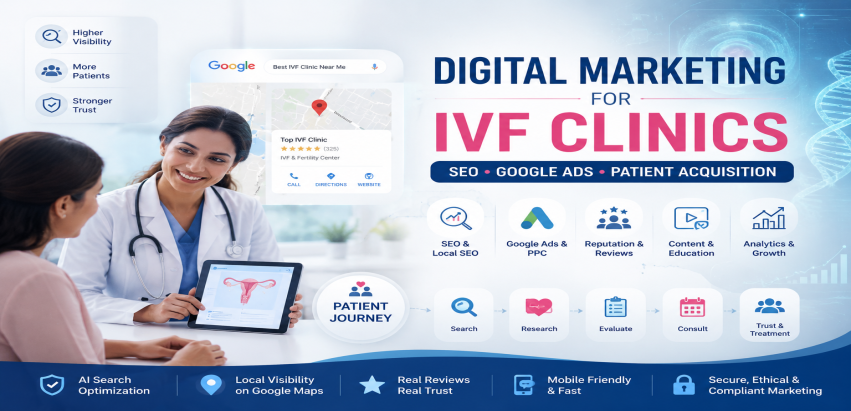
IVF clinics no longer compete only through medical expertise, treatment success rates, or referrals. Today, patients evaluate fertility clinics online long before they schedule a consultation. They compare doctors, read reviews, search treatment costs, watch educational videos, explore clinic websites, and quietly assess trust signals across multiple digital touchpoints.
This makes digital marketing for IVF clinics very different from traditional healthcare advertising. Fertility patients are emotionally cautious, privacy-sensitive, and highly research-driven. Most couples spend weeks or even months evaluating clinics online before contacting anyone directly.
A poorly structured digital presence can reduce patient confidence even when the clinic has excellent doctors and infrastructure. Weak websites, generic healthcare content, poor Google reviews, slow-loading pages, or inconsistent communication often create silent trust loss during the patient research journey.
Modern IVF marketing therefore works as a complete patient acquisition ecosystem rather than a single advertising channel. Search visibility, doctor branding, local SEO, Google Ads, patient education, reputation management, consultation funnels, and conversion-focused website experiences now work together to influence patient decisions.
Clinics investing in strategic digital marketing services are increasingly focusing on long-term trust architecture instead of short-term lead generation alone. This includes SEO visibility for fertility searches, high-intent Google Ads campaigns, educational social media content, AI-search optimization, and conversion systems designed around patient psychology.
Google search still remains one of the highest-intent acquisition channels for fertility clinics because patients actively search for terms such as “best IVF clinic near me,” “fertility specialist,” “IVF success rate,” or “IVF treatment cost” when evaluating treatment options.
At the same time, AI-driven search experiences are beginning to reshape how fertility information is discovered online. AI Overviews, conversational search systems, and entity-driven search interpretation are changing how clinics build visibility and authority across search ecosystems.
This guide explains how digital marketing for IVF clinics actually works in 2026, including SEO for fertility centers, Google Ads strategy, reputation management, local SEO, AI-search visibility, website optimization, patient nurturing systems, and the operational marketing frameworks clinics use to increase consultations and long-term growth.
1. Why Digital Marketing Matters for IVF Clinics
IVF clinics operate in one of the most trust-sensitive healthcare categories online. Patients searching for fertility treatment are not making impulsive decisions. They spend significant time researching clinics, comparing doctors, reading reviews, evaluating treatment transparency, and looking for reassurance before booking consultations. This makes digital visibility directly connected with patient confidence and clinic perception.
Traditional referral-based growth alone is no longer enough for many fertility centers. Patients now discover IVF clinics through Google search, Google Maps, YouTube videos, Instagram reels, healthcare directories, and online patient discussions before they ever contact the clinic directly.
A strong digital presence helps fertility clinics become visible during these early research stages. Search rankings, educational content, doctor branding, patient reviews, and website experience all influence whether a patient trusts the clinic enough to schedule an appointment.
Clinics investing in structured digital marketing services are increasingly building integrated patient acquisition systems instead of relying on isolated campaigns. SEO, Google Ads, social media education, local SEO, and conversion-focused websites now work together as part of a long-term growth strategy.
Patients Research IVF Clinics Extensively Before Booking
Fertility treatment decisions usually involve emotional stress, financial consideration, medical uncertainty, and long decision cycles. Patients often compare multiple clinics online before choosing where to begin treatment.
During this process, they commonly search:
- IVF treatment cost
- Best IVF clinic near me
- IVF success rates
- Fertility specialist reviews
- IUI vs IVF comparisons
- Male infertility treatment options
Every search interaction becomes part of the clinic’s trust-building process. Poor search visibility or weak online presentation can reduce patient confidence before the first consultation even happens.
Digital Visibility Influences Trust and Perception
IVF patients often associate strong online visibility with credibility and professionalism. Clinics appearing consistently across Google search results, Maps listings, educational videos, and patient reviews usually gain higher trust perception compared to clinics with limited digital presence.
Trust signals that strongly influence fertility patients include:
- Doctor expertise visibility
- Educational treatment content
- Patient testimonials
- Google reviews
- Clinic infrastructure visuals
- Transparent communication
- Mobile-friendly website experience
These digital trust signals influence both organic patient acquisition and paid campaign performance.
Why Generic Healthcare Marketing Often Fails for IVF Clinics
Generic healthcare marketing strategies usually focus only on lead generation metrics. IVF marketing requires a more patient-sensitive approach because fertility treatment decisions are deeply emotional and trust-driven.
Aggressive promotional messaging, unrealistic promises, weak educational content, or poor consultation experiences can damage patient confidence quickly.
Successful fertility marketing focuses more on:
- Patient education
- Trust architecture
- Doctor authority
- Reputation management
- Consultation conversion experience
- Long-term patient nurturing
This is one reason IVF clinics increasingly invest in specialized healthcare marketing strategies rather than generic advertising campaigns.
Modern IVF Marketing Works as a Connected Growth System
Digital marketing for IVF clinics now works as a connected ecosystem where SEO, paid advertising, local search visibility, website optimization, reputation management, and social media education support each other simultaneously.
For example, a patient may first discover the clinic through Google Ads, later watch doctor videos on Instagram, read Google reviews, explore treatment pages on the website, and finally book a consultation through WhatsApp or a website form.
Each touchpoint contributes to patient trust accumulation throughout the decision journey.
Clinics that treat digital marketing as long-term patient acquisition infrastructure usually create stronger brand authority, more stable lead generation, and better consultation conversion rates over time.
2. How Patients Choose IVF Clinics Online
Most IVF patients do not choose a fertility clinic after a single advertisement or website visit. The decision process is usually emotional, research-intensive, and trust-driven. Patients often compare multiple clinics online before taking the first consultation.
During this journey, patients evaluate not only medical expertise but also how trustworthy, transparent, and reassuring the clinic appears across digital platforms.
A clinic’s online presence therefore becomes part of the patient decision-making process itself.
Google Search Usually Starts the Patient Journey
Many fertility patients begin with Google searches related to symptoms, infertility concerns, treatment options, success rates, or clinic comparisons.
Common searches include:
- Best IVF clinic near me
- IVF treatment cost
- Fertility specialist in my city
- IUI vs IVF
- IVF success rate by age
- Female infertility treatment
Clinics appearing consistently across search results, Google Maps, educational content, and review platforms usually gain higher patient attention during this early research phase.
This is why fertility centers increasingly invest in structured SEO services to improve visibility for high-intent treatment searches.
Patients Evaluate Trust Before Booking Consultations
IVF patients rarely make decisions based only on rankings or advertisements. Trust signals strongly influence whether a patient moves forward with consultation inquiries.
Some of the strongest digital trust signals include:
- Doctor credibility and experience
- Google reviews and ratings
- Patient success stories
- Educational content quality
- Website professionalism
- Transparent communication
- Clinic infrastructure visuals
Patients often compare these signals across multiple fertility clinics before deciding whom to contact.
Doctor Reputation Influences Patient Confidence
Fertility treatment is highly doctor-driven. Patients want reassurance that they are consulting experienced specialists who communicate clearly and understand sensitive emotional concerns.
Doctor visibility across search engines, YouTube videos, interviews, educational reels, patient testimonials, and Google reviews contributes significantly to trust perception.
Clinics that position doctors as visible healthcare authorities often create stronger consultation confidence compared to clinics using only generic promotional advertising.
Educational Content Reduces Patient Anxiety
Fertility treatment decisions often involve confusion and fear because patients encounter complex medical terminology and emotionally stressful situations during research.
Educational content helps reduce uncertainty by explaining:
- How IVF works
- IUI vs IVF differences
- Treatment timelines
- Success-rate factors
- Male infertility issues
- Egg freezing options
- Treatment expectations
Clinics publishing educational content consistently usually build stronger authority and patient trust over time.
Website Experience Affects Conversion Decisions
Patients often judge clinic professionalism through website quality. Slow-loading pages, outdated design, weak mobile experience, unclear consultation pathways, or missing trust signals can reduce conversion rates significantly.
Modern fertility websites increasingly focus on:
- Mobile-first experience
- Doctor-focused layouts
- WhatsApp integration
- Easy consultation booking
- Treatment clarity
- Patient testimonials
- Fast loading speed
Clinics investing in conversion-focused healthcare websites generally improve both patient trust and lead quality.
Patients Interact With Multiple Channels Before Conversion
IVF patient journeys are rarely linear. A patient may first discover the clinic through Google search, later watch educational videos on Instagram, read reviews on Google Maps, revisit through remarketing ads, and finally contact the clinic through WhatsApp or website forms.
This is why successful fertility marketing strategies combine SEO, paid advertising, social media education, local SEO, and conversion-focused patient nurturing systems together instead of relying on a single channel alone.
3. SEO for IVF Clinics and Fertility Centers
SEO for IVF clinics is one of the highest-intent patient acquisition channels because fertility patients actively search for treatments, doctors, success rates, costs, and clinic comparisons before scheduling consultations. Unlike interruptive advertising, SEO allows clinics to appear when patients are already researching fertility solutions.
Search visibility therefore becomes directly connected with trust, authority, and consultation opportunities.
Fertility clinics investing in structured SEO services usually focus on long-term visibility across treatment keywords, local search, educational content, Google Maps, and AI-driven search experiences.
Local SEO for IVF Clinics
Local SEO is critical because most fertility patients search within specific cities or nearby locations when evaluating clinics.
Common high-intent local searches include:
- Best IVF clinic in Surat
- Fertility center near me
- IVF specialist in Ahmedabad
- Top fertility clinic in Mumbai
- IVF hospital near me
Clinics appearing in Google Maps and local search results usually receive significantly higher consultation intent compared to clinics with weak local visibility.
Strong IVF local SEO strategies often include:
- Google Business Profile optimization
- Location-specific landing pages
- Review acquisition systems
- Local citations
- Location schema markup
- City-based fertility keywords
Google reviews and local authority signals also heavily influence map-pack visibility for fertility-related searches.
Treatment-Based SEO Pages
IVF clinics usually require dedicated treatment pages targeting specific fertility services and patient concerns. Generic service pages rarely perform strongly for competitive healthcare searches.
High-performing fertility SEO structures commonly include pages for:
- IVF treatment
- IUI treatment
- ICSI treatment
- Egg freezing
- Male infertility treatment
- Female fertility treatment
- IVF success rates
- IVF treatment cost
These pages help clinics improve topical relevance across fertility-related search ecosystems while supporting long-tail keyword visibility.
Doctor Entity SEO and Healthcare Authority
Doctor visibility strongly affects fertility SEO performance because patients frequently evaluate specialists before trusting the clinic itself.
Search engines increasingly analyze healthcare entities such as doctors, clinics, specialties, reviews, credentials, and topical expertise together when determining search relevance.
Strong doctor entity optimization often includes:
- Detailed doctor profile pages
- Medical credentials and experience
- Educational videos and interviews
- Patient testimonials
- Healthcare schema markup
- Consistent brand mentions
Clinics building strong doctor authority online generally improve both SEO trust signals and patient conversion confidence.
AI SEO and Conversational Search for IVF Clinics
AI-driven search systems are changing how patients discover fertility information online. Google AI Overviews and conversational search experiences increasingly summarize healthcare information directly within search results.
IVF clinics therefore need content structures that support:
- Clear treatment explanations
- Entity-focused healthcare content
- Structured FAQ sections
- Semantic content relationships
- Conversational search queries
- Schema-supported healthcare information
Clinics focusing only on traditional keyword placement may struggle as AI-driven search experiences continue evolving.
Content Clusters for Fertility Topics
Fertility SEO works best when clinics build interconnected educational content instead of isolated blog posts. Search engines increasingly evaluate topical depth and semantic relationships across healthcare websites.
Strong IVF content clusters often include:
- IVF treatment guides
- Fertility myths vs facts
- Pregnancy preparation content
- IVF cost guides
- Age-related fertility articles
- Success-rate explanations
- Male infertility education
Educational clusters help fertility clinics improve organic visibility, patient trust, and AI-search relevance simultaneously.
Technical SEO Still Impacts IVF Search Visibility
Many fertility clinics focus heavily on content while ignoring technical SEO problems affecting visibility underneath the surface.
Common healthcare SEO issues include:
- Slow mobile performance
- Weak Core Web Vitals
- Poor internal linking
- Indexing inconsistencies
- Duplicate service pages
- Weak schema implementation
- Poor mobile UX
Technical SEO stability remains important because fertility patients primarily research clinics through mobile devices and local search environments.
4. Google Ads for IVF Clinics
Google Ads is one of the fastest patient acquisition channels for IVF clinics because fertility patients actively search for treatment solutions with strong consultation intent. Unlike social media interruption advertising, Google Ads allows clinics to appear when users are already searching for fertility specialists, IVF treatment, or consultation support.
High-intent healthcare searches often include:
- Best IVF clinic near me
- IVF treatment cost
- Fertility specialist consultation
- IVF center in my city
- IUI vs IVF treatment
- Male infertility doctor
These searches usually carry stronger conversion intent compared to generic awareness traffic because patients are already researching treatment options actively.
Clinics investing in structured Google Ads management often focus on consultation-focused acquisition systems instead of running broad healthcare campaigns without targeting precision.
Search Campaigns Capture High-Intent Fertility Traffic
Search campaigns are usually the core paid acquisition strategy for IVF clinics because they target users already searching for fertility treatment solutions.
Effective IVF search campaigns typically focus on:
- Treatment-specific keywords
- Location-based searches
- Doctor consultation intent
- Emergency fertility concerns
- Competitor comparison searches
Search ads generally perform better when the messaging focuses on trust, consultation clarity, doctor credibility, and patient reassurance instead of aggressive promotional language.
Call Campaigns Improve Consultation Conversion
Many fertility patients prefer direct phone communication because IVF treatment involves emotional sensitivity and medical uncertainty. Call campaigns help clinics connect patients with consultation teams immediately during high-intent search moments.
Mobile-focused call campaigns are especially effective for:
- Urgent consultation inquiries
- Local fertility searches
- Treatment cost discussions
- Appointment scheduling
- Doctor availability questions
Proper call tracking also helps clinics measure which campaigns generate actual patient inquiries instead of only website clicks.
Remarketing Helps Rebuild Patient Trust
IVF patients rarely convert during their first interaction. Many users revisit clinic websites multiple times before booking consultations because fertility decisions involve extensive comparison and emotional evaluation.
Remarketing campaigns help clinics stay visible during this research cycle through:
- Display remarketing
- YouTube remarketing
- Consultation reminder ads
- Educational content promotion
- Doctor credibility campaigns
These campaigns often improve patient recall and consultation conversion rates during longer decision journeys.
Landing Page Optimization Directly Affects Lead Quality
Many IVF clinics lose paid traffic conversions because ad campaigns send users to poorly optimized pages with weak trust signals and unclear consultation pathways.
High-performing fertility landing pages usually include:
- Doctor-focused credibility
- Clear consultation CTAs
- Mobile-first design
- Patient testimonials
- WhatsApp integration
- Transparent treatment information
- Fast loading speed
Clinics using specialized PPC management services often improve campaign performance significantly by optimizing both advertising and landing-page conversion systems together.
Healthcare Conversion Tracking Is Critical
Many fertility clinics run paid campaigns without accurate conversion tracking, making it difficult to understand which channels actually generate patient consultations.
Strong IVF advertising systems usually track:
- Phone calls
- WhatsApp inquiries
- Consultation forms
- Appointment bookings
- Returning patient interactions
Conversion tracking helps clinics improve budget allocation, campaign quality, keyword targeting, and patient acquisition efficiency over time.
IVF Advertising Requires Trust-Focused Messaging
Fertility marketing performs poorly when advertisements feel overly promotional or emotionally manipulative. IVF patients usually respond better to educational, reassuring, and consultation-focused messaging.
Effective healthcare advertising generally emphasizes:
- Doctor expertise
- Treatment clarity
- Patient support
- Transparent communication
- Consultation guidance
- Trust-building language
Clinics that combine search advertising, consultation optimization, reputation management, and patient nurturing systems together often create stronger long-term acquisition performance compared to clinics running isolated ad campaigns alone.
5. Website Optimization for IVF Patient Conversion
An IVF clinic website is not just an informational platform. It directly influences whether patients trust the clinic enough to schedule consultations. Fertility patients often evaluate website quality as part of their overall perception of medical professionalism, transparency, and treatment confidence.
Many clinics lose potential consultations because their websites create friction during the patient research journey. Slow-loading pages, confusing layouts, weak doctor visibility, poor mobile experience, or unclear consultation pathways often reduce patient trust silently.
Modern fertility websites therefore focus heavily on trust-based user experience instead of generic healthcare design alone.
Doctor Credibility Should Be Visible Immediately
IVF patients usually evaluate doctors before evaluating the clinic itself. This makes doctor visibility one of the most important conversion elements on fertility websites.
High-performing IVF websites commonly highlight:
- Doctor qualifications
- Years of fertility experience
- Specialization areas
- Educational videos
- Patient success stories
- Consultation availability
Strong doctor positioning helps reduce uncertainty during the early patient research phase.
Mobile Optimization Is Critical for IVF Websites
Most fertility-related searches now happen on mobile devices. Patients often browse clinics, compare treatments, and read reviews directly from smartphones during emotionally sensitive moments.
Poor mobile experience can damage conversion performance significantly.
IVF websites should therefore prioritize:
- Fast mobile loading speed
- Simple navigation
- Clickable phone numbers
- Easy consultation booking
- WhatsApp accessibility
- Readable treatment information
Mobile-first healthcare UX also supports better SEO performance and local search visibility.
Consultation CTAs Should Feel Reassuring
IVF patients are often emotionally cautious during their first interaction with fertility clinics. Aggressive sales-focused CTAs can reduce trust instead of improving conversion rates.
High-converting fertility websites usually use consultation-focused messaging such as:
- Book Consultation
- Talk to Fertility Specialist
- Discuss Treatment Options
- Speak With IVF Expert
- Get Guidance From Specialist
Trust-focused consultation flows generally perform better than hard-selling healthcare messaging.
Patient Testimonials Improve Trust Signals
Fertility patients frequently search for reassurance before beginning treatment. Patient testimonials and real experiences help reduce emotional anxiety during this decision-making process.
Effective testimonial sections often include:
- Real patient stories
- Video testimonials
- Treatment journey experiences
- Review screenshots
- Google review integration
Authentic patient experiences usually create stronger trust than promotional claims alone.
WhatsApp Integration Improves Patient Communication
Many IVF patients prefer private and immediate communication before committing to consultations. WhatsApp integration helps reduce communication friction and improves patient accessibility.
Fertility clinics commonly use WhatsApp for:
- Consultation inquiries
- Treatment questions
- Appointment coordination
- Location support
- Initial patient guidance
Fast communication systems often improve both patient confidence and lead conversion quality.
Website Structure Should Support SEO and Conversion Together
Many healthcare websites focus only on design while ignoring search visibility and conversion architecture underneath the surface.
Strong IVF website structures usually support:
- SEO-friendly treatment pages
- Internal linking between fertility topics
- Fast loading performance
- Clear consultation pathways
- Structured healthcare content
- Schema implementation
- Local SEO optimization
Clinics investing in conversion-focused healthcare website systems often combine SEO, UX, consultation optimization, and technical performance together instead of treating them separately.
Businesses developing modern healthcare websites increasingly focus on operational website strategy rather than only visual design, especially when patient trust and consultation conversion directly affect growth.
6. Social Media Marketing for IVF Clinics
Social media marketing for IVF clinics works best when the focus is patient education, trust-building, and doctor visibility instead of aggressive healthcare promotion. Fertility patients often use Instagram, YouTube, and Facebook to understand treatments, compare clinics, and evaluate doctor credibility before scheduling consultations.
Social platforms therefore function as trust-building environments rather than only awareness channels.
Clinics investing in structured social media marketing services usually focus on educational healthcare content, doctor-led communication, patient reassurance, and long-term audience trust.
Instagram Reels Improve Doctor Visibility
Short-form video content has become one of the strongest engagement formats for healthcare education. IVF clinics increasingly use Instagram Reels to explain fertility treatments, answer patient questions, and improve doctor visibility.
High-performing fertility reels commonly cover:
- IVF treatment process
- Fertility myths vs facts
- Common infertility causes
- IUI vs IVF explanation
- Age-related fertility guidance
- Treatment preparation tips
Educational reels generally perform better than highly promotional healthcare content because patients respond more positively to helpful and reassuring communication.
Doctor-Led Video Content Builds Trust Faster
IVF treatment decisions are highly doctor-driven. Patients often feel more confident when fertility specialists communicate directly through educational videos instead of generic brand messaging.
Doctor-led content helps clinics:
- Build authority
- Reduce patient anxiety
- Improve consultation trust
- Humanize fertility treatment
- Increase patient familiarity before appointments
Consistent doctor visibility across social platforms also supports stronger brand recognition during long patient research cycles.
Educational Content Performs Better Than Promotional Content
Fertility patients are usually looking for guidance, reassurance, and clarity rather than direct advertising. Educational healthcare content therefore tends to generate stronger engagement and trust compared to promotional campaigns focused only on offers or packages.
High-performing IVF educational content often includes:
- IVF success factors
- Fertility awareness education
- Female reproductive health
- Male infertility awareness
- Hormonal health discussions
- Treatment expectation management
Educational content also supports SEO visibility, YouTube discoverability, and AI-search relevance across healthcare search ecosystems.
YouTube Helps Build Long-Term Healthcare Authority
YouTube is increasingly important for fertility marketing because many patients prefer detailed visual explanations before making consultation decisions.
IVF clinics commonly use YouTube for:
- Treatment explainers
- Doctor interviews
- Patient success journeys
- FAQ videos
- Clinic walkthroughs
- Fertility awareness education
Video-based healthcare education often increases patient trust more effectively than text-only content because it creates stronger emotional reassurance during the decision process.
Patient Stories Improve Emotional Connection
IVF treatment involves emotional uncertainty, making patient stories highly influential for trust-building. Authentic success journeys help patients feel understood and emotionally supported during fertility research.
Effective patient-story content usually focuses on:
- Treatment experiences
- Emotional reassurance
- Consultation support
- Doctor communication
- Positive treatment journeys
Clinics should maintain healthcare sensitivity and patient privacy while using testimonial-based social content.
Social Media Supports the Entire Patient Journey
Social media rarely works as a standalone acquisition channel for fertility clinics. Instead, it supports the broader patient journey alongside SEO, Google Ads, website conversion systems, and reputation management.
A patient may first discover the clinic through Google search, later watch doctor reels on Instagram, revisit through YouTube videos, and finally schedule a consultation after multiple trust-building interactions.
Clinics treating social media as part of a connected patient acquisition ecosystem usually create stronger long-term engagement and consultation quality compared to clinics using isolated content posting strategies.
6. Social Media Marketing for IVF Clinics
Social media marketing for IVF clinics works best when the focus is patient education, trust-building, and doctor visibility instead of aggressive healthcare promotion. Fertility patients often use Instagram, YouTube, and Facebook to understand treatments, compare clinics, and evaluate doctor credibility before scheduling consultations.
Social platforms therefore function as trust-building environments rather than only awareness channels.
Clinics investing in structured social media marketing services usually focus on educational healthcare content, doctor-led communication, patient reassurance, and long-term audience trust.
Instagram Reels Improve Doctor Visibility
Short-form video content has become one of the strongest engagement formats for healthcare education. IVF clinics increasingly use Instagram Reels to explain fertility treatments, answer patient questions, and improve doctor visibility.
High-performing fertility reels commonly cover:
- IVF treatment process
- Fertility myths vs facts
- Common infertility causes
- IUI vs IVF explanation
- Age-related fertility guidance
- Treatment preparation tips
Educational reels generally perform better than highly promotional healthcare content because patients respond more positively to helpful and reassuring communication.
Doctor-Led Video Content Builds Trust Faster
IVF treatment decisions are highly doctor-driven. Patients often feel more confident when fertility specialists communicate directly through educational videos instead of generic brand messaging.
Doctor-led content helps clinics:
- Build authority
- Reduce patient anxiety
- Improve consultation trust
- Humanize fertility treatment
- Increase patient familiarity before appointments
Consistent doctor visibility across social platforms also supports stronger brand recognition during long patient research cycles.
Educational Content Performs Better Than Promotional Content
Fertility patients are usually looking for guidance, reassurance, and clarity rather than direct advertising. Educational healthcare content therefore tends to generate stronger engagement and trust compared to promotional campaigns focused only on offers or packages.
High-performing IVF educational content often includes:
- IVF success factors
- Fertility awareness education
- Female reproductive health
- Male infertility awareness
- Hormonal health discussions
- Treatment expectation management
Educational content also supports SEO visibility, YouTube discoverability, and AI-search relevance across healthcare search ecosystems.
YouTube Helps Build Long-Term Healthcare Authority
YouTube is increasingly important for fertility marketing because many patients prefer detailed visual explanations before making consultation decisions.
IVF clinics commonly use YouTube for:
- Treatment explainers
- Doctor interviews
- Patient success journeys
- FAQ videos
- Clinic walkthroughs
- Fertility awareness education
Video-based healthcare education often increases patient trust more effectively than text-only content because it creates stronger emotional reassurance during the decision process.
Patient Stories Improve Emotional Connection
IVF treatment involves emotional uncertainty, making patient stories highly influential for trust-building. Authentic success journeys help patients feel understood and emotionally supported during fertility research.
Effective patient-story content usually focuses on:
- Treatment experiences
- Emotional reassurance
- Consultation support
- Doctor communication
- Positive treatment journeys
Clinics should maintain healthcare sensitivity and patient privacy while using testimonial-based social content.
Social Media Supports the Entire Patient Journey
Social media rarely works as a standalone acquisition channel for fertility clinics. Instead, it supports the broader patient journey alongside SEO, Google Ads, website conversion systems, and reputation management.
A patient may first discover the clinic through Google search, later watch doctor reels on Instagram, revisit through YouTube videos, and finally schedule a consultation after multiple trust-building interactions.
Clinics treating social media as part of a connected patient acquisition ecosystem usually create stronger long-term engagement and consultation quality compared to clinics using isolated content posting strategies.
8. Local SEO and Google Maps Optimization for IVF Centers
Local SEO is one of the most important patient acquisition channels for IVF clinics because fertility patients usually search within nearby cities or regions when comparing treatment options. Searches such as “best IVF clinic near me” or “fertility specialist in Surat” often carry very strong consultation intent.
Clinics appearing prominently in Google Maps and local search results usually gain higher visibility, stronger patient trust, and more consultation inquiries compared to clinics with weak local search presence.
Local visibility therefore directly affects both patient acquisition and reputation perception in competitive fertility markets.
Google Business Profile Strongly Influences Local Visibility
Google Business Profile is often the first digital touchpoint patients interact with during fertility research. Patients frequently evaluate reviews, clinic photos, doctor details, contact information, and directions directly from Google Maps before visiting websites.
Strong IVF Google Business Profiles usually include:
- Accurate clinic information
- Doctor visibility
- Updated clinic images
- Consistent review activity
- Service descriptions
- Location accuracy
- Regular content updates
Optimized Google Maps profiles often improve both local rankings and patient trust simultaneously.
City-Based SEO Pages Improve Regional Visibility
Many fertility patients search using city-specific treatment queries. IVF clinics therefore benefit from creating localized pages targeting nearby regions and treatment searches.
Common local healthcare searches include:
- IVF clinic in Ahmedabad
- Best fertility center in Surat
- IVF treatment in Mumbai
- Fertility doctor near me
- IUI treatment in Delhi
Well-structured location pages help clinics improve local relevance, semantic coverage, and treatment visibility across multiple regions.
Google Reviews Affect Local Rankings and Patient Trust
Review quality and review frequency strongly influence Google Maps visibility for healthcare searches. Patients also use reviews to evaluate consultation experiences, doctor communication, treatment transparency, and clinic professionalism.
High-performing fertility clinics usually maintain:
- Consistent review acquisition
- Professional review responses
- Patient-focused communication
- Positive consultation experiences
- Strong doctor credibility signals
Review ecosystems often influence local SEO performance more heavily in healthcare categories compared to many other industries.
Local Citations Improve Healthcare Trust Signals
Local citations help search engines verify clinic legitimacy and geographic relevance across healthcare ecosystems. Fertility clinics commonly appear on healthcare directories, hospital listings, local business directories, and medical platforms.
Citation consistency is important because mismatched clinic details can weaken local trust signals.
Key citation elements include:
- Clinic name consistency
- Phone number accuracy
- Address consistency
- Doctor details
- Website linking
Local SEO systems work more effectively when citation structures remain consistent across healthcare platforms.
Location Schema Helps Search Engines Understand Clinic Relevance
Structured data helps search engines understand healthcare entities, clinic locations, doctor relationships, and treatment relevance more clearly.
IVF clinics commonly use:
- MedicalOrganization schema
- LocalBusiness schema
- Doctor schema
- FAQ schema
- Review schema
Proper schema implementation can improve search clarity, local relevance, and rich-result eligibility across healthcare search results.
Local SEO Works Together With Reputation and Website Optimization
Many clinics treat local SEO as only a Google Maps optimization task, but strong local visibility depends on multiple connected systems working together.
Local SEO performance is influenced by:
- Review quality
- Website trust signals
- Mobile performance
- Doctor authority
- Location relevance
- Consultation conversion quality
- Patient engagement signals
Clinics combining local SEO, patient reputation systems, healthcare content, and conversion-focused digital experiences usually create stronger long-term local visibility compared to clinics focusing only on directory listings alone.
9. AI Search and the Future of IVF Digital Marketing
AI-driven search experiences are changing how fertility patients discover clinics, treatments, doctors, and healthcare information online. Search engines are increasingly generating summarized answers, conversational recommendations, and AI Overviews directly inside search results instead of showing only traditional website listings.
This shift is beginning to change how IVF clinics approach SEO, educational content, structured data, and healthcare authority building.
Clinics focusing only on traditional keyword rankings may struggle as search behavior becomes more conversational and entity-driven.
AI Overviews Are Changing Healthcare Search Visibility
Google AI Overviews now summarize healthcare information directly within search results for many informational queries. Fertility patients increasingly receive AI-generated explanations before clicking websites individually.
Common IVF-related searches affected by AI-driven results include:
- How IVF works
- IUI vs IVF
- IVF success rates
- Best fertility treatment options
- Infertility causes
- Egg freezing information
Clinics producing structured, educational, and semantically clear content are more likely to improve visibility within evolving AI-search environments.
Entity SEO Is Becoming More Important for Fertility Clinics
Search engines increasingly evaluate healthcare entities such as doctors, clinics, specialties, reviews, treatments, and medical expertise relationships together.
This means fertility SEO is no longer only about keyword placement. Search systems now analyze:
- Doctor expertise signals
- Topical authority
- Review consistency
- Content relevance
- Healthcare trust signals
- Clinic reputation
- Semantic content relationships
Clinics building strong doctor visibility, educational content ecosystems, and healthcare trust signals usually create stronger long-term authority across AI-driven search systems.
Conversational Search Is Influencing IVF Content Strategy
Fertility patients increasingly search using natural-language questions instead of short keywords alone. Search behavior now commonly includes conversational queries such as:
- Which fertility treatment is best after 35?
- Why does IVF fail?
- How successful is IVF for first attempt?
- When should couples visit a fertility specialist?
- Is IVF painful?
IVF content strategies therefore need to support detailed patient questions, FAQ structures, educational explanations, and conversational healthcare guidance.
Long-form educational content also improves topical depth and AI-search relevance across fertility topics.
Structured Data Helps Search Engines Understand Healthcare Content
Structured data helps search engines interpret healthcare entities, doctor relationships, treatment information, and FAQ content more accurately.
Fertility clinics commonly benefit from:
- MedicalOrganization schema
- Doctor schema
- FAQ schema
- Review schema
- Breadcrumb schema
- LocalBusiness schema
Proper schema implementation supports search clarity, AI-search understanding, and rich-result eligibility within healthcare search ecosystems.
Video Search Is Growing Rapidly in Healthcare Discovery
Patients increasingly consume healthcare information through video-first platforms and visual search experiences. YouTube, Instagram Reels, and short educational healthcare videos now influence fertility research journeys significantly.
Video content helps IVF clinics:
- Improve doctor visibility
- Increase patient trust
- Explain treatments visually
- Support AI-search discoverability
- Improve engagement signals
Clinics producing educational healthcare videos consistently often strengthen both social visibility and search authority simultaneously.
Future IVF Marketing Will Focus More on Trust Ecosystems
AI-driven healthcare search systems increasingly prioritize trustworthy medical information, strong entity relationships, patient-focused educational content, and reputation signals.
Future-ready fertility marketing strategies will likely combine:
- SEO
- AI-search optimization
- Doctor authority building
- Educational content ecosystems
- Structured healthcare data
- Patient trust systems
- Video-first communication
Clinics treating digital marketing as long-term healthcare authority infrastructure rather than short-term advertising alone are likely to build stronger visibility and patient trust as AI-search environments continue evolving.
10. Common IVF Marketing Mistakes That Reduce Patient Trust
Many IVF clinics invest in advertising, SEO, or social media campaigns without realizing that small trust failures across the patient journey can reduce consultation conversion significantly. Fertility patients are emotionally cautious and highly research-driven, which means weak digital experiences often create silent patient drop-offs before inquiries even happen.
Some clinics focus heavily on lead generation volume while ignoring the trust architecture required to convert fertility patients into consultations.
Using Generic Healthcare Marketing Content
One of the most common IVF marketing mistakes is publishing generic healthcare content that lacks emotional understanding, treatment clarity, and patient relevance.
Fertility patients usually search for:
- Treatment explanations
- Success-rate guidance
- Emotional reassurance
- Doctor credibility
- Real patient experiences
- Cost understanding
Generic promotional blogs and repetitive healthcare articles rarely build strong patient trust or long-term SEO authority.
Weak Mobile Experience and Slow Website Performance
Most fertility-related searches happen on mobile devices, yet many IVF websites still suffer from poor mobile UX, slow-loading pages, broken forms, and confusing consultation pathways.
Common mobile conversion issues include:
- Slow page speed
- Hard-to-read content
- Weak CTA visibility
- Poor WhatsApp accessibility
- Broken consultation forms
- Cluttered page layouts
Poor mobile experience often increases bounce rates and reduces consultation trust during the patient research process.
Overpromotional Healthcare Messaging
IVF marketing performs poorly when clinics use aggressive advertising language, unrealistic promises, or emotionally manipulative messaging.
Fertility patients usually respond better to:
- Educational guidance
- Transparent communication
- Doctor-led explanations
- Trust-focused consultation messaging
- Realistic treatment expectations
Healthcare marketing should build confidence rather than pressure patients emotionally.
Ignoring Google Reviews and Reputation Systems
Some fertility clinics focus heavily on advertising while neglecting online reputation management. Weak review profiles often reduce patient confidence even when advertising visibility is strong.
Common reputation mistakes include:
- Ignoring patient reviews
- Weak review response systems
- Inconsistent review acquisition
- Defensive complaint handling
- Outdated Google Business Profiles
Reputation systems strongly influence both local SEO visibility and consultation conversion rates for fertility clinics.
Running Ads Without Proper Conversion Systems
Many clinics invest in Google Ads campaigns without optimizing landing pages, consultation pathways, or patient follow-up systems. This often increases acquisition cost while reducing lead quality.
Common IVF conversion problems include:
- Weak landing-page trust signals
- Slow response time
- Poor call tracking
- Missing WhatsApp workflows
- Unclear consultation process
- No patient nurturing system
Clinics running structured patient acquisition systems usually perform better than clinics focusing only on traffic generation.
Ignoring AI Search and Healthcare Entity SEO
Some fertility clinics still rely entirely on traditional keyword-based SEO while ignoring AI-search visibility and healthcare entity optimization.
Search engines increasingly evaluate:
- Doctor expertise
- Healthcare authority
- Structured medical content
- Semantic relevance
- Review consistency
- Educational depth
Clinics failing to build strong healthcare authority systems may gradually lose visibility as AI-driven search experiences continue evolving.
Not Treating Digital Marketing as Long-Term Infrastructure
One of the biggest strategic mistakes is treating IVF marketing as isolated campaigns instead of a connected long-term growth system.
Sustainable fertility marketing usually requires:
- SEO visibility
- Reputation management
- Doctor branding
- Educational content
- Patient nurturing
- Conversion optimization
- Local SEO
- AI-search readiness
Clinics building connected digital ecosystems generally create stronger patient trust, consultation quality, and long-term visibility compared to clinics running disconnected marketing activities independently.
11. How to Choose the Right Digital Marketing Agency for an IVF Clinic
Choosing the right digital marketing agency for an IVF clinic requires more than checking advertising portfolios or SEO rankings. Fertility marketing involves healthcare sensitivity, emotional patient journeys, trust-building systems, and long decision cycles that generic marketing agencies often fail to understand properly.
IVF clinics usually need marketing partners capable of combining healthcare SEO, patient psychology, conversion optimization, local SEO, reputation management, and consultation-focused advertising into one connected growth strategy.
Healthcare Experience Matters in IVF Marketing
Healthcare marketing differs significantly from standard lead-generation industries because patient trust directly affects conversion quality. Agencies without healthcare experience often use overly promotional messaging that can reduce patient confidence.
Fertility clinics should evaluate whether the agency understands:
- Healthcare communication sensitivity
- Patient trust architecture
- Doctor branding
- Healthcare SEO
- Medical advertising compliance
- Consultation-focused conversion systems
Agencies experienced in healthcare marketing usually build more patient-focused acquisition strategies compared to agencies using generic advertising templates.
SEO and Local Search Capability Are Critical
Many fertility patients begin their journey through Google search and Google Maps. Agencies working with IVF clinics should therefore understand healthcare SEO, local search optimization, and AI-search visibility strategies.
Important SEO capabilities include:
- Local SEO for fertility searches
- Google Business Profile optimization
- Treatment-based SEO pages
- Doctor entity optimization
- Technical SEO
- AI-search readiness
Clinics looking for long-term organic growth often prioritize agencies with strong healthcare SEO execution instead of agencies focused only on paid advertising.
Performance Marketing Should Focus on Consultation Quality
IVF advertising campaigns should prioritize qualified consultation inquiries rather than maximizing low-quality lead volume.
Fertility clinics should evaluate whether agencies can manage:
- Google Ads campaigns
- Call tracking systems
- Remarketing campaigns
- Landing-page optimization
- Conversion tracking
- Patient inquiry workflows
Strong healthcare advertising systems usually focus on patient trust, consultation intent, and conversion quality instead of aggressive lead-generation tactics alone.
Reporting Transparency Is Extremely Important
Many clinics struggle with agencies that provide unclear reporting or focus only on vanity metrics such as impressions and clicks.
IVF clinics should look for transparent reporting around:
- Consultation inquiries
- Call tracking
- Lead quality
- SEO visibility
- Local rankings
- Landing-page performance
- Patient conversion trends
Operational reporting helps clinics understand whether marketing activities are actually improving patient acquisition quality over time.
Website and Conversion Expertise Should Not Be Ignored
Many agencies run advertising campaigns without optimizing the clinic website underneath the conversion journey. This often creates high acquisition costs and weak consultation performance.
Fertility clinics should evaluate whether agencies understand:
- Healthcare UX
- Mobile-first website performance
- Consultation CTAs
- WhatsApp workflows
- Trust-focused layouts
- SEO-friendly website architecture
Clinics investing in structured healthcare website systems often improve both SEO visibility and patient conversion simultaneously.
Businesses exploring long-term healthcare growth strategies frequently work with agencies offering connected healthcare digital marketing solutions instead of isolated marketing services managed independently.
The Best IVF Marketing Agencies Build Long-Term Trust Systems
Sustainable fertility marketing usually depends on long-term authority building rather than short-term advertising spikes.
Strong IVF marketing agencies typically combine:
- SEO
- Google Ads
- Social media education
- Reputation management
- Patient nurturing
- AI-search optimization
- Conversion-focused website systems
Clinics choosing agencies capable of building connected digital ecosystems generally create stronger visibility, consultation quality, patient trust, and long-term growth stability.
12. Frequently Asked Questions About IVF Digital Marketing
How much does digital marketing for IVF clinics cost?
IVF digital marketing cost depends on services such as SEO, Google Ads, social media marketing, website optimization, and reputation management. Most clinics invest based on competition level, city targeting, and patient acquisition goals.
Is SEO important for IVF clinics?
Yes. SEO helps fertility clinics appear for high-intent searches such as “best IVF clinic near me,” “fertility specialist,” and treatment-related searches. Organic visibility often improves long-term consultation acquisition.
How long does IVF SEO take to show results?
Most IVF clinics begin seeing measurable SEO improvement within 3 to 6 months, depending on website quality, competition, local SEO strength, and content authority.
Are Google Ads effective for fertility clinics?
Yes. Google Ads can generate high-intent consultation inquiries because fertility patients actively search for treatment solutions online. Campaign quality, landing-page trust, and conversion tracking strongly affect results.
Why are Google reviews important for IVF clinics?
Reviews influence both patient trust and local SEO visibility. Many fertility patients evaluate reviews before scheduling consultations because IVF treatment decisions are highly trust-sensitive.
What type of content works best for IVF marketing?
Educational content usually performs best, including treatment explainers, fertility awareness guides, doctor videos, FAQs, patient stories, and IVF process education.
Can social media generate IVF patients?
Social media supports trust-building and patient education. Platforms like Instagram and YouTube help clinics improve doctor visibility, patient engagement, and brand familiarity before consultations.
What is AI SEO for IVF clinics?
AI SEO focuses on optimizing fertility content for AI-driven search experiences such as conversational search, AI Overviews, and entity-based healthcare search systems.
Why do IVF clinics need local SEO?
Most fertility patients search within nearby cities or regions when evaluating clinics. Local SEO improves Google Maps visibility, city-based rankings, and consultation discovery for regional searches.
How important is website design for IVF clinics?
Website experience strongly affects patient trust. Fast-loading pages, doctor visibility, consultation-focused UX, mobile optimization, and patient testimonials usually improve conversion performance.
Can IVF clinics advertise legally in India?
Yes, but fertility marketing must follow healthcare advertising guidelines, ethical communication standards, patient privacy requirements, and medical compliance regulations.
What is the biggest mistake IVF clinics make in digital marketing?
Many clinics focus only on lead generation while ignoring trust-building systems such as reputation management, educational content, doctor branding, and patient nurturing workflows.
13. Why IVF Clinics Need a Long-Term Digital Growth Strategy
Digital marketing for IVF clinics is no longer limited to running advertisements or publishing occasional healthcare content. Fertility patients now interact with multiple digital touchpoints before choosing a clinic, making long-term trust-building one of the most important parts of patient acquisition.
Search visibility, doctor reputation, educational content, Google reviews, website experience, local SEO, and patient communication systems now work together as a connected digital ecosystem influencing consultation decisions.
Clinics relying only on short-term lead generation campaigns often struggle with inconsistent patient acquisition, rising advertising costs, and weak long-term brand authority.
Patient Trust Builds Over Multiple Digital Interactions
IVF patients rarely convert after a single interaction. Many patients discover clinics through Google search, revisit through social media, compare reviews on Google Maps, watch doctor videos, and return multiple times before scheduling consultations.
This means fertility marketing should focus on cumulative trust-building rather than isolated campaigns alone.
Strong digital growth systems usually combine:
- SEO visibility
- Google Ads
- Doctor authority building
- Educational healthcare content
- Reputation management
- Local SEO
- Conversion-focused websites
- Patient nurturing workflows
Clinics integrating these systems together generally create stronger consultation quality and long-term visibility stability.
Healthcare SEO Creates Long-Term Patient Acquisition Assets
Paid advertising can generate immediate visibility, but SEO and educational healthcare content continue building authority over time.
Fertility clinics investing in structured SEO systems often improve:
- Organic consultation discovery
- Local search visibility
- Doctor authority
- AI-search relevance
- Patient education reach
- Healthcare topical authority
Long-term SEO growth also helps reduce dependence on constantly increasing advertising budgets.
Future IVF Marketing Will Become More Trust and AI Driven
AI-search systems, conversational healthcare queries, and entity-driven search experiences are already changing how fertility information is discovered online.
Clinics preparing for future healthcare search environments are increasingly focusing on:
- Structured healthcare content
- Doctor entity optimization
- Educational video ecosystems
- Semantic SEO
- Healthcare schema implementation
- Patient-focused content strategy
Future-ready fertility marketing will likely depend more on authority, educational relevance, and healthcare trust signals than aggressive promotional advertising alone.
Connected Marketing Systems Usually Perform Better
IVF clinics often achieve stronger long-term results when SEO, paid advertising, social media, reputation management, website optimization, and patient communication systems work together operationally.
Businesses increasingly invest in integrated healthcare marketing systems because disconnected campaigns frequently create inconsistent patient experiences across the research journey.
Clinics working with structured healthcare-focused digital marketing solutions often focus on building sustainable patient acquisition ecosystems instead of short-term visibility spikes alone.
Digital Growth Now Shapes Fertility Clinic Authority
In competitive fertility markets, digital presence increasingly influences how patients evaluate trust, expertise, and consultation confidence before interacting with clinics directly.
Clinics investing in long-term digital infrastructure usually strengthen:
- Patient trust
- Consultation quality
- Local visibility
- Doctor authority
- Brand credibility
- Organic patient acquisition
As fertility patient journeys continue becoming more research-driven and digitally influenced, long-term digital marketing strategy will remain one of the strongest operational growth systems for IVF clinics in 2026 and beyond.