

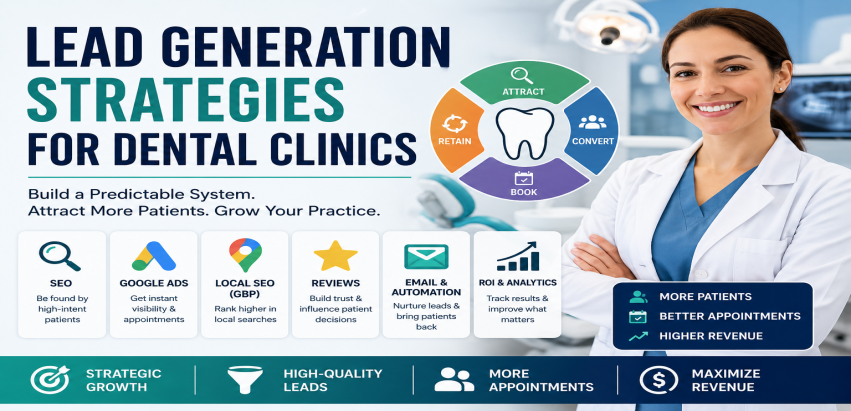
A clinic can have skilled dentists, modern equipment, and genuine patient satisfaction and still watch its schedule develop gaps it cannot explain.
The dentistry is not the problem. The acquisition system is.
When new patient flow depends on referrals filling gaps unpredictably, when ads run without tracking which ones generate appointments, when no consistent process exists between a website visit and a confirmed booking, the result is a month that looks strong followed by three weeks that look concerning. That cycle is not a marketing problem. It is a structural one, and it compounds quietly until expansion plans slow, hiring decisions stall, and revenue becomes genuinely difficult to forecast.
This guide builds a complete patient acquisition framework. You will find channel comparisons grounded in dental-specific economics, treatment-by-treatment strategy breakdowns, growth stage models that match channel selection to clinic maturity, patient lifetime value calculations that change how acquisition costs are evaluated, and a checklist that identifies exactly where your current system is losing patients before they book.
What Is Dental Lead Generation?
Dental lead generation is the process of attracting potential patients and converting their interest into a booked appointment. A lead is any individual who has expressed treatment intent through a call, form submission, ad click, or website enquiry.
A lead is not a patient. That distinction matters more than most clinics realize.
A practice generating 200 enquiries per month and converting 15 percent of them into confirmed appointments is not performing better than a practice generating 60 enquiries and converting 55 percent. The first clinic looks busier. The second clinic is growing faster.
How Patients Actually Move Toward Booking
Patients rarely decide on a clinic in a single session. The journey looks more like this: a person searches a symptom or treatment question, reads several results, checks reviews for two or three clinics, visits their websites, compares what they find, and then calls or submits a form. The clinic that appears at the right stage of that journey with the right information earns the appointment. Clinics that appear only at one stage lose patients to those that appear at multiple stages.
| Channel | How It Generates Leads | Intent Level |
|---|---|---|
| Search visibility | Captures patients actively searching for treatment | High |
| Google reviews | Builds trust before first contact | Medium to High |
| Paid campaigns | Generates immediate high-intent enquiries | High |
| Referrals | Transfers trust from existing patients | Very High |
| Social media | Creates awareness and familiarity over time | Low to Medium |
| Email follow-up | Re-engages undecided prospects | Medium |
Lead Generation vs Patient Acquisition: Why the Gap Between Them Costs Clinics Revenue
Lead generation creates interest. Patient acquisition converts that interest into revenue. Those are connected but not the same thing.
Consider a clinic that generates 50 enquiries in a month. Thirty answer follow-up calls. Eighteen schedule consultations. Ten begin treatment. The clinic generated 50 leads and acquired 10 patients. Every stage between the first two numbers is a conversion problem, not a lead generation problem. Identifying which stage is weakest often produces more growth than increasing the initial lead volume.
What Makes a High-Quality Dental Lead?
High-quality leads share one characteristic: the patient already knows what treatment they want and is comparing providers rather than researching whether to seek treatment at all.
Someone searching "dental implant clinic booking" is not the same as someone searching "what are dental implants." The first patient is at the end of a decision process. The second is at the beginning. Both matter, but they require different content, different follow-up speed, and different conversion approaches. Treating them identically reduces conversion rates on both.
Why Many Dental Clinics Struggle to Generate Patients Consistently
Inconsistent patient flow rarely happens because a clinic offers poor treatment. It happens because the systems generating new patients stop matching the clinic's goals as the practice evolves.
The Referral Ceiling Most Practices Hit Between Years Three and Six
Referrals build practices in the early years because they carry pre-existing trust. A patient referred by a friend or family member arrives with confidence already established. Conversion rates are higher, treatment acceptance is better, and acquisition cost is near zero.
The ceiling appears when a practice tries to grow beyond its current patient base. A clinic with 800 active patients generates referrals at the rate those 800 patients choose to recommend it. That rate cannot be adjusted by spending more. It cannot be directed toward implants or cosmetic cases specifically. It cannot scale proportionally when a new associate joins and needs their own patient flow. Referrals sustain a practice. They rarely expand one.
Competition That Did Not Exist Five Years Ago
Dental patients compare more before booking than they did a decade ago. They check Google reviews before calling. They compare websites. They look at before-and-after images for cosmetic cases. They read treatment explanations and assess which clinic seems most knowledgeable about the specific procedure they need.
A long-established clinic with strong clinical outcomes loses appointments to a newer clinic with a stronger online presence not because the dentistry is worse but because the patient never gets far enough into the comparison to discover the quality difference. Visibility determines the shortlist. Clinical quality determines the final choice. Clinics that are not on the shortlist never reach the final choice stage.
Activity Without Measurement Produces the Same Results Every Month
Running a social post one week, pausing Google Ads after two months because results felt unclear, updating the website once a year, and asking reception to request reviews inconsistently produces activity. It does not produce a system. The distinction is measurability. A system tells you which channel produced which patients at what cost. Activity tells you what you spent. Without the system, a clinic making a budget decision is guessing.
Poor Retention Quietly Raises the Acquisition Bar Every Month
A clinic losing 25 percent of its patient base annually through attrition needs to acquire enough new patients to replace those losses before it sees any net growth. That replacement cost compounds. The acquisition budget that would fund genuine growth gets consumed replacing patients who left because recall systems were inconsistent or because the post-treatment experience did not create a strong reason to return. Fixing retention often produces faster growth than increasing acquisition spend.
How Successful Dental Clinics Build Predictable Patient Acquisition Systems
An implant specialist generating consistent consultation volume does not have a better marketing budget than a competitor generating inconsistent volume. They have a better system: a connected process where visibility, trust, enquiry handling, conversion, and retention all function as parts of one framework rather than separate activities managed by different people with different objectives.
What a Patient Acquisition System Actually Is
A patient acquisition system is a structured, repeatable process that moves a potential patient from first search to booked appointment and from first appointment to returning patient. It is not a single channel. It is the combination of channels, follow-up processes, tracking tools, and retention mechanisms that work together to produce consistent patient flow regardless of season or competitive movement.
The difference between a system and a collection of tactics is measurement. A system operator knows: which channel produced last month's implant consultations, what percentage of enquiries became booked appointments, what the average cost per booked patient was by treatment type, and which patients from six months ago have not returned. A tactic runner knows what was spent. That information gap creates different decisions.
Why Systems Compound While Tactics Decay
A tactic produces results while it runs and stops when it stops. A Google Ads campaign paused to save budget stops generating patients the day it pauses. An SEO investment made 18 months ago continues generating organic traffic today without additional spend. A review generation process started 12 months ago has now created 90 additional reviews that influence every patient who searches for the clinic. Systems create assets. Tactics create events.
| Stage | Goal | Primary Channel | Key Metric |
|---|---|---|---|
| Awareness | Reach patients searching for treatment | SEO, Google Ads, GBP | Impressions, clicks, calls |
| Consideration | Build trust before first contact | Reviews, website content | Review volume, session depth |
| Conversion | Turn visitors into enquiries | Landing pages, booking forms | Enquiry rate, call rate |
| Booking | Turn enquiries into appointments | Front desk process, online scheduler | Enquiry-to-booking rate |
| Retention | Maximise patient lifetime value | Recall system, email, SMS | Return visit rate, LTV |
The Bottleneck Principle
A system is only as strong as its weakest stage. A clinic spending aggressively on Google Ads while its landing page converts at 2 percent is effectively paying to drive patients to a competitor's booking page. A clinic with excellent organic visibility and a 4.9-star review profile that takes 48 hours to respond to enquiries loses patients to the clinic that called back within the hour. Identifying the bottleneck and fixing it produces more growth than increasing investment in stages that are already functioning.
The Patient Journey: From Search to Booked Appointment
A patient considering dental implants does not call a clinic after seeing one ad. They search a question, find several clinics, compare reviews, read treatment descriptions, look at case photos, and eventually contact the clinic that gave them enough information and trust to feel confident making that call. The entire process may take three days or three months depending on the treatment and the patient's anxiety level. Understanding each stage reveals where clinics are losing patients they could be converting.
Discovery: The Patient Has a Problem and Starts Looking
Discovery begins before the clinic is visible. A patient searches "how much do dental implants cost" or "emergency dentist open Saturday" or "Invisalign vs braces for adults." These are not decisions yet. They are the beginning of an information-gathering process. Clinics that create content addressing these early-stage questions appear in results before any preference for a specific practice has formed. This is where SEO builds its most defensible long-term advantage: capturing the patient's attention before they know which clinic they prefer.
Consideration: Filtering From Several Options to a Shortlist
After discovery, a patient typically compares two to four clinics. They read Google reviews. They look at websites to assess how the clinic presents itself, whether it addresses their specific treatment need, and whether pricing or consultation information is visible. A clinic that provides clear treatment explanations, visible social proof, and transparent contact options earns a position on the shortlist. A clinic with an outdated website, limited reviews, and no treatment-specific pages loses the comparison before the patient has made any contact.
Trust: The Decision Checkpoint Before Calling
Before a patient picks up the phone for an implant consultation or a cosmetic case, they are asking one question internally: can I trust this clinic with something that is going to cost this much and affect how I look and feel? Trust is built through review volume and quality, before-and-after outcome evidence, team credentials presented clearly, and treatment explanations that demonstrate the clinic understands their specific situation. Clinics that address these trust signals explicitly convert more website visits into phone calls than clinics that present only a list of services.
Booking: Where Friction Destroys Appointments That Were Already Won
A patient who has done the research, checked the reviews, and decided to call has already made the hardest decision. Losing them at the booking stage is the most expensive conversion failure a clinic can have because all the acquisition cost has already been spent. A phone that rings out, a contact form with no response for 24 hours, or an online booking system showing no availability within two weeks turns a motivated patient into a competitor's appointment. Booking friction at this stage costs more per lost patient than any earlier stage failure.
Retention: Where Long-Term Revenue Is Either Built or Left Unrealised
A patient who attends a first appointment is not yet a retained patient. They become one through the post-appointment experience: the recall message at the right interval, the follow-up on a treatment plan they expressed interest in, the review request that feels personal rather than automated, and the communications that make it clear the clinic values the relationship. Retention is where lifetime value is either built systematically or left to chance.
| Stage | Patient Action | Clinic Response Required |
|---|---|---|
| Discovery | Searches treatment or symptom question | Appear in results, create relevant content |
| Consideration | Compares clinics, reads reviews | Build review volume, maintain informative site |
| Trust | Evaluates clinical credibility and outcomes | Display social proof, case results, credentials |
| Booking | Calls, messages, or submits enquiry | Fast response, minimal friction, online booking option |
| Retention | Attends first appointment | Recall system, follow-up, review request |
How Dentists Get Patients in 2026: Main Acquisition Channels Explained
No single channel fills a dental schedule independently. The most consistently booked practices use a channel mix calibrated to their treatment priorities and growth stage, not a channel chosen because a competitor uses it or because it was the easiest to start.
SEO: The Compound Channel That Rewards Patience
Search engine optimisation targets patients already searching for dental treatment or a local dentist. A clinic ranking in the top three organic results for "dental implants" in its city receives consistent patient enquiries without paying per click. The disadvantage is time. Building competitive rankings for high-intent treatment keywords takes 6 to 12 months of consistent content and technical investment in most markets.
Once established, SEO produces the lowest cost per booked patient of any digital channel because traffic accumulates without per-click spend increasing proportionally. A clinic that invested in SEO 18 months ago is now receiving implant enquiries at effectively zero incremental cost per search. A clinic that paused its SEO budget 18 months ago is competing in paid auctions for every single one of those same enquiries.
For a detailed breakdown of dental SEO strategy, see the Dental SEO Guide.
Google Ads: The Speed Channel That Requires Conversion Discipline
Google Search Ads place a clinic at position one within 24 hours of campaign launch. For a practice opening a new implant suite, adding a specialist, or entering a new geographic market, that immediacy is the primary advantage no other channel matches. A clinic waiting for organic rankings to develop cannot fill a new associate's schedule in the meantime. Google Ads can.
The cost per click for competitive dental keywords is significant, which makes conversion rate the variable that determines whether the spend is profitable. A clinic spending double the budget of a competitor with a weak landing page will generate fewer booked consultations. The ad budget determines who sees the clinic. The landing page and follow-up process determine who books. Both matter equally.
For a complete guide to dental Google Ads campaign structure and optimisation, see PPC Advertising for Dentists and Dental Clinics.
Google Business Profile: Local Visibility That Costs Almost Nothing to Maintain
Google Business Profile drives map pack results for searches like "dentist near me" and "[treatment] [suburb]." A clinic with a fully optimised GBP, consistent photo updates, regular posts, and a strong review count captures local patients who are ready to book right now. In competitive suburbs, GBP visibility often generates call volume comparable to paid campaigns at a fraction of the cost. Treating GBP as an afterthought is one of the most common and most expensive missed opportunities in dental marketing.
Reviews: The Trust Signal That Converts Before the Patient Makes Contact
Two clinics with identical treatments, similar pricing, and comparable locations produce very different booking rates when one has 180 reviews and the other has 30. Review volume signals longevity and repeated patient trust. A patient choosing a clinic for an implant or an orthodontic case is not looking for perfection in reviews. They are looking for volume of evidence that other patients have trusted this clinic and been satisfied. That confidence threshold is what gets the call made.
Email: The Reactivation Channel Most Clinics Underuse
A patient who attended 16 months ago and has not returned is not a lost patient. They are a reactivation opportunity at near-zero acquisition cost because the relationship already exists. A targeted email or SMS to lapsed patients consistently generates appointments at a fraction of new patient acquisition cost. Clinics that build this reactivation process generate consistent appointment volume from a pool they have already paid to acquire once.
Referrals: High Quality, Low Scalability
Referrals produce the highest-trust patients with the strongest treatment acceptance rates. They are also the acquisition channel with the lowest controllability. A clinic cannot double its referral volume next month by making a budget decision. It can only grow referrals by growing the patient base and the quality of the patient experience, both of which take time. Referrals sustain a practice. They cannot alone expand one.
| Channel | Speed to Results | Lead Quality | Scalability | Best Application |
|---|---|---|---|---|
| SEO | 6 to 12 months | High | Very High | Long-term cost efficiency, treatment authority |
| Google Ads | Immediate | High | High | Immediate volume, new locations, high-value treatments |
| Google Business Profile | 2 to 4 weeks | High | Medium | Local proximity searches, near-me queries |
| Reviews | Ongoing | Conversion support | Medium | Trust building, local ranking improvement |
| Email and SMS | 1 to 2 weeks | High for existing patients | Medium | Patient reactivation, low-cost appointments |
| Referrals | Ongoing, unpredictable | Very High | Low | High-trust acquisition, zero media cost |
| Social Media | 3 to 6 months | Low to Medium | Medium | Cosmetic treatment awareness, brand familiarity |
Lead Quantity vs Lead Quality: Why More Leads Do Not Always Mean More Revenue
An implant specialist generating 40 qualified consultation requests per month from Google Ads is outperforming a general practice generating 180 enquiries from a broad social campaign, even if the second clinic's marketing report looks more impressive. Revenue comes from booked appointments on profitable treatments, not from enquiry volume.
What Lead Quality Actually Measures
Lead quality measures conversion probability and treatment value in combination. A high-quality lead comes from a patient who has already researched their treatment, knows approximately what it costs, is within a realistic geographic radius of the clinic, and is comparing providers rather than comparing whether to seek treatment at all. A low-quality lead comes from a patient who clicked an ad out of general curiosity, is not yet committed to any treatment timeline, or is searching for a service the clinic either does not offer or cannot offer competitively.
The metric that reveals quality is not CPL. It is cost per booked appointment by treatment type. A clinic paying a higher cost per lead for implant enquiries and converting 55 percent of them into consultations is acquiring patients more efficiently than a clinic paying a lower cost per lead for general enquiries converting at 18 percent into appointments for hygiene visits.
Volume Creates Hidden Costs That Most Clinics Do Not Account For
Every enquiry that arrives at a clinic costs something beyond the marketing spend that generated it. Reception staff time, follow-up calls, missed call callbacks, and administrative handling all carry a cost. A clinic generating 150 low-intent enquiries per month is paying for 150 qualification conversations, many of which produce no appointment. A clinic generating 50 high-intent enquiries is paying for 50 qualification conversations, most of which result in a booking. The second clinic's marketing spend looks higher on a CPL basis and produces better revenue on a cost-per-booked-patient basis.
| Metric | Clinic A | Clinic B |
|---|---|---|
| Monthly enquiries | 150 | 50 |
| Booked consultations | 22 | 28 |
| Primary treatment | General dentistry | Dental implants |
| Revenue per patient | Lower | Higher |
| Reception workload | Very High | Manageable |
Treatment Profitability Changes Everything
A single implant consultation that converts to a full arch restoration generates more revenue than 40 hygiene appointments. A clinic that allocates marketing budget proportionally to treatment revenue potential, rather than evenly across all service types, generates a better return on the same spend. Implant campaigns with higher CPL and higher conversion value consistently outperform general dentistry campaigns with lower CPL and lower patient value when measured on the only metric that matters: revenue generated per pound or dollar of marketing spend.
Cost to Acquire New Dental Patients
The most useful financial question in dental marketing is not "how much are we spending?" It is "how much does it cost us to put one new patient in the chair, and is that cost justified by what that patient generates over their relationship with the clinic?"
The Metrics That Actually Matter
Cost Per Lead (CPL) is total spend divided by enquiries. It is a useful efficiency indicator but it measures top-of-funnel performance only. A low CPL from low-quality leads is worse than a high CPL from high-intent enquiries.
Cost Per Booked Patient divides total spend by confirmed appointments. This is the metric that connects marketing spend to revenue. A Google Ads campaign generating 30 implant consultations from a budget that produces a cost per booked patient well below the treatment value is profitable regardless of what the CPL looks like.
Cost Per Consultation is most relevant for high-value treatments. An implant practice paying a meaningful cost per consultation for a case that generates significant treatment revenue is operating at a favorable acquisition ratio. Without this metric, implant campaigns get paused prematurely because the CPL appears high before treatment value is factored in.
| Metric | What It Measures | Why It Matters |
|---|---|---|
| Cost Per Lead (CPL) | Spend divided by total enquiries | Top-of-funnel channel efficiency |
| Cost Per Booked Patient | Spend divided by confirmed appointments | Real measure of acquisition profitability |
| Cost Per Consultation | Spend divided by treatment consultations | Essential for implants, orthodontics, cosmetics |
| ROAS | Revenue generated divided by ad spend | Overall paid channel return |
| Lead-to-Booking Rate | Booked appointments divided by enquiries | Reveals front desk and conversion process quality |
Why Acquisition Costs Vary So Dramatically Between Clinics
Two clinics in the same suburb using the same campaign structure can produce very different costs per booked patient. The variables are landing page conversion rate, front desk response speed, treatment type, booking friction, and the quality of the follow-up process. A clinic with a 4 percent landing page conversion rate is paying twice as much per enquiry as a clinic with an 8 percent conversion rate on the same ad spend. A clinic that calls back enquiries within 5 minutes books at significantly higher rates than one that calls back within 4 hours. These operational differences determine acquisition cost more than campaign budget does.
Patient Lifetime Value in Dentistry: The Metric Most Clinics Ignore
A clinic that measures marketing performance only by first-appointment value is making every budget decision with incomplete information. The patient who comes in for a hygiene appointment today and returns twice yearly for the next eight years, has two crowns placed, refers their partner who has orthodontic treatment, and eventually becomes an implant patient is not worth the value of that first hygiene visit. They are worth the cumulative revenue of every treatment, every recall, and every referral they generate across the entire relationship.
What LTV Looks Like in Practice
A conservative calculation for a patient who attends twice yearly for preventive care and has one major restorative treatment in year three generates substantially more revenue than a first-appointment calculation would suggest. Add one referral who follows a similar pattern and the effective LTV of the original patient nearly doubles. A clinic that understands this will allocate acquisition budget very differently than one that evaluates only the revenue from appointment one.
| Scenario | Clinic A | Clinic B |
|---|---|---|
| Acquisition cost | Lower | Higher |
| First appointment value | Lower | Higher |
| Retention rate | Low | High |
| Average patient LTV | Lower | Significantly higher |
| Long-term revenue stability | Vulnerable to attrition | Compounding through referrals |
Why Treatment Type Changes LTV Dramatically
Emergency patients who never return generate low LTV. Orthodontic patients who complete treatment with positive outcomes generate high LTV because they often become long-term patients with strong referral behaviour. Implant patients who are satisfied with their outcomes are among the highest-LTV patients any clinic can acquire. They are typically older, financially established, require ongoing maintenance appointments, and frequently refer family members for treatments they themselves had deferred for years. An implant practice paying a meaningful amount to acquire a patient with a multi-year LTV is making an investment with a return that justifies the cost without question.
How LTV Changes Budget Decisions
A clinic that knows its average patient LTV can justify paying significantly more per acquisition than a clinic evaluating only first-appointment revenue. An implant campaign that appears expensive on a CPL basis becomes clearly profitable when the five-year patient value is calculated against the acquisition cost. Without LTV data, that same campaign gets paused. With it, the decision becomes how to scale rather than whether to continue.
Best Marketing Channels by Treatment Type
An emergency patient and a cosmetic patient are not the same buyer. They search differently, decide differently, convert differently, and respond to different content. A marketing strategy that applies identical channel logic across all treatments will consistently underperform one built around treatment-specific patient intent.
Dental Implants: The Treatment That Rewards Long Acquisition Funnels
Implant patients research for weeks before committing. They compare treatment explanations, read case studies, check pricing transparency, and evaluate multiple clinics. Google Ads for implant-specific keywords capture patients close to deciding. SEO content addressing cost, procedure detail, recovery expectations, and patient outcomes builds trust during the research phase. Remarketing keeps the clinic visible during the extended consideration period for patients who visited but did not enquire. Running implant campaigns without remarketing misses a significant portion of the patients who were interested but needed more exposure before committing.
Emergency Dentistry: Speed Beats Everything
Emergency patients are not comparing clinics. They are in pain and need to reach a dentist as quickly as possible. Call-only ads that connect patients directly to the front desk without requiring a landing page visit produce lower cost per booked appointment for emergency queries than standard search ads. A patient searching for emergency treatment at 9pm who reaches a voicemail will call the next clinic in the search results. Response speed and immediate availability are the only competitive advantages that matter for emergency dental acquisition.
Orthodontics and Invisalign: The Comparison Buyer Who Needs Multiple Touchpoints
Orthodontic patients, particularly adults considering Invisalign, do not convert on first exposure. They compare provider qualifications, treatment timelines, before-and-after results, and cost structures across several clinics over days or weeks. Visual content showing adult case transformations performs well for practices targeting the 25-to-45 demographic. Google Ads capturing "Invisalign near me" and "braces cost" queries reach patients actively comparing providers. SEO addressing cost and comparison questions captures patients earlier in the process who are not yet ready to book but are forming preferences.
Cosmetic Dentistry: Trust and Social Proof Drive the Decision
A patient considering veneers or a smile makeover is making an aspiration-driven decision heavily influenced by visual evidence. Before-and-after photography, patient testimonials about the experience, and a clinic's visual presentation online matter more for cosmetic cases than for almost any other treatment type. A cosmetic practice with strong case photography and credible outcome evidence consistently converts cosmetic searches at higher rates than one with only treatment descriptions. The quality of the visual proof is the primary differentiator.
Root Canal: Urgency Makes Speed the Conversion Variable
Root canal searches are pain-driven. The patient is not evaluating long-term relationships. They want pain relief and they want it today. GBP visibility, paid search for urgent queries, and fast website response time with an obvious click-to-call button are the three elements that determine booking rates. A clinic that makes the path from search to phone call take 30 seconds books the appointment. A clinic that requires the patient to navigate three website pages first loses them to the competitor who loaded the phone number above the fold.
| Treatment | Best Channel | Decision Speed | ROI Profile |
|---|---|---|---|
| Dental Implants | Google Ads plus SEO plus Remarketing | Weeks to months | High case value, strong LTV |
| Invisalign and Orthodontics | Social plus Google Ads plus SEO | Days to weeks | High case value, strong referral behaviour |
| Emergency Dentistry | Call Ads plus GBP | Same day | Lower per-visit value, high volume potential |
| Cosmetic Dentistry | Social plus SEO plus Google Ads | Weeks to months | High case value, strong social proof cycle |
| Root Canal | GBP plus Google Ads | Same day to 48 hours | Moderate per-visit value, retention opportunity |
SEO vs PPC vs Referrals: Which Generates Patients Faster?
Google Ads wins on speed. SEO wins on compounding cost efficiency. Referrals win on trust. Each answer is correct for a different clinic at a different stage with a different growth objective. The mistake is choosing one and treating the others as optional.
Speed: Google Ads Is the Only Channel That Generates Patients in 24 Hours
A clinic that needs to fill a new associate's schedule, launch a second location, or recover from a slow quarter cannot wait for organic rankings to develop. Google Ads is the only channel that generates patient enquiries within a day of launch. For immediate needs, it is not a choice between channels. Paid search is the only option that operates on that timeline.
Cost Efficiency Over Time: SEO Is the Only Channel That Gets Cheaper as It Grows
A clinic that invested in SEO 18 months ago is now receiving treatment enquiries that cost effectively zero per click. A clinic relying entirely on paid traffic is paying the same CPC for every single enquiry it receives today as it paid on day one. Over a 36-month horizon, a combined SEO and paid approach consistently produces a lower blended cost per patient than either channel run in isolation. The initial SEO investment feels expensive relative to its early results. By month 18, the economics invert.
Trust: Referrals Convert at Rates No Digital Channel Matches
A patient referred by a friend arrives with confidence already established. Their conversion rate from enquiry to treatment is higher. Their treatment acceptance rate is better. Their likelihood of becoming a long-term patient is significantly stronger. The limitation is that referral volume cannot be controlled, cannot be directed toward specific treatment types, and does not scale when a new associate joins and needs their own patient pipeline from month one.
| Factor | SEO | PPC | Referrals |
|---|---|---|---|
| Speed to first patients | 6 to 12 months | 24 to 72 hours | Unpredictable |
| Cost structure | Agency investment, no per-click cost | Management fee plus ad spend | Near zero media cost |
| Cost trend over time | Falls as traffic compounds | Consistent per click | Stays near zero |
| Lead quality | High | High | Very High |
| Scalability | Very High, compounds | High, budget dependent | Low, base dependent |
| Stops when spend stops | No | Yes | No |
The Only Defensible Strategy Combines All Three
Clinics that run only Google Ads are permanently dependent on spend and vulnerable the moment budget is reduced. Clinics that build only on referrals cap their growth at the rate their existing patients choose to recommend them. Clinics that invest only in SEO wait too long to solve immediate capacity problems. The combination, paid search for immediate volume, SEO for long-term cost reduction, and retention systems that generate referrals, produces the most financially resilient growth model available to a dental practice at any size.
How Google Reviews Influence Dental Lead Generation
A patient shortlisting two implant clinics who finds that one has 210 reviews at 4.8 stars and the other has 35 reviews at 4.9 stars will, in the significant majority of cases, call the first clinic first. The marginally higher rating of the second clinic does not overcome the trust signal created by 175 additional patient experiences. Review volume answers the question every patient asks implicitly before calling: have enough people trusted this clinic that I can feel confident doing the same?
Reviews also influence local search ranking directly. Google's algorithm for Business Profile visibility factors in review count, recency, and keyword diversity in review content. A practice whose patients mention "dental implants," "gentle," and "no waiting" in their reviews builds broader relevance signals for those terms than a practice with generic reviews, which can translate into map pack positions for treatment-specific local searches that organic content alone cannot achieve as quickly.
The most effective review generation approach is a triggered process with no manual dependency. A follow-up message sent by SMS within two hours of a positive appointment, including a direct link to the Google review page, produces review submission rates four to five times higher than verbal requests at the desk. A clinic generating 12 new reviews per month builds an insurmountable competitive review advantage within 18 months that a competitor who requests reviews inconsistently cannot close without years of effort.
Negative reviews managed professionally also contribute to trust. Patients reading a one-star review followed by a thoughtful, accountable clinic response often feel more confident booking than patients reading a review profile with no negative feedback at all. The response demonstrates communication quality and accountability that positive-only profiles cannot show.
Dental Website Optimisation: Turning Visitors Into Appointments
A clinic ranked first organically for "dental implants" in its city that converts 2 percent of its landing page visitors into enquiries is performing worse than a clinic ranked third that converts 6 percent. The first clinic is paying with organic authority to drive patients to a page that does not convert them. The second clinic is extracting three times the patient volume from two-thirds of the traffic. Conversion rate is not a design question. It is a revenue question.
Treatment-Specific Landing Pages: The Single Highest-Impact Change
A patient who clicks a Google Ad for dental implants and arrives at a clinic's general homepage has to navigate to find the information they searched for. Most do not. They press back and click the next ad. A patient who clicks the same ad and arrives at a dedicated implant page with the treatment name in the headline, patient testimonials for that specific treatment, a visible phone number above the fold, and a clear next step converts at rates two to four times higher than the homepage landing. This single structural change, adding treatment-specific landing pages for each major campaign, is the fastest improvement available to most dental PPC campaigns.
Call Tracking: The Measurement Gap That Misdirects Budget
Without call tracking, a clinic cannot determine which marketing channel generates phone enquiries. A patient who finds the clinic through Google Ads and calls the main number is indistinguishable in the data from a patient who found the clinic through organic search, unless dynamic number insertion assigns unique tracking numbers by source. The result is that budget decisions are made on incomplete data. A channel that generates 60 percent of phone bookings but receives 20 percent of the budget because it shows lower form submission rates is being systematically underfunded. Call tracking corrects that mismatch.
Online Booking: The Conversion Rate Change That Costs Nothing to Implement
A patient who decides at 9pm that they need a dental appointment will not wait until morning for a callback. A real-time booking system showing available appointment slots converts that patient in the same session as their decision. Clinics that offer online booking for routine appointment types consistently report higher booking rates from digital channels and lower no-show rates because the patient completed a commitment in the same moment as their decision rather than leaving it to a follow-up call that may arrive when they are less motivated.
Mobile Load Speed: The Invisible Conversion Killer
Over 70 percent of dental searches occur on mobile. A clinic website that takes more than three seconds to load on mobile loses a measurable percentage of those visitors before the page even renders. Those visitors are not going to wait. They return to the search results and click the next result, which loaded faster. Page speed is not a technical nicety. For a practice generating significant monthly traffic, it is a direct revenue variable.
Why Some Dental Clinics Grow Faster Than Others
The difference between a clinic that grew 8 percent last year and one that grew 35 percent is almost never the quality of the clinical work. It is the quality of the acquisition system, the consistency of the conversion process, and how frequently both are measured and improved against specific performance targets.
New Clinics: Visibility Is the Only Problem That Matters
A clinic in its first two years has one growth problem above all others: nobody knows it exists. Referrals are minimal because the patient base is minimal. Organic rankings have not had time to develop. The solution is not complicated. Google Ads for immediate visibility, aggressive GBP optimisation, and a systematic review generation process from the first patient. SEO should begin immediately because the foundations take time to build, but new clinics cannot survive on organic traffic timelines. Budget at this stage should weight 60 to 70 percent toward paid channels that produce results within weeks, with the remainder building the long-term organic foundation that will reduce acquisition costs over time.
Growing Clinics: Conversion Problems Become the Growth Constraint
Once enquiries are arriving consistently, a different problem becomes the binding constraint: converting those enquiries into booked appointments efficiently. A growing clinic often discovers that its front desk conversion rate is 35 to 40 percent when it should be 55 to 65 percent. The gap represents appointments being lost not because marketing is failing but because follow-up is slow, booking friction is high, or the reception process does not handle high-intent enquiries with appropriate urgency. Fixing this conversion gap generates more revenue from the same marketing spend than increasing the budget.
Scaling Clinics: Multiple Channels Must Contribute Simultaneously
A clinic with multiple chairs and practitioners cannot fill capacity through a single channel. At scale, every channel must contribute: SEO for organic volume, Google Ads for treatment-specific demand capture, GBP for local proximity searches, email and SMS for patient reactivation, and retention systems for referral generation. A clinic at this scale should have defined KPIs for each channel, a monthly performance review against those KPIs, and a clear decision framework for reallocating budget from underperforming to overperforming channels.
Multi-Location Groups: Standardisation Determines Whether Quality Scales
Each location in a dental group needs its own GBP, its own local SEO content, its own review generation process, and its own campaign targeting its specific geographic catchment area. Blending performance data across locations hides the underperforming ones behind the averages of the high-performers. A group that segments performance by location and treats each as a distinct acquisition unit makes better budget decisions and identifies operational differences between locations that are costing appointments.
Clinic Growth Stages and Recommended Marketing Channels
| Clinic Stage | Primary Channels | Focus Priority | Marketing Objective |
|---|---|---|---|
| New clinic (0 to 18 months) | Google Ads, GBP, review generation | Immediate patient flow | Fill schedule while building organic foundation |
| Growing (18 months to 3 years) | Google Ads plus SEO, email reactivation | Conversion optimisation | Improve booking rates, shift toward high-value treatments |
| Scaling (3 to 6 years) | Full channel mix, LTV tracking, referral systems | Acquisition cost reduction | Compound SEO returns, optimise paid campaigns by treatment |
| Multi-location | Brand SEO, location SEO, geo-segmented paid ads | Per-location acquisition performance | Maintain brand consistency, grow each location independently |
The most consistent strategic mistake is operating a multi-channel program without tracking which channels produce revenue at each growth stage. Spending across multiple channels without knowing which ones are generating booked appointments is not a multi-channel strategy. It is an expensive guess.
Patient Retention vs New Patient Acquisition: Which Matters More?
Clinics need both. The question is which one is being underinvested relative to its revenue impact. For most practices, the answer is retention.
Reactivating a dormant patient who attended 18 months ago costs a fraction of acquiring a new patient through any digital channel, because the relationship already exists and the trust has already been established. A targeted recall message to lapsed patients generates appointments at near-zero incremental acquisition cost. A Google Ads campaign generating those same appointments pays a meaningful cost per booked patient. Both are valuable. The retention channel is consistently underused relative to its economics.
The compounding effect matters too. A clinic that retains 90 percent of its patient base annually requires far less new patient acquisition spending to achieve the same revenue growth as a clinic retaining 70 percent. The lower-retention clinic is effectively funding a treadmill: acquisition spending that replaces lost patients rather than growing the practice. The higher-retention clinic's acquisition spend produces net growth instead of replacement volume.
One retention activity delivers disproportionate returns: the post-treatment follow-up at peak satisfaction. A patient who has just completed a successful implant placement or orthodontic case is at the highest point of satisfaction they will ever experience. A timely, personal follow-up message at this moment requesting a review, offering a referral for a family member, and confirming their next recall appointment captures three high-value outcomes from a single interaction that costs almost nothing to execute.
| Focus Area | Primary Goal | Revenue Effect | Cost Efficiency |
|---|---|---|---|
| New patient acquisition | Expand patient base | Drives growth | Higher cost per patient |
| Patient retention | Increase lifetime value | Protects and compounds revenue | Fraction of acquisition cost |
| Referral generation | Trust-based growth | Supports both acquisition and retention | Near zero media cost |
AI in Dental Lead Generation: How Automation Changes Patient Acquisition
AI in dental marketing is not primarily about creating content or generating ad copy. Its most significant practical impact is operational: reducing the gaps that exist between a patient expressing interest and a clinic successfully converting that interest into a confirmed appointment.
The Response Speed Problem AI Solves
An implant patient who submits an enquiry at 7pm and receives no response until the following morning has already checked two other clinics by the time the callback arrives. The first clinic to reach a motivated enquiry consistently books the appointment at higher rates than the second or third clinic to respond, regardless of how much better those clinics' dentistry or pricing might be. An AI-powered initial response system that acknowledges the enquiry immediately, collects the treatment information needed to route it correctly, and offers available appointment times before the reception team is available turns a timing disadvantage into a competitive advantage.
Lead Nurturing for High-Consideration Treatments
An implant patient who enquires in March and is not yet ready to book in March is not a lost lead. They are a patient in a longer consideration cycle who needs to encounter the clinic's name and capability evidence several more times before they commit. An automated nurture sequence that delivers relevant implant content, cost information, patient testimonials, and consultation invitations over a 60-day period keeps the clinic present throughout that cycle without requiring manual follow-up effort for every individual enquiry. Clinics without this system lose those patients to competitors who maintained contact.
Appointment Reminders: The ROI That Is Easiest to Quantify
Automated appointment reminders sent 48 hours and again 2 hours before a scheduled appointment consistently reduce no-show rates by 20 to 35 percent compared to clinics relying on manual reminder calls. For a clinic running 150 appointments monthly with a 15 percent no-show rate, reducing that to 10 percent through automated reminders generates 7 to 8 additional revenue-producing appointments per month from the same booked schedule. That is the most straightforward ROI calculation in dental operations.
What AI Cannot Do
Automation improves the speed and consistency of processes. It cannot substitute for clinical credibility, genuine patient trust, or a strong consultation experience. A patient who receives an immediate AI-generated response and then arrives at a consultation with a poorly communicating clinician has not been well-served. AI works best as an enhancement layer on systems that already function, not as a replacement for systems that do not exist or clinical experiences that do not satisfy.
Common Dental Marketing Mistakes That Reduce Patient Flow
The most expensive dental marketing mistakes are not bad channel choices. They are structural gaps that cause clinics to generate enquiries at significant cost and then fail to convert them into appointments that generate revenue.
Sending paid traffic to the homepage. An implant patient who clicks an ad and arrives at a general practice homepage navigates away in seconds. Treatment-specific landing pages matching the ad's intent convert at two to four times the rate of homepage landings. This single structural correction on a clinic spending meaningfully on paid search can double booked appointment volume without increasing budget.
Tracking clicks instead of booked appointments. A campaign reporting strong click volume and conversion events sounds productive until you discover the conversion events are set to page views rather than completed enquiries. Every budget decision made on that data is wrong. Conversion tracking must be configured to register actual patient contacts: calls, form submissions, and appointment bookings.
No structured follow-up for unconverted leads. An implant enquiry that does not convert on the first callback is not a dead lead. It is a patient in a longer decision cycle who needs two to four more contacts before committing. A clinic that makes one follow-up attempt and marks the lead as inactive is leaving a material percentage of its paid acquisition investment unrealised.
Equal budget allocation across unequal treatment values. Allocating the same monthly budget to emergency dentistry campaigns and implant campaigns produces chronically underinvested implant campaigns relative to their revenue potential. Budget should be proportional to treatment LTV, not distributed evenly across service types.
Inconsistent review generation. A clinic that generates reviews only when individual staff members remember to ask will never build the volume needed for competitive local search visibility. A triggered SMS process after positive appointments generates reviews four to five times more consistently than verbal requests.
Pausing campaigns during slow periods. Pausing a Google Ads campaign to save budget resets Smart Bidding's learning and removes visibility during the exact period when a competitor who maintained their campaign is capturing additional market share. Reducing budget during slow periods is the right response. Pausing is not.
When Dental Clinics Need Professional PPC Management
Internal marketing management works until the complexity of running multiple acquisition channels simultaneously exceeds the available time and specialist knowledge of the people responsible for it. That threshold arrives earlier than most clinic owners expect.
A Google Ads campaign that has not been actively optimised in eight weeks is not running. It is spending. Bids are not being adjusted against current competition. Negative keywords are not being updated to remove irrelevant search terms consuming budget. Creative testing has stopped. Quality Scores have drifted. The campaign that looked efficient when it launched is now producing fewer booked appointments at higher cost, and the clinic owner is not aware because the reporting shows spend and clicks rather than cost per booked patient by treatment type.
The signs that professional management would produce materially better results are consistent across practices of different sizes. Google Ads campaigns not reviewed in the past four weeks. Landing pages not updated in six months. Review count not growing. Cost per booked patient unmeasured because tracking is incomplete. Any one of these indicates an acquisition system operating below its potential. All four together indicate significant monthly revenue being left unrealised.
For clinics ready to scale paid acquisition with proper campaign structure, weekly optimisation, and performance reporting against booked appointment targets rather than click metrics, our PPC Management Services team builds and manages dental campaigns designed specifically for patient acquisition.
Checklist: Build a Predictable Patient Acquisition System
A patient acquisition system has six stages. Each requires a functioning component before the next stage can operate at full efficiency. Use this checklist to identify where your clinic's system is losing patients before they book.
| Stage | Goal | Key Metric |
|---|---|---|
| Visibility | Appear in search when patients look for your treatments | Organic rankings, ad impressions, GBP views |
| Traffic | Drive qualified visitors to website or landing pages | Sessions by treatment page, click-through rate |
| Conversion | Turn visitors into enquiries through calls or forms | Enquiry rate, landing page conversion rate |
| Booking | Convert enquiries into confirmed appointments | Enquiry-to-booking rate, response time |
| Retention | Return patients for recall and further treatment | Return visit rate, recall completion rate |
| Measurement | Track cost per patient by channel | Cost per booked patient by channel, LTV by treatment |
Self-audit questions that reveal system gaps faster than traffic reports:
Do you know which channel produced the majority of your booked implant or orthodontic consultations last month? Can you state your average cost per booked patient for your highest-value treatment? What percentage of incoming enquiries become confirmed appointments? How many patients from 18 months ago have not returned and received a recall message? What is your average review generation rate per month?
Uncertainty on more than two of these indicates acquisition system gaps that are costing appointments every month they remain unaddressed.
Final Framework: How Dental Clinics Create Sustainable Growth
Sustainable patient growth does not come from finding the right single channel. It comes from building a connected system where every stage, from first search to returning patient, functions as part of one measurable process.
Three questions separate clinics that grow predictably from those that grow unpredictably. First: what does it cost to acquire a new patient by treatment type and channel? Second: what does an average patient generate in revenue over the first three years of their relationship with the clinic? Third: which stage of the acquisition funnel is currently producing the most loss between patients who could book and patients who do?
Clinics that can answer all three make better decisions about where to invest next. Clinics that cannot answer any of them are making budget decisions based on intuition rather than performance data, which almost always produces suboptimal allocation.
If your clinic generates inconsistent appointments, the starting point is not more spend. It is identifying where the system is losing patients: at the visibility stage, the conversion stage, or the booking stage. Address the bottleneck before scaling. Scaling a broken process produces more expensive broken results.
If you are ready to build a predictable patient acquisition system, the first step is understanding exactly where your current setup is losing patients and what the highest-priority changes are. Request a growth audit for a clinic-specific assessment of your acquisition gaps and the most direct path to resolving them.
Frequently Asked Questions
How do dentists attract new patients?
The highest-performing practices combine Google Search Ads for immediate high-intent visibility, SEO for long-term organic traffic, Google Business Profile for local proximity searches, and systematic review generation. Single-channel dependence produces single-channel vulnerability. Multi-channel acquisition systems produce more predictable patient flow.
What marketing channel works best for dental clinics?
Google Ads produces the fastest results for clinics needing immediate appointments. SEO produces the lowest long-term cost per patient for clinics with an 18-month investment horizon. The most effective strategy combines both, with channel weighting adjusted by treatment priority and growth stage. A clinic that runs only one channel is always exposed to what happens when that channel underperforms.
How much does dental marketing cost?
The more useful question is cost per booked patient, not total spend. A clinic spending more per month but generating a lower cost per booked implant consultation is outperforming a clinic spending less with a higher effective cost per appointment. Total spend without the cost-per-patient denominator is a budget figure, not a performance figure.
What is patient acquisition cost?
Patient acquisition cost is total marketing spend divided by confirmed new patients booked from that spend, measured by channel and by treatment type. A channel producing a higher CPL but a stronger lead-to-booking rate may produce a lower cost per booked patient than a cheaper CPL channel with weak conversion. The denominator must be booked appointments, not enquiries.
What is patient lifetime value?
Patient lifetime value is total revenue generated across all appointments, treatments, and indirect referral contribution over the patient's active relationship with the clinic. LTV data allows clinics to justify higher acquisition costs for treatment types that produce long-term revenue relationships. Without LTV data, implant campaigns appear expensive. With it, they appear essential.
SEO or PPC for dentists?
Google Ads wins on speed. SEO wins on compounding cost efficiency. Clinics needing patients within 60 days should prioritise Google Ads. Clinics building for 18-month growth should invest in SEO simultaneously. Running both produces a lower blended cost per patient over time than either channel run alone.
How long does dental SEO take?
Meaningful organic ranking improvements for competitive treatment keywords typically take 6 to 12 months in metro markets. Less competitive markets may show movement earlier. The compounding nature of SEO means a clinic that started 18 months ago is now generating organic traffic at near-zero incremental cost per visit. A clinic that starts today will reach that position 18 months from now. The best time to start was 18 months ago. The second best time is today.
Do Google Ads work for dentists?
Yes, when campaigns are structured by treatment type, directed to treatment-specific landing pages, and measured at the level of booked appointments. A campaign tracking only clicks and optimizing toward click volume is not a patient acquisition campaign. It is a traffic campaign. The distinction matters for every budget decision that follows.
How can dental clinics reduce their cost per patient?
Three levers produce the fastest improvement: improving landing page conversion rate so more traffic becomes enquiries, improving enquiry-to-booking rate so more enquiries become confirmed appointments, and building SEO authority so more traffic arrives without per-click cost. A 10 percent improvement in conversion rate at any stage reduces effective cost per patient across the entire acquisition system without requiring any increase in total spend.
What causes inconsistent appointments?
Inconsistent appointments almost always trace to one or more of four causes: over-dependence on referrals as the primary acquisition source, activity-based marketing without measurement, insufficient channel diversification creating single-channel vulnerability, or poor retention creating continuous attrition that requires new acquisition spending just to maintain current revenue. Identifying which combination applies is the first step toward building more predictable patient flow.