
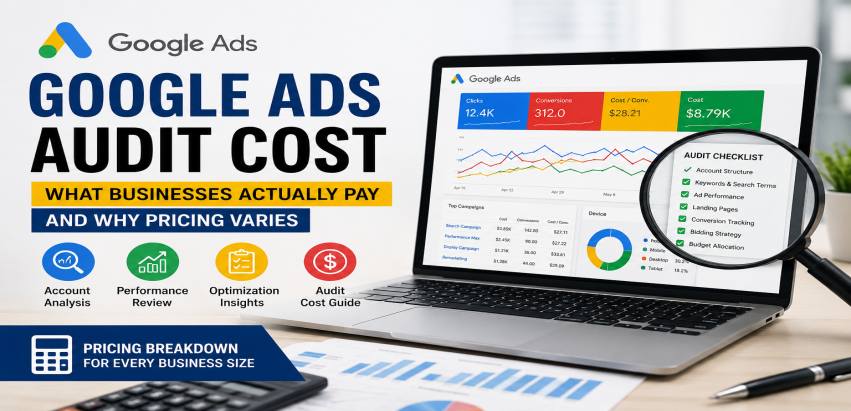
A Google Ads audit should answer one question above all others: where is your budget going, and is it working? The problem is that "audit" means very different things depending on who is doing it and what they are looking at.
A $99 automated report and a $5,000 expert-led PPC account review are both marketed as audits. One generates a PDF in four minutes. The other is a senior specialist spending days inside your account, working through conversion tracking configurations, Performance Max behavior, negative keyword gaps, and attribution logic, then building a prioritized action plan from what they find.
This guide lays out realistic Google Ads audit pricing for businesses across the United States, explains what drives cost differences between account types, and helps you evaluate whether what you are paying for will actually move results.
What Is a Google Ads Audit?
A Google Ads audit is a structured review of an advertising account covering its settings, campaigns, targeting, conversion tracking, bidding strategy, and performance data to identify inefficiencies and missed opportunities.
It is not a monthly report. It is not a competitor analysis. It is a diagnostic process that examines the account from the inside to surface the specific reasons performance is underperforming, plateauing, or simply costing more than it should.
What Happens Inside a Google Ads Audit
A thorough manual Google Ads audit works through several interconnected layers. The measurement layer comes first, confirming that conversion tracking is recording accurate data, checking for duplicate GA4 events, and identifying broken Google Tag Manager triggers that silently corrupt reporting before any campaign decisions are made.
From there, the audit examines bid strategy alignment, budget distribution, Quality Score patterns, search term coverage, and audience exclusions at the campaign level. Structural problems surface here: campaigns cannibalizing each other, broad match running without adequate negative keyword lists, and ad groups carrying too many unrelated keywords.
Landing page relevance is reviewed in parallel, checking whether the experience a user reaches after clicking actually matches what the ad promised. Misalignment here drives up CPA while lowering conversion rates, two effects that reinforce each other. The outcome of a complete Google Ads audit service is a prioritized list of specific, actionable findings rather than generic suggestions a specialist could have written without logging in.
Why US Businesses Request PPC Audits
The most common trigger is a rising cost-per-acquisition with no clear explanation. Budget is being spent, clicks are arriving, but conversions are stalling or becoming more expensive month over month. This pattern shows up repeatedly across markets in the United States, from small local service businesses in Texas and Florida to mid-market SaaS companies in California and New York.
Other businesses request audits before onboarding a new agency, wanting an independent baseline of what the existing account actually looks like before committing. Some request them after a significant Google Ads change, like a forced migration to Performance Max or a broad match expansion, to understand the downstream effects on performance. Campaign inefficiencies tend to accumulate quietly over months before they show up in headline numbers.
How Much Does a Google Ads Audit Cost in the USA?
US audit pricing spans a wide range, from solo freelancers charging a flat fee to full-service agencies conducting multi-week reviews of enterprise accounts. The ranges below reflect the current United States market across these provider types and account complexity levels.
Small Business Audit Pricing
For small businesses running a single campaign type, typically local service ads or a straightforward search campaign, audits generally fall between $300 and $1,500. Small businesses in cities like Phoenix, Denver, Nashville, Charlotte, and Portland running lead generation or local search campaigns sit comfortably in this tier. The account scope is limited: fewer campaigns, simpler bidding, and lower budget complexity mean a specialist can move through the review efficiently.
A skilled freelancer or boutique PPC consultant can deliver solid value here, provided they go beyond the automated tool and examine actual search terms, negative keyword gaps, and conversion tracking health.
Mid-Market PPC Audit Pricing
Mid-market accounts, typically businesses spending $10,000 to $100,000 per month, involve multiple campaign types, audience layering, and often some combination of search, display, and Performance Max. This tier covers a wide range of US businesses: regional healthcare groups in the Midwest, multi-location home services companies across the Southeast, B2B SaaS companies in Texas or Illinois, and growing ecommerce brands headquartered anywhere from Ohio to Colorado. Audit pricing at this tier commonly ranges from $1,500 to $5,000.
At this level of complexity, the audit must go deeper into attribution modeling, examining how conversion credit is being distributed across touchpoints. GA4 configuration, Google Tag Manager setup, and bid strategy logic all require hands-on review rather than automated flagging.
Enterprise and Ecommerce Audit Pricing
Enterprise and large ecommerce accounts occupy a different category entirely. These accounts, common among national brands based in New York, Los Angeles, Chicago, Seattle, and Miami, often run Shopping, Performance Max, remarketing, and YouTube simultaneously, with Merchant Center feed management, product-level ROAS targets, and sometimes offline conversion imports from CRM systems layered on top.
Audit pricing for these accounts typically starts at $5,000 and can reach $10,000 or higher for multi-brand accounts with complex attribution setups. Examining feed quality, asset group performance, audience signal architecture, and attribution chain demands senior specialist time measured in days rather than hours.
| Audit Type | Typical Cost (USA) | Complexity | Best For |
|---|---|---|---|
| Automated Tool Report | Free to $99 | Surface metrics only | Quick initial health check |
| Freelancer, Basic Audit | $300 to $800 | Low to medium | Local service businesses, simple search accounts |
| Freelancer, Advanced Audit | $800 to $1,500 | Medium | SMBs with multi-campaign accounts |
| Agency, Mid-Market Audit | $1,500 to $5,000 | High | Growing businesses, lead generation, ecommerce |
| Agency, Enterprise Audit | $5,000 to $10,000+ | Very High | Large ecommerce, SaaS, multi-location, multi-brand |
Why Google Ads Audit Pricing Varies So Much
Two businesses in the same US city, spending similar monthly budgets, can receive audit quotes that are $3,000 apart. The difference almost always comes down to what the specialist actually has to examine and how long that examination takes.
Campaign Complexity Changes Audit Scope
A local plumbing company in Atlanta or a single-location dental practice in Minneapolis running two standard search campaigns with a clear conversion action is straightforward to audit. The specialist knows exactly what to check: keyword match types, negative keyword coverage, Quality Score distribution, ad copy relevance, and landing page alignment.
An account run by a multi-location franchise across California, Texas, and Florida, or an enterprise software company targeting buyers across the Northeast and Midwest, multiplies that scope considerably with multiple campaign types, bid strategies, overlapping audiences, and shared budgets. Every layer of complexity adds review time, and review time is what drives pricing. This parallel also holds for ongoing work. The guide on Google Ads management cost shows a similar pattern where management fees scale with account depth for the same reason audits do.
Ecommerce and SaaS Audits Require More Analysis
Ecommerce accounts carry structural complexity that search-only accounts do not. Product feed health in Merchant Center directly affects Shopping and Performance Max performance. Feed titles, attributes, and product type hierarchies all require examination before campaign behavior can be accurately interpreted.
SaaS companies based in markets like San Francisco, Austin, Boston, and Seattle often have longer sales cycles, meaning conversion events span multiple sessions and attribution becomes genuinely complicated. Auditing these accounts means evaluating whether what Google Ads reports as conversions actually reflects real business outcomes rather than just platform-credited touchpoints.
Tracking and Attribution Problems Increase Audit Depth
When GA4 is implemented correctly and Google Tag Manager is configured cleanly, a specialist can pull reliable data and move through the campaign review efficiently. When tracking is broken, which is more common than most US businesses realize, the audit must first establish what is actually being measured before any campaign finding can mean anything.
Duplicate conversion events, missed micro-conversions, incorrect attribution windows, and broken GTM triggers all require diagnostic time that automated tools do not touch. If an account has been optimizing toward unreliable conversion data for months, part of the audit's job is reconstructing a more accurate picture of real performance. That work takes time, and fair pricing reflects it.
What Is Included in a Professional Google Ads Audit?
A credible paid audit delivers specific findings in each major area of the account rather than a generic best-practice checklist rephrased for your industry. Here is what a professional PPC account review should cover and why each component matters.
Conversion Tracking Analysis
This is where most audits should start, because everything downstream depends on it. The specialist verifies that GA4 is recording the correct events, that GTM tags are firing without duplication, and that the conversion actions inside Google Ads are aligned with actual business goals rather than platform events that only look like conversions.
A healthcare practice in Houston or a legal firm in Chicago counting "page visits" as conversions while their bid strategy optimizes toward that signal is training campaigns to deliver the wrong outcome entirely. Identifying this early prevents every subsequent recommendation from being built on a flawed foundation.
Search Query and Keyword Review
Search term reports reveal what queries are actually triggering ads, and frequently that picture looks quite different from the intended keyword list. The audit surfaces irrelevant search terms that have accumulated spend, identifies keyword cannibalization between campaigns, and flags negative keyword gaps allowing wasted ad spend to continue unchecked.
Quality Score analysis fits inside this layer as well. Low Quality Scores signal misalignment between keywords, ad copy, and landing page, a structural problem that raises CPC across the account without requiring any budget increase to feel the impact. For advertisers in competitive US markets like New York, Los Angeles, Chicago, or Miami running in high-cost verticals like legal, insurance, or real estate, this CPC pressure compounds quickly.
Landing Page Evaluation
Click-to-conversion rate problems often originate on the landing page rather than inside Google Ads itself. The audit assesses whether each campaign's traffic is reaching a page that matches user intent, loads quickly, and presents a clear conversion path without unnecessary friction.
For lead generation campaigns, this means examining form placement and friction. For ecommerce, it means reviewing product page relevance, pricing clarity, and checkout progression. Ad-to-landing-page relevance also directly influences Quality Score, which means landing page weakness and rising CPC are often connected problems rather than separate ones.
Campaign Structure and Budget Analysis
How campaigns are organized determines how budget flows and how bidding logic behaves. The audit identifies shared budget structures that starve high-performing campaigns, ad group setups that prevent effective bid adjustments, and campaign types competing against each other for the same auction inventory.
Bid strategy alignment is reviewed here too: whether Target CPA, Target ROAS, or Maximize Conversions settings are appropriate given the account's conversion volume, bid strategy learning phase status, and actual business goals.
| Audit Area | What Gets Reviewed | Business Impact |
|---|---|---|
| Conversion Tracking | GA4 events, GTM tags, attribution windows, duplicate tracking | Ensures bidding and optimization use accurate data |
| Search Terms and Keywords | Search query reports, negative keywords, keyword match types, Quality Score | Reduces wasted ad spend, improves relevance |
| Ad Copy and Extensions | RSA asset combinations, extension coverage, message relevance | Improves CTR and ad auction performance |
| Landing Page Review | Page relevance, load speed, conversion path, CTA clarity | Lifts conversion rate, reduces CPA |
| Campaign Structure | Budget allocation, bid strategy fit, campaign type mix, audience exclusions | Prevents budget waste, improves campaign control |
| Performance Max Review | Asset groups, audience signals, feed quality, search term insights | Identifies where PMax is cannibalizing or underperforming |
| Attribution Analysis | Conversion path review, cross-channel credit, offline import validation | Surfaces true ROI picture across the funnel |
Cheap Automated Audit vs Manual Expert Audit
Automated PPC audit tools have a legitimate place in the workflow. They scan account settings quickly and flag technical issues that are easy to miss at scale: duplicate keywords, missing ad extensions, and low impression share on branded terms. Used as a starting point, they save time.
The problem arises when an automated report is presented as a complete audit, or when a business makes strategic decisions based solely on what an automated tool flagged without any context behind those signals.
How Automated PPC Audits Work
Automated audit tools connect to the Google Ads API and check account data against a set of pre-defined rules. Quality Score below a threshold gets flagged. No responsive search ads in an ad group gets flagged. CTR below an industry benchmark turns red on the report.
These flags are real but they are pattern matches, not diagnoses. They describe what the numbers look like. They do not explain why those numbers exist or what specific action would improve them in the context of your particular account, market, and business model.
Where Automated Audit Tools Fall Short
Automated tools cannot evaluate whether conversion tracking is measuring the right thing. They cannot assess whether campaign structure makes strategic sense for a specific sales cycle. They cannot determine if Performance Max is cannibalizing branded search traffic that would have converted at a fraction of the cost, which is one of the most common hidden cost problems in US accounts running both simultaneously.
Intent also sits outside their reach. A keyword carrying a low Quality Score might be deliberately maintained because it targets high-value bottom-funnel searches where the account owner accepts a higher CPC for the quality of traffic it delivers. An automated tool marks it as a problem. A specialist understands the difference.
Why Human Interpretation Still Matters
The core value of a manual PPC audit is strategic interpretation: the ability to look at what the data shows and understand why the account behaves that way. That requires knowing how bid strategies interact with conversion volume thresholds, how audience exclusion gaps affect remarketing reach, and how landing page changes ripple into Quality Score over time.
Contextual judgment of that kind cannot be automated. Experienced PPC specialists recognize structural patterns that rule-based tools are simply not built to detect. Aarmus Marketing regularly audits US accounts where automated reports produced clean scores while conversion tracking errors and Performance Max cannibalization were silently reducing actual return on ad spend.
| Evaluation Criterion | Manual Expert Audit | Automated Audit Tool |
|---|---|---|
| Identifies wasted ad spend | Yes, with root cause analysis | Partially, flags anomalies |
| Conversion tracking validation | Yes, GA4 and GTM reviewed directly | No |
| Performance Max analysis | Yes, asset groups, signals, cannibalization | Limited or none |
| Search term diagnosis | Yes, pattern analysis with business context | Partial, rule-based flagging only |
| Attribution review | Yes, full funnel analysis | No |
| Strategic recommendations | Yes, prioritized and account-specific | Generic best-practice suggestions |
| Time to complete | Days | Minutes |
| Typical cost in the USA | $800 to $10,000+ | Free to $99 |
Google Ads Audit Cost by Business Type in the United States
Pricing is shaped by how much work the audit actually requires. Different business types carry very different levels of PPC complexity. A local HVAC company in Dallas and a multi-category ecommerce retailer in Los Angeles both need Google Ads audits, but those reviews have almost nothing structurally in common.
Local Service Business Audits
Local service businesses across the United States, including contractors, medical practices, law firms, dental offices, real estate agents, and home service providers in cities like San Antonio, Jacksonville, Columbus, Indianapolis, Las Vegas, Memphis, and Baltimore, typically run search campaigns targeting geographic radii with a defined service list. Campaign structures are usually straightforward, and conversion actions are limited to calls, form fills, or appointment bookings.
Audits for these accounts focus on call tracking accuracy, geographic bid adjustments, local keyword coverage, and negative keyword management to prevent irrelevant traffic from outside the serviceable area. Complexity increases when businesses operate across multiple locations in different states, such as franchise chains across the South or multi-location healthcare groups across the Northeast.
Lead Generation PPC Audits
B2B and high-ticket B2C lead generation accounts are common across US industries including financial services in New York and Connecticut, technology consulting in Silicon Valley and Austin, legal services in Washington DC and Boston, and manufacturing in the Midwest states of Ohio, Michigan, and Illinois. These accounts introduce meaningful complexity: longer consideration cycles, multiple conversion touchpoints, and often a significant gap between what Google Ads reports as conversions and what the sales team actually sees as qualified leads.
CRM integration, offline conversion imports, and lead quality filtering are all within scope. Pricing for thorough lead generation audits in the United States commonly ranges from $1,000 to $3,500.
Ecommerce PPC Audits
Ecommerce audits are the most technically demanding in the search advertising space. Merchant Center feed health, Shopping campaign structure, Performance Max asset group architecture, ROAS segmentation by product category, and attribution modeling across extended purchase cycles all require specialist review.
For US ecommerce businesses in markets like New York, Los Angeles, Chicago, Seattle, and Miami spending $20,000 or more per month on Google Ads, thorough audits typically start at $2,500 and can reach $8,000 for accounts with complex multi-channel attribution and large product catalogs.
Enterprise PPC Audits
Enterprise accounts including national retailers, multi-state service companies, insurance providers, and large-scale direct-to-consumer brands headquartered in major US metros like New York City, Chicago, Los Angeles, San Francisco, and Dallas require a coordinated audit approach. Reviews at this scale often involve multiple specialists examining different account segments simultaneously, with a senior strategist synthesizing findings into a coherent picture.
Enterprise PPC audits in the United States typically start at $5,000 and scale upward based on account footprint, number of active campaign types, and the depth of attribution analysis required.
| Business Type | Typical Audit Cost (USA) | Complexity Level |
|---|---|---|
| Local Service Business | $300 to $1,200 | Low |
| Lead Generation, B2B and SMB | $1,000 to $3,500 | Medium |
| Ecommerce, Mid-Market | $2,500 to $6,000 | High |
| SaaS, Healthcare, Legal, Insurance | $2,000 to $6,000 | High |
| Enterprise and Multi-Brand | $5,000 to $10,000+ | Very High |
Ecommerce Google Ads Audit Pricing in the USA
Ecommerce PPC deserves its own section because the complexity gap between a search-only audit and a full ecommerce audit is large enough to affect both pricing and provider selection. If you run Shopping campaigns or Performance Max for a product catalog, the audit scope expands well beyond what most PPC generalists are equipped to handle thoroughly.
Merchant Center Complexity
Merchant Center is the data layer that feeds both Shopping and Performance Max. Feed quality directly determines which searches trigger your ads and how competitively they appear in the US auction. Product titles, descriptions, GTINs, availability status, and category taxonomy all require careful examination.
A thorough audit of Merchant Center alone can take several hours on a large US catalog. Common findings include disapproved products accumulating quietly, title structures that miss high-intent search terms used by American shoppers, and attribute mismatches that suppress product eligibility without triggering any obvious alert inside the campaign interface.
Performance Max Audit Challenges
Performance Max campaigns are intentionally opaque. Google provides limited visibility into where budget is being allocated across its inventory. Auditing PMax requires examining asset group structure, audience signal quality, and the search term insights that surface at the campaign level, then piecing together a picture from incomplete data.
One of the most common and costly issues for US advertisers is Performance Max capturing branded search traffic previously handled by lower-cost branded campaigns. Without careful exclusion architecture, PMax inflates costs on traffic that would have converted cheaply anyway. Identifying and quantifying this effect requires a human specialist, as automated tools have no framework for detecting it.
Attribution and Feed Analysis
US ecommerce purchase journeys often span multiple sessions, devices, and channels. Google Ads can claim conversion credit that was genuinely driven by email, organic search, or a prior touchpoint that was not in the paid path. A thorough audit examines attribution window settings, cross-channel conversion overlap, and whether reported ROAS figures reflect actual paid media contribution or an inflated number that includes assists the platform had little to do with producing.
Freelancer vs Agency Google Ads Audit Pricing in the USA
The freelancer vs agency decision is less about trust and more about matching account complexity to available expertise. Neither is inherently better. The right choice depends on what your account actually needs reviewed and at what depth.
When Freelancers Make Sense
Experienced PPC freelancers across the United States often deliver excellent audit value for accounts with contained complexity: single campaign types, smaller budgets, and clear conversion actions. Freelancers in mid-size US cities like Austin, Denver, Portland, Raleigh, and Nashville often provide competitive pricing due to lower overhead costs compared to large agency rates in New York or San Francisco, without compromising analytical depth when their specialization is genuine.
A senior US-based freelancer who has audited hundreds of accounts across American industries will catch structural problems that a generalist relying on automated tools will miss entirely, regardless of what either party charges.
When Agencies Add More Value
Agencies bring capacity that solo practitioners cannot match: multiple specialists reviewing different account segments simultaneously, access to cross-account benchmarking data across US industries, and a structured process for converting findings into implementation plans.
For ecommerce accounts with complex feed structures, enterprise accounts spanning multiple US states, or situations where the audit needs to inform a broader media strategy across Google, Meta, and Amazon, the organizational depth of an agency is genuinely useful rather than just a cost premium attached to a logo.
How Audit Quality Usually Differs
The most reliable quality signal is the deliverable format itself. A strong audit from either a US freelancer or an agency produces findings that are account-specific, prioritized by business impact, and accompanied by clear explanation of why each issue matters and what the recommended action is. A weak audit produces a checklist of generic best practices that could apply to any Google Ads account in any American industry without modification.
| Criterion | Freelancer | Agency |
|---|---|---|
| Typical pricing in the USA | $300 to $2,500 | $1,500 to $10,000+ |
| Best for | SMB, single campaign type, contained complexity | Mid-market, ecommerce, enterprise, multi-state |
| Specialist depth | High if experienced, variable otherwise | More consistent, access to multiple specialists |
| Process structure | Varies by individual | Standardized across clients |
| Cross-account benchmarking | Limited | Available from US portfolio data |
| Turnaround time | Faster for simple accounts | More structured timelines |
What US Businesses Should Expect From a Paid Audit
Paying for a Google Ads audit should produce findings specific enough to act on rather than a presentation that confirms what you already suspected in language too vague to do anything useful with.
What a Good Audit Should Reveal
The audit should identify specific issues, not categories of issues. Not "your negative keywords need improvement" but "your broad match keywords triggered 340 irrelevant search terms in the past 90 days, accounting for approximately 18% of total spend." The difference between those two statements is the difference between a real finding and a generic observation.
Tracking validation findings carry the same standard. If conversion data is unreliable, every optimization decision made over the previous months was based on noise. The audit should make that explicit, with clear identification of which tags or events are responsible and what the remediation requires.
How Recommendations Should Be Structured
Strong audit deliverables prioritize recommendations by potential business impact rather than by how quickly they can be implemented. A tracking fix that restores accurate conversion data belongs at the top even if it requires developer work, because every other optimization depends on measurement integrity first.
Each recommendation should explain the issue, quantify estimated impact where the data supports it, and describe the specific action required. A recommendation like "improve landing page experience" without specifying which pages, what needs to change, and what outcome is expected is not a recommendation. It is a placeholder that transfers the analytical work back to the client.
What Happens After the Audit
The audit is a starting point, not the destination. What businesses do with the findings determines the actual return on the investment. Some US companies implement recommendations using internal marketing teams. Others bring in a specialist to execute changes as part of ongoing Google Ads management services.
Either path can work. The most important outcome of a strong audit is clarity: a precise understanding of where budget is going and a prioritized plan for changing that. That clarity is what justifies the fee, regardless of who handles the implementation afterward.
Can AI Tools Replace Manual Google Ads Audits?
AI-powered audit tools have improved meaningfully in recent years. They process account data faster, surface pattern anomalies more reliably, and occasionally flag issues that experienced specialists might miss on initial review. The right question is not whether AI tools are capable, as some genuinely are, but what they are built to do versus what a manual audit actually requires.
What AI Audit Tools Can Detect
AI tools are effective at pattern recognition at scale. They can analyze impression share loss across hundreds of keywords, identify CPC trends against historical benchmarks, surface Quality Score degradation by ad group, and flag campaigns under-delivering against budget, all without manual review.
For large US accounts where a human would spend hours surfacing these patterns, AI augmentation genuinely accelerates the process. The most effective specialist-led audits use automated tooling for data extraction and pattern detection first, then apply human judgment to interpret what those patterns actually mean for the specific business.
Why Strategic Context Still Requires Humans
AI tools work from what is visible in the data. They cannot assess whether a campaign objective is correctly aligned with a business goal. They cannot evaluate whether conversion events being optimized toward actually represent pipeline value or just tracked platform activity. They cannot determine if a Performance Max campaign's strong reported performance is masking incremental waste on brand terms that would convert organically at a fraction of the cost.
Strategic PPC analysis requires understanding what is happening in the business behind the data: the sales cycle, the margin structure, the competitive context in a specific US market, and the offline follow-up process. Without that grounding, a report can be technically accurate and still fail to produce anything worth acting on. Aarmus Marketing audits US accounts across industries and consistently finds that automated tools miss the attribution errors and structural problems that most directly affect profitability.
How to Choose the Right Google Ads Audit Provider in the USA
The US PPC audit provider market ranges from highly experienced specialists to consultants who rely almost entirely on automated tool exports and present them as manual reviews. A few specific criteria separate them reliably before you commit.
Questions US Businesses Should Ask
Before hiring anyone for a PPC audit, ask what the deliverable looks like and request a sample or prior case example relevant to your business type. Ask how conversion tracking is reviewed and what process is used to validate GA4 and GTM implementation. Ask whether Performance Max is included in scope and how asset group architecture gets evaluated.
Also ask what happens when the audit uncovers tracking problems. Some providers scope narrowly and hand off a finding list. Stronger providers either include tracking remediation in scope or specify clearly what that work would involve as a separate engagement, so you are not left holding a problem list with no path to resolution.
Red Flags in Cheap PPC Audits
Be cautious of audits delivered as automated tool exports with minimal commentary. If the document looks like a PDF generated by Optmyzr, WordStream, or a similar platform with a consulting logo added at the top, you are paying for branding rather than expert analysis.
Watch for recommendations that are not account-specific. Suggestions like "improve ad relevance" or "test more ad variations" without reference to specific campaigns, ad groups, or data points indicate the reviewer did not spend meaningful time inside the account. Be equally skeptical of any provider who quotes a complex US account review in hours, as thorough audits of mid-market accounts routinely take two to four business days to complete properly.
What Strong Audit Providers Usually Show
Credible PPC audit providers explain their methodology clearly before you hire them. They describe what layers of the account they review, what data they pull, how they validate tracking, and how they structure and prioritize findings. They ask questions about your business including conversion values, sales cycle length, product margins, and geographic target markets within the United States, because that context shapes how they interpret the account data.
Aarmus Marketing conducts structured PPC account reviews for businesses across the United States, working through tracking validation, campaign architecture, keyword and search term analysis, landing page relevance, and bid strategy alignment with findings prioritized by business impact rather than audit checklist order.
Google Ads Audit Cost FAQs for US Businesses
How Much Should a Google Ads Audit Cost in the United States?
For US businesses, a professional manual audit typically starts around $500 for small accounts and rises to $10,000 or more for large ecommerce or enterprise accounts. The right budget depends on account complexity, campaign type mix, and the depth of tracking and attribution review required. Automated reports priced under $100 are not a substitute for a manual expert review. They serve a different purpose entirely.
Are Free Google Ads Audits Worth It?
Free audits offered by US agencies are typically lead generation tools rather than comprehensive account reviews. They surface enough issues to create a reason for a follow-up sales conversation, which is their actual purpose. They can be useful for a quick directional read, but they rarely examine conversion tracking validity, attribution logic, or campaign structure at the depth needed to make real optimization decisions.
How Long Does a PPC Audit Take?
An automated tool generates output in minutes. A meaningful manual audit of a mid-market US account typically requires two to four business days, covering tracking validation, search term analysis, campaign structure review, landing page assessment, and documented prioritized findings. Enterprise and ecommerce audits take longer depending on account scope and the depth of attribution analysis involved.
Can PPC Audits Improve ROAS?
Audits identify the specific causes of underperformance including wasted spend, tracking gaps, bid strategy misalignment, and landing page friction. Acting on those findings typically improves ROAS by eliminating inefficiencies rather than simply raising bids. The audit itself does not move ROAS. Implementing its findings does. Accounts with broken conversion tracking often see the most significant improvements, because correcting measurement accuracy changes what the bid strategy is actually optimizing toward.
Do Ecommerce Accounts Need Specialized Audits?
Yes. Ecommerce audits require review of Merchant Center feed quality, Shopping campaign structure, Performance Max asset groups, and product-level ROAS. These are areas that a search-focused PPC generalist may lack the depth to evaluate meaningfully. For US ecommerce businesses with large product catalogs or significant Shopping spend, prioritizing a provider with specific ecommerce PPC audit experience is worth the additional selection effort.
What Is the Difference Between an Audit and Management?
An audit is a point-in-time diagnostic. It examines what is happening in the account, explains why, and produces recommendations. Management is an ongoing service that implements optimizations, monitors performance, and adjusts strategy over time. Some US businesses use audits to evaluate their current management quality before deciding whether to stay or switch providers. Others use them as a structured entry point before beginning a new management engagement. The two are complementary rather than interchangeable.
If your account has never been audited, or if performance has been declining without a clear explanation, a structured PPC account review is a reasonable starting point before committing to any ongoing management contract. Aarmus Marketing scopes and prices audit engagements based on actual account complexity rather than flat-rate packages that apply the same process regardless of what the account contains or what the US business actually needs to understand.