

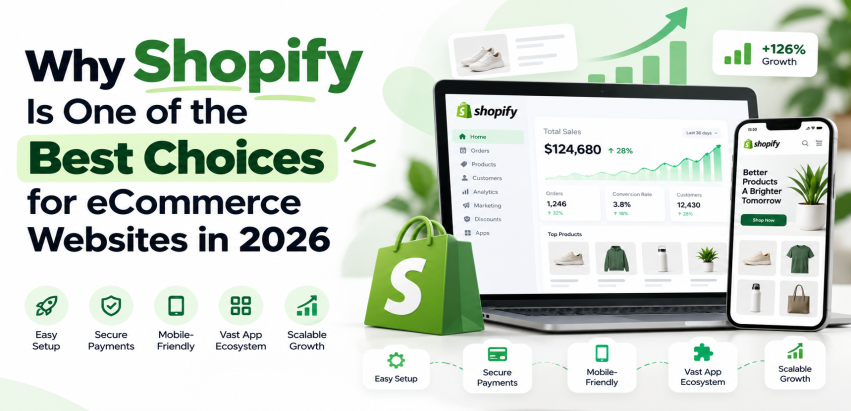
Shopify is one of the strongest default choices for many product-led eCommerce businesses because it combines hosting, store administration, checkout, inventory, integrations, sales channels and international commerce inside one managed platform.
Its biggest advantage is not that Shopify has every possible feature. It is that Shopify removes much of the technical operating burden that normally sits behind an online store, while still giving the business room to customize and expand.
That does not make Shopify the right platform for every company. Businesses needing unusual backend workflows, complete infrastructure control or very specific payment economics may have better options. The decision should come down to how you want to operate the business, not simply which platform is most popular.
Is Shopify Really the Best Choice for an eCommerce Website?
For many businesses, Shopify is a strong default rather than a universal winner.
It tends to fit particularly well when the company wants to launch and manage commerce without maintaining its own hosting environment, checkout infrastructure, security updates and a collection of independently maintained plugins.
A new D2C brand, for example, may want its team to spend time on product, merchandising, advertising, fulfilment and customer experience instead of server maintenance. An established retailer moving online may value having products, inventory, orders and sales channels managed through one commerce system.
That is the real reason Shopify remains popular.
The decision is less about a single feature and more about the operating model:
- Shopify manages much of the commerce infrastructure.
- Your team manages the business, products and customer experience.
- The platform can be extended through themes, apps and custom development.
- You can begin with a relatively standard store and add complexity when the business actually needs it.
Merchant discussions reflect the same trade-off. Shopify users often praise the relatively low technical effort required to get a store running, while recurring app costs and customization constraints appear frequently among the complaints. Those are merchant opinions rather than controlled platform comparisons, but they highlight the right question: how much technical responsibility do you want the business to own?
Shopify's Biggest Advantage: You Run the Store, Not the Infrastructure
Shopify is a hosted SaaS commerce platform. Hosting, core platform infrastructure, SSL and the underlying commerce environment are part of the service rather than separate systems that the merchant has to assemble and maintain.
That changes the operating burden considerably.
| Shopify largely manages | Your business still manages |
|---|---|
| Commerce hosting | Product catalog |
| SSL/TLS infrastructure | Pricing and offers |
| Core platform updates | Store navigation and UX decisions |
| Checkout infrastructure | Apps and integrations you install |
| Platform-level PCI environment | Staff access and permissions |
| Core commerce administration | Marketing and customer acquisition |
| Underlying hosted platform | SEO strategy and content |
| Core system availability | Analytics, tracking and business reporting decisions |
What Shopify manages for you
Shopify plans include commerce hosting and SSL, which means a store owner does not need to separately purchase hosting and build the commerce environment around it. Shopify is also certified Level 1 PCI DSS compliant, with its compliance extending to Shopify-hosted stores, shopping carts and hosting.
This removes a significant amount of technical administration compared with a self-hosted stack where the business may be responsible for hosting configuration, server updates, software compatibility, backups and infrastructure security.
For companies still deciding between different technology models, the broader eCommerce website development decision should start with how much of that responsibility the business actually wants to own.
What your business still has to manage
Managed infrastructure does not mean a managed business.
Shopify does not decide which products you should sell, how collections should be structured, which apps are safe to add, how permissions should be managed or whether your advertising and analytics setup is accurate.
A Shopify store can still become slow, difficult to shop, expensive to operate or poorly measured if its theme, apps, navigation and integrations are implemented badly.
The benefit is reduced infrastructure responsibility, not removal of merchant responsibility.
Your Team Can Run the Store Without Calling a Developer for Every Change
Another reason Shopify works well for many businesses is that routine store operations can usually be handled by marketing, merchandising and operations teams rather than developers.
Through Shopify Admin, teams can work with products, collections, inventory, orders, discounts, customers, analytics and sales channels from the same operating environment.
Consider a fashion retailer preparing a new collection.
The merchandising team can add products, update images, adjust descriptions, organize collections and change pricing. Operations can work with inventory and orders. Marketing can create discount offers and update campaign landing content. Management can review store and marketing reports.
None of those routine activities should require custom development every time.
That distinction matters because "easy to use" is often treated as a beginner feature. For a growing business, it is more valuable than that.
It means fewer routine tasks have to wait in a development queue.
Custom development is still relevant for store architecture, complex integrations, unusual merchandising requirements, migrations, custom themes and functionality that goes beyond standard configuration. Shopify simply separates everyday commerce administration from deeper technical work more effectively than platforms where both are tightly coupled.
Shopify Gives You a Commerce-Ready Checkout Instead of Making You Build One
Checkout is not just another website page. It is payment and conversion infrastructure.
When building a commerce platform from the ground up, checkout requires decisions around cart state, addresses, shipping, discounts, taxes, payment flows, validation, error handling, security and device behaviour.
Shopify provides a managed checkout foundation rather than expecting each merchant to engineer this system independently.
Why a managed checkout matters
A standardized commerce checkout reduces the amount of development and testing needed simply to get transactions working reliably.
Shopify also connects checkout with the wider commerce system, including orders, inventory and payment integrations.
Customization depth still depends on the Shopify plan and implementation. Shopify Plus provides deeper checkout customization than lower-tier plans, so "Shopify checkout is customizable" should not be interpreted as unlimited control on every plan.
Shopify currently states on its India pricing page that its checkout converts 15% better on average than other commerce platforms. That is a Shopify-published performance claim, not independent proof that moving any store to Shopify will increase its conversion rate by 15%.
Your actual conversion performance still depends on traffic quality, pricing, product demand, trust, shipping, product presentation and the rest of the buying journey.
For Indian Stores, Payments Are Shopify's Biggest Cost Reality Check
Shopify works in India, but Indian merchants need to evaluate its payment economics differently from merchants operating in countries where Shopify Payments is available.
As of October 2026, India is not listed among Shopify Payments supported countries. An Indian merchant accepting online payments will therefore generally need to use a supported third-party payment provider.
This creates two different cost layers:
Payment cost = payment gateway processing fee + applicable Shopify third-party transaction fee
Shopify Payments is not currently available in India
Shopify Payments is Shopify's own payment-processing system in supported markets. Third-party payment gateways are separate providers connected to the Shopify checkout.
That difference matters because Shopify can charge an additional transaction fee when a merchant uses a third-party payment provider.
The current Shopify India pricing page lists the following rates:
| Plan | Current annual-plan price | Third-party payment provider fee |
|---|---|---|
| Basic | ₹1,499/month | 2% |
| Grow | ₹5,599/month | 1% |
| Advanced | ₹22,680/month | 0.6% |
| Plus | From ₹1,75,000/month | 0.2% |
Pricing checked in October 2026. Shopify can change plan prices and fees, so verify current rates before selecting a plan.
Calculate the real payment cost before you pick a plan
Suppose an Indian store on Basic processes ₹1,00,000 of qualifying online payments through a third-party payment provider.
At the currently published 2% Shopify third-party provider rate:
₹1,00,000 × 2% = ₹2,000 Shopify transaction fee
That ₹2,000 does not include whatever processing fee the chosen payment gateway separately charges.
At higher revenue volumes, the difference between plan transaction rates can become commercially meaningful. The cheapest subscription is therefore not automatically the cheapest overall plan.
Manual payment methods are treated differently. Shopify's current billing documentation says third-party transaction fees do not apply to manual payment methods such as cash, cash on delivery and bank transfers.
For an Indian merchant, payment volume, online versus COD mix, gateway charges and Shopify's transaction fee should be modelled before selecting the plan.
Start With a Theme. Build Custom When the Business Actually Needs It
Shopify's design model allows a business to match development effort with its actual stage of growth.
You do not have to commission a completely custom frontend before proving that the store can sell.
A common progression is:
Theme → Customized theme → Custom Shopify theme → Headless architecture
A new brand can begin with a suitable free or paid theme, configure its visual identity and establish its commerce workflow.
As requirements become clearer, developers can add custom sections, modify Liquid templates, change product presentation and build custom functionality.
Businesses with genuinely advanced frontend requirements can evaluate headless architecture, including Shopify's Hydrogen ecosystem, without necessarily replacing Shopify as the commerce backend.
Theme to custom development should follow business requirements
A common mistake is either extreme.
Some businesses overbuild a custom storefront before proving what customers need. Others continue forcing a generic theme to support increasingly unusual workflows long after custom development has become justified.
The better question is: what part of the customer or operational experience now requires something the current implementation cannot provide cleanly?
If that requirement is clear, Shopify eCommerce website development can cover custom themes, integrations and architecture without replacing the underlying commerce platform simply for the sake of customization.
Shopify's App Ecosystem Is a Strength Until You Use Apps for Everything
Shopify's app ecosystem is one of its strongest forms of extensibility.
Businesses can add functionality for areas such as reviews, subscriptions, loyalty, shipping, reporting, CRM connections, ERP integrations and marketing without building every feature from scratch.
That can dramatically reduce implementation time.
It can also create a different problem: app dependency.
Every additional app can introduce another subscription, script, integration point, configuration layer and vendor dependency.
Merchant discussions about Shopify often reflect both sides of this trade-off. App availability is praised because functionality can be added quickly, while the cumulative monthly cost of several apps is a recurring complaint.
Native feature, app or custom development?
A disciplined Shopify build should consider solutions in this order:
- Can Shopify already do it natively? Use the platform capability when it meets the requirement.
- Does a mature app solve it cleanly? Use an app where the fit is strong and its cost is justified.
- Is the requirement strategically unique? Consider theme development, a custom app or deeper integration.
A product-review feature may be well suited to an established app.
A proprietary B2B pricing or approval workflow may need custom logic.
The goal is not to avoid apps. It is to avoid turning the store into a collection of overlapping apps solving problems the platform, theme or a cleaner implementation could already handle.
Shopify Gives You an SEO Foundation, Not Automatic Rankings
Shopify is a workable platform for SEO because several technical foundations are already handled. That does not mean a Shopify store will rank simply because it runs on Shopify.
| Shopify provides or supports | Your SEO strategy still needs to handle |
|---|---|
| Canonical tags | Keyword and intent targeting |
| Automatically generated sitemap.xml | Collection architecture |
| robots.txt | Internal linking |
| SSL | Product and collection content |
| Editable title tags | Technical audits |
| Editable meta descriptions | Content strategy |
| Editable URLs | Authority and backlinks |
| Image alt text controls | Ongoing Search Console analysis |
What Shopify handles technically
Shopify automatically generates canonical tags, sitemap files and robots.txt files, while providing SSL and controls for titles, meta descriptions, page URLs and image alt text.
For international stores, Shopify Markets can also support market-specific domains and languages, hreflang relationships and international sitemap handling when configured appropriately.
What still requires an SEO strategy
A sitemap can help search engines discover a collection. It cannot decide whether that collection targets the correct search intent.
A technically valid product page can still have thin content. A crawlable store can still have poor internal linking. A fast theme cannot compensate for weak category architecture.
This is why Shopify's built-in capabilities should be treated as an SEO foundation rather than a ranking system.
Stores competing seriously in organic search still need a deliberate Shopify SEO strategy covering architecture, content, technical issues, internal linking and authority.
One Commerce Backend Can Support Your Store, Social Channels and Retail
Shopify becomes more useful when a business is selling through more than one customer touchpoint.
The platform can connect the main online store with social sales channels, marketplaces and physical retail through Shopify POS and supported integrations.
The benefit is not simply "more channels."
The business value is having products, orders and inventory connected to a common commerce backend rather than rebuilding the product catalog separately for every channel.
For example, a fashion retailer may sell through its website and physical store while also promoting products through social channels. Centralized product and inventory information reduces the operational gap between the online store and other selling environments.
Channel capabilities still vary by geography, platform, plan and integration. A business should verify the exact functionality it needs rather than assuming every marketplace or social integration works identically in every country.
Shopify Can Scale With the Business, but the Right Plan Still Matters
Shopify's scalability is better understood through increasing business requirements than through vague claims that it "handles unlimited growth."
The current plan structure provides a progression from Basic to Grow, Advanced and Plus.
Moving upward can provide additional staff access, international capabilities, lower third-party transaction rates and more advanced commerce features.
Shopify Plus is aimed at more complex businesses and currently includes capabilities such as deeper checkout customization, higher operational limits and B2B functionality.
When Shopify Plus starts to become relevant
Plus should solve an actual requirement.
Examples may include:
- B2B commerce and catalog requirements
- deeper checkout customization
- larger operational teams
- complex international commerce
- enterprise integrations
- higher API or automation requirements
A growing business does not need to upgrade simply because revenue increased.
Move plans when the operational or financial value of the additional capabilities justifies the added cost.
Shopify's Real Cost Is More Than the Monthly Subscription
Comparing eCommerce platforms only by monthly subscription price produces a weak financial comparison.
The better metric is total cost of ownership.
For Shopify, that can include:
Platform subscription + theme + apps + payment processing + Shopify transaction fees where applicable + development + POS requirements + ongoing optimization
| Cost component | How it enters the budget |
|---|---|
| Shopify plan | Recurring platform subscription |
| Theme | Free or one-time premium theme cost |
| Apps | Often recurring subscriptions |
| Payment gateway | Processing charges from the provider |
| Shopify transaction fee | May apply when third-party providers are used |
| Development | Setup, custom design, integrations and custom functionality |
| Optimization | SEO, analytics, CRO and ongoing technical work |
This is where Shopify's managed platform model should be evaluated fairly.
A self-hosted platform may have a lower platform fee but require more developer time, infrastructure work or maintenance. Shopify may have a higher visible subscription and app cost while removing some of those responsibilities.
The right comparison is therefore not "Which subscription is cheaper?"
It is: What does it cost us to operate this commerce system at the level the business requires?
When Shopify Is Not the Right Platform
Shopify loses some of its advantage when the business values infrastructure freedom or unusual commerce logic more than managed simplicity.
You should investigate alternatives when:
- You need deep server-side control. Shopify deliberately manages infrastructure, so businesses wanting full control of the application and server stack may prefer another model.
- Your business has highly bespoke workflows. Unusual quoting, approval, product configuration or pricing logic can push beyond normal Shopify architecture.
- You already have a large WordPress content ecosystem. A content-led business adding commerce may find WooCommerce operationally logical.
- Third-party transaction fees materially affect unit economics. This deserves particular attention for Indian merchants.
- You require unusual checkout behaviour. Shopify checkout is intentionally controlled, with deeper customization available at higher platform levels.
- You want complete platform independence. A managed SaaS platform always involves some dependency on the platform provider.
These do not make Shopify a bad platform. They describe cases where Shopify's operating model may not match the business requirement.
If the decision has reached this stage, use a deeper Shopify vs WooCommerce vs custom development comparison rather than forcing one technology into a requirement it was not designed to solve.
A Good Platform Can Still Produce a Bad eCommerce Store
Choosing Shopify removes some technical problems. It does not solve every commercial problem.
A poorly designed Shopify store can still have:
- confusing navigation
- weak collection architecture
- poor product discovery
- unnecessary apps
- bad mobile UX
- incorrect analytics
- weak SEO
- checkout friction before the actual checkout begins
- thin product information
The relationship is simple:
Platform foundation + store execution = eCommerce outcome
A fast hosted platform with badly organized collections still makes products difficult to find.
A polished theme with inaccurate purchase tracking still gives advertising platforms unreliable conversion data.
A large app ecosystem does not help if every new requirement is solved by installing another app without considering performance or maintenance.
That is where professional Shopify eCommerce website development becomes relevant. The work shifts from merely "getting Shopify online" to designing the store architecture, integrations, tracking, SEO foundation and buying flow around the business.
And if the store already attracts users but still struggles commercially, platform choice may no longer be the primary issue. Diagnose why an online store gets traffic but no sales before assuming another platform migration will fix the problem.
Shopify Is a Strong Fit If These 8 Things Are True for Your Business
You do not need a complicated platform-scoring model to make an initial decision.
Shopify deserves serious consideration if most of these statements are true:
- You do not want to manage hosting infrastructure yourself.
- You want to launch commerce relatively quickly.
- Your internal team should handle everyday products, orders and merchandising without developer involvement.
- Your store fits standard product-commerce patterns, even if the frontend requires customization.
- You value access to a large ecosystem of themes, apps and integrations.
- You understand the full payment and transaction cost for your country.
- You expect the business to grow across channels or markets.
- You prefer managed commerce infrastructure over complete stack control.
If several of those statements are false, investigate another platform before committing development budget.
Shopify works best when its operating model aligns with the company. Choosing it simply because other brands use it is not platform strategy.
Shopify for eCommerce: Frequently Asked Questions
Why is Shopify so popular for eCommerce?
Shopify combines managed hosting, commerce administration, checkout, inventory, analytics, themes, apps and selling channels in one platform. This reduces the number of separate technical systems many merchants need to assemble and maintain, which makes Shopify attractive to businesses that want to focus more on commerce operations than infrastructure.
Is Shopify the best eCommerce platform?
Shopify is one of the strongest default choices for many product-focused businesses, particularly when managed infrastructure, operational simplicity and extensibility matter. It is not universally best. Businesses requiring complete server control, highly specialized workflows or different payment economics should compare other platforms.
Is Shopify good for beginners?
Yes for routine store operations. Products, collections, inventory, orders, discounts and content can be managed without deep programming knowledge. Developers may still be needed for custom themes, architecture, complex integrations, migrations, analytics implementation and functionality beyond standard configuration.
Is Shopify good for SEO?
Shopify provides a useful technical SEO foundation, including canonical tags, sitemap.xml, robots.txt, SSL and editable metadata. Those features make optimization easier but do not generate rankings automatically. Keyword targeting, collection architecture, internal linking, content, authority and technical monitoring still require an SEO strategy.
Does Shopify include hosting?
Yes. Shopify plans include secure commerce hosting, unlimited bandwidth and SSL/TLS support for connected domains, so merchants do not need to purchase and maintain a separate hosting environment for the Shopify store.
Is Shopify secure?
Shopify is certified Level 1 PCI DSS compliant and provides managed platform security. Merchants still remain responsible for areas such as staff permissions, passwords, installed apps, fraud procedures, privacy obligations and other business-level security practices.
Does Shopify Payments work in India?
As of October 2026, India is not listed as a supported Shopify Payments country. Indian merchants generally need a supported third-party payment provider and should account for both the provider's processing charges and Shopify's applicable third-party transaction fee.
What are the disadvantages of Shopify?
The main trade-offs include recurring subscription and app costs, additional third-party transaction fees in markets such as India, restrictions compared with complete infrastructure control and increased complexity when a business requires unusual backend or checkout behaviour.
Can Shopify handle a growing eCommerce business?
Yes, Shopify provides a plan progression from Basic through Grow, Advanced and Plus. More complex requirements such as B2B, deeper checkout customization, international operations and enterprise workflows can require higher plans. Scalability does not mean every merchant eventually needs Shopify Plus.
Do I need a Shopify developer?
Not for everyday store administration. A developer becomes useful when the business needs custom themes, store architecture, migrations, complex integrations, advanced tracking, performance improvements or custom functionality that standard theme configuration and apps do not handle cleanly.
So, Why Choose Shopify for eCommerce?
Shopify's strongest argument is not that it has more features than every alternative.
Its advantage is the way those capabilities are packaged into a managed commerce operating model.
Hosting, checkout, core platform infrastructure and everyday store administration are already connected. Themes and apps provide a relatively quick route to customization. More advanced businesses can move toward custom themes, international markets, complex integrations and Shopify Plus without immediately replacing the underlying commerce platform.
The trade-off is that managed infrastructure comes with platform rules, recurring costs and less infrastructure freedom. Indian merchants also need to model third-party payment fees carefully because Shopify Payments is not currently available in India.
If your business values reduced technical overhead, faster commerce execution and a platform that can grow in complexity as requirements mature, Shopify is a strong option.
If complete infrastructure control or highly specialized commerce logic is central to the business model, investigate the alternatives before committing.
For businesses that have already established that Shopify fits their operating model, the next decision is implementation. Aarmus Marketing's Shopify eCommerce website development service covers store architecture, theme implementation, integrations, tracking, SEO foundations and the commerce experience needed around the platform.